
Invisible Disabilities Week started on Sunday, October 19th and continues through Saturday, October 25th.
The goal behind Invisible Disabilities Week is to raise awareness, because not all disabilities are easily recognizable or easily seen. Not all disabilities look the same. Not all people living with disability behave in the same way.
But just because you don’t see it doesn’t mean it’s not there.
Just because I “look fine,” doesn’t mean I feel fine.
This week, I borrowed an activity from my teaching days — I created an acrostic poem as a way of raising awareness and sharing a bit of my personal experience. (In an acrostic poem, the first letter of each line spells out a word or phrase. I used the word Disability.)
Dinner time is generally hard for me. My family doesn’t know this, but many times I cry while I’m in the kitchen preparing dinner. Sometimes I think it’s because my body is tired after all day. Sometimes it all just feels like too much; I’m hurting so much I don’t know how I’ll keep standing, let alone wash the pot in the sink or cook the rice on the stove.
Invisible disability means I don’t regularly use an assistive device. So at first glance you may think I’m “fine.” But if you pay attention you’ll notice that instead of climbing the five stairs out front, I walk up the ramp to get into the building where I go for my physical therapy. You may notice I limp sometimes when going for a walk in the neighborhood. Look carefully, and you may see me pause after crossing the street and stepping up onto the sidewalk. (Some of those curbs seem so high!)
Symptoms vary and are not always a direct result of anything I did or didn’t do. Sometimes I experience a heaviness in my leg, as if I’m walking through mud and just can’t get my feet to move any quicker. Sometimes my left calf feels hard and tight, as if it’s stuck in a charley horse. Sometimes my left leg feels like it’s being squeezed, as if someone has strapped a blood pressure cuff around my leg.
Ableism is discrimination in favor of non-disabled people. Like when my son’s high school expects all parents to navigate the stairs and hallways during Back to School Night. (You can read about my experience in this blog post.) Or when I used to see someone park their car in a handicap parking spot and exit their car looking “fine,” and I immediately thought they must be faking, using someone else’s placard. It’s embarrassing to admit, but it’s the truth.
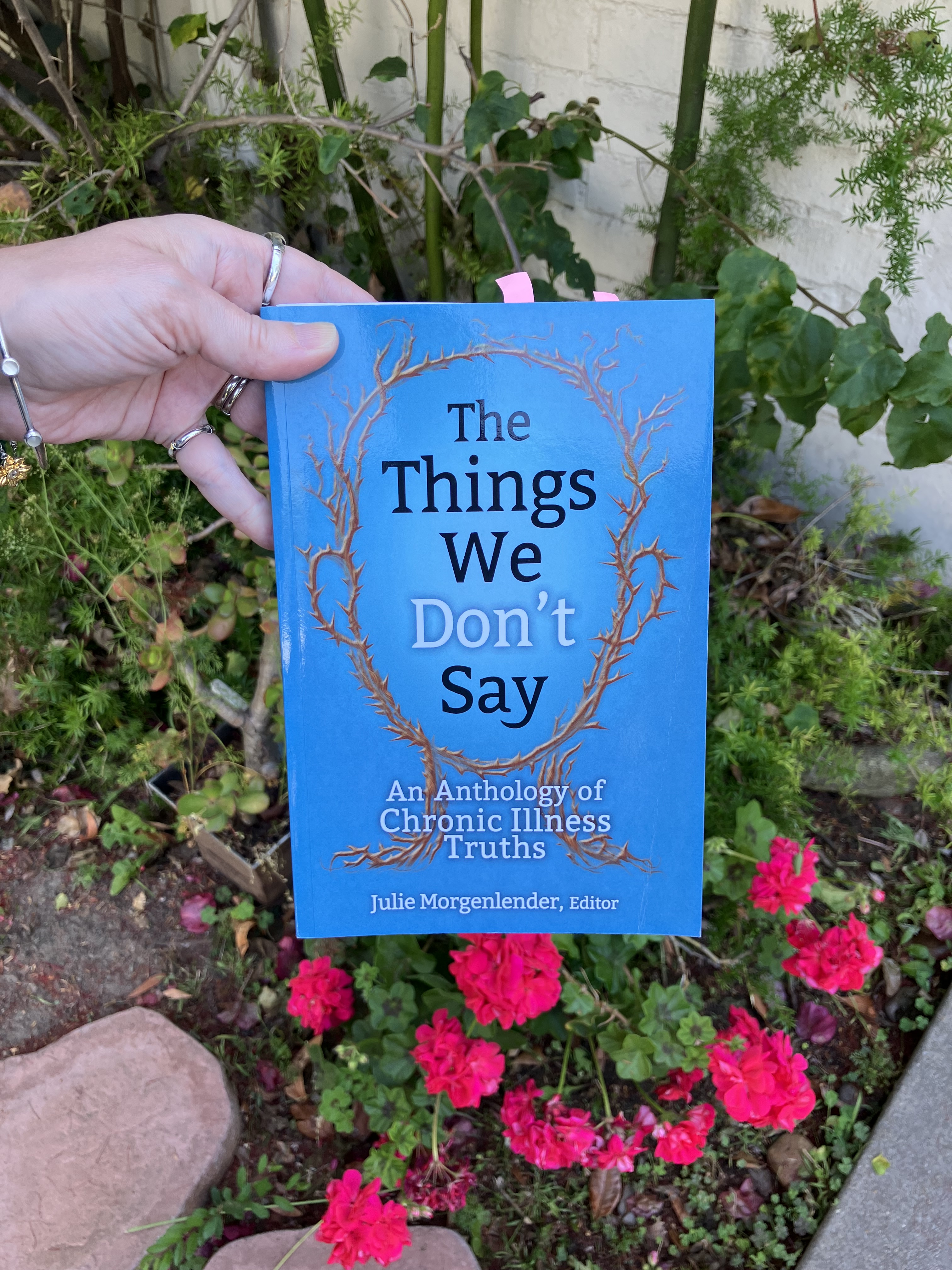
Books. After receiving my diagnosis, I went searching for books on the subject. Then I looked for books written by authors on parallel paths, maybe their diagnosis was different than mine, but the emotions would be similar. I really couldn’t find much. Which is why I’m always recommending The Things We Don’t Say: An Anthology of Chronic Illness Truths. Full disclosure, one of my essays is included in this anthology. (Side note – this is why I believe there is an audience for my as-yet-unpublished memoir.)
Ironic. When I was in high school, I had such a hard time learning to swallow pills. I gagged. I coughed and sputtered, certain I would choke. Yet, here I am all these years later, and I take almost 20 pills a day (both prescription medication and over-the-counter supplements/vitamins).
Live the life you’ve dreamed of. We had a plaque with that expression hanging on the wall by the staircase. It didn’t happen right after I became ill, but sometime later I came to realize I no longer liked that wall hanging and I no longer wanted it in our home. In some respects, this is absolutely not the life I dreamed of. I didn’t dream of retiring from teaching because I was physically unable to continue. I didn’t dream of qualifying for a disabled parking placard before my parents. It happened. Period. But I definitely didn’t dream it.
Individual experiences do vary. Each chronically ill patient is dealing with a different set of variables, including different symptoms and different treatments. Which means it’s not helpful when someone (who knows very little of my medical history) makes a general statement trying to convince me that the solution is yoga/green smoothies/becoming gluten-free/fill-in-the-blank because it worked for their friend/neighbor/coworker/relative.
Treatment is challenging. Because what worked for a while (meaning, what kept my inflammation under control) can suddenly stop working. There are so many variables at play, including physical movement, mental health, stress, menopause, and sleep it’s hard to really know which one is the biggest factor in how I feel.
Yearning to feel like my “old self.” The Wendy who woke up feeling rested. The Wendy who didn’t dread that first walk downstairs. The Wendy who didn’t have to think about her pain and her knees and her sensitive calf. The Wendy who could walk for an hour. The Wendy who could walk to the nearby shopping center without thinking twice about how I’d feel during and after the walk. The Wendy who trusted her body would always work the way I expected it to.
Please note: I am including a link to buy the book that I’m highlighting this week. If you use my link, I do make a small commission on your purchase at no additional cost to you. I am working with Bookshop.org which also sends a portion of the profit to support local, independent bookstores.
 WendyKennar.com