This Was a Big Deal for Me

Something happened a few weeks ago that I haven’t told anyone about. 

Until now.

A few Saturdays ago, I came in from watering the plants on our back patio. (Just to paint the picture — we don’t have a hose out back. Watering the plants requires multiple trips in and out of the house, filling up two watering cans in our kitchen, carrying them outside, back in the house for refills, and so it goes.)

I came back inside after I had watered the last of the plants, and thought to myself, “I feel awful and I haven’t even done anything.”

But what happened next was not part of my usual pattern. Because immediately after that thought, a new thought entered my mind.

“That’s not true. I’ve done a lot.”

And as I put the yellow/green watering can on top of the refrigerator and the smaller, red watering can on the shelf near the refrigerator, I started mentally listing all I had done in the few hours I’d been awake.

Made the bed.

Made breakfast for myself and my son.

Emptied the dishwasher, with my husband’s help.

Got dressed. 

Shredded papers and old bills.

Took out the trash and recycling.

Swept the patio.

Watered the plants.

That pause in my regularly-scheduled-programming — the internal loop that usually plays about my limited stamina and my increased pain — was, is, huge. It’s a sign that I have been working on myself. That I am actively trying to take better care of myself. Because while I know all about drinking water and trying to get enough sleep and taking my meds on time, the mental part of taking care of myself has been more difficult for me.

So I share all this in this week’s blog post because I am proud of myself. My therapist will know what a big deal this was, this is, for me. 

I’m also sharing because I know how much it means to me to come across a piece of writing that speaks of this hard, hard experience of living with a chronic illness and chronic pain. When I read a personal essay that I connect with, that makes me think Yes, That. Absolutely that, I feel less alone in this isolating world of invisible illness. 

It’s my hope this post can be that piece of writing for someone else.

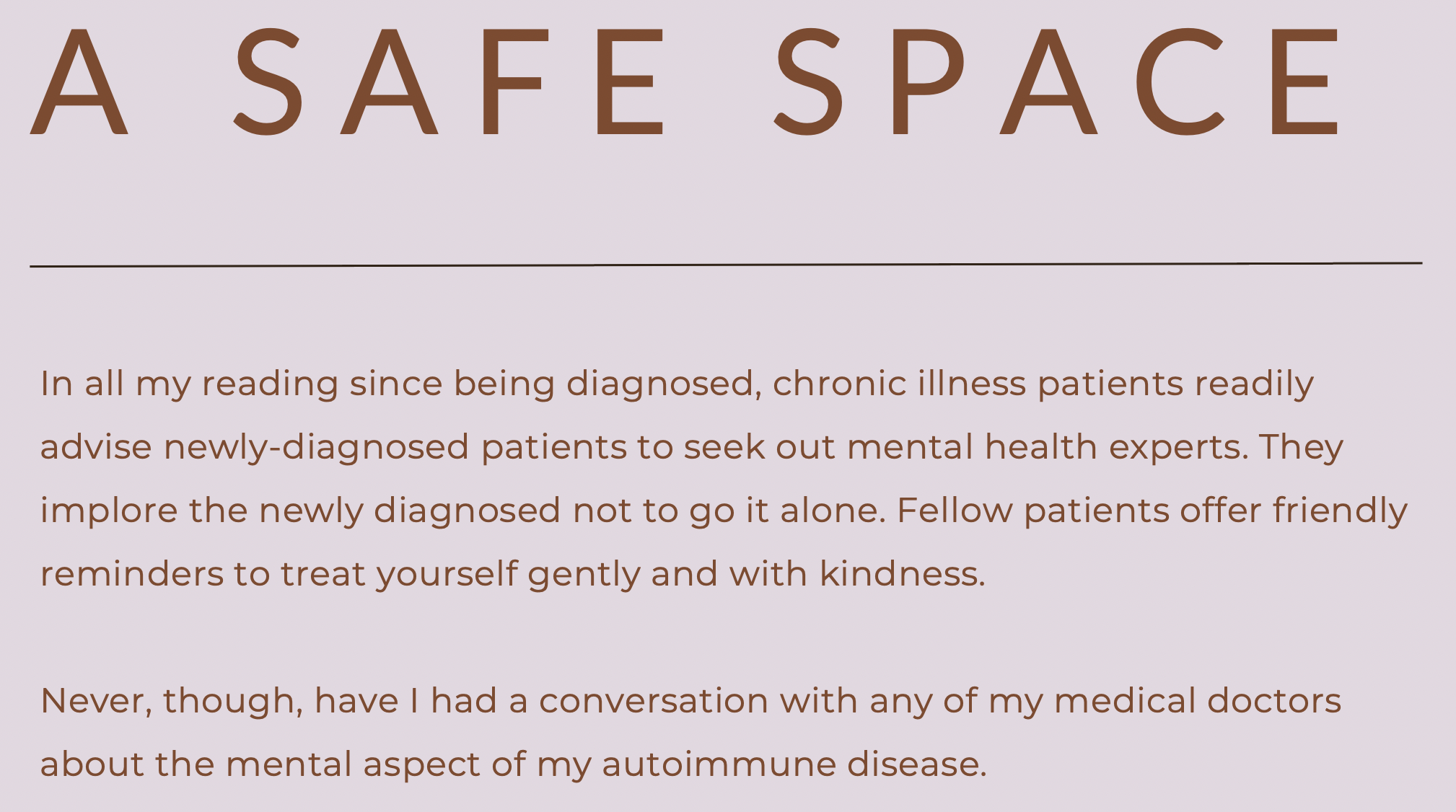
A Safe Space

“I foolishly thought having an autoimmune disease would be no big deal. I thought it was something that would fade into the background, behind more important things like my family and career. I thought Undifferentiated Connective Tissue Disease (UCTD) would be another footnote in my medical history, along the lines of my allergy to penicillin. I disclose my allergy any time it’s relevant, explain about the hives that develop, and when necessary, wear a hospital bracelet identifying “allergy.” But on a daily basis, my allergic reaction to penicillin isn’t a big deal. I don’t give it much thought. I assumed having UCTD would work the same way.

Wrong.”

The paragraphs above are excerpts from my personal essay, “A Safe Space.” And I’m proud to share “A Safe Space” has recently been published in Wishbone Words, Issue 11. You can access the issue by clicking here.  (Just a note – there is a slight fee to download the issue.)

An Unplanned Path

I am pleased to share that my personal essay, “An Unplanned Path,” has been published in the most recent issue of Cosmic Daffodil Journal. You can click here to read the essay in its entirety. (The theme was “NATURA,” and nonfiction submissions had a 300-500 word count limit.)

In addition, Cosmic Daffodil Journal has created a free e-book, which will soon be available for download on the website, so you can read all the fine pieces of writing included in NATURA

An Anniversary and a First

This photo was taken at the National Museum of American History.

Everyone has defining moments. Moments you may not realize are monumental when they’re happening. But later — days, weeks, months, or even years later — you look back at that moment, that significant event and see it for what it is — a distinct, neon-yellow line dividing your life into before and after.

Thirteen years ago, I woke up on a Sunday morning, but I couldn’t get out of bed. My left calf had ballooned, and I suddenly couldn’t do the thing I had done for years — stand up. Next came a visit to the emergency room, a hospitalization, and what would become the beginning of my life as a chronic illness patient. 

Last week, on the anniversary of that defining day, my family and I were on a summer trip visiting Washington, D.C. 

It was a vacation of firsts — the first time we had visited our nation’s capital, and the first time I rented a wheelchair for the duration of our stay.

As I told my son, I don’t know if all future trips will require use of a wheelchair. But this year, it was an absolute must. (I also requested wheelchair assistance in the airports.)

Initially, I didn’t think I would need a wheelchair at all. Then I thought I could just borrow one of the wheelchairs most museums have available for guests. Finally, I admitted the truth — my pain has been incredibly intense, my leg incredibly weak. If my family and I wanted to take this trip, I had to use a wheelchair.

There was one part of me that was heartbroken. All I could think of were the negatives — I’m 47 years old and, for this trip anyway, an ambulatory wheelchair user. My mind went down that scary, dark path — thinking ahead to future trips, picturing myself with increasingly limited mobility.

I made an effort to reframe how I thought about the facts — I’m 47 years old and not letting this chronic illness and my chronic pain stop me from living my life the way I want to live it. I wasn’t going to stay home because I needed a wheelchair. I adapted and figured out how to make this trip work for my body as it is now.

I don’t know. Maybe we’ll look back at this D.C. trip as one of those defining moments — the start of travel requiring a wheelchair. 

But maybe not. 

We’ll have to wait and see next year.

P.S. Lots more to come about this incredible trip. We spent 6 days, 5 nights away from home. We visited museums and memorials. We admired and appreciated. We listened and learned.  

Still Going

One year ago, my family and I were in Maui. (If you missed it, you can read my post about our fantastic trip by clicking here. My son took this photo during our zip lining adventure.)

This year, we’re in the almost-done-planning stage of our summer trip, happening later this summer. (I’ll be writing about this summer’s trip in a blog post next month. Stay tuned!)

If I’m being honest, I do have to admit that I am a bit worried.

The truth is I’m very good at keeping it all together, of making my life, my family’s life, look like everything is under control. Because it is — in many ways. But I’m also dealing with incredible amounts of daily pain. I’m trying to get through my days while struggling with high levels of fatigue, unexpected muscle twitches, and knees that make bending painful.

Will I come home feeling more intense pain than I did before the trip? Maybe. But also, maybe not. 

Will I have hours during our trip when my left leg will feel wobbly and shaky like Jello on a dessert plate? Maybe, but maybe not. 

Two family members have voiced their concerns about the trip. “Won’t it be too much for you?” I was asked.

“Probably,” I answered.

But we’re still going. I am not going to let my chronic illness stop me. 

Every Day Resilience

“Living with an autoimmune disease has caused me to re-define words I thought I knew. Words I thought I understood. Words like strength, weakness, and pain don’t mean what they once did. Their definitions have grown and expanded, because living with a chronic illness causing chronic pain is hard. And I’m doing it every day.”

The paragraph above is an excerpt from my personal essay, “Every Day Resilience.” I am pleased to share that my essay has been published in Fahmidan Journal Issue 15: Thyroid and Autoimmune Warriors. You can click here to read it in its entirety.

Saving My Tears

The other morning, as I drove home, I heard the song “Save Your Tears” by The Weeknd on the radio. I had taken myself to my favorite neighborhood cafe for some outdoor reading and writing time. 

“Save Your Tears” is a song I’ve heard a fair amount of times. Usually it’s a song I listen to, a song I enjoy. But this time, it actually brought me to tears. 

I parked the car and sat inside for a bit. I didn’t want to run the risk of seeing any of my neighbors, I didn’t want to have to try and explain why I was crying, because I wasn’t quite sure. 

I don’t think it was any one thing.

Actually, there were a number of reasons I could have been crying. 

For over two weeks now, I’ve been dealing with a pinched nerve, which at its worst led to tingling down my arm, into my right hand and fingers. It has created pain and tightness in my neck/shoulder area. It has made everyday things like brushing my teeth and washing my face harder to do. But that wasn’t why I was crying.

Since my son’s high school hosted Open House, about a month ago, I have had extreme pain in both my knees. It’s difficult to bend and pick up something that I dropped. It’s too painful to squat and pull weeds out of my garden. So I plop down onto the sidewalk and weed my garden and then have to figure out a way to get back up. But that wasn’t why I was crying either.

I think it was the lyrics, the simple repetition of “Save your tears for another day.” 

Because I do that, all the time. I save my tears for another day or another part of the day. I stop myself from crying in the Ralphs parking lot, as I load our bags of groceries into the car. I don’t cry as I unlock our front door, but wait until I get inside where no one can see me or hear me. 

And that is the bottom line — where no one can see me or hear me. Because it’s been my experience that me crying — out of pain, or fear, or frustration, or weariness — makes those around me uncomfortable. Which means on top of me trying to take care of myself and let the tears out, I’m left trying to soothe and reassure my family while downplaying my tears and whatever it was that caused me to cry in the first place.

Except. 

Except the other day during my virtual therapy session. I cried. I cried multiple-Kleenex, nose-running, red-blotchy-eyes kind of crying. Because I generally keep everything in. I am so good at biting my tongue. At keeping my stoic game face on. At not letting on how hurt I really am. How much pain I really feel. And how much help I need.

I wouldn’t say I felt “better” after my crying session. But I definitely didn’t feel worse, either.

The Healing Journal

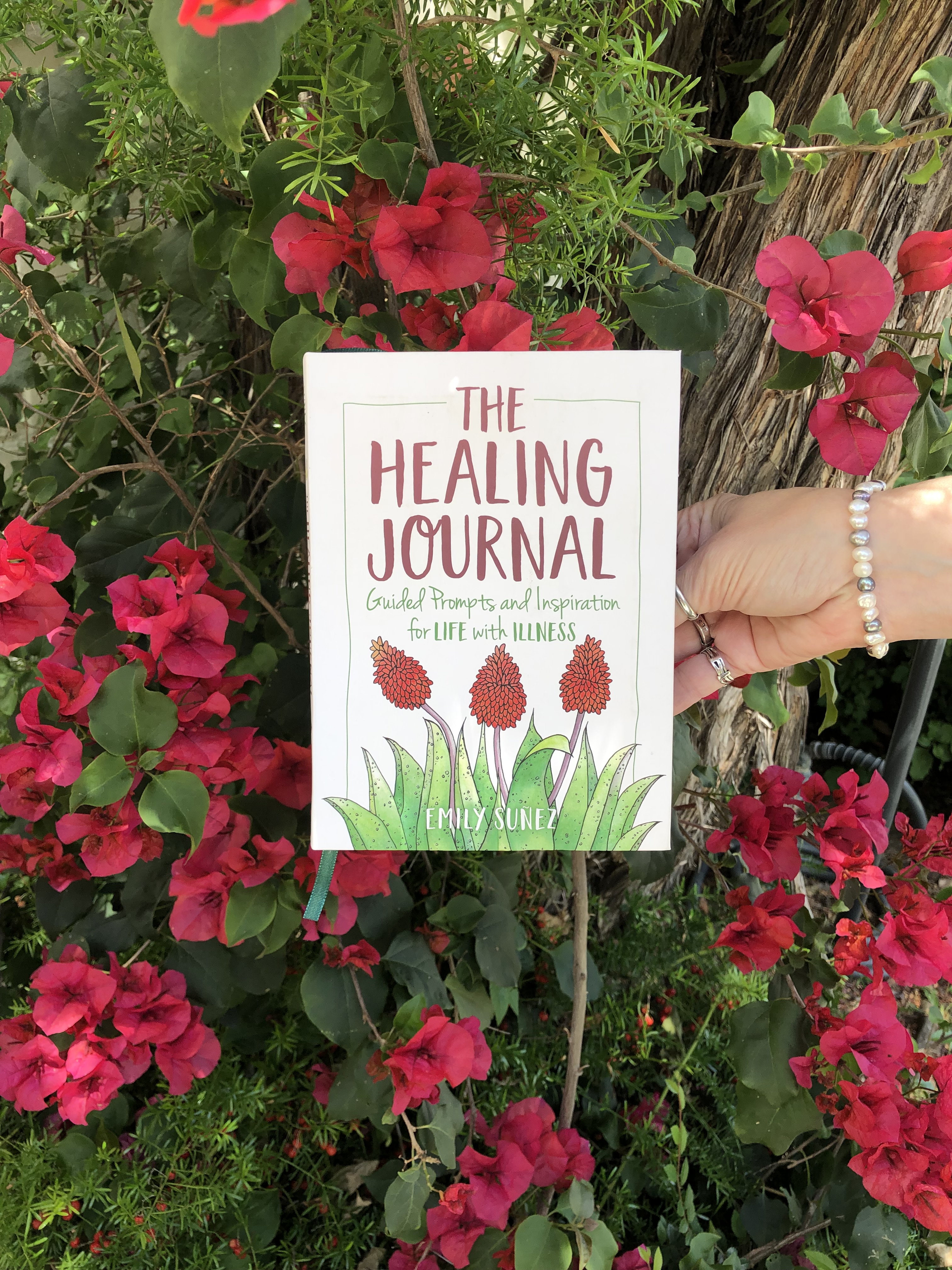
I recently finished working my way through Emily Suñez’s beautiful book The Healing Journal: Guided Prompts and Inspiration for Life with Illness.

If you read my blog on a regular basis, you might remember that twice before my blog posts were inspired by prompts in this lovely book. (You can read “I Am Alive With Creativity” by clicking here, and “My Illness Does Not Define Me” by clicking here.)

I finished reading the book and answering the writing prompts, but I haven’t finished healing. And that’s part of what makes life with a chronic illness so complicated. You never really completely heal from a chronic illness. 

There is no finish line. No specific treatment plan in place, that once you work through all the steps you’re “better.” It doesn’t work that way for me. It doesn’t work that way for a lot of people. There is no ideal world of “fully healed” to strive for. 

What I have found in the more than-a-decade that I have lived with my autoimmune disease, is that healing is a continuous process. Just as my symptoms go through periods of flares and remission, my feelings about my invisible disability ebb and flow as well.

My illness, and my healing, will forever be a part of me.

One Step At a Time, One Book At a Time

This past weekend, I attended the Los Angeles Times Festival of Books. For those who aren’t familiar with it, the Festival of Books is a huge, two-day, annual event held on the campus of USC (University of Southern California). 

Years ago, before my son was born, I went to the Festival every year. Back then it was held on the campus of UCLA (University of California Los Angeles.) 

I attended the Festival last year for the first time in many years. There was a certain thrill and energy that came with being surrounded by all things book-related, at attending an event that is a true celebration of books and authors. 

This year, though, I really wasn’t sure if I should go or not. Because I haven’t been feeling well lately. Because my pain level has been high and my energy level has been low. 

That’s the hard part for me — deciding when to push myself and when to hold back and admit that my body needs rest.

The truth was, I really wanted to go. I didn’t want to stay home because I was worried about my pain or the heat. I wanted to prove that I’m still capable of being out in the world, doing things I feel passionately about, not letting my illness completely dictate my life. 

I tried to make it as easy and stress-free as possible for myself by not attending any panel discussions or book signings. I didn’t want to have to worry about being in a particular place at a particular time. 

I simply strolled around the Festival, wearing my mask and sunhat, and doing my best to be present and enjoy the experience.  

I admit — I did start to daydream about what it would be like to be an author with my own exhibition area, selling copies of my memoir. Immediately I thought of giving out small, wrapped candies to those who stopped at my table. (Starburst and Hershey’s Kisses came to mind, though the Kisses might melt in the heat. Jolly Ranchers could be another possibility.)

I walked around, I took pictures, I picked up books, chatted with some authors, and bought three books, even though I have more than a dozen books at home, just waiting for me to read them. 

I loved being there. But, (you knew there was a but coming) it was incredibly hard on my body. It took me about 15 minutes to walk from the parking structure to the exhibition area. Plus, I had parked on level 5 which meant I would ordinarily take the elevator down to the ground level. However, eager attendees were crowding onto the elevator each time it stopped at 5, and I will not ride in a super-crowded elevator. (During my teaching years, I once was stuck in the school elevator for 55 minutes one morning.) So I walked down five flights of stairs. (Thankfully when it was time for me to leave, no one else was waiting for the elevator so I rode it up to parking level 5.)

When I felt my speed decreasing, when I found myself searching for a place to sit and rest in the shade, I knew it was time to go. That’s when the mask comes in handy. No one can see me talking to myself as I retraced my steps back to the parking area. One step at a time. Okay, you can do this. 

Am I glad I went? Yes. 

But I’m also sad. Because I miss the old days, the years I could just go out and do something without weighing all the possible risks. When I didn’t have to worry about having a pain-hangover the day (or days) after a particularly strenuous activity. 

I Am Alive With Creativity

I have slowly been making my way through The Healing Journal: Guided Prompts and Inspiration for Life with Illness by Emily Suñez.

This is a book that you don’t read all at once. You “savor the flavor,” as we say in our family. You pay attention to each beautiful illustration and each writing prompt. (I last wrote about The Healing Journal in a December blog post. You can click here to read it.)

The book is much too pretty for me to write in. Instead, I use the statements in the book as prompts for my daily five-minute writing exercise. 

If you’re not familiar with it, my five-minute writing time is exactly what it sounds like. You set a timer and you write for five minutes. That’s it. Sometimes I am surprised by what I write during those five minutes. Something comes out on the paper that astonishes me, delights me, saddens me. 

Sometimes I know those five-minutes were just the beginning of something more to come. I feel as if there is more to explore and so I do. Several of my published personal essays were born from my five-minute writing exercises. But sometimes, the five-minutes were just that. Five minutes that are done and over with, that produced writing I won’t ever return to.

Last week, it was a case of me wanting to further explore what I began in my son’s partially-used composition book from last year that I now use for my five minute exercises. It was this statement:

“I am alive with creativity.”

I am alive with creativity. I write — in some way, shape, or form — each day. Sometimes it’s a blog post, sometimes it’s an article for MomsLA.com, sometimes it’s just my five-minute writing exercise. 

What I realized as my timer counted backwards was that my definition of creativity has changed over time. It has broadened and expanded in ways I didn’t realize, until I answered this prompt.

I surprised myself by listing all the ways I am creative, all the ways I demonstrate my creativity. My garden. The way I display the books on my bookcase. The way I use stickers to decorate the envelopes for the letters I mail to my pen pal. The flowers on my dining table and the candles in my writing room. The earrings and necklace I select to wear each day. 

Many days, lately in particular, it’s easy to think of the glass-half-empty parts of my life — the unsatisfying physical therapy appointments, the prescription medications, the pain that leaves me crying when I step out of the shower. 

But my life is more than that. I am more than that. 

Dear Readers, I’d love to know about your creativity. Tell me about it in the comments!