Unorthodox Love

When book mail arrived, containing Heidi Shertok’s recently-published novel, Match Me If You Can, I was super excited. (I think book mail is the second-best kind of mail to receive. What’s better than book mail? Mail from my pen pal, my dear friend, Aya!) 

Then I realized I had Ms. Shertok’s first novel, Unorthodox Love, waiting for me on one of my overflowing, want-to-read shelves.

What a delight! Unorthodox Love is a rom-com, featuring a main character who is an Orthodox Jewish woman. Not only was I a fan of Penina, I liked her spunk and her originality, I also learned quite a bit about traditions and rituals within the Orthodox Jewish community. 

Here are a few of my favorite passages:

“‘What’s so bad about helping people?’
“He stops moving and turns to face me. ‘You do realize that there are millions and millions of people in the world suffering right now, and there’s absolutely nothing you or I can do to stop it?’
“‘I’m three for three so far,’ I say, lifting my shoulders. ‘And the day is still young.’” 

“I close my eyes, breathing in the familiar newborn scent, and focus on the feel of the baby’s heart beating against mine. I wish I could suspend this moment in time, where I can pretend, even briefly, that this child belongs to me instead of someone else. Sometimes, the yearning to be a mother is so strong that it literally steals my breath away, and I have to remind myself to breathe.” (Just for context, Penina volunteers in the NICU of the local hospital.)

“‘And the dessert is from the kosher bakery,’ he adds with a crooked smile, ‘so you’re covered there too.’
“My stomach somersaults. Everyone says that the way to a man’s heart is through his stomach, but apparently it works for me too — maybe because I can barely manage to feed myself, unless frozen microwave dinners count.
“For a moment, time seems to stand still as his eyes hover on my face, then run over my dress, as though it’s the sexiest thing he’s ever seen. His gaze is scorching hot, and I feel myself melting, but I force myself to tear my eyes off his. Everyone at the table has stopped talking and is glancing between the two of us with undisguised interest. Sam either doesn’t notice or doesn’t care, made further evident when he bends down to whisper in my ear, ‘Green is my new favorite color.’” 

“Sam was right when he said that I’m more than just a woman who can’t have kids. I’m a daughter, a sister, aunt, and friend, and a very fine sales associate. Peoples’ lives are messy and complicated, and even though we don’t always see it, everyone has struggles. You can’t be human and go through life without some kind of trauma or pain, but those experiences don’t define who we are.”

“I can’t even begin to encapsulate how much this experience has meant to me. How do I explain that meeting him was a turning point in my life? That because of this fake engagement, I’ve learned to trust that my family will take care of their problems. That I’ve realized it’s okay — no, it’s essential to focus on my own needs.”

Friends, do you enjoy reading romance novels? What was the last romance novel you read and loved?

Please note: I am including a link to buy the book that I’m highlighting this week. If you use my link, I do make a small commission on your purchase at no additional cost to you. I am working with Bookshop.org which also sends a portion of the profit to support local, independent bookstores.
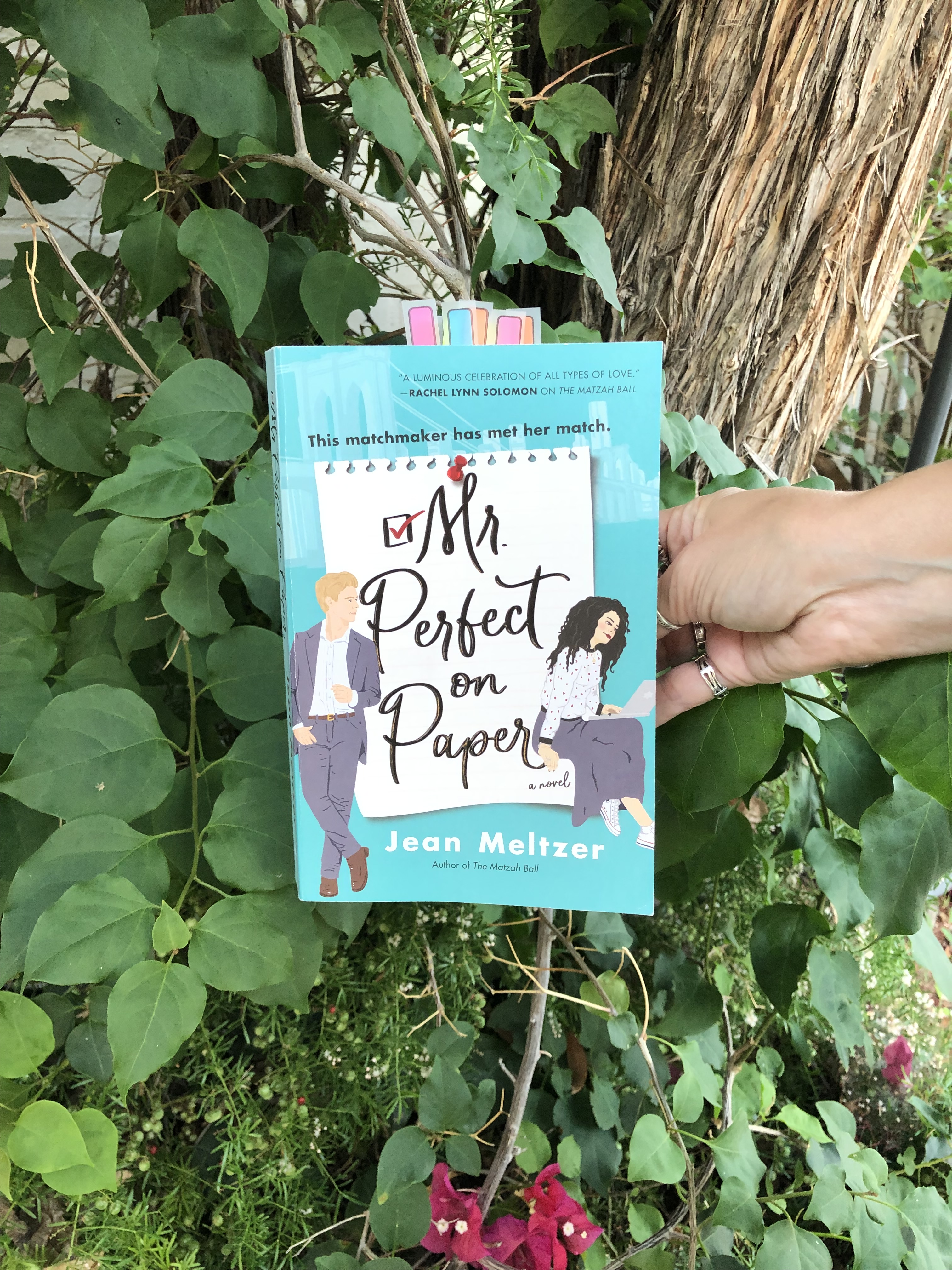
 

Mr. Perfect on Paper

There aren’t many books written by an author who has earned a daytime Emmy, “and spent five years in rabbinical school before her chronic illness forced her to withdraw.” 

That author is Jean Meltzer.

(You might remember I raved about Ms. Meltzer’s first novel, The Matzah Ball, in a blog post from several months ago. Click here if you missed it.)

And as was the case in her first novel, Ms. Meltzer’s second book also features a main character who is a Jewish woman living with an invisible chronic illness. 

The book is Mr. Perfect on Paper. The character is Dara Rabinowtiz.  

Mr. Perfect on Paper was such an enjoyable read. Smart, funny, heartfelt. Plus, it gave readers a chance to learn about Jewish holidays in an easy-to-understand manner. Most of all, it gave us characters we cared about.

Here are a few of the passages I marked during my reading:

“He beamed as he entered, a bounce in his step, offering a hearty good morning to each person he passed. He was a champ at this. Faking it. Looking happy. Smiling through whatever pain was threatening to drown him.”

“There were days when Dara was so exhausted from her struggles that she could barely find the courage to get out of bed. It was then that her mother would show up, standing over her — and sometimes tearing off her covers — demanding that she fight. Fight, Dara. Her mother would repeat it like a mantra on her bad days. You’re allowed to be afraid, you’re allowed to be anxious, but you have to fight.” 

“There isn’t one way to be Jewish,” she said, finally. “Some people are very observant. Some people aren’t. Some people fall in the middle of the spectrum, or have different philosophies behind the reasons for their observance. Some people don’t do anything. When two Jews marry, they have to negotiate these religious choices. For example, will they keep a kosher home? Will they observe Shabbat? Will you cover your hair, or go to mikvah? Those are some of the big ones…”

“But,” Dara said thoughtfully, “you learn to live with it. The sadness never goes away. Maybe it never gets smaller, either. But after a time, you learn to hold both. You learn that joy still exists … there’s still laughter, and falling in love, and —“ she smiled, glancing down at the crumbs of her pizza “—there’s still jalapeño-and-pineapple pizza. You learn that good things still happen. You meet someone. You fall in love. Maybe you even get married. And when you walk down that aisle, you hold both. You hold the joy of the moment alongside your sadness for the one who can’t be there.” 

“But what I learned from this journey, from finding my real-life Mr. Perfect on Paper, is that love isn’t something that can be quantified on a list. Love is messy. And terrifying. It shows up when you least expect it, and complicates your life in every way. But it’s also … safe. And comforting. It allows you to be yourself completely, without judgment or fear, and it feels right. I don’t know how something so incredibly scary can also feel right, but I need to give this inkling in my heart —in my soul—a chance.”

“I know you think…because you have anxiety, that you’re not brave. But that’s not true. I’ve been thinking about it a lot, actually, and here’s what I want to tell you. Courage ins’t about jumping out of airplanes or building businesses from scratch. Real courage is showing up, even when you’re afraid. Real courage is putting yourself out there, even when you fail — especially when you fail. Courage is saying, this is who I am, standing up, allowing yourself to be vulnerable. And you are brave, Dara. You’re the bravest person I have ever met.”