
If you’ve been reading my blog for a while, you know I’m a big Jean Meltzer fan. (If you haven’t been reading my blog for a while, don’t worry. Click here to read my post about Ms. Meltzer’s debut novel, The Matzah Ball. Click here to read my thoughts about her second novel, Mr. Perfect on Paper. And click here to read some of my favorite passages from her third novel, Kissing Kosher.)
And if you have been reading my blog for a while, you also know I don’t usually read books right when they’re published, simply because everyone else is. I like to wait a bit, until the hoopla has settled down. Then, I select the book from the large number of to-be-read-books I currently own. I read the book and post about it here on my blog and on my Instagram. (If you’re not already following me there, why not?)
My system allows me to show the author some love and attention when they’re in-between books and perhaps aren’t being discussed and celebrated like they were immediately upon publication.
Ms. Meltzer’s fourth novel, Magical Meet Cute (published in August 2024), was not your standard rom-com. The book’s main character is Faiga Kaplan (Faye to her friends), a Jewitch potter living in Woodstock, New York. And while there most definitely is a romance aspect to the story, the book also confronts the ugliness and the reality of blatant anti-Semitism.
There is so much to say about this book, about Faye and Greg. Allow me to share some of my favorite passages:
“Greg caught on the word. ‘Home.’
“ ‘The place where you belong. The place where people love you.’
“Home felt like Faye.” (I love this definition of home!)
“Greg didn’t see her broken bits as flaws. If anything, it was the opposite. She was like that one vase in the store she had hidden behind the fancier and more elaborate-looking Seder plate. She saw herself as warped and damaged, undeserving of love and attention. Yet it was all the bubbles in her clay memory, the scratches and scars … that made her unique.”
“And, at the end of the day, none of that making herself smaller mattered. Because nothing about what these people had done to her, chosen for her, was fair. Or right.
“Just like it had never, ever been her fault.
“But she was exhausted from a lifetime of making other people feel comfortable. And suddenly, she was done. Straight-up finished with all these less than deserving people arriving to her shoreline. Damn the silence. Damn the consequences. She was ready to live her life without constantly interrupting herself to say that she was sorry.”
“She gave others what she had always needed from them — love and affection, security and protection, a place to land when things got bad — while never demanding the same for herself.”
“We can hold on to memory, bear the things that shape us, but also … write our own story going forward.”
“ ‘You want the truth about settling down, Greg?’ Tom asked. ‘About spending the rest of your life with one woman, raising a family … about giving up the adventure sometimes, just for a quiet boredom?’ “
“ ‘Yeah.’
“ ‘It’s awesome,’ Tom said.
“Greg laughed.
“ ‘I’m serious,’ Tom said, his whole face turning red as he spoke. ‘Every single day, I wake up and go to bed with my best friend in the world. When i’m having a hard day — shit, when I needed neck surgery — she’s there for me. When I’m having a good day, when I want to watch a game or a movie on Netflix with the kids, there’s no one I would rather spend time with more than her. It’s not just that she busts my chops, or has fun with me, or makes me better … it’s that I can’t imagine how there was ever a me without her’.”
“It was the most remarkable type of magic — falling in love, finding your person, crafting your own life, writing a story where you deserved to be valued.”
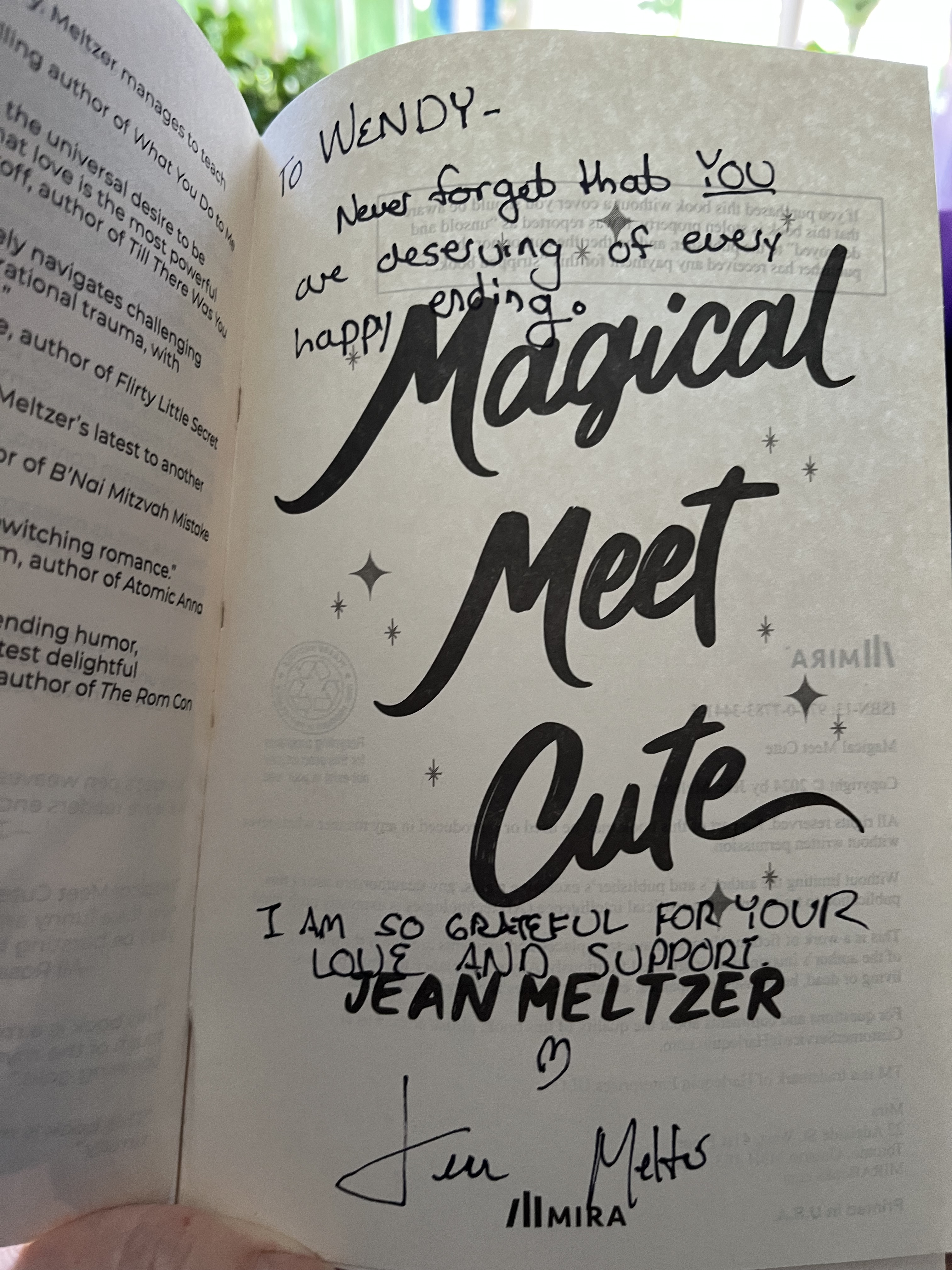
FYI – Ms. Meltzer’s fifth novel, The Eight Heartbreaks of Hanukkah, will be available on October 21st. You can pre-order a signed copy now.
Please note: I am including a link to buy the book that I’m highlighting this week. If you use my link, I do make a small commission on your purchase at no additional cost to you. I am working with Bookshop.org which also sends a portion of the profit to support local, independent bookstores.

 WendyKennar.com