P.T.

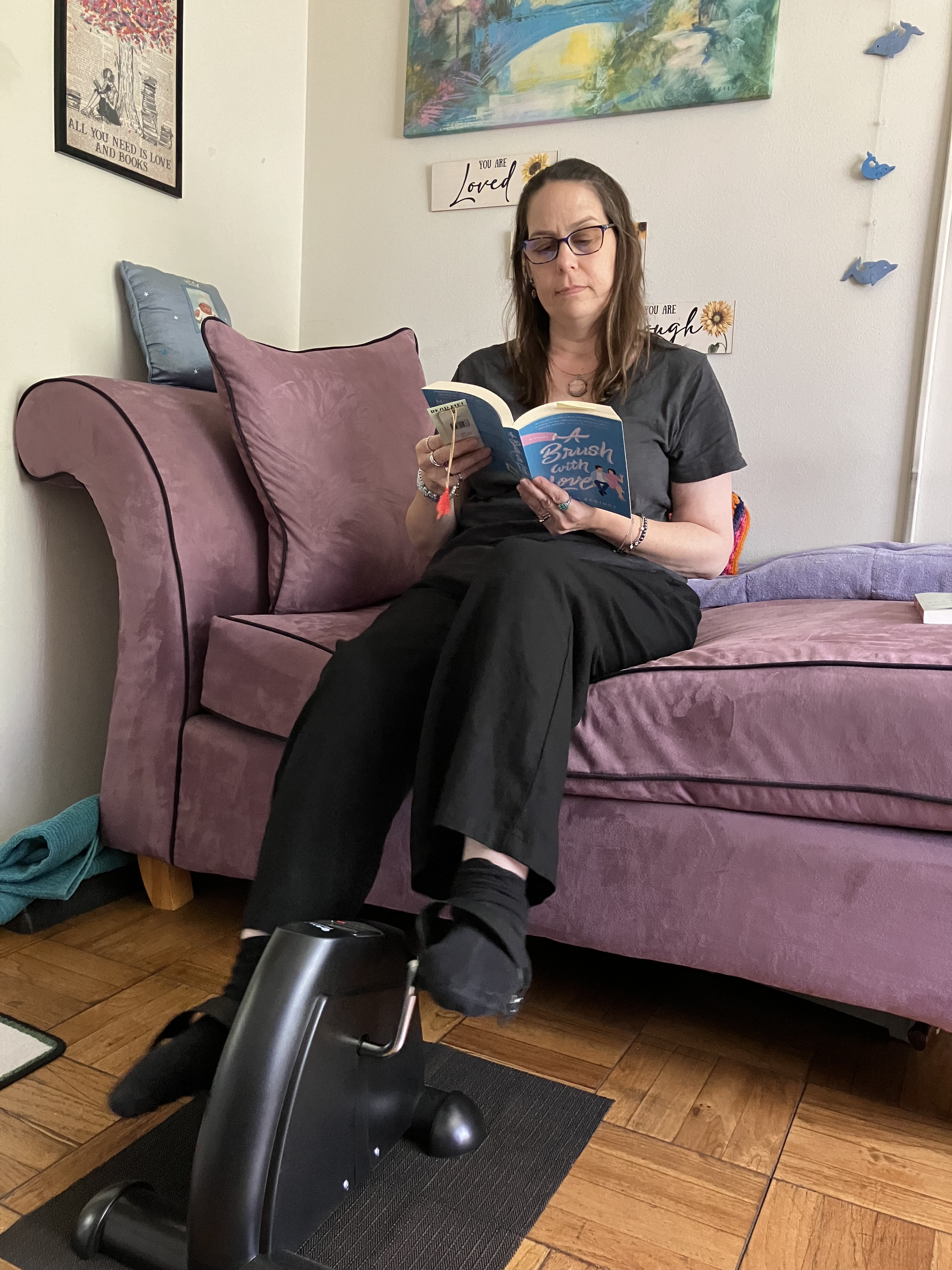
I call this my pedal machine. My physical therapist encouraged me to try it, since we usually start our sessions with me on an exercise bike. I started pedaling for 5 minutes each day, and have slowly increased my time. I'm now up to 10 minutes daily! Generally, I use the time to read.

I have lived with chronic illness and chronic pain for almost fourteen years. 

During this time, I have tried physical therapy. Many times. 

It never worked out for me. For instance:

–   One of my first attempts at physical therapy ended shortly after it started. The physical therapist told me he would no longer work with me, because, “There’s no point. Nothing we do can help you.”


–  Another therapist, in a different location, always made me feel as if I couldn’t do much, and what I could do wasn’t anywhere close to being enough. I left our sessions feeling worse than I started. Worse in terms of higher pain levels and worse in terms of self-confidence.

–  There was the physical therapy group with a close-to-my-home location. I quit that one, after having four appointments with three different therapists, each one giving me some contradictory information.

Based on my previous experiences, you can understand my hesitation when my rheumatologist didn’t just suggest physical therapy, he strongly encouraged it.

This time I’m pleased to say my physical-therapy-is-not-beneficial streak is now over. 

I finally am working with a physical therapist who speaks kindly and smiles. A physical therapist who celebrates my effort, who acknowledges just how hard some stretches are for me, who encourages me to try, who modifies as needed. 

Plus, during last week’s physical therapy session, my therapist did something no other therapist has done before — he made me laugh.

Now, most people know PT is shorthand for Physical Therapy. 

But there’s another meaning for that acronym. 

Let me give you a bit of context — my therapist had demonstrated a new stretch, something that would work my quadriceps. It hurt when I tried it, so we modified it, with me not stretching quite as hard or quite as much. 

That’s when my physical therapist told me one of his patients invented a different meaning for PT: Pleasant Torture.

It was so unexpected, I couldn’t help but laugh out loud.

I have never thought of PT like that before. 

While it’s not torture, physical therapy is hard work. Each time I leave, I am tired and worn out. The following day I’m usually sore. 

Yet even with all of that, overall, the process, this time, is pleasant.

Readers, do you have any physical therapy experiences you want to share? Have you been fortunate to work with someone who makes the process pleasant? I hope so!
Chronic? Yes, Unfortunately.

“Chronic congestion.”

No, she wasn’t talking about the 405. 

The physical therapist was talking about my left calf. My calf is, was, the primary source of pain related to my autoimmune disease. For the last few months, the pain has traveled and now extends up into my thigh.

But apparently, what I refer to as a hard knot, or tightness, in my leg, my physical therapist calls “chronic congestion.”

She held my leg up, my foot pointing toward the ceiling as she rubbed and massaged and gave a basic summary of my case to another physical therapist. “She’s got chronic congestion all in here.”

It is chronic. I’ll give her that. My condition began in 2010 when I woke up with a swollen left calf, unable to stand or bear weight or walk for days. I was hospitalized and treated for cellulitis, a bacterial infection doctors believed was the cause of my swollen, red calf. 

But even after my calf regained its normal appearance, even after I could walk and drive and climb stairs, my legs were never the same.

About a year and a half after my hospitalization, I was diagnosed with a rare autoimmune disease called Undifferentiated Connective Tissue Disease (UCTD). It has overlapping symptoms of lupus, rheumatoid arthritis, and myositis without it being any of those diseases. It’s a medical hodgepodge in a sense, and a whole lot fancier way for doctors to say they don’t really know what’s wrong with my legs or what is causing it.

Whatever you call it, it means each day I experience varying levels of pain, fatigue, weakness in my legs with my left leg always worse.

So I completely agree with the chronic part of her statement.

But “congestion”?

I hear congestion, and I think of a stuffy nose. 

Or I think L.A. traffic and planning a visit to the Aquarium of the Pacific on a Sunday, a day the 405 is generally less congested.

It’s been weeks since the physical therapist used that term, and I can’t stop thinking about it – “chronic congestion.” 

It bothers me. 

Because, what can we do about chronic congestion?

City planners haven’t figured it out when it comes to southern California’s freeways.

And, as of right now, doctors and physical therapists haven’t figured it out when it comes to my legs.


Helpful or Hurtful?

Working my muscles – playing with my son at the playground.

“How long has it been like this? When did it start?”

My physical therapist asked me that at last week’s session as she was massaging my left leg.

“Nine years ago,” I said.

She made a “tsk, tsk” sort-of-sound. 

“It feels like you’ve got 10 years’ worth of tightness in here,” she said. 

She rubbed some more. “How do you walk around like that?”

“What other choice do I have?” I replied.

For the past three weeks, I’ve been going to physical therapy. Many years ago, a doctor had referred me to physical therapy. And the physical therapist discharged me after just a few visits, telling me that PT wouldn’t help me.

This time, my rheumatologist referred me because of “new” pain I described to him. After an exam, he believed I had injured my IT band, and now, because we had a specific injury to treat, physical therapy might help.

My physical therapist seems to wholeheartedly believe she can help me, but I’m skeptical. 

At my first appointment, my physical therapist told me I have a lack of flexibility and mobility in my left leg. 

I knew that already.

At the same time, going to PT has also given me a certain sense of validation. Someone else recognized and acknowledged my pain; someone else was able to “see” what is largely unseen.

I came home from my first appointment with my knees taped up. Later that afternoon, my eleven-year-old son told me it looked cooler on basketball players than it did on me.

I left my third appointment with more pain than I had when I began the appointment. 

Meanwhile, I’ll keep with it. I’ll continue going, partly because my insurance covers most of it, but also because I don’t want to entirely give up. At least not this soon.

Though at this point in my life, I wonder if anything can really help me. 

Plus, physical therapy is just more work. With the therapist, I’m working my muscles in different, and sometimes uncomfortable, ways. 

At home, I have my “homework” to do – a series of exercises and stretches I do daily. 

And there are days, when I’m just tired of it all. Tired of the work involved – of staying on top of prescription refills, appointments, and medical insurance. 

And I’m tired of the pain.