Magical Meet Cute

If you’ve been reading my blog for a while, you know I’m a big Jean Meltzer fan. (If you haven’t been reading my blog for a while, don’t worry. Click here to read my post about Ms. Meltzer’s debut novel, The Matzah Ball. Click here to read my thoughts about her second novel, Mr. Perfect on Paper. And click here to read some of my favorite passages from her third novel, Kissing Kosher.)

And if you have been reading my blog for a while, you also know I don’t usually read books right when they’re published, simply because everyone else is. I like to wait a bit, until the hoopla has settled down. Then, I select the book from the large number of to-be-read-books I currently own. I read the book and post about it here on my blog and on my Instagram. (If you’re not already following me there, why not?)

My system allows me to show the author some love and attention when they’re in-between books and perhaps aren’t being discussed and celebrated like they were immediately upon publication. 

Ms. Meltzer’s fourth novel, Magical Meet Cute (published in August 2024), was not your standard rom-com. The book’s main character is Faiga Kaplan (Faye to her friends), a Jewitch potter living in Woodstock, New York. And while there most definitely is a romance aspect to the story, the book also confronts the ugliness and the reality of blatant anti-Semitism. 

There is so much to say about this book, about Faye and Greg. Allow me to share some of my favorite passages:

“Greg caught on the word. ‘Home.’
“ ‘The place where you belong. The place where people love you.’
“Home felt like Faye.”  (I love this definition of home!)

“Greg didn’t see her broken bits as flaws. If anything, it was the opposite. She was like that one vase in the store she had hidden behind the fancier and more elaborate-looking Seder plate. She saw herself as warped and damaged, undeserving of love and attention. Yet it was all the bubbles in her clay memory, the scratches and scars … that made her unique.”

“And, at the end of the day, none of that making herself smaller mattered. Because nothing about what these people had done to her, chosen for her, was fair. Or right.
Just like it had never, ever been her fault.
“But she was exhausted from a lifetime of making other people feel comfortable. And suddenly, she was done. Straight-up finished with all these less than deserving people arriving to her shoreline. Damn the silence. Damn the consequences. She was ready to live her life without constantly interrupting herself to say that she was sorry.”

“She gave others what she had always needed from them — love and affection, security and protection, a place to land when things got bad — while never demanding the same for herself.”

“We can hold on to memory, bear the things that shape us, but also … write our own story going forward.”

“ ‘You want the truth about settling down, Greg?’ Tom asked. ‘About spending the rest of your life with one woman, raising a family … about giving up the adventure sometimes, just for a quiet boredom?’ “
“ ‘Yeah.’
“ ‘It’s awesome,’ Tom said.
“Greg laughed.
“ ‘I’m serious,’ Tom said, his whole face turning red as he spoke. ‘Every single day, I wake up and go to bed with my best friend in the world. When i’m having a hard day — shit, when I needed neck surgery — she’s there for me. When I’m having a good day, when I want to watch a game or a movie on Netflix with the kids, there’s no one I would rather spend time with more than her. It’s not just that she busts my chops, or has fun with me, or makes me better … it’s that I can’t imagine how there was ever a me without her’.” 

“It was the most remarkable type of magic — falling in love, finding your person, crafting your own life, writing a story where you deserved to be valued.”
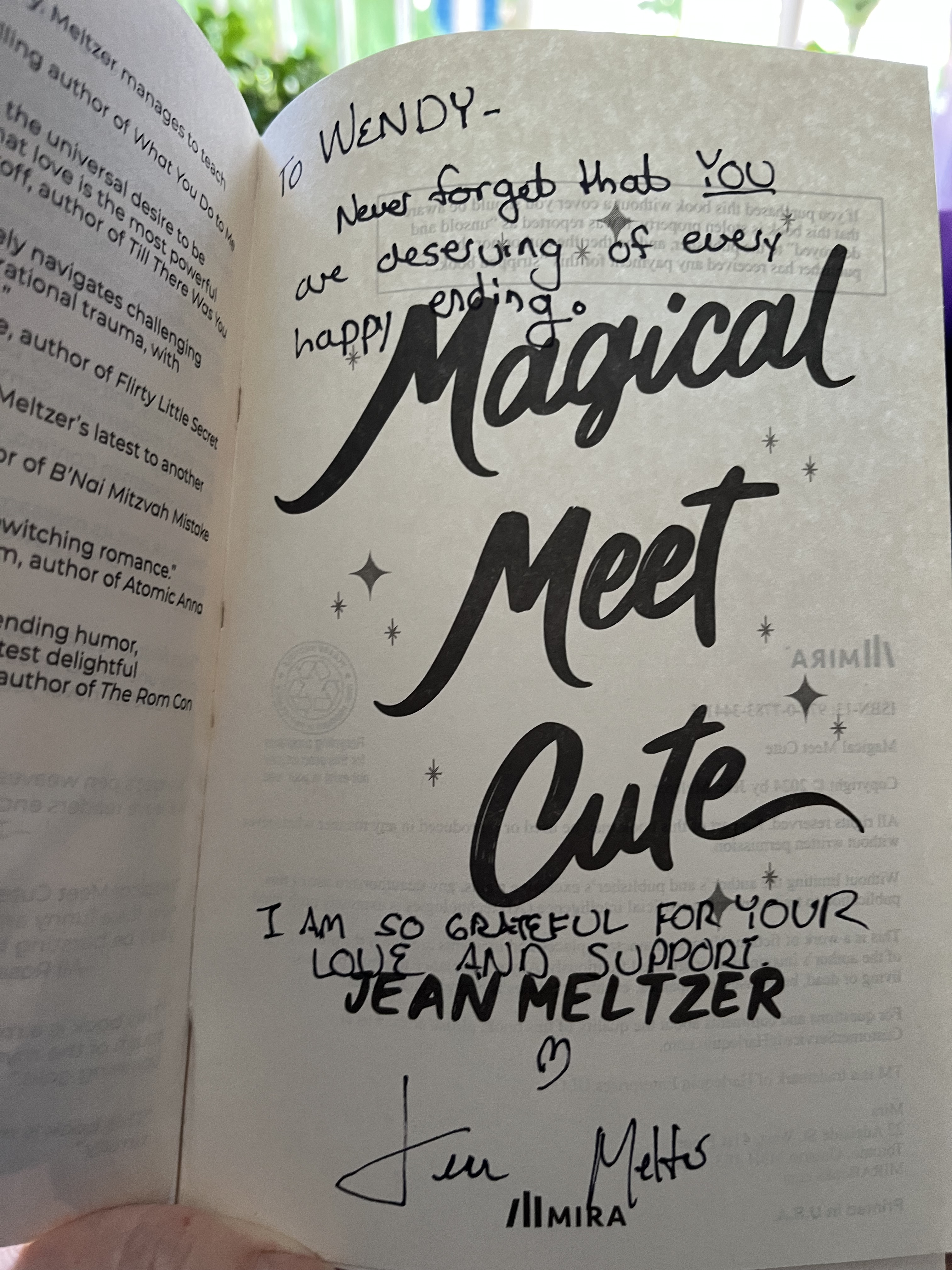
FYI – Ms. Meltzer’s fifth novel, The Eight Heartbreaks of Hanukkah, will be available on October 21st. You can pre-order a signed copy now.  

Please note: I am including a link to buy the book that I’m highlighting this week. If you use my link, I do make a small commission on your purchase at no additional cost to you. I am working with Bookshop.org which also sends a portion of the profit to support local, independent bookstores.


Kissing Kosher

Here’s what you should know about Kissing Kosher by Jean Meltzer.

It’s a rom-com. A delightful rom-com.

But even more than that — the protagonist, Avital Cohen, happens to be a Jewish woman who lives with a chronic illness and chronic pain. And for that I applaud Ms. Meltzer. (I have written about Ms. Meltzer’s first two books in previous blog posts, which you can read here and here.)

While the rom-com was fun to read and provided me with a fantastic escape from real life, it was the very real, very relatable aspects of Avital’s chronic illness that I most resonated with. 

Here are just a few of the passages I marked with sticky notes:

“She got used to disappearing into the ceiling while doctors poked and prodded. That was the funny thing about chronic pain. It didn’t disconnect her from her body. Instead, it made every single second of her life about her body. She couldn’t escape the never-ending reminders of her pain if she tried.”

“Like many folks dealing with the onset of chronic illness, she had hope — this great and unfettered optimism — that she would one day wake up normal again if she could just find the right treatment.
“There was no cure. While some of the treatments helped, nothing completely eradicated the constant ache she lived with. There were bad days and better days, but rarely did she experience pain-free days.
“Despite all her best efforts to win the war against her own failing body — despite the fact that she was trying not to make her disease her identity — she kept getting worse. Some nights, the fear that accompanied the realization that nothing she did was working was more awful than the pain itself.”

“People always say, Don’t make your disease your identity. And you know what, Josh? I hate that statement. I think it’s the most ableist thing I’ve ever heard. The very definition of chronic is that it’s every day. It’s something I will have to negotiate, and manage, for the rest of my life. It touches everything.”

“But mainly, the most important thing I’ve realized is that if I’m going to be in pain the rest of my life, then it’s even more important that I hold on to my joy. I need to create the life that makes me happy. So that when the bad days come, because they will keep coming, Josh … they don’t hurt me as much.”

Please note: I am including a link to buy the book that I’m highlighting this week. If you use my link, I do make a small commission on your purchase at no additional cost to you. I am working with Bookshop.org which also sends a portion of the profit to support local, independent bookstores.

The Matzah Ball

Sometimes you find a book, or a book finds you, and you just want to tell everyone about it. You want to grab the pom-poms you never owned and create a cheer for this book. Then you want to place the book into the hands of readers everywhere. 

That’s how I feel about The Matzah Ball by Jean Meltzer.

The Matzah Ball is a holiday romance with a twist. It’s a Hanukkah romance, and our main character, Rachel, lives with a chronic illness. Right away I was intrigued, and the book did not disappoint. (Additionally, the author is a Jewish woman living with a chronic illness — myalgic encephalomyelitis.)

I loved getting a glimpse into some of the Jewish traditions I’m less familiar with. I loved seeing Rachel and all the messiness that comes with a chronic illness depicted on the page. And, I loved that this book gave Rachel, and by extension – me as the reader, the happy ending I was hoping for. 

I read a library copy which I tagged with many sticky notes, which means I now need to buy my own copy at my next bookstore visit. 

This week, I’m excited to share just a few of the passages that stood out to me:

“Turning beneath the covers, she blinked and took a careful accounting of how she was feeling. Would it be a good day or a bad day? She could never be certain.
Some mornings she woke up feeling well, only to find herself completely depleted two hours later. Sometimes it was the opposite. She would crash for days at a time, with no ability to do even the most menial tasks. Her disease was constant but fluid. It peaked and ebbed with only one discernible pattern. Everything she did, everything, from writing two pages to carrying the groceries one block to her apartment, came with a kickback.
It was her normal.”

“There was no way to know how long these crashes would last. It could be hours, days, weeks…or even years. The only way to avoid the flare-ups was through a very unscientific method of pacing oneself and rest.
The problem was, of course, that Rachel was awful at pacing herself or resting.
On good days, she pushed even harder. On bad days, she still pushed…usually making herself way worse in the process.”

“She wasn’t ‘out’ about her disease. She wasn’t out about …anything. Sitting in a wheelchair meant accepting you were disabled and dealing with awkward stares from healthy people.
Most of all, and because she had a disease with a name like chronic fatigue syndrome, there was always a fear tucked away inside of her that someone would look at her and say she was doing this for attention. That she really wasn’t that sick. And so, though a wheelchair would certainly make her more mobile and give her a higher quality of life, she often chose to stay home.”