Funny Story

Emily Henry has become one of my auto-buy authors. Meaning, when Emily Henry publishes a book, I’m going to buy it. Sometimes I wait a bit, for the paperback edition or for the hardcover to be on sale. Or I wait for a promotion or sale like those periodic free shipping days offered by Bookshop.org

But, even though I buy Emily Henry’s novels I don’t read them right away. It’s kind of like saving the best for last. (Am I the only one who eats the cake part of a cake first and then eats the frosting part last?) 

So although I know Funny Story was published last year, and I still have to buy Ms. Henry’s most recent novel (Great Big Beautiful Life), I just finished reading it. And this week, I wanted to share some of my favorite parts with you. 

“Still, a chorus of ridiculous little voices rises as I approach, cries of ‘Miss Daffy!’ and other adorable mispronunciations of my name. In my heart, it feels like little kernels are bursting into fluffy blossoms of popcorn.”

“It’s funny: As a kid, I had no idea how to interact with other kids. I felt most at home with Mom and her friends. But as an adult, I find kids so much easier to understand.
“They say how they feel, and they show it too. There are fewer ulterior motives and written rules. Silences aren’t unbearably awkward, and abrupt segues to different subjects are the norm. If you want to be friends with someone, you just ask, and if they don’t want, to, they’ll probably just tell you.”

“ ‘ How did it start?’ he asks. ‘The library thing.’
“ I cast my mind back, to before grad school, before undergrad even, all the way to the first moment I remember loving a story. Feeling like I was living it. Being, even as a child, bowled over by how something imaginary could become real, could wring every emotion from me or make me homesick for places I’d never been.”

“ ‘I have noticed you tend to do well with the over-seventy set,’ I allow. ‘Then again, you’re not so bad with the under-seventy set.’

“He rolls his eyes, but he’s smiling. ‘I guess it’s nice being around people who’ve made it through shit, you know?’ He shrugs. ‘Like probably all their worst mistakes are behind them, and they know who they are now, and how to be who they want to be.” 

“’The library is, like, the single best cross section of humanity,’ I tell him. ‘You meet all kinds of interesting people.’”

“All those moments throughout the days, weeks, months that don’t get marked on calendars with hand-drawn stars or little stickers.
“Those are the moments that make a life.
“Not grand gestures, but mundane details that, over time, accumulate until you have a home, instead of a house.

“The things that matter.
“The things I can’t stop longing for.
“There’s only one place that feeling exists for me, only one person with whom I belong.” 

“ ‘You?’ she says. ‘You, my girl, are whoever you decide to be. But I hope you always keep some piece of that girl who sat by the window, hoping for the best. Life’s short enough without us talking ourselves out of hope and trying to dodge every bad feeling. Sometimes you have to push through the discomfort, instead of running.’”

“… I’d wanted so badly to escape myself, my life, that I forgot about all the beautiful little pieces of it I’ve been acquiring like sea glass these last few months.” 

“But if I’ve learned anything from parenting, it’s that it matters way more that you’re present than that you’re perfect. Just be here, really be here, and the kids will love it.” 

“… sometimes the unexpected is better than what you plan.
“The same universe that dispassionately takes things away can bring you things you weren’t imaginative enough to dream up.”

Please note: I am including a link to buy the book that I’m highlighting this week. If you use my link, I do make a small commission on your purchase at no additional cost to you. I am working with Bookshop.org which also sends a portion of the profit to support local, independent bookstores.

An Acrostic Poem for Invisible Disabilities Week

Not all disabilities are immediately visible

Invisible Disabilities Week started on Sunday, October 19th and continues through Saturday, October 25th. 

The goal behind Invisible Disabilities Week is to raise awareness, because not all disabilities are easily recognizable or easily seen. Not all disabilities look the same. Not all people living with disability behave in the same way.

But just because you don’t see it doesn’t mean it’s not there. 

Just because I “look fine,” doesn’t mean I feel fine.

This week, I borrowed an activity from my teaching days — I created an acrostic poem as a way of raising awareness and sharing a bit of my personal experience. (In an acrostic poem, the first letter of each line spells out a word or phrase. I used the word Disability.)

Dinner time is generally hard for me. My family doesn’t know this, but many times I cry while I’m in the kitchen preparing dinner. Sometimes I think it’s because my body is tired after all day. Sometimes it all just feels like too much; I’m hurting so much I don’t know how I’ll keep standing, let alone wash the pot in the sink or cook the rice on the stove. 

Invisible disability means I don’t regularly use an assistive device. So at first glance you may think I’m “fine.” But if you pay attention you’ll notice that instead of climbing the five stairs out front, I walk up the ramp to get into the building where I go for my physical therapy. You may notice I limp sometimes when going for a walk in the neighborhood. Look carefully, and you may see me pause after crossing the street and stepping up onto the sidewalk. (Some of those curbs seem so high!) 

Symptoms vary and are not always a direct result of anything I did or didn’t do. Sometimes I experience a heaviness in my leg, as if I’m walking through mud and just can’t get my feet to move any quicker. Sometimes my left calf feels hard and tight, as if it’s stuck in a charley horse. Sometimes my left leg feels like it’s being squeezed, as if someone has strapped a blood pressure cuff around my leg. 

Ableism is discrimination in favor of non-disabled people. Like when my son’s high school expects all parents to navigate the stairs and hallways during Back to School Night. (You can read about my experience in this blog post.) Or when I used to see someone park their car in a handicap parking spot and exit their car looking “fine,” and I immediately thought they must be faking, using someone else’s placard. It’s embarrassing to admit, but it’s the truth.

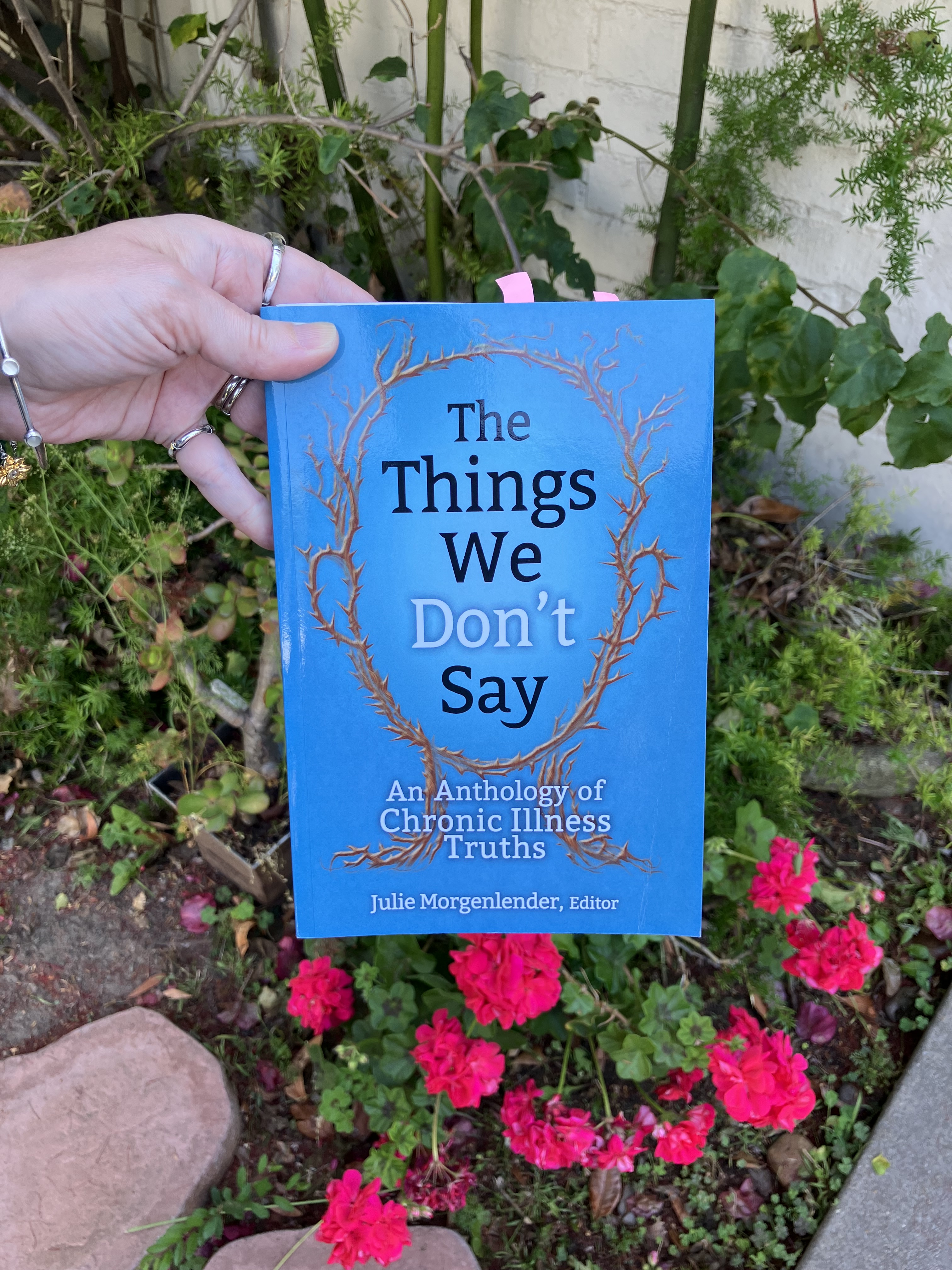
Books. After receiving my diagnosis, I went searching for books on the subject. Then I looked for books written by authors on parallel paths, maybe their diagnosis was different than mine, but the emotions would be similar. I really couldn’t find much. Which is why I’m always recommending The Things We Don’t Say: An Anthology of Chronic Illness Truths. Full disclosure, one of my essays is included in this anthology. (Side note – this is why I believe there is an audience for my as-yet-unpublished memoir.)

Ironic. When I was in high school, I had such a hard time learning to swallow pills. I gagged. I coughed and sputtered, certain I would choke. Yet, here I am all these years later, and I take almost 20 pills a day (both prescription medication and over-the-counter supplements/vitamins). 

Live the life you’ve dreamed of. We had a plaque with that expression hanging on the wall by the staircase. It didn’t happen right after I became ill, but sometime later I came to  realize I no longer liked that wall hanging and I no longer wanted it in our home. In some respects, this is absolutely not the life I dreamed of. I didn’t dream of retiring from teaching because I was physically unable to continue. I didn’t dream of qualifying for a disabled parking placard before my parents. It happened. Period. But I definitely didn’t dream it.

Individual experiences do vary. Each chronically ill patient is dealing with a different set of variables, including different symptoms and different treatments. Which means it’s not helpful when someone (who knows very little of my medical history) makes a general statement trying to convince me that the solution is yoga/green smoothies/becoming gluten-free/fill-in-the-blank because it worked for their friend/neighbor/coworker/relative.

Treatment is challenging. Because what worked for a while (meaning, what kept my inflammation under control) can suddenly stop working. There are so many variables at play, including physical movement, mental health, stress, menopause, and sleep it’s hard to really know which one is the biggest factor in how I feel. 

Yearning to feel like my “old self.” The Wendy who woke up feeling rested. The Wendy who didn’t dread that first walk downstairs. The Wendy who didn’t have to think about her pain and her knees and her sensitive calf. The Wendy who could walk for an hour. The Wendy who could walk to the nearby shopping center without thinking twice about how I’d feel during and after the walk. The Wendy who trusted her body would always work the way I expected it to. 

Please note: I am including a link to buy the book that I’m highlighting this week. If you use my link, I do make a small commission on your purchase at no additional cost to you. I am working with Bookshop.org which also sends a portion of the profit to support local, independent bookstores.

Sunflowers

Summer 2021

I don’t remember when I decided sunflowers were my favorite flower. 

Was it before or after I started working part-time in a flower shop? (I started working there during my last semester of high school and continued working there during the years I spent at community college before transferring to a four-year university.)

I do know that a year after I graduated high school, my mom gave me a large tote bag, with sunflowers on both sides.

Spring 1995. This is a photo of the photo.

It was a perfect gift then, but I’m pretty sure neither one of us imagined I would still be using that bag today, thirty years later.

Why do I like sunflowers? Or should I say, why do I like sunflowers more than other flowers? Several reasons:

In my eyes, they’re bright and happy flowers. Cheerful. 

As flowers go, they’re pretty low maintenance — no thorns or excessive leaves to remove before snipping off the bottom of the stem and putting them into a vase full of water. 

I always felt good about selling sunflowers because they’re long-lasting, unlike other flowers, like irises for example, which only last a day or two, maybe three if you’re lucky. 

Yet, the older I get, and the more my body changes, the more it makes sense that I would find myself identifying with sunflowers. As in, maybe I liked sunflowers for more superficial reasons, and now I regard them as a sort of symbol of my life. 

I like to think I share some of the characteristics that make sunflowers the special flowers they are. 

Sunflowers, with their bright yellow color, are said to symbolize positivity and optimism. Generally speaking I try to go through life looking for the good. Hoping for the good. Spreading good by complimenting a stranger’s pretty pink nail polish. Sweeping my neighbor’s back patio. Picking up the package of cookies that fell off the shelf at the market (even though some days it really hurts to bend and pick anything up).   

Sunflowers are resilient. They are known for their ability to turn towards the sunlight and to thrive in what many would consider to be impossible-to-thrive conditions. And let’s just say that becoming chronically ill at age 34 left me no choice but to develop my resilience and create this whole other career and identity for myself as a writer. 

Sunflowers are hardy. Tough. Because when you live with chronic pain you don’t have a choice. You have to be strong.  

Some of the sunflowers in my writing room.

And, sunflowers are also a symbol for the chronic illness community. 

“The Hidden Disabilities Sunflower is a simple tool for you to voluntarily share that you have a disability or condition that may not be immediately apparent – and that you may need a helping hand, understanding, or more time in shops, at work, on transport, or in public spaces.”

That’s why you’ll find sunflowers on my website (in the header).

And when I dream of my book and the cover for my memoir-in-essays, I imagine sunflowers on it in some way. 

Dear Readers, that’s the story behind my favorite flower. May I ask, what’s your favorite flower? And, is there a particular reason why you chose that flower? Feel free to share in the comments. Let’s create a virtual bouquet of all our favorite flowers!

More sunflowers in my writing room.

Dear Writer

A few weeks ago, I wrote a blog post about the “pep talks” portion of Maggie Smith’s Dear Writer: Pep Talks & Practical Advice for the Creative Life. (If you missed the post, click here to read it.)

This week, I’d like to share some more, because Dear Writer is one special book. In fact, I think Dear Writer is one of those books that won’t just sit on the shelf with other writing-related books. Dear Writer will be read and re-read. 

The book is organized into “ten essential elements”: attention, wonder, vision, surprise, play, vulnerability, restlessness, connection, tenacity, and hope. Within each section, readers will find craft-centered essays, writing prompts, and suggestions for related reading. 

But, I don’t think this book is only for writers. Or artists. I think the inspiring words found within this book, could really be applied to any area of life.

Here are some of the passages I marked with a sticky note. What do you think — only for writers or all humans?

“Although my work has changed over time, the act of writing feels no different to me than it did five or ten or twenty years ago. I’m still gathering, still collecting, still trying to make a garment from these scraps. The pleasure in the writing is the surprise — having no idea what you’re making as you’re making it.”

“When you try something new, whether it’s writing or baking or running, you’re in a period of apprenticeship to that art or activity. You’re a beginner, a novice, an amateur. But the root of amateur is the Latin amare, meaning ‘to love.’ An amateur does something for the love of it. And when you love something, you stick with it.
“When you stick with something out of love, you grow in it and with it. Each day, truly.”

“I don’t go to literature for comfort, as a writer or as a reader — I read and write to be changed, to see anew, to revise my own thinking. Actually, change is the opposite of comfort. But change invigorates. It stretches muscles you might not have known you had. It might hurt a little, that strain, but ultimately it strengthens. 
“I want to write and read pieces that lean toward wonder and rediscovery — toward questioning rather than knowing, toward authenticity and sincerity rather than irony and cynicism. Art is a site of wonder and discover — or rediscovery. Art is a place where we might learn what we think, not a place where we teach the reader what we’ve already processed.”


“The discovery doesn’t end when the piece is published. Sometimes readers will point things out that surprise you. Sometimes you’ll be reading a piece aloud in front of an audience, and something will strike you differently. The piece isn’t static, because you aren’t static. You change, your perspective changes, your experiences pile up, and you engage with the piece differently because of it.” 

“Creativity is artistic mischief. As writers and artists, our work is play. We come to the page — to the canvas, to the stage, to the studio — with trickster energy and a sense of daring. We’re working, but we’re delighting in the work.” 

“When we create, we choose the openness, the exposure, the risk — and that takes courage and nerve.
“There is no vulnerability without courage. They travel together, and I don’t think you can create without them both.” 

“I got ordained on the Internet for the same reasons I write poems. To marry two people is an act of hope, optimism, and connection. To write is an act of hope, optimism, and connection.”

“I’ve said for years that what every writer needs is a combination of tenacity — fierce, bulldog-like tenacity — and patience. The two go hand in hand. Tenacity is stick-to-it-ive-ness: part perseverance, part stubborn persistence, part fortitude, part endurance, part determination, part mettle (I love that word: mettle), and part drive.” 

“To make things that don’t exist yet — and don’t need to exist, because that is the very definition of art — and to send them out into the world is wildly, impractically, gorgeously hopeful.
“This is my way of saying there is no creativity without hope. Creativity is inherently hopeful, and the reverse is also true: Hope is inherently creative. Hope is imaginative; it allows you to envision what might be up ahead, even when you see nothing.”

“Remember: You are a writer if you write. You’re succeeding if you answer when the idea knocks — if you let it in, and pay attention to it, and see it through. If you don’t half-ass it. WHOLE-ASS IT. Your creative life deserves all of you. The whole you.”

Please note: I am including a link to buy the book that I’m highlighting this week. If you use my link, I do make a small commission on your purchase at no additional cost to you. I am working with Bookshop.org which also sends a portion of the profit to support local, independent bookstores.

107 Days — More Than Just a Book

When I click on the Dictionary app at the bottom of my laptop, and search the word book, here’s what I read: 

1. “A written or printed work consisting of pages glued or sewn together along one side and bound in covers.” 

2. “A literary composition that is published or intended for publication as a book.”

So, when is a book more than a book?

When it’s 107 Days by Kamala Harris. 

And purchasing the book did not mean visiting one of my favorite independent bookstores. Instead, I purchased a ticket for “A Conversation with Kamala Harris” at The Wiltern Theater in Los Angeles, which also included a copy of the book! (The event was held just a few days ago, on Monday, September 29th.) 

I attended the event with one of my closest friends which made it even more special. Before and after the discussion, my friend and I talked about what we already knew about the book, about the heartbreak of this last presidential election, about our concern/anger/frustration/sadness/dismay at the current state of our country. 

And then, up on stage, standing before us was Madame Vice President. She talked about why she chose to write the book, even sharing that she and her husband, former Second Gentleman Doug Emhoff, had never spoken about election night until she wrote about that night for this book. 

Completely unexpected!! -- The Former Second Gentleman graciously posed for pictures shortly before the conversation began.

I consider this book to be a historic document. A primary account of an unparalleled time in our country’s history. Many years from now, my copy of 107 Days will be passed down to future generations of my family. By then, I’m sure the book will have sticky notes on many pages. Maybe notes in the margins. Maybe a sentence underlined. 

Years from now, I’ll share my memories of this time. How close our country came to doing something groundbreaking, (or ceiling-breaking, I should say). Something already being done in other countries — electing a female to the highest office in the land. 

“Kamala Harris, for the people.” 

And Monday night the people in Los Angeles were there for Kamala Harris and her book. 

Love this photo on the back cover of the book!

Please note: I am including a link to buy the book that I’m highlighting this week. If you use my link, I do make a small commission on your purchase at no additional cost to you. I am working with Bookshop.org which also sends a portion of the profit to support local, independent bookstores.