In Praise of Poetry

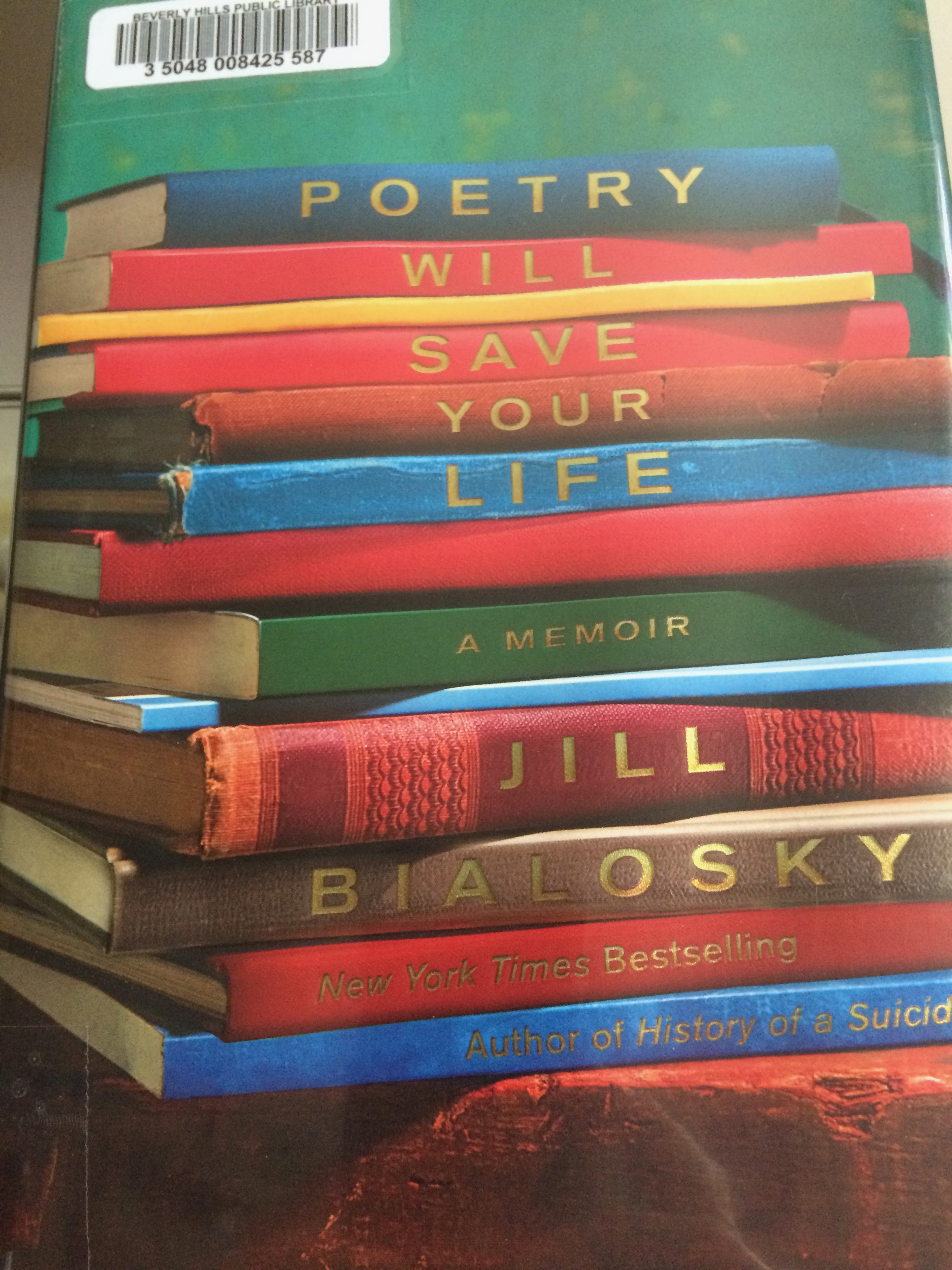
The latest book in my “just read” pile is Jill Bialosky’s memoir Poetry Will Save Your Life.

I’m not a huge fan of poetry; a poem either speaks to me or it doesn’t, though I do have a (small) number of poems that touch my soul.  And there were several things I liked about this book that I wanted to share with you this week.

From a writer’s perspective, I thought the structure was so original.  The author shares a moment of time, a memory, an anecdote and then included a relevant poem.

From a book lover’s perspective, I thought the cover was beautiful (see the picture above) as were the front and end pages (see the picture below).

From a reader’s perspective, here are some of the passages I tagged as I read:

“A poem’s meaning alters by the associations, insights, and experience we bring to it.  A poem can do many things at once.  Like “The Road Not Taken,” it can challenge the reader intellectually, spiritually, and emotionally.  It can validate our experiences or cause us to question our beliefs.”

“Surely this is one of the reasons poetry enriches us.  A poem links us to a universe at once intimate and communal.  Poets and artists work in solitude and by intuition.  They have the same mission: to capture and fathom the reality beyond appearances, the world invisible to the eye.”

“I realize that through the artfulness of poetic form, one can trap experience and make it palpable to a reader.  A poem might be about what hurts, and most illuminating, the subject might be drawn from one’s own life.  A poem could be both personal and communal and save a person from the dark shadow of shame.”

“Poems often begin from a question, or a needling of something disturbing or provoking, sometimes even from ignorance.  From there a poet takes elements, either an image, a particular scene or landscape, a memory, maybe only an expression – and appeals to her unconscious, her place of unknowing in hopes that as words, phrases, and fragments take shape, like beads on a string, something original and exciting might evolve.”

Readers, what are your favorite poems?  Feel free to share in the comments section!

Playing in Pain

The other afternoon, my son and I played hopscotch.

That was after we had played handball.

There are a few details that make those statements more meaningful than they may initially appear.

First off, in our neighborhood, we don’t see many parents outside playing with their kids.  Where we live, kids are left to wander on their own.  Most of the families near us are not only-child families like ours so often times siblings play together, or neighboring kids play together.  But the other day, we were the only ones outside enjoying the sunshine so I was my son’s playmate.

Secondly, neither hopscotch or handball are easy sports for me to play.  Me, the woman with an autoimmune disease, the woman who qualifies for a disabled placard, the woman who experiences pain in her legs (primarily the left leg).

But my son wanted to play.  And I wanted to play with him.  So I did, until I just couldn’t.  Until I was balancing on one foot, bending down to pick up the rock from the hopscotch square, and pain began to shoot up and down my leg a bit.  Then I had to sit the rest of the game out, and cheer on my son while he played alone.

That part hasn’t gotten any easier for me — knowing when to stop and knowing when to say “I can’t do this any more.”  Because I do want to play with my son, and because I realize how special it is that my ten-year-old still wants to play with me. 

Our afternoon playtime session got me thinking about a personal essay I wrote a few years back that was published at muthamagazine.com.  Click here to read, “The ‘A’ Word: Parenting with an Invisible Disability.”


5th Grade – The Home Stretch

My 5th Grade School Picture

My son is a fifth grader. 

School started yesterday, which means this will be Ryan’s last year at his elementary school and then it’s off to middle-school.

But I don’t want to rush ahead.  We have 180 days of fifth grade to experience first.  And like in years past, I’d like to share with you memories of my own fifth grade year.  (To remind you, you can click here to read about my fourth grade experiences and click here to read about my life in third grade).

I had the same teacher for fourth, fifth, and sixth grades.  Ryan has had a new teacher each year.  My elementary school went up to sixth grade, so unlike Ryan, at this stage I wasn’t yet looking ahead to middle school.

And though I was in fifth grade back in the 1980s, one thing remains the same.  All fifth graders are still required to complete the fifth grade physical education fitness test.

Unlike Ryan’s school, my elementary school didn’t have a physical education teacher.  When I was in elementary school, our classroom teachers took their classes out for P.E. once in a while, usually on Fridays, and usually as a reward for good behavior.  We didn’t train and practice for this physical fitness test.

Luckily, Ryan’s school has a group of physical education coaches.  They have been training for this test since kindergarten, slowly building up the endurance needed to run a mile.

And when it comes time for this test, I’ll give Ryan the same words of encouragement I always give him for any test: Do your best. 

Because really, no matter what grade you’re in, no matter what you’re being tested on, that’s the only thing you can do.

Summer Reading

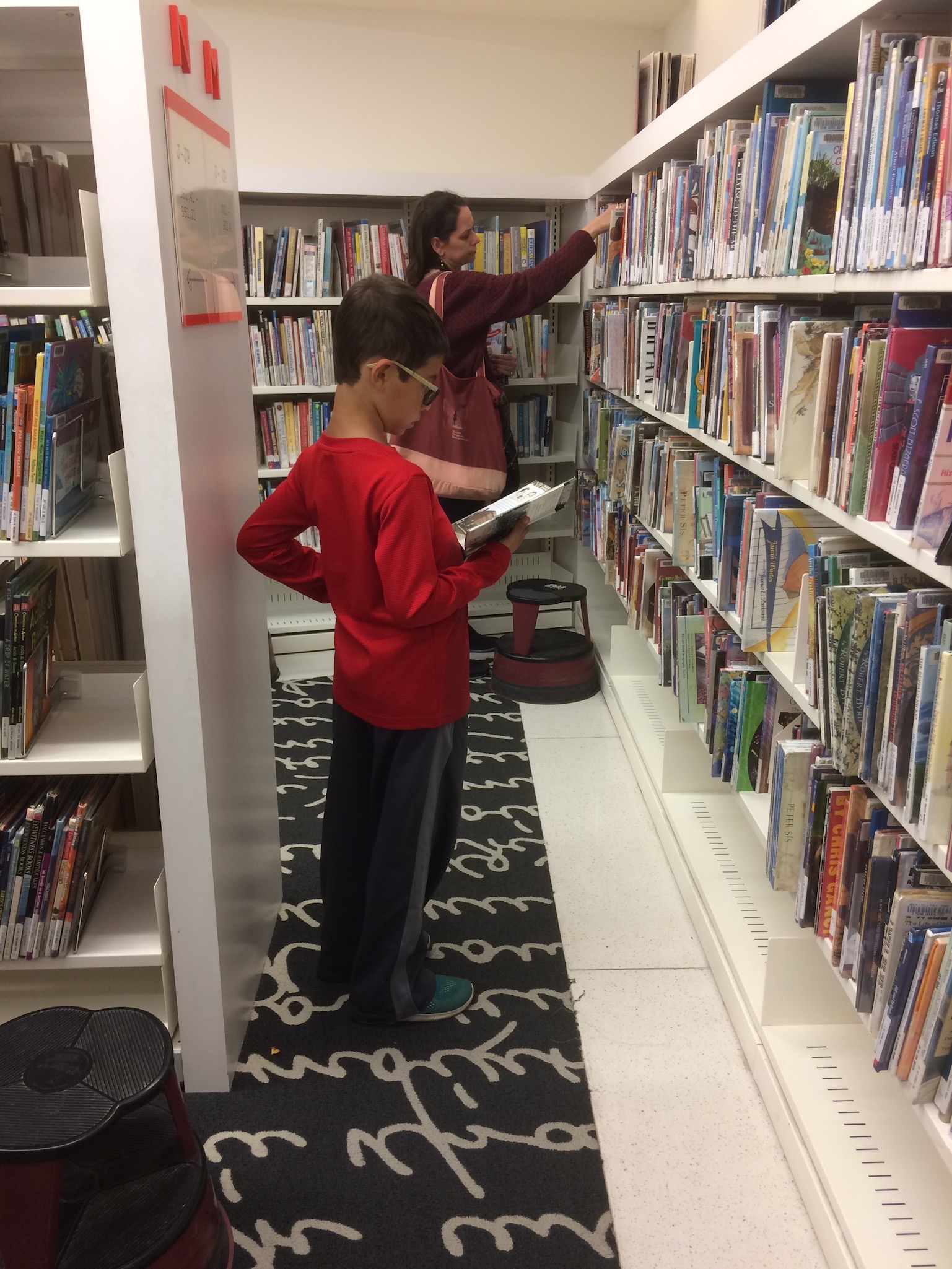
A photo taken a few months ago showing Ryan and I browsing at the library.

We’re coming to the end of summer break.  In our family that means school resumes next week, as does afternoon homework and a note packed into my son’s lunchbox each day.

Our summers usually consist of:  one family trip (we were in Santa Barbara and Cambria this year); numerous museum visits (including LACMA, the La Brea Tar Pits and Museum, the Natural History Museum, the California Science Center, the Norton Simon Museum, the Getty Center, and the Skirball Cultural Center); and lots of reading.

My ten-year-old son just completed the reading log required for the public library’s summer reading program.  We never tell Ryan what to read, or insist he sit down and read each day.  He just reads.  Sometimes alone, sometimes together — on our patio, on our couch, at our local Coffee Bean.

And looking over his list of books makes me smile.  Ryan read about LeBron James and King Tut.  He read joke books and books based on Pixar films.  He read about Katherine Johnson and Buzz Aldrin.  He read about Michael Jackson and Stevie Wonder.  He read about Nintendo’s Mario and Curious George.

It’s been a good summer.

Parenting Color-Aware

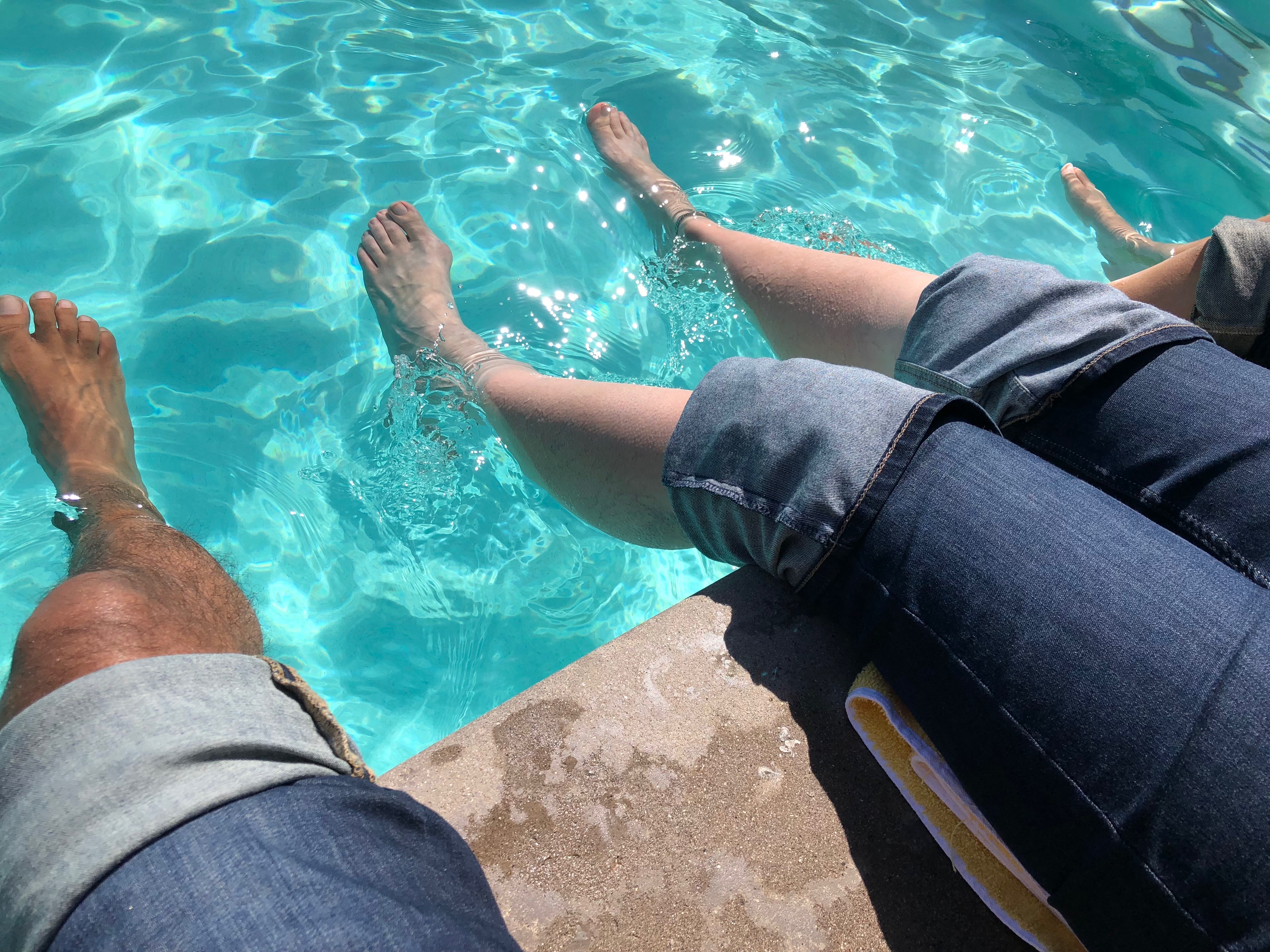
Three sets of legs, three different skin tones. One family.

I am a mother.

I am the mother of a son.

I am the mother of a ten-year-old son.

I am the mother of a bi-racial, ten-year-old son.

My family’s racial identity is not always up front in my mind, and yet I am in no way color-blind.  Click here to be re-directed to MomsLA.com to read my recently published essay “Parenting Color-Aware (The Opposite of Color-Blind).”

It’s A Different World

My double-digit son with his new iPod Touch and chocolate birthday cake!

The other night, my ten-year-old son and I were having a discussion about technology.  Specifically, how it seems like many of the kids in our neighborhood and in his last class at school have things he doesn’t have — namely a phone.

Ryan is ten years old.  I take him to school and pick him up each day.  He doesn’t travel anywhere without an adult.  There is no need for a phone.  (We did give him an iPod Touch for his 10th birthday).

I asked Ryan who he would call if he had a phone.  He listed me, my husband, and my parents.  I asked him if he needed a phone, and he told me no.

Then he asked me how old I was when I got my first cell phone.  I told him — I was in college, commuting on six buses a day, a roundtrip travel time of 3 1/2 to 4 hours each day.  My parents gave me a cell phone that looked like a brick.  With it came strict instructions not to use the phone unless, heaven forbid, there was a real emergency.  Otherwise, always keep some quarters in my backpack, and use a pay phone when needed.  (I never used that phone).

That is not the world in which my son is growing up. 

And that got me thinking about a post I wrote for MomsLA back in 2013.  Click here to read “6 Ways My Son’s Childhood Is Different Than Mine.”

Moments of Happiness

A few months ago, a good friend gave me Option B written by Sheryl Sandberg and Adam Grant.  I’m about halfway through it, and already have quite a few Post-Its tagging pages.

As I’ve mentioned in previous blog posts, there has been an awful lot going on in our family during the last couple of months.  The other night I read a few passages in Option B which really impacted me, and I wanted to share them with my readers.

“When we look for joy, we often focus on the big moments.  But happiness is the frequency of positive experiences, not the intensity.”

“Paying attention to moments of joy takes effort because we are wired to focus on the negatives more than the positives.  Bad events tend to have a stronger effect on us than good events. “

“Even when we’re in great distress, joy can still be found in moments we seize and moments we create.  All of these can provide relief from pain.  And when these moments add up, we find that they give us more than happiness; they also give us strength.”

And, I’d like to take it a few steps further and share with you three moments that made me happy this past week:

  1. Driving in our car, my ten-year-old son sat in the back seat, singing along to “Sugar, Sugar” by The Archies, but doing it our family-way — substituting “Oh Ryan” for “Oh Sugar.”
  2. My son and I watching Apollo 13 (again), and applauding when the three astronauts safely splashdown.
  3. Sitting on our patio the other night after dinner as my son and husband ate bowls of chocolate ice cream, and I sat and watched — our giant pinwheel spinning, a hummingbird, and “my guys” on our glider.

It’s a good reminder that when things seem hard, or scary, or overwhelming, moments of happiness are all around us.  We just have to pay attention to them.

Readers, I’d love to hear from you.  I invite you to share your recent moments of happiness in the comments section below!


My Son

Ryan and Grandpa a.k.a. My son and My dad at the King Tut Exhibit

Last month, my family visited the King Tut: Treasures of the Golden Pharaoh exhibit at the California Science Center.  While we marveled at the artifacts (many of which have never left Egypt before), my ten-year-old son, Ryan, kept focusing on King Tut’s young age when he became ruler of Egypt.  King Tut was only nine years old, earning him the nickname “Boy King.” 

We joked with my ten-year-old son that he was a year behind.  Actually, I think Ryan is a great mix of innocent, little boy and mature, young man.  But in many ways, I fear that my illness has somewhat colored his childhood, prompting him to have experiences and knowledge I didn’t have when I was his age (and younger).

Because Ryan only knows me as I am now — a mommy who has an illness, whose legs often hurt, who takes a lot of medicines, and who sees the doctor fairly regularly.

It got me thinking of a personal essay I wrote last year for www.Mother.ly. Click here to read, “My Son is Already Becoming My Caretaker – And It’s Both Heartbreaking and Inspiring.”

Simply Sun-sational

It doesn’t get much better than this — an amazing sunset, the ocean, and a hug from my son. Cambria, June 2018

Our family doesn’t regularly make it a point to stop what we’re doing and watch the nightly sunset.  Once in a while, we’ll notice the splashes of orange and pink in the sky; we’ll come to the window and admire for a moment or two before continuing on with our nightly routines.

But in Cambria, people do regularly stop and watch and marvel at the sunset.  We were there recently (we go once a year), and on our first night there, we weren’t granted much of a show.  The day had been extremely foggy, and most of the sunset was hidden from view.  But on our second and final night, we were gifted with a glorious show.  The temperature had dropped considerably (my son was quite entertained by my chattering teeth), but the cold was well worth it.

On that note, I’d like to encourage my readers to try and make a point of witnessing a sunset.  It’s important to stop and stand in awe of the beauty that surrounds us.  It really does help put things in perspective.  If perhaps the view from your home isn’t the best, then click here and take a look at a post I wrote last year for MomsLA.com for a list of some fantastic sunset-viewing spots all around Los Angeles.

Looking Beneath the Surface

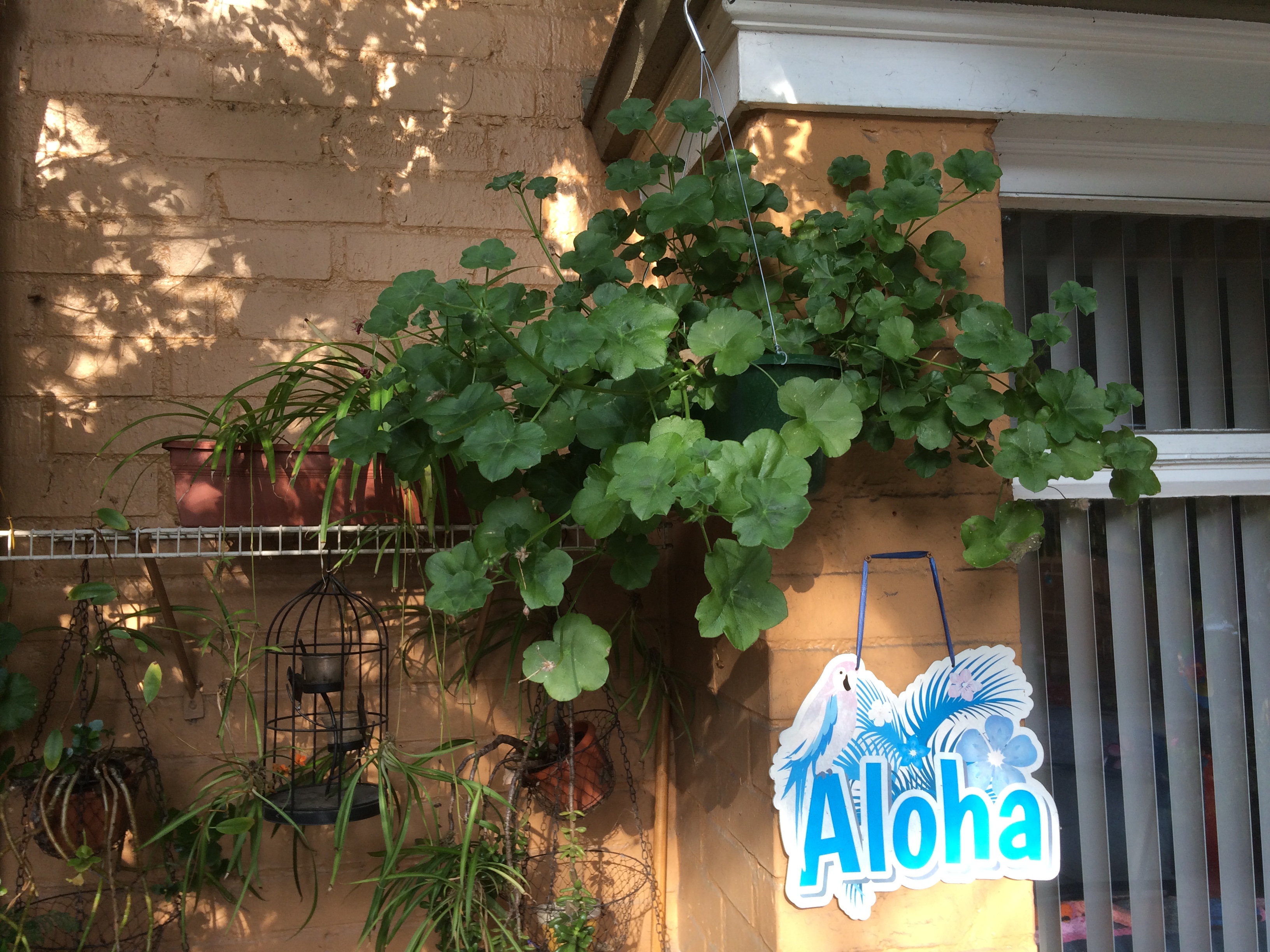
When you first look at the picture above, all you see is a lush, green hanging plant.  But if you looked inside, if you looked down at the soil that is hidden by the leaves, you’d find more than a plant.  You’d find a bird sitting on her nest.  And in that nest, if the bird flew away, you might get lucky to spot the baby birds in there.

A week or so ago, we discovered the nest when I was watering our plants.  I accidentally startled the mama bird, and after she flew away, I saw four small eggs tucked into the nest.

Those eggs have hatched, and now this plant on our back patio is home to a bird family.

Yet when you first walk by, all you see is this plant.  “Our” bird family is hidden.  Just like my autoimmune disease.

It’s funny how the mind works, but discovering this nest, listening to “Tweet Tweet” (my son’s name for the mama bird), has got me thinking about a piece I wrote for MUTHA Magazine. Click here to read my personal essay, “Can Acknowledging My Weakness Actually Be a Sign of Strength?”