The many family photos on our refrigerator. There is a reference to these photos in my essay.
How would you complete this prompt:“When I look in the mirror, I see…”?
My latest publication is a personal essay answering that question. As I wrote in my short biography for Ailment – Chronicles of Narrative Illness, “My personal essay describes all the different “Wendy’s” I see when I look in the mirror. Living with an invisible disability, an autoimmune disease called Undifferentiated Connective Tissue Disease, has changed the way I look at myself and changed the way I see myself.”
Click here to be re-directed to Ailment – Chronicles of Narrative Illness to read the essay as well as other pieces exploring lives with chronic mental and physical illness.
You don’t see the wind. But you know it’s there when you hear the wind chime.
“The battles that count aren’t the ones for gold medals.
The struggles within yourself –
the invisible, inevitable battles inside all of us –
that’s where it’s at.”
– Jesse Owens
I had an experience that made me think of this quote.
Many times over the years I’ve been told I don’t look sick.
And I don’t feel sick.
I think of sick as throwing up, coughing, fever. I’m not sick. (Thankfully).
I am uncomfortable. In pain.
And the worst part is when the pain just randomly hits out of nowhere. Sometimes the pain makes sense. I spend 30 minutes pulling weeds and gardening, my legs hurt. My son and I go shopping at Target (such a huge store), and I’m hurting.
But a couple of weeks ago, my husband and I went out to lunch. I was ok. We were walking to our car in the adjoining parking lot, and all of a sudden I clutched my husband’s hand. An intense pain gripped my left thigh. We found a ledge to sit down on. And while I tried to take deep breaths, I quietly cried behind my sunglasses.
I cried because of the pain.
And, I cried because I was out with my husband, celebrating his birthday, and I couldn’t even walk to our car.
The pain subsided enough for me to get up and keep walking. But for the rest of the day my thigh hurt. The kind of lingering hurt you get after you’ve clumsily walked into the corner of a table or something.
Except I hadn’t walked into anything. I had simply walked.
Painting your hand is just one way to show support of Rare Disease Day
Saturday, February 29th is Rare Disease Day. “The main objective of Rare Disease Day is to raise awareness among the general public and decision-makers about rare diseases and their impact on patients’ lives.”
I became ill in July 2010 but wasn’t diagnosed with Undifferentiated Connective Tissue Disease until November 2011. When my rheumatologist finally put a name to my symptoms, he told me UCTD is rare and that if I wanted to walk around and call it “the Kennar,” I could.
At the time, I joked with my doctor, telling him I had always “dared to be different,” so why should this be any different.
But since that morning, I’ve changed my mind.
I don’t want a rare condition most people have never heard of. I’d much rather live with a more common, even ordinary, chronic medical condition.
A disease doctors understand and can easily treat.
Maybe even a disease with its own awareness month or magnetic ribbon I can attach to my car.
It hurt to get up on that fence, but I was determined to do it and have this special, silly moment with my son.
“Above all, be the heroine of your life, not the victim.”
– Nora Ephron
I am trying very hard to be the heroine of my life.
In the beginning of this medical odyssey (which began almost ten years ago), no one knew what was going on inside my body. Which meant no one knew how to help.
I did everything every doctor suggested. Went to every appointment. Met with every specialist I was sent to. Did every test doctors recommended.
For my readers who don’t know, I first became ill in July 2010. I didn’t receive my diagnosis until November 2011. During that time, I met with a neurologist, geneticist, rheumatologist, vascular surgeon, and ophthalmologist (did you know certain cancers reveal themselves through your eyes?).
Back then, I automatically said yes to everything. My body felt out of my control. I was scared. My son wastwo years old when I became sick. I needed answers, and I needed help.
Now, almost ten years later, I know I’m dealing with a chronic illness, and nothing fatal (thank goodness), and I’m not so quick to readily agree to a doctor’s “recommendation.” I probe for further information. I email my doctor and ask for clarification on something he said during my appointment. And I ask a lot of questions.
Why are you recommending this procedure?
What are you looking for?
What are the side-effects?
I didn’t “do” anything to get sick. And there’s really nothing I can do to make it go completely away.
In that sense, I am a victim.
But, I can exercise some control over how I choose to live with my autoimmune disease. Which means asking questions, taking my time to make a decision about a procedure, and gathering as much information as I can.
And apparently, from a medical standpoint, I’m still weird.
Here’s the thing. I’ve said it before, I’ve written it before, and I’ll write it again – I’m okay with being weird. I know a lot of people think it’s weird I like to eat leftover Thanksgiving turkey cold and dipped in ketchup. Maybe it’s weird that I always have to sleep with blankets covering me. Some might find the nine rings I wear to be weird.
Weird can be good. Weird can be unique. And special. And celebrated. It tells the world I don’t need to be like everyone else.
Except – when it comes to medicine.
I’m going through a rough time right now. Actually, for the last several months. My rheumatologist referred me to a neurologist in his office. I’ve had two different (unpleasant) tests/procedures.
One test revealed “muscles abnormalities.” Abnormalities – just a fancy word for weird.
The other test supported the findings of the first test.
But when my rheumatologist walked into the exam room the other day for my follow-up, he told me he had met with the neurologist, reviewed the findings, and in his words, “She says you’re weird.”
“I’ve heard that before,” I replied.
But inside I didn’t say that. In my imagination, a whole other scenario played out. I got off the exam table and started screaming at everyone.
“Don’t call me weird,” I hollered, enunciating each word.
“Tell me you don’t know what to do. Tell me you don’t know how to help me. But do not f – – -ing call me weird. It’s not me that’s weird. It’s this disease.”
I had images of me standing outside on Wilshire Boulevard, using a baseball bat to whack the street signs.
The police officers would come. I would admit all my wrongdoing. Take full responsibility. And tell the officers that I was just overcome with emotion. I had been called weird once too many.
Because when my doctor told me I was weird, I knew we didn’t have any more answers. I knew I wasn’t going home with a new treatment plan.
I live with pain. Each and every day.
Pain isn’t weird. Pain is exhausting. Pain is depressing. Pain is want-to-pull-the-hair-out-of-my-head upsetting. But it’s not weird.
The physical therapist was talking about my left calf. My calf is, was, the primary source of pain related to my autoimmune disease. For the last few months, the pain has traveled and now extends up into my thigh.
But apparently, what I refer to as a hard knot, or tightness, in my leg, my physical therapist calls “chronic congestion.”
She held my leg up, my foot pointing toward the ceiling as she rubbed and massaged and gave a basic summary of my case to another physical therapist. “She’s got chronic congestion all in here.”
It is chronic. I’ll give her that. My condition began in 2010 when I woke up with a swollen left calf, unable to stand or bear weight or walk for days. I was hospitalized and treated for cellulitis, a bacterial infection doctors believed was the cause of my swollen, red calf.
But even after my calf regained its normal appearance, even after I could walk and drive and climb stairs, my legs were never the same.
About a year and a half after my hospitalization, I was diagnosed with a rare autoimmune disease called Undifferentiated Connective Tissue Disease (UCTD). It has overlapping symptoms of lupus, rheumatoid arthritis, and myositis without it being any of those diseases. It’s a medical hodgepodge in a sense, and a whole lot fancier way for doctors to say they don’t really know what’s wrong with my legs or what is causing it.
Whatever you call it, it means each day I experience varying levels of pain, fatigue, weakness in my legs with my left leg always worse.
So I completely agree with the chronic part of her statement.
But “congestion”?
I hear congestion, and I think of a stuffy nose.
Or I think L.A. traffic and planning a visit to the Aquarium of the Pacific on a Sunday, a day the 405 is generally less congested.
It’s been weeks since the physical therapist used that term, and I can’t stop thinking about it – “chronic congestion.”
It bothers me.
Because, what can we do about chronic congestion?
City planners haven’t figured it out when it comes to southern California’s freeways.
And, as of right now, doctors and physical therapists haven’t figured it out when it comes to my legs.
Without going into details, I have a medical test/procedure scheduled later this week.
Here’s what you should know:
I’m living with my autoimmune disease for almost 10 years now. In that time, I’ve already experienced this particular test twice. Each time the results were inconclusive.
The test is being done a third time mainly for comparison purposes. It’s been a few years since the last test, and doctors are interested in seeing if any changes show up this time around. There are some concerns that my left leg may be worsening. If so, this test may give some clues about what’s going on in my leg.
Aside from the fact that I don’t want to have this test in the first place, I’m not sure what to think about this test and its possible results.
Here’s the dilemma:
Do I want the test to reveal something? To pinpoint a reason why my leg pain is increasing and my leg strength is decreasing? Would this perhaps give doctors a lead, a clue, in terms of more effective treatment?
But what if my leg does test worse? What would that mean?
Or, do I want this test to be like every other test I take – indeterminate? Within the boundaries of normal-enough?
Which is reassuring I guess, but on the other hand it also means it provides doctors (and me) no answers, no explanations, no reasons why I feel the way I feel.
In reality the only thing I can realistically hope for is courage. Courage during the test. And courage after the test. In whatever form I may need it.
Today is generally the day when many people state their new year’s resolutions. Grand plans for dreams, goals, and aspirations.
I’m not going to do that.
Instead, I’m going to state my intention to continue working on my memoir. I’m going to promise myself that I will not give up on sharing my story.
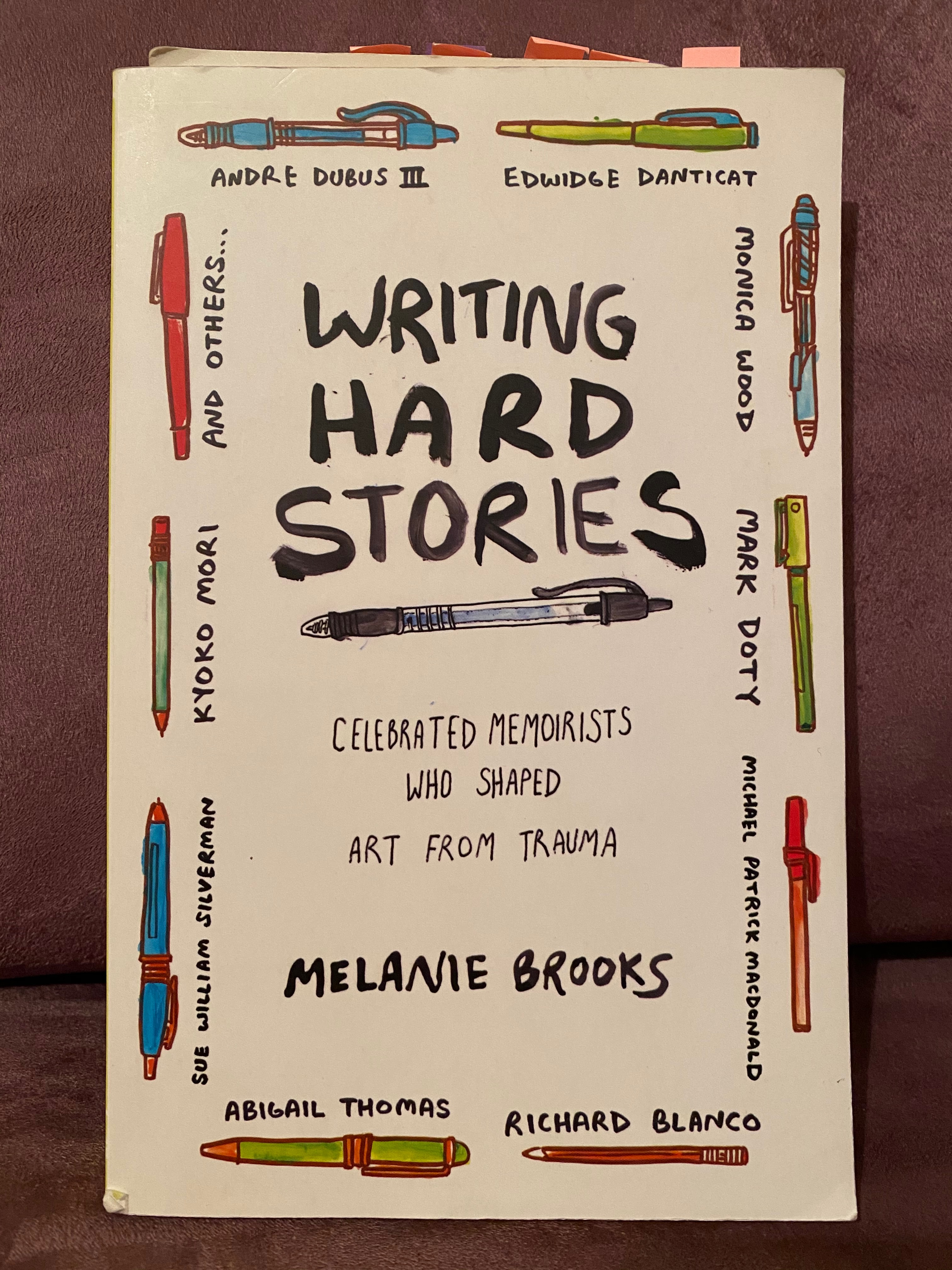
For my fellow writers out there, I highly recommend Writing Hard Stories: Celebrated Memoirists Who Shaped Art From Trauma by Melanie Brooks. This collection is such an inspiration, providing insight into how different writers took something hard/terrible/horrific and used it to create something beautiful/meaningful/relevant.
Here are a few passages I’d like to share with you:
“The reason I write memoir is to be able to see the experience itself in a new way. I hardly know what I think until I write. The therapy is one way of sort of processing things. But it’s only in writing about some of these things that we discover and understand the metaphors of our experience that give our life meaning. Writing is a way to organize your life, give it a frame, give it a structure, so that you can really see what it was that happened.” – Sue William Silverman
“I was a writer, and then this big thing happened in my family. And the way that I tend to try to understand things is through stories – both things that I write and things that I read. That’s the deepest way I know of expressing something inexpressible.” – Joan Wickersham
“You take what you’ve been through, and if you are a writer, you have to write about it.” – Suszanne Strempek Shea
“It really becomes memoir, though, when you open up space for others to enter – when it becomes about more than you, or your family, or your own personal feelings.” – Edwidge Danticat
“Don’t forget, it’s scarier not to do it than to do it.” – Abigail Thomas
Both authors live with autoimmune diseases. They’ve been there – dealing with the uncertainties that come with living with an autoimmune disease, the unpredictability, the sheer will it sometimes takes just to get through the day.
But, there were many times I came close to not finishing the book.
It was written in an overly simplistic, just-keep-going and make-some-changes kind of way. And that doesn’t work for everyone.
For my readers who don’t know, I was an elementary school teacher, before retiring due to a disability. I taught for 12 years. I had planned on teaching for many more. But teaching doesn’t provide many opportunities for flexible work hours or workplace modifications (topics discussed in this book).
However, even though I didn’t particularly like this book, I did find passages that caused me to pause for a moment and think, “Exactly.”
This week I’d like to share these passages with you.
“Autoimmune diseases are fickle, and what might adversely impact your symptoms one day might not affect you the next.”
“It takes determination to look at deceasing possibilities and refuse to crumble. It takes courage to face the loss of what you could do and see opportunity in its place.”
“Grief is an emotion that is often overlooked when talking about chronic illness, but it is critical to any discussion about living with AD – with translates into learning to live with loss. That’s not to say that there aren’t gains here, too. But loss is inevitable, even at the basic level of not being able to do or feel as you once did.”
“The truth is that no one knows what’s around the corner, but living with chronic illness means that unpredictable health is more likely.”
“On the days when you feel your worst, you can look fine. You don’t sport the red nose of a cold or the cast of a broken wrist to support your case. Because you look the same as you do on your good days, you wonder if people understand the symptoms that they cannot see.”
“It’s undeniably true: your illness has changed the way you view your world and your life. It has quite literally transformed your physical capabilities – at least for the short term – and has most likely altered your perception of yourself.”
Working my muscles – playing with my son at the playground.
“How long has it been like this? When did it start?”
My physical therapist asked me that at last week’s session as she was massaging my left leg.
“Nine years ago,” I said.
She made a “tsk, tsk” sort-of-sound.
“It feels like you’ve got 10 years’ worth of tightness in here,” she said.
She rubbed some more. “How do you walk around like that?”
“What other choice do I have?” I replied.
For the past three weeks, I’ve been going to physical therapy. Many years ago, a doctor had referred me to physical therapy. And the physical therapist discharged me after just a few visits, telling me that PT wouldn’t help me.
This time, my rheumatologist referred me because of “new” pain I described to him. After an exam, he believed I had injured my IT band, and now, because we had a specific injury to treat, physical therapy might help.
My physical therapist seems to wholeheartedly believe she can help me, but I’m skeptical.
At my first appointment, my physical therapist told me I have a lack of flexibility and mobility in my left leg.
I knew that already.
At the same time, going to PT has also given me a certain sense of validation. Someone else recognized and acknowledged my pain; someone else was able to “see” what is largely unseen.
I came home from my first appointment with my knees taped up. Later that afternoon, my eleven-year-old son told me it looked cooler on basketball players than it did on me.
I left my third appointment with more pain than I had when I began the appointment.
Meanwhile, I’ll keep with it. I’ll continue going, partly because my insurance covers most of it, but also because I don’t want to entirely give up. At least not this soon.
Though at this point in my life, I wonder if anything can really help me.
Plus, physical therapy is just more work. With the therapist, I’m working my muscles in different, and sometimes uncomfortable, ways.
At home, I have my “homework” to do – a series of exercises and stretches I do daily.
And there are days, when I’m just tired of it all. Tired of the work involved – of staying on top of prescription refills, appointments, and medical insurance.




 WendyKennar.com