Disability Pride Month

Parasailing in Maui with my son, June 2022

July is Disability Pride Month. The designation coincides with the anniversary of the Americans with Disabilities Act (ADA) being signed into law, thirty-four years ago. 

In prior years, I’ve written about Disability Pride Month. (You can click here to read my post “There Is No Shame” from July 2021, and click here to read “Disability Pride Month Reading” from July 2022.)

This year, however, I’m having a really hard time putting into words how I feel about this month and how it impacts me. Partly because within the last couple of years, my physical abilities have decreased, and my dis-abilities — things I can no longer do or only do with extreme pain — have increased. 

I live with an autoimmune disease that most people have never heard of, that most healthcare providers don’t fully understand. A chronic illness that has no cure. And it is this part of my identity that is the catalyst for my currently-querying memoir-in-essays. 

One day, when you pick up my memoir in your local independent bookstore or public library or multi-floor Barnes and Noble and begin reading it, you will find that my disability identity is only a part of my story. I’m so much more than my body and how it can and cannot function. 

I am Wendy Kennar.

I am a white woman married to an African-American man. 

I am the mother of a mixed-race son.

I am a college graduate, the first in my family.

I am a ketchup-using tomato-disliker.

I am a morning apple juice drinker.

I am a night shower-er.

I am a handwritten list maker.

I am an envelope decorator. (Which means I am someone who still mails cards and letters the old fashioned way, with a stamp on the envelope.)

I am a save-the-avocado-for-last salad eater.

I am a chocolate ice cream only consumer (except if I’m eating a Vanilla Soft Serve ice cream at McDonald’s, which is the only thing I eat from McDonald’s.)

I am a daughter. A pen pal. A friend. A neighbor. 

I am a Los Angeles native.

I am generally a no-crust-for-me pizza-eater.

I am a woman who has never spent any time in the snow. 

I am a woman who owns more pairs of earrings than shoes. 

I am a curious person, who wonders about all sorts of things. (Why do you walk a red carpet at awards shows? Why red? Why not blue? Or purple?)

I am adventurous. (I have gone parasailing twice, ridden in a hot air balloon twice, and gone zip lining once.) 

I am a disabled woman. 

But that’s not all I am. 
Disability Pride Month Reading

July is Disability Pride Month, and Sunday, July 10th is Chronic Disease Awareness Day

For me, July also marks  the anniversary of “the day,” — the day I went into the hospital with a swollen left calf, unable to walk, unable to stand, without knowing that was only the beginning of my life with an invisible disability. (Twelve years ago this month.)

After I became ill and was finally diagnosed, I went looking — for help, for support, for community — in books. I didn’t find much.

Since then, however, my library has expanded and includes books that speak to my life with an invisible disability. Not necessarily because the author also has an autoimmune disease or chronic pain in her left leg. In fact, the specific details can vary widely, yet it’s the emotions we share. I read these books, and feel understood, and heard, and seen. And when you’re living with a medical condition that isn’t easily understood — by those closest to you and those treating you — that sense of community is huge. 

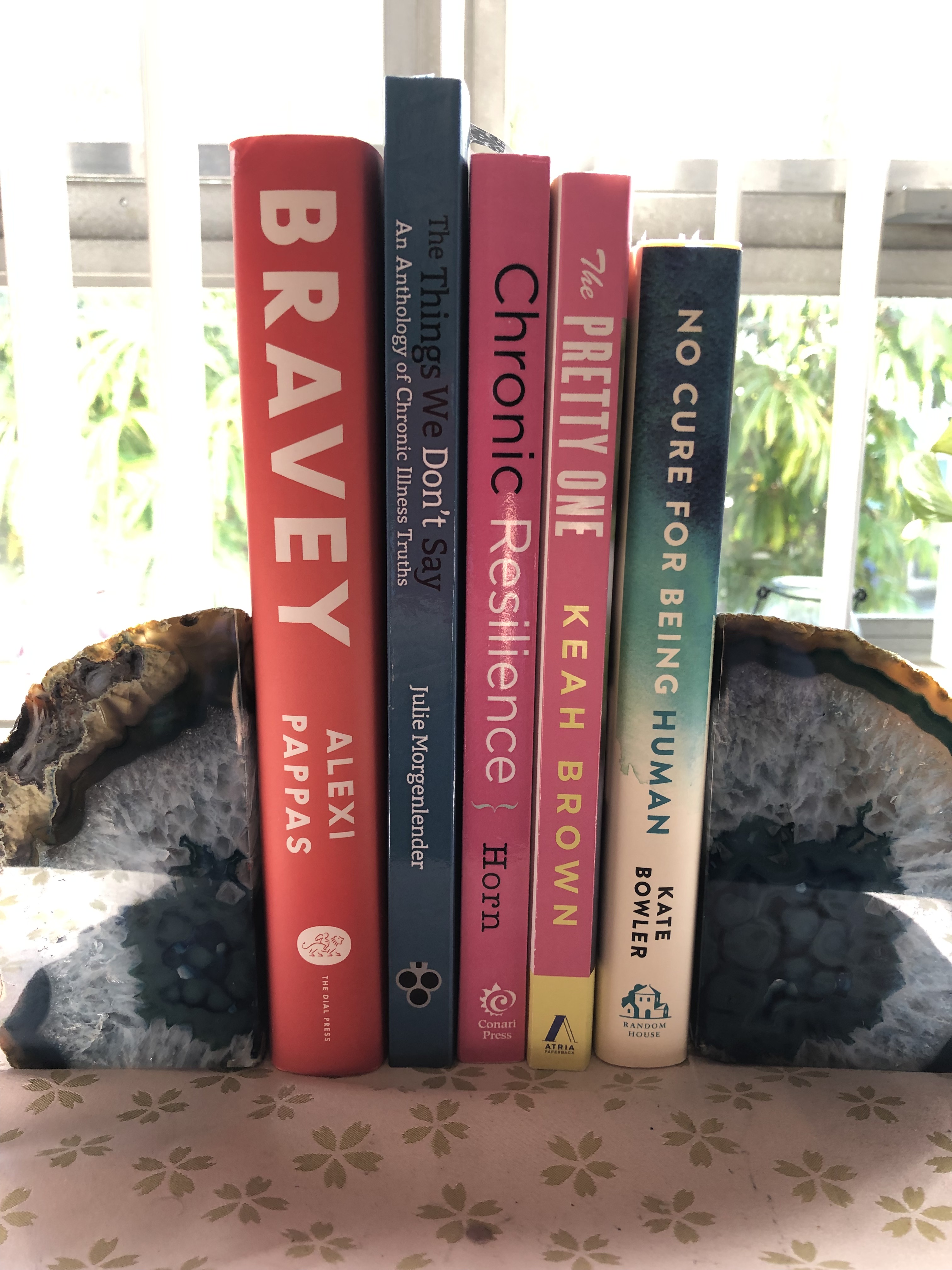
So this week, I’d like to share just a few books in honor of Disability Pride Month and Chronic Disease Awareness Day.

Bravey by Alexi Pappas. The specifics are very different (she’s an Olympian after all!), but the emotions are similar. My copy is full of sticky notes. (You can check out my blog post, “Trying To Be a Bravey,” by clicking here.)

The Things We Don’t Say: An Anthology of Chronic Illness Truths edited by Julie Morgenlender. I’m proud to say my essay, “Chronic Contradictions,” is included in this incredible collection. In this anthology “forty-two authors from around the world open up in fifty true stories about their chronic illnesses and their search for answers, poor treatment by doctors, strained relationships with loved ones, self-doubt, and more.” (You can read an earlier blog post written shortly after the anthology was published by clicking here.)

Chronic Resilience by Danea Horn. I don’t remember how I discovered this book. I just know I felt so lucky to have found it. I have read it more than once, and even wrote the author a fan letter! I highly recommend it. (You can learn more about the book here.)

The Pretty One by Keah Brown.  I found this book at Target and was captivated by the author’s smile and joy that is so evident on the front cover. (I wrote a blog post about Ms. Brown’s book and several of my favorite passages. You can read it here.)

No Cure For Being Human by Kate Bowler. Incredible writing. Beautiful, profound, and funny too. (This book I read fairly recently, back in April. You can read my blog post, “No Cure For Being Human,” by clicking here.)

Readers, any recommendations? I’d love to hear about books you have read that you think those of us with disabilities and/or chronic diseases would enjoy reading.  

There Is No Shame

Did you know July is Disability Pride Month?

I didn’t. 

Maybe it’s because I don’t feel pride when it comes to my invisible disability.

It’s more like resignation. Sometimes.

And sometimes it’s denial.

I don’t really know what it is, honestly, because having an invisible disability means I have a complicated relationship with my body. 

It’s a relationship that requires me to learn, and re-learn, what it means to be brave, to be strong, to be courageous, to ask for help, to say no.

And I have learned that just because it’s complicated and confusing, doesn’t mean it’s something I need to hide. Because the fact is, my invisible disability is a part of who I am. And it’s not going anywhere. And neither am I.

On that note, I’d like to share a link to a post I wrote last year for The Mighty. I think its message is an appropriate way to acknowledge Disability Pride Month. 

Click here to read my essay “There Is No Shame in Life With Chronic Illness.”