What I Write and Why

I am currently participating in a three-month (May1 – July 31) Mastermind program run by Dan Blank. This Mastermind is different than the one I wrote about in March. (If you missed that post, you can click here to read it.)

This Mastermind uses the ideas and information Dan wrote about it in his book Be the Gateway. I read this book a couple of years ago and wrote about it here. I’m re-reading the book, to coincide with our weekly topics. 

Why am I doing all this? Because I believe there is an audience for my memoir-in-essays. And while I continue to research publishing paths (so far, I have entered a couple of competitions which offer a publishing contract to winners), I want to make sure I’m as ready as I can be for that publication journey. I want my online presence — my website, my weekly blog, my Instagram account, and my as-of-now-unwritten Substack, to be as solid and welcoming to my readership as they can be. I want to make clear what it is I write and why I write it. 

With that in mind, this week I’d like to share with you, my dear weekly blog readers, something I shared with the Mastermind group just last week. The comments had involved thinking of our own missions and our creative work and what our creative work promises to others. I wrote:

Dan, lots to think about here. As you spoke about the transformation our mission and our work promises something clicked for me. I was transported back in time, when I received my diagnosis, and later that day went home and Googled this rare autoimmune disease of mine. I found a handful to links. That’s it. I wanted to know someone else out there in this big world of ours was living with the same chronic illness and still fully living their life. I wanted to know I wasn’t going to feel sick forever. I wanted to know what happened next, after coming home with a name for the symptoms I had been experiencing. And I couldn’t find out any of those things. That is why I write what I do. That’s the transformation I hope to provide for my readers.”

And from that, I’m proud to share My Mission Statement with you — what I create and why:

Everyone lives with pain and scars of some kind; some easily visible, some seemingly invisible. I write personal nonfiction to demonstrate the wide-ranging experiences of disability and to offer connection and support to others living with chronic illness and chronic pain.”  

Thank you, friends, for being on this journey with me! I welcome any feedback or comments you have. Please feel free to share.

Please note: I am including a link to buy the book that I’m highlighting this week. If you use my link, I do make a small commission on your purchase at no additional cost to you. I am working with Bookshop.org which also sends a portion of the profit to support local, independent bookstores.

An Update on My Memoir

I wanted to use this week’s blog post to give you all an update on my memoir.

I have been querying literary agents on-and-off since March. Some agents respond to your query with either a yes or no, while other agents will only respond if they are interested in reading more from you. I have received some form rejections as well as some very nice, encouraging rejections; however, no literary agent has said yes, or even a variation of yes — as in, I’d like to read more before making up my mind

Which means I now go to plan B — researching smaller publishing houses. These independent presses do not require an author to be represented by a literary agent and accept submissions from the writers themselves.

The bottom line is — I’m not giving up. I’m not stopping. I’m just changing course, because I truly believe in my book and I want to get my book into the hands of readers. 

You may remember my October post when I described my memoir and explained that it’s divided into three parts. (If you missed the post, click here to read it.)

The first piece in the first section is a Letter to the Reader. The letter explains why I eventually felt compelled to write my memoir. For several years I refused to write about my “medical condition.” Notice I used the word condition and not illness or disease. I didn’t think my autoimmune disease was important enough to write about. Surely other people dealt with more life-altering, more painful, more scary health issues. And while that’s definitely true, it doesn’t mean my experiences are any less important or any less book-worthy. 

So this week, I’d like to share a portion of my Letter to the Reader with you. You all are on this journey with me, and knowing you’re here, reading my work week after week, liking, commenting, sending me emails, supporting me is something I don’t take for granted. I appreciate you all. I hope you know that. 

From my Letter to the Reader:

“This book is deeply personal to me. It has lived in my head and my heart for years. I have created it with love and respect, for me — and for you. 
“I was thirty-four years old, a wife, a mother, a daughter, and a teacher, when I became ill. I didn’t comprehend what a rare, autoimmune disease diagnosis would mean. I didn’t realize my life would forever be changed.”

“The book you are reading is the book I wish had been available to me. It is the book I needed to read. 
“It is my hope that readers who don’t live with a chronic illness will finish this book with a different perspective, an adjusted way of looking at people. A bit more patience and understanding for others. A realization that you simply can’t know someone’s hurts just by looking at them.
And for my readers who live with chronic illness and/or chronic pain and/or invisible disabilities, I sincerely hope that you read this book and feel a connection with my words. I hope, in these pages, you see a part of yourself, to the point where you can show an essay to a loved one and say, ‘Here, please read this. This is what I mean. This is how it feels.’ I hope, too, that reading this book brings you comfort in knowing you’re not alone. Many of us feel so desperately isolated with our medical struggles. It is an unbelievable comfort to find someone who ‘gets it.’ 
“I get it.”

A Bit of Serendipity

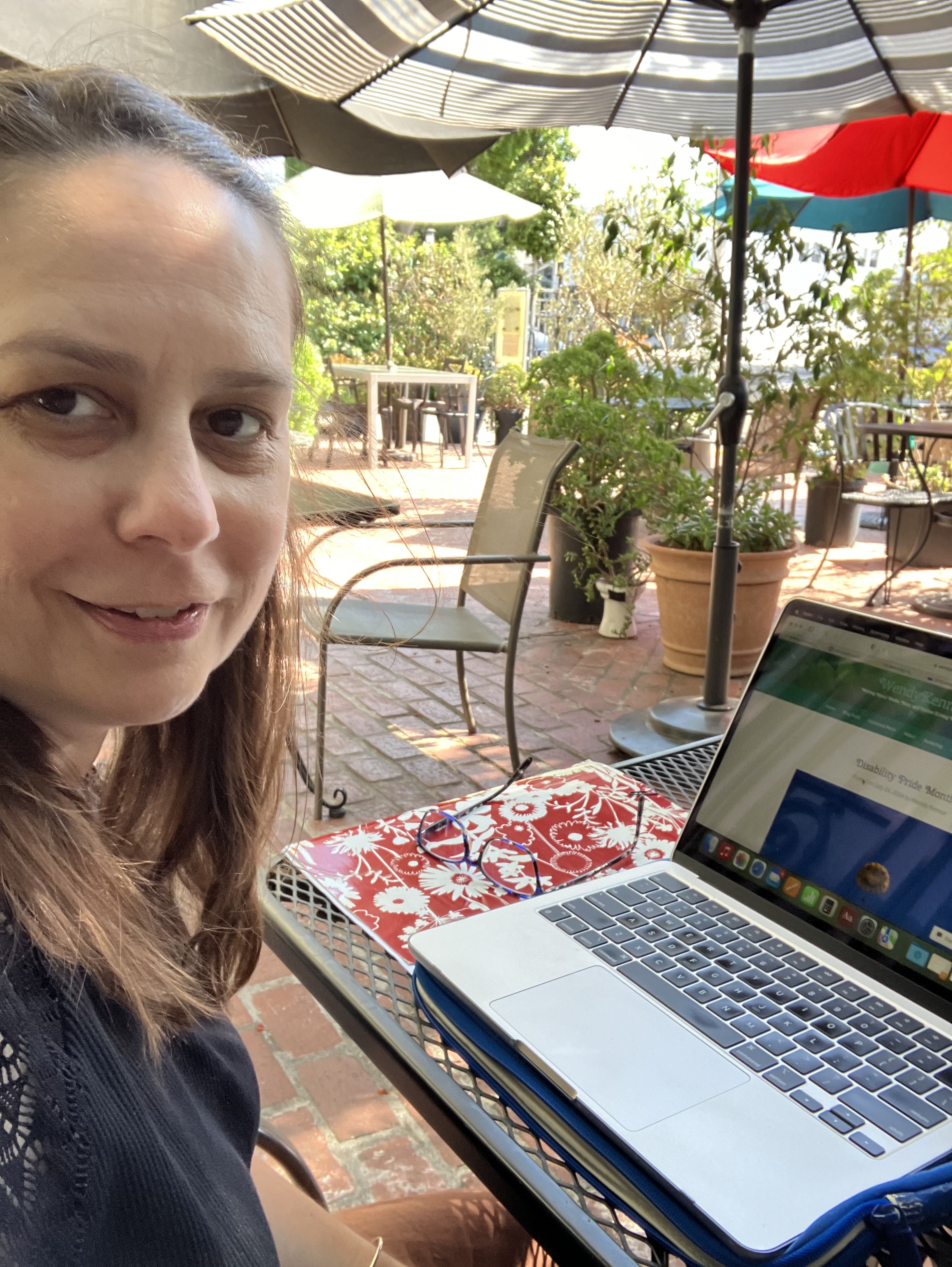
I took this photo during last week's writing session.

Last week I spent time at one of my favorite not-at-home writing spaces; a cafe serving a yummy ice blended mocha, and providing many tables and chairs on a large patio with plenty of shade. 

This week, I wanted to share something that happened during last week’s visit.

Two women sat at a table close enough to me that I could overhear bits and pieces of their conversation without even trying. It felt serendipitous that of all the available tables, these two women sat near me. After all, I was sitting off to the side, near a wall, trying to distance myself from any loud chatter and distractions. 

Within a few minutes, I learned the two women were middle school science teachers. I heard them talking about sixth grade, about sedimentary rocks and fossils, about a project requiring a long roll of adding machine paper. (And I admit to feeling old when one of the teachers had no idea what adding machine paper even was.)

These two teachers spent their own time lesson planning. These were “off-the-clock” conversations. Because that’s what teachers who are passionate about teaching do. Your teacher brain is never really off, and teachers don’t actually get “the whole summer off,” as many non-teachers believe. Teachers are always working in some shape or form. It brought back memories of my own lesson planning days and the blended mochas my closest teacher friend and I used to enjoy while brainstorming and planning for our fourth graders. (I’m thinking of you, Nance!)

As if that wasn’t enough, after a bit of quiet individual work time, the two teachers began chatting again. I heard different phrases this time — it’s so lonely, I look fine on the outside, many people don’t get it.  

I learned that one of the teachers lives with an invisible illness. The other teacher’s partner lives with an invisible illness and was asking questions about how to best support a chronically ill loved one. 

I momentarily sat there in shock. 

What were the odds? 

Not only were these two women teachers, they were also among the target audience for my memoir! (My target audience includes those living with chronic illness, especially invisible illnesses, both physical and mental, as well as friends and families of those living with chronic illness.)

That day at that cafe, I had spent a portion of my writing time researching literary agents to query my memoir-in-essays. 

And then these two women entered the outer edges of the writing cocoon I create for myself at this cafe. 

I took it as a sign.

Something to Endure

My memoir is divided into three parts.
The final essay in this part, and the book, is
"Something to Endure."

Super exciting news:  my manuscript is complete, and I will now be entering a new stage of the writing process — the querying-agents phase. 

But before I got here, when I was revising and rewriting my manuscript, I had to make a decision regarding my final essay. I had three essays that my book coach and I agreed were all possible candidates for that all-important last essay in the book.

It is my hope that my memoir will be read by those living with chronic illnesses, as well as those who know people who are living with chronic illness. I’m hoping that my story can serve as an example. Though the medical specifics may vary, the emotions may be quite similar. So someone who lives with diabetes, for example, could give my book to a loved one, point to one of my essays, and say, “Here. Read this. This is what I feel like sometimes.” 

For far too long, terms such as “disability” and “disabled” have been too narrowly defined. I really want my memoir to broaden those definitions, and I would like my story to serve as just one example of what a disabled life looks like.

When I started working with my book coach, I told her I was writing the book I needed to read when I became ill. I hope after reading my memoir that my chronically ill readers feel less alone and more understood. Along those lines, I want my final essay to give readers a sense of comfort, a dose of good-feels. 

Before making my final decision, I stopped to reflect and think about how I want my readers to feel when they’re done reading my memoir-in-essays. 

These were the adjectives that I came up with:

Hopeful.

Enlightened.

Inspired.

Comforted. 

With that in mind, I made my decision (and my book coach agrees). My final essay is titled “Something to Endure.” Because basically that is the bottom line when it comes to chronic illness. You have to endure the illness. You need to stick it out and figure out ways to handle it, to be with it day-in and day-out for the long haul.

But you don’t have to do it alone. Books, including my own, connect us.

Cancer and Fishnet Stockings

As I continue working on my own memoir-in-essays, I find myself reading more memoirs. Partly because I’m curious about other people’s lives. But also because I’m curious to see how other writers did it. How did they structure their memoirs? What does their table of contents look like? Does their book include photos?

I discovered Cancer and Fishnet Stockings: How Humor Helped Me Survive a Life-Threatening Disease, the Loss of My Favorite Nail Polish… and Other Calamities by Maryann Grau when our family spent a few days in Cambria (one of our most favorite places, along California’s Central Coast). The book was for sale in one of the shops in town, and when the cashier told me it was written by a local author, I knew I had to buy it.

While reading the book, it’s impossible to miss Ms. Grau’s positive outlook and spunk. 

Here are a few gems:

A few of the patients aimed weak smiles in my direction. My heart ached for them and their predicament, as though I wasn’t facing initiation into the same club. The question Why me? flashed through my mind followed immediately with the obvious answer …Why not me?” 

Thinking back on the past hour of excruciating pain, I was reminded of an Ayn Rand quote I had read many years ago in her novel Atlas Shrugged. In discussing emotions, Rand begins with the premise that ‘joy is not the absence of pain.’ I understood and accepted the concept immediately, but never was it more self-evident to me until now. To not feel pain, physical or emotional, is a good thing, but it is a neutral feeling at best. Joy comes when you awake to find yourself wrapped in the arms of someone you love.”

Just a little more than a year after the operation, and I sometimes think, my cancer may be back. The thought hits me hard. Not the cancer itself – the revelation that I used the word my. The acceptance of it, the familiarity with it, the ownership of that dreaded disease by referring to it as ‘my cancer.’
Don’t we hold things that belong to us as good, desirable, worthy, or even cherished? Does the word ‘my’ presuppose that the things that belong to us are good for us; things like my home, my career, my garden, my child, my love? Shouldn’t cancer belong in the category used to describe words that distance themselves from us, like ‘that thief, that scoundrel, that crummy movie, that poison, that killer disease’?

And from her last chapter, where she offers “words of wisdom”:

“Every one of us will face death…eventually. But why help it along by standing still? Instead, learn something new to keep your mind active, to grow intellectually.

Keep moving! Especially outdoors. That’s where most of life happens.”

“Let others help you. If you’re stubbornly independent like I am, get over it!

“Indulge in your favorite things.”