The Light We Carry, Part Three

This is my third and final post about Michelle Obama’s book The Light We Carry: Overcoming in Uncertain Times.

(You can read my post about part one by clicking here.)

(And part two is here.)

There were parts of this book that read so smooth and easy, as if I was fortunate enough to sit down and have a conversation with Mrs. Obama. And there were parts that just stopped me in my reading, passages I re-read and marked with a highlighter because they really resonated with me.

Here are just some of those passages:

“When someone chooses to lift the curtain on a perceived imperfection in her story, on a circumstance or condition that traditionally might be considered to be a weakness, what she’s often actually revealing is the source code for her steadiness and strength.”

“When we share our stories with fullness and honesty, we often discover that we’re less alone and more connected than we might ever have believed.” 

“All I can do is try to draw closer to your uniqueness, to feel linked by the small overlaps between us. This is how empathy works. It’s how differentness starts to weave itself into togetherness. Empathy fills the gaps between us, but never closes them entirely. We get pulled into the lives of others by virtue of what they feel safe and able to show us, and the generosity with which we are able to meet them. Piece by piece, person by person, we begin to apprehend the world in more fullness.”

“For me, the process of writing can be an incredibly helpful tool when it comes to going high. It’s a means through which I am able to move through my emotions, filtering them into useful form.”

“Joy and pain often live in close proximity; they intermingle. Most of us exist in the in-between, following that most innate of human impulses, which is to hang on to hope. Don’t give up, we tell one another. Keep working.
“This matters, too.”

“Kids, for me, are always a reminder that we are all born loving and open-minded, free of hate. They are the reason the rest of us maintain a thick skin and keep trying to clear the path. Watching a child grow into an adult, you understand both how mundane and profound the process can be, how it happens slowly and quickly all at once, in steps and also in strides.”

Please note: I am including a link to buy the book that I’m highlighting this week. If you use my link, I do make a small commission on your purchase at no additional cost to you. I am working with Bookshop.org which also sends a portion of the profit to support local, independent bookstores.  

The Light We Carry, Part Two

This week’s blog post features some of the oh-yes-passages from part two of The Light We Carry by Former First Lady Michelle Obama. What do I mean by oh-yes-passages? Passages that resonated with me. Passages that made me pause and reflect. Passages that touched me in some way. 

(If you missed the blog post about part one, you can click here to read it.)

“I’m not sure how friendship, or even just engaging with another person in the three minutes it takes to buy your morning cup of coffee, has come to feel like a small act of bravery. But increasingly it seems that way. Perhaps, as I mentioned earlier, it’s because we now carry with us little rectangular shields against face-to-face sociability — our phones — which I think also shield us from serendipity. Any time we avoid even a small real-life connection, we are to some extent avoiding possibility.”

“When we drop our fears about newness and open ourselves to others, even through quick and casual interactions, even while masked — saying hello to someone in the elevator, for example, or chatting in a grocery line — we are practicing an important form of micro-connection. We’re signaling a general okayness between us, adding just a drop of social glue to a world that desperately needs it.”

“The best way to be a friend to someone, as I see it, is to revel in their uniqueness, to appreciate each person for what they bring, receiving them simply as themselves.”

“Over the course of my adult life, I’ve lived in a number of places, but as far as I’m concerned, I’ve only ever had one real home. My home is my family. My home is Barack.”

“Like a lot of people, I had ideas about what marriage would be like, and few of them turned out to be right.”

“Much as it is with marriage and partnership, the fantasy versions of being a parent sit at the forefront of our cultural imagination, whereas the reality is way, way, way less perfect.”

“Caring for your kids and watching them grow is one of the most rewarding endeavors on earth, and at the same time it can drive you nuts.”

Please note: I am including a link to buy the book that I’m highlighting this week. If you use my link, I do make a small commission on your purchase at no additional cost to you. I am working with Bookshop.org which also sends a portion of the profit to support local, independent bookstores.     

Hiding My Realness

This photo was taken a few years ago in Cambria, CA.

Last week I highlighted some of my favorite passages from part one of Michelle Obama’s The Light We Carry.

This week, it’s one sentence I want to highlight. One sentence I cannot stop thinking about.

“We only hurt ourselves when we hide our realness away.”

In many areas of my life, I am unapologetically real. I don’t color my hair. I allow my definitely-non-brown strands to commingle with my very-brown strands.

I don’t wear make-up. What you see is what you get.

If my purse ever matches my shoes, it was purely coincidental. I don’t have enough purses, or shoes for that matter, to make that particular accessory match happen on a regular basis.

I do, however, change my necklace and earrings each day, and do my best to match those with the top I’m wearing. 

I realize most people don’t wear nine rings on eight fingers. But I do. And I’m okay with not being like everyone else.

Aside from all that; however, I do hide my realness away. 

Often. 

And, if you’re chronically ill, a.k.a a “spoonie,” you probably do, too.

(If you missed it, you can click here to read my blog, “Trying to Figure Out This Spoonie Life.”)

Because when you’re chronically ill and experiencing chronic pain, you have learned to put on, what I call, your “game-face.” Living with a chronic illness is sometimes like being in a high-stakes poker game that doesn’t end. You can’t let on how bad the pain is. For a number of reasons you mask your pain so you look “fine.”

Sometimes I do that because I don’t want any more suggestions about medicinal cannabis or green smoothies or compression socks. 

Sometimes I wear my game face because it’s just easier. Showing my pain often makes those around me uncomfortable. And if I’m already feeling bad, I don’t need to add to the situation by making those around me feel bad, too. 

There are more reasons. But I’ll stop there, because it brings me back to Mrs. Obama’s statement:  “We only hurt ourselves when we hide our realness away.”

That’s the part I haven’t completely figured out. I’m certainly not trying to hurt myself. Yet I am very much trying to protect my near and dear ones. 

The work on myself continues.

Please note: I am including a link to buy the book that I’m highlighting this week. If you use my link, I do make a small commission on your purchase at no additional cost to you. I am working with Bookshop.org which also sends a portion of the profit to support local, independent bookstores.
The Light We Carry, Part One

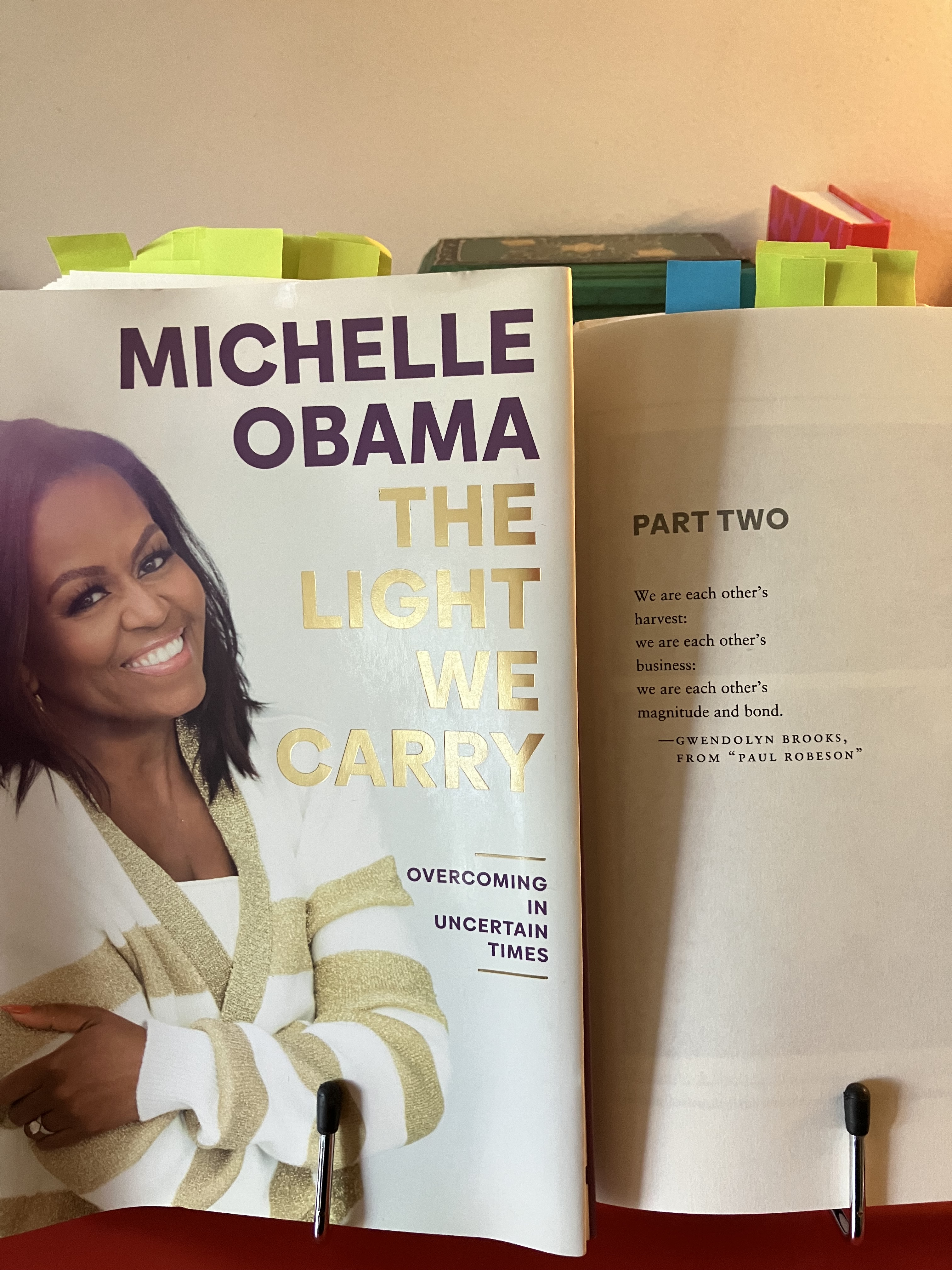
I am currently reading Michelle Obama’s The Light We Carry: Overcoming In Uncertain Times. And let me say, I am about halfway through the book and have many pages flagged with sticky notes. 

So rather than have one super-long post, I decided to share some of my favorite passages one part at a time. (The book is split into three parts.)

(Last week I wrote about buying a wheelchair and referenced a little bit from Mrs. Obama’s book. If you missed last week’s post, you can read it here.)

This week, allow me to share some of my favorites from Part One:

“That’s what tools are for. They help keep us upright and balanced, better able to coexist with uncertainty. They help us deal with flux, to manage when life feels out of control.” 

“What does it mean to be comfortably afraid? For me, the idea is simple. It’s about learning to deal wisely with fear, finding a way to let your nerves guide you rather than stop you. It’s settling yourself in the presence of life’s inevitable zombies and monsters so that you may contend with them more rationally, and trusting your own assessment of what’s harmful and what’s not. When you live this way, you are neither fully comfortable nor fully afraid. You accept that there’s a middle zone and learn to operate inside of it, awake and aware, but not held back.”

“Our hurts become our fears. Our fears become our limits.”

“Because what my mother showed me is that if you try to keep your children from feeling fear, you’re essentially keeping them from feeling competence, too.”

“The unknown is where possibility glitters. If you don’t take the risk, if you don’t ride out a few jolts, you are taking away your opportunities to transform.”

“What [Toni] Morrison was doing for her kids is what my own parents did for me: She was giving them a simple message of enoughness. She was validating their light, that unique bit of brightness inside each of them — literally showing them it was there and it belonged to them, a power they could carry for themselves.”

“My father, whose shaky demeanor and foot-dragging limp sometimes caused people to stop and stare at him on the street, used to tell us, with a smile and a shrug, ‘No one can make you feel bad if you feel good about yourself.’ “

Please note: I am including a link to buy the book that I’m highlighting this week. If you use my link, I do make a small commission on your purchase at no additional cost to you. I am working with Bookshop.org which also sends a portion of the profit to support local, independent bookstores.