Pain Awareness Month. Again.

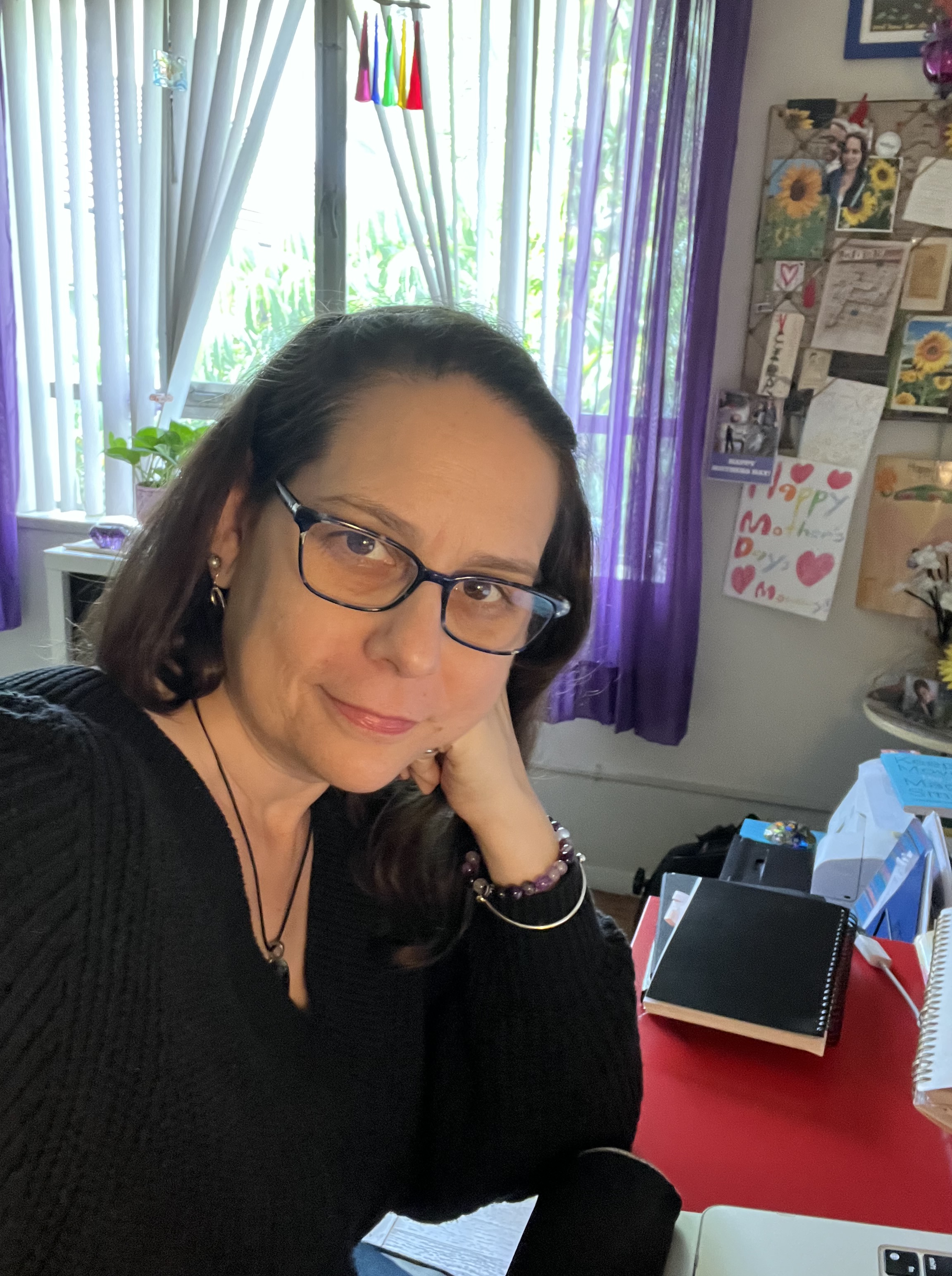
Oahu, June 2025. This is a photo of a woman in pain.

September is Pain Awareness Month.

I wrote about it last year.

I wrote about it in 2023.

I wrote about it in 2022.

I wrote about it in 2021.

I wrote about it in 2020.

You get the idea. 

Each post shares some variation of the same message:

I live with pain. Every. Single. Day. For fifteen years and counting. 

That’s why it’s called “chronic pain.” It’s long-lasting.

You never know what someone is going through just by looking at them. 

Because during those fifteen years, I have lived. I have made new friends. I have written, and published. I have traveled. I have adventured (horseback riding, hot air ballooning, parasailing – twice, zip lining). I have attended Back to School Nights and Open Houses. I have gone grocery shopping and shoe-shopping for my son. I have attended book launch events and Harlem Globetrotter games. I’ve visited museums and beaches. 

I remember meeting with a neurologist, referred to me by my neurologist-at-the-time. She thought this other doctor could look at my medical records and give us a fresh perspective with another set of eyes. 

Instead, this fresh-set-of-eyes-doctor was condescending and rude and mean. Before leaving the exam room he patted my shoulder and told me my pain really couldn’t be all that bad if I truly did all the things I told him I do each day.

And that, right there, is the purpose of Pain Awareness Month.

Those of us living with chronic pain have figured out how to navigate our days while struggling with pain that doesn’t ever completely go away. We have developed work-arounds and shortcuts when possible. We have learned to bite our tongue or clench our fists or whatever it is we do that helps us push past the limit of what we thought our bodies were capable of. 

Oahu, June 2025. Same day as the picture above. This is also a photo of a woman in pain. Notice my lips. I often do that when in pain.

Which leads me to this — please, be kind and patient and compassionate toward others. That person walking slowly in front of you could be me. Someone who is walking slowly but it’s the best she can do because each step brings a fresh jolt of pain up and down her leg. 

Or maybe it’s someone whose stomach hurts. Or their head. Or their back. Or their feet. Or their shoulder. Or their elbow. 

I could go on, but you get the idea. 

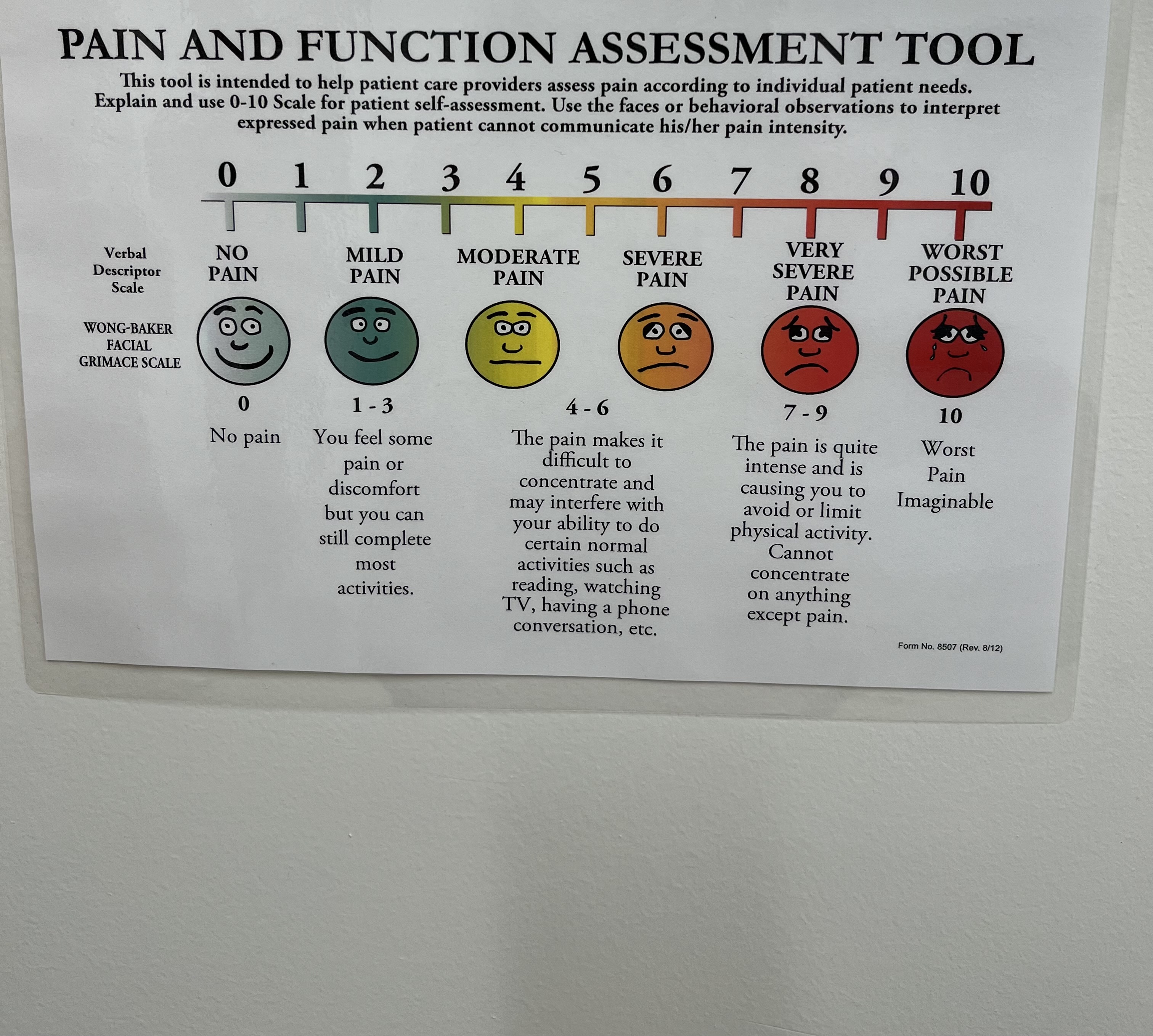
And, one more thing – this year, I wanted to end the post introducing you to an alternative way to talk about pain. Most of us have experience with the (dreaded) pain scale that depicts faces on a 1-10 scale. And if you haven’t had personal experience with this scale (wonderful for you!), it’s most likely you’ve seen it hanging on the wall in an exam room.

Christina Irene, a hidden disability advocate, speaker, and author, has developed what she calls the “Splat” system. As she writes, “Splat is a system of communication for people with chronic illnesses, mental health diagnoses, and other hidden disabilities. Our conditions are often a ‘moving target,’ meaning we never know how we’re going to feel from one day to the next. The one certainty is: Every day, we feel like we’ve been run over by something.” Check out her website where she has a whole page dedicated to the Splat system, with resources you may find helpful.

Defining Disability

The work in my Mastermind program continues. 

Part of our tasks has been to think about what we write and why. (I wrote a bit about this in a May blog post. Click here if you missed it.)

This week, however, I am sharing two photos with you as another example of what I write and why.

The photo shows my seventeen-year-old son and me parasailing, a week-and-a-half-ago during our family trip to Oahu. We calmly dangled 1000 feet above the Pacific Ocean. We talked and marveled at the incredible view below us and around us, noticing the quiet and the sense of peace we felt being that high up.

On that day, in those moments, my body was physically strong enough to climb aboard the boat, maneuver into the harnesses, and smile and wave at those down on the boat looking up at us. 

Yet back at the hotel, my backpack held my blue disabled parking placard. And when I left Los Angeles and arrived in Honolulu I received wheelchair assistance at both airports. (I also had wheelchair assistance at both airports for our return flight.)

Both situations are true. 

I may fit the more narrow, stereotypical idea of a disabled woman when someone sees me sitting in a wheelchair at the airport. 

But, I’m still a disabled woman, even when I’m gliding through the air, with a multi-colored parachute open behind us. 

And that is why I write — to demonstrate there is no definitive, one-and-done definition of disability.

Friends, I’m curious. Have any of you gone parasailing? Where? What was your experience like? Please feel free to share in the comments!

Time to Take a Seat

Image Credit: Wishbone Words Magazine

Friends, I’m pleased to share that my personal essay, Time to Take a Seat, has been published in Wishbone Words Magazine, Issue 15

This piece was a difficult one to write. It’s a personal essay that went through many revisions before I submitted it.  

It’s a personal essay about my decision to purchase a wheelchair. 

I’m grateful Wishbone Words Magazine provides this space for me and other “disabled, chronically ill, and/or neurodiverse writers and artists” to share our experiences and our creations in a safe, inclusive space. 

You can click here to learn more about purchasing Wishbone Words Magazine, Issue 15. 

Image Credit: Wishbone Words Magazine

Am I a Spoonie?

“Choosing to define yourself as a spoonie is an individual decision. It is not a medical term bestowed upon you by someone else. Other terms, such as disabled and chronically ill, are assigned to us by those in the medical field. No one will call you a spoonie, until you decide to call yourself one. Being a spoonie was fine for others, but I didn’t think it applied to me. Until there was no denying that it did.”

The paragraph above is excerpted from my personal essay, “Am I a Spoonie?” which I’m proud to share was recently published in FLARE Magazine. From the website: FLARE was named after autoimmune flares one gets when they are chronically ill and a play on the word “flair” for writers to show their “flair” despite the “flares” they encounter.”

Click here to read “Am I a Spoonie?” in its entirety.

For my chronic illness friends, do you consider yourself a spoonie? Or is there another term your prefer? Please share if you’re comfortable!

It’s a 24/7 Job

It's just me - using my (invisible) superpower

My son returned to school on Monday after his week-long spring break. It was nice to have a change in my routine and be able to sleep past 6 am.

But his spring break, along with my husband’s days off work (timed to coincide with our son’s week off), just amplified what I am always aware of but generally don’t call attention to — when you live with a chronic illness, you never get a day off.

This is not to say that things are all the same, across the board, for everyone who lives with a chronic illness. Because that’s not the case at all. Medical conditions and health histories differ from person to person. 

However, I think it is fair to say that, for the most part, all chronically ill folks are dealing with a lot on a daily basis:

– overseeing medication: keeping track of when to take the meds, refilling the prescriptions, making trips to the pharmacy to pick up prescriptions and/or arranging to be at home to sign for and receive mailed prescriptions. 

– keeping track of symptoms: looking for patterns between what we did and how we feel. Or patterns between what we didn’t do and how we feel. Or patterns between how we slept and how we feel. Or patterns between what we ate and how we feel. Or patterns about what we didn’t eat and how we feel. You get the idea.

–  managing finances: writing checks to cover co-payments. Making credit card payments towards the expensive, insurance-didn’t-cover-the-full-amount, most-recent, doctor-recommended scan. 

– scheduling: consultations, evaluations, and follow-up appointments. Figuring out days and times for routine lab work. Keeping track of what you can and can’t do before each appointment or medical test. Fasting before some labs, but not all labs. 

– fatigue: it’s not feeling tired. It’s not even being exhausted. Because those are temporary. With a good night’s sleep, general tiredness and exhaustion disappear. Chronically ill folks live with fatigue that is not related to the amount of sleep you get each night. It’s the awful feeling of waking up feeling absolutely un-rested and completely drained and knowing you still have the whole day ahead of you.  

– dealing with side effects: every medication comes with a long list of potential side effects. Some are common, such as constipation and diarrhea (for which you may need medication to help with those side effects, even though those symptoms were caused by medication in the first place). Generally, any possible, unpleasant side effects are deemed worth it by the prescribing doctor. In other words, the possible good outweighs the possible bad — including weight gain and hair loss.  

And there’s one more thing. Something I think most people aren’t even aware of. 

Everyone I know who lives with a chronic illness, also lives with a superpower.

What’s the superpower? you wonder. I’ll tell you:

Pretending we’re well, when we’re not. 

Someone living with a chronic illness and/or chronic pain is never faking being sick. Instead, they’re actually faking being well. 

Every day.

5 Things I Still Haven’t Learned

A few things you should know:

1.  I became ill in July 2010.
2.  I received my diagnosis in November 2011. (This is considered relatively fast when it comes to autoimmune diseases.)

3.  Certain things don’t get easier the longer you live with a chronic illness. 

It’s the third statement that was the inspiration for my recently published “listicle” —  5 Things I Still Haven’t Learned That Are Amplified by My Chronic Illness.

To read the piece in its entirety, click here to be re-directed to Knee Brace Press.

Friends, do any of you relate? Would you add anything to the list? Let me know in the comments.

Hoping For a Change in the Program

Last week, I saw my rheumatologist for my three-month check-in appointment. 

You’d think by now that I wouldn’t be surprised or disappointed by the way these appointments tend to go. 

But I am.

I’m still holding out hope that one day, at one appointment, a doctor will look me in the eyes and recognize my daily experience and my effort, as I navigate my life with a chronic illness causing chronic pain. 

This fantasy doctor will listen to me, really listen, when I explain that my days are challenging. That my family has noticed changes in me, and the truth is, my physical capabilities are not what they were, even just a couple of years ago. This doctor will acknowledge my tears as I explain how everyday tasks, like getting in and out of the car or going grocery shopping, are no longer things I can easily do.  

This fantasy doctor will look at me and say:

“That sounds really hard.”

“I realize it’s frustrating, not knowing how you’ll feel when you wake up each morning.”

“I know you’re trying to be the best version of yourself for your family.”

“Good for you for keeping up with your physical therapy exercises at home.”

“It’s fantastic that you continue to move your body and go on your daily walks.”

“I can see you’re trying to implement small changes. That’s great.”

But that’s not what happened at last week’s appointment. Instead I sat on the exam table where my doctor proceeded to move and bend my leg in ways it doesn’t usually move or bend. 

I left the office in more pain than I had when I arrived. 

I dealt with high levels of pain for the next two days. 

And in three months, I get to do it all over again.

I Gave Myself a Time-Out

Why am I smiling? Because I'm proud of myself. Giving myself a break was, is, a big deal.

For some reason, this week’s blog post felt hard to write. I think it’s because there’s so much going on — within our home, within our family, within our world. And sometimes, it just feels like a lot. Like too much, actually. Like I really wouldn’t mind if we could somehow press pause on the day, and I could just have a day to try and catch up. Catch up on emails and podcasts and magazines. Catch up on sleep and watching laugh-out-loud movies. 

Of course, life doesn’t work that way. 

But last week, I did do something that was my version of a brief pause. A kind of time-out.

Last Wednesday morning, I went to physical therapy. The session went well, and my physical therapist was pleased with my progress. When it comes to walking on the treadmill, both my speed and my stamina have increased over the months we’ve worked together. Those improvements don’t necessarily transfer into less pain; however, those improvements do mean my legs, especially my left leg, is “strong enough.” Because the week before physical therapy, while I went for one of my neighborhood walks before my son’s dismissal from school, I had an “incident.” I was in the middle of walking around the block, when a sudden pain shot through my left leg. It was the type of pain that made me stop and look around, searching for something I could lean on. The type of pain that brought tears to my eyes. I paused for a couple of minutes, but then what else could I do but continue walking? I had to get back to the car. And I did. (I also had really bad pain the rest of the day.) It was super scary, honestly. When I told my physical therapist what had happened, he of course had no magic solutions to offer. But he did tell me that my body is strong; I’ve been doing the work. And even though the pain felt awful, even though I limped the rest of the walk back to the car, I got to where I needed to be. My body, my legs, are strong enough to do what I need them to do.

But, my body is also tired. And sensitive. And worn-out. 

So Wednesday afternoon, after physical therapy, I did something I don’t usually do. I didn’t come right home so I could get back to work on getting things done on my to-do list. I had a post to work on for MomsLA.com, greeting cards to write out, gifts to wrap, bills to pay.

But instead of coming home, I took myself to our neighborhood cafe. I ordered a cafe mocha, sat at a table that was neither in the shade nor in the sun, and I read two chapters of my novel. (By the way, reading Katherine Center’s The Rom-Commers and really enjoying it!)

It might not seem like a lot to some people, but for me it was. It was me taking time for myself. Doing something because I wanted to do it. Not because I felt I should. Or because it had to get done. But because I wanted to do something purely for the pleasure it brought me. 

And I’m so glad I did!

How about you, dear readers? What was something you did recently just for you? Feel free to share in the comments. 

Please note: I am including a link to buy the book that I’m highlighting this week. If you use my link, I do make a small commission on your purchase at no additional cost to you. I am working with Bookshop.org which also sends a portion of the profit to support local, independent bookstores.

An Update on My Memoir

I wanted to use this week’s blog post to give you all an update on my memoir.

I have been querying literary agents on-and-off since March. Some agents respond to your query with either a yes or no, while other agents will only respond if they are interested in reading more from you. I have received some form rejections as well as some very nice, encouraging rejections; however, no literary agent has said yes, or even a variation of yes — as in, I’d like to read more before making up my mind

Which means I now go to plan B — researching smaller publishing houses. These independent presses do not require an author to be represented by a literary agent and accept submissions from the writers themselves.

The bottom line is — I’m not giving up. I’m not stopping. I’m just changing course, because I truly believe in my book and I want to get my book into the hands of readers. 

You may remember my October post when I described my memoir and explained that it’s divided into three parts. (If you missed the post, click here to read it.)

The first piece in the first section is a Letter to the Reader. The letter explains why I eventually felt compelled to write my memoir. For several years I refused to write about my “medical condition.” Notice I used the word condition and not illness or disease. I didn’t think my autoimmune disease was important enough to write about. Surely other people dealt with more life-altering, more painful, more scary health issues. And while that’s definitely true, it doesn’t mean my experiences are any less important or any less book-worthy. 

So this week, I’d like to share a portion of my Letter to the Reader with you. You all are on this journey with me, and knowing you’re here, reading my work week after week, liking, commenting, sending me emails, supporting me is something I don’t take for granted. I appreciate you all. I hope you know that. 

From my Letter to the Reader:

“This book is deeply personal to me. It has lived in my head and my heart for years. I have created it with love and respect, for me — and for you. 
“I was thirty-four years old, a wife, a mother, a daughter, and a teacher, when I became ill. I didn’t comprehend what a rare, autoimmune disease diagnosis would mean. I didn’t realize my life would forever be changed.”

“The book you are reading is the book I wish had been available to me. It is the book I needed to read. 
“It is my hope that readers who don’t live with a chronic illness will finish this book with a different perspective, an adjusted way of looking at people. A bit more patience and understanding for others. A realization that you simply can’t know someone’s hurts just by looking at them.
And for my readers who live with chronic illness and/or chronic pain and/or invisible disabilities, I sincerely hope that you read this book and feel a connection with my words. I hope, in these pages, you see a part of yourself, to the point where you can show an essay to a loved one and say, ‘Here, please read this. This is what I mean. This is how it feels.’ I hope, too, that reading this book brings you comfort in knowing you’re not alone. Many of us feel so desperately isolated with our medical struggles. It is an unbelievable comfort to find someone who ‘gets it.’ 
“I get it.”

Accessing Parenthood

In 2019, I wrote a personal essay titled, “Paying the Price,” and submitted it to the Pen 2 Paper writing contest, a “disability-focused creative writing contest.” That year, in addition to submitting in the Nonfiction category, I also submitted my essay to the Oleb Books Personal Essay category, meaning my essay, if chosen, would be included in an Oleb Books Anthology about parenting and disability. 

Five years later, I am so proud to share my essay, “Growing Up with Me and My Invisible Disability,” has been included in the recently published anthology, Accessing Parenthood: Stories By and About Parents with Disabilities.

During the last five years, my essay has been slightly edited and re-titled. (I admit — titles are not my strength. The editors politely informed me I needed a different title, one that would “add some pizazz that will pull readers in and make them curious enough to read on.”)

A few details are no longer accurate — namely the ages mentioned and the fact that our Los Angeles Clippers now play at Intuit Dome. 

But the emotions and the lessons learned haven’t changed.

Here are just a few passages from my personal essay:

“If I agreed, made the plans, and went horseback riding, would I be demonstrating the valuable life skills of perseverance and resiliency? Was my let’s-do-it attitude fortitude or stubbornness or stupidity? Was my go-getter-ness a refusal to submit to my disease or a life-affirming decision to go out and do things that might seem scary, hard, and uncomfortable?
“I didn’t know.
“I did know I wanted Ryan to grow up believing in himself and believing in the value of trying new things. Many things — food, music, places, experiences. Because they’re new and different. Because he’s curious. Because he wants to find out for himself. 
“I wanted Ryan to grow up living his life.”

“Through my actions and my words, I am trying to teach Ryan the broader definitions of strength, perseverance, and bravery. And along those lines, I’m trying to teach by example broader definitions for disability, pain, and handicap.”

“Maybe I hadn’t planned on being a mother with an inivisible disability, but it doesn’t change the way I love my son. Maybe I am teaching my son lessons I hadn’t expected to teach him. Maybe Ryan’s levels of patience, empathy, and sensitivity have grown exponentially while he’s growing up with me and my invisible disability.”

You can find out more about this unique collection by clicking here

Please note: I am including a link to buy the book that I’m highlighting this week. If you use my link, I do make a small commission on your purchase at no additional cost to you. I am working with Bookshop.org which also sends a portion of the profit to support local, independent bookstores.