It Feels Like…

“In the beginning, it was easier to describe the pain. Because the pain was new. Because the pain was concentrated in my left calf. And, most importantly, because I truly believed the pain was temporary.”

The paragraph above is taken from my personal essay, “It Feels Like…” And I am so proud to share that my essay has been published in The Mersey Review, Issue 2. 

I have never had so many personal essays published one-after-the-other, like I have recently. (Five of my personal essays have been published between January 2024 and March 2024! My Published Work page has a complete listing.)

You can click here to access the entire issue.

And you can click here to be taken directly to my essay.

Also, be sure to read all the way to the bottom. After my bio, you’ll come to a statement that says: “You can read Wendy Kennar’s Few Words here.” Click on the link and you’ll be taken to another page which includes my answers to a few questions the editor asked me about the writing process. Plus, I answer that “eternal question” — hardback or paperback?

Dear Readers, feel free to share your preference in the comments: hardcover or paperback?

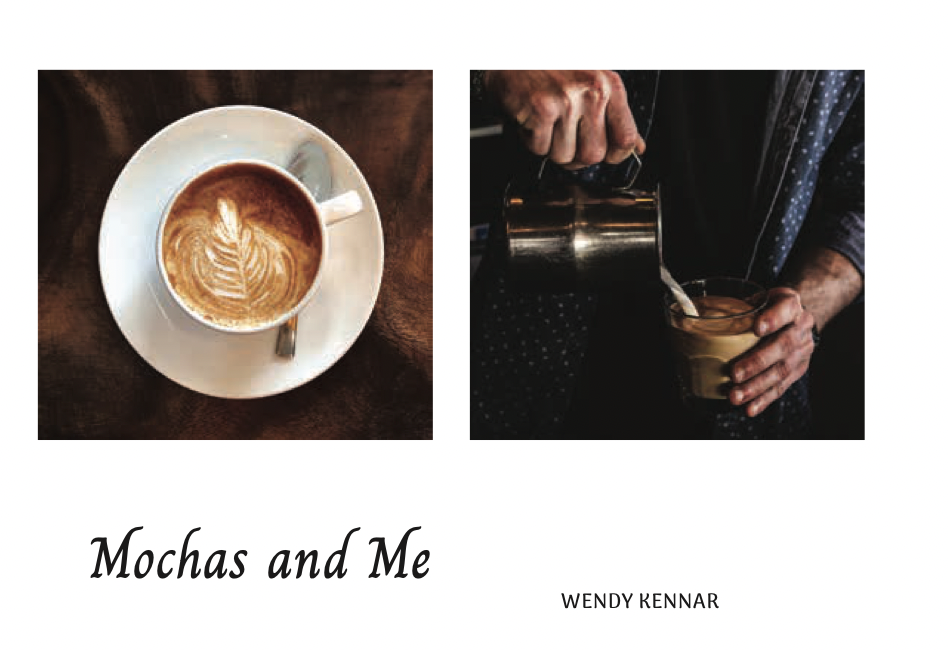
Mochas and Me

Photo credit: Shanti Arts, Still Point Arts Quarterly

My dear readers,

Something has happened that I don’t think has ever happened to me before. For the third consecutive week, I have publication news to share! (In case you missed it, you can read about week one here and last week’s news here.)

This week I’m proud to share my personal essay, “Mochas and Me,” has been included in the Spring 2024 issue of Still Point Arts Quarterly. The issue’s theme is “Coffee, Tea, Cocoa.” You can click here to access the entire issue online or click here to be taken directly to my essay. 

By the way, do you have a favorite coffee, tea, or cocoa beverage? Let me know in the comments!

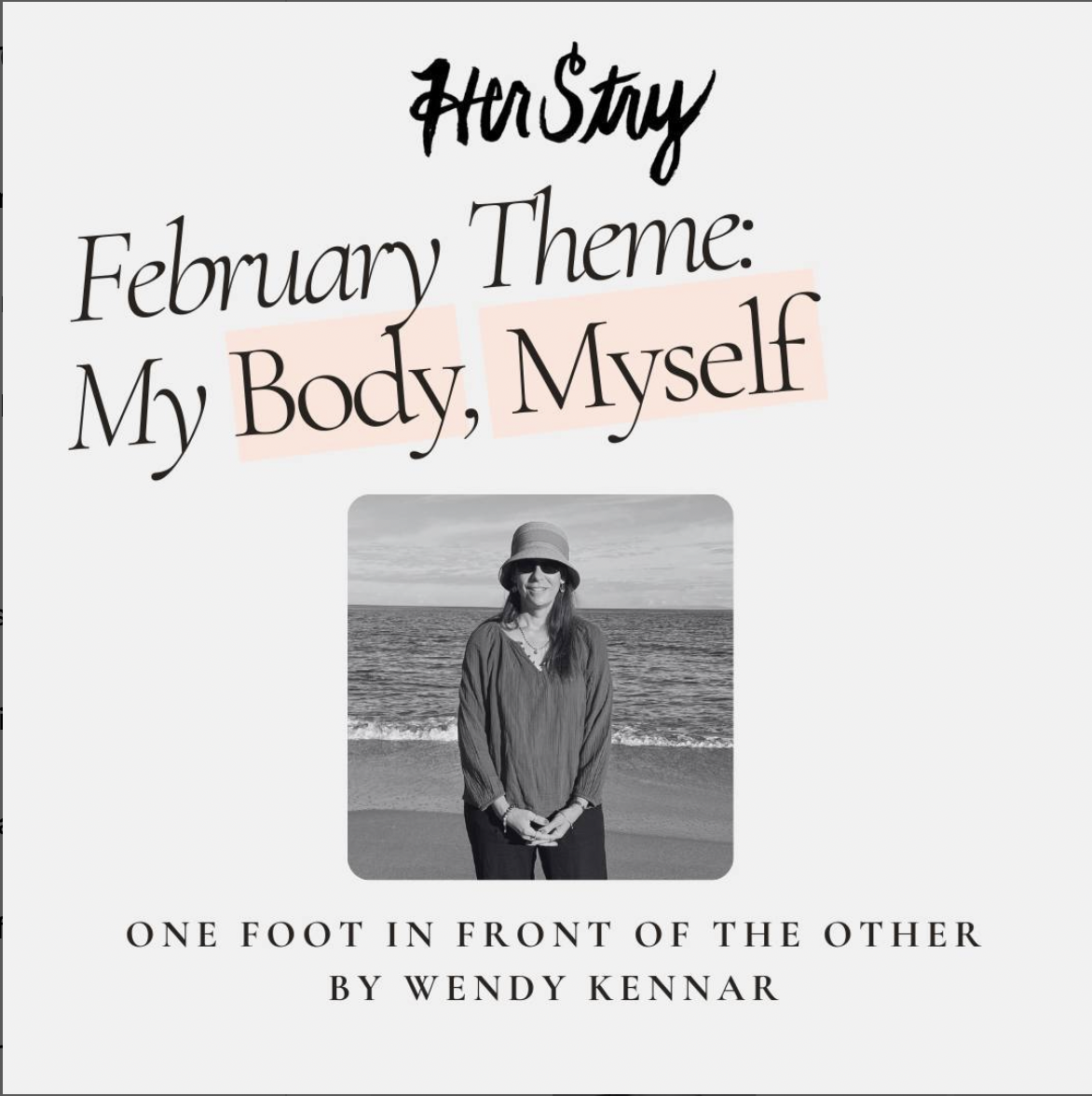
One Foot In Front of the Other

Photo Credit: HerStry

Dear Readers, I have more publication news to share!

I’m proud to say my personal essay, “One Foot In Front of the Other,” was published by HerStry as part of their Monthly Theme Series. February’s theme was “My Body, Myself.”

Here is just a snippet:

“It’s easy to look at my body and feel disappointed, disheartened, and cheated. I’m in my forties, a time when many women feel empowered, as if they have reached their prime. But that’s not how I feel. I feel like my aging process has been sped up, like a time lapse video. I feel like my body can’t entirely be relied on, as if I’m defective. 

“I’m closer to fifty than I am to forty and am trying to make peace with this compromised body of mine. Occasionally I look at myself in the mirror and linger on my face. I think back to all those days when I yearned for clearer skin. Now, an occasional pimple doesn’t even register on my list of things to be concerned about. Now my self-consciousness has transferred to my left leg with its two scars (from two different muscle biopsies) and prominent red, blue, and purple veins.” 

You can click here to read the essay in its entirety.

Chronic Illness, Chronic Pain, and Gold Stars

I am pleased to share that my personal essay, “Chronic Illness, Chronic Pain, and Gold Stars,” has been published in a new anthology, Chronic Poetics. “The book contains artwork, essays and poetry written entirely by people who have experience of chronic pain and chronic illness.” Each piece of writing has been “arranged and visually interpreted,” making it possible to create an anthology that tells a “visual story as well as a literary one.”

I’d like to share two excerpts from a section near the end of my essay:

“I wish someone had handed me a manual of some sort. My car came with one. The new little handheld vacuum I recently bought came with one. (I don’t remember the last time my trunk looked so clean.) But no one told me how to navigate living with a chronic illness. No one pointed out that a chronic illness is one thing. A chronic illness causing chronic pain is something else.”

“There are moments I want to cry. Moments I want to scream. Moments I want to throw things and break things. Because this is hard. And it’s tiring. And it often doesn’t feel like it gets any easier or any better.” 

You can find more information about the anthology here.

The visual interpretation of my personal essay.

Something to Endure

My memoir is divided into three parts.
The final essay in this part, and the book, is
"Something to Endure."

Super exciting news:  my manuscript is complete, and I will now be entering a new stage of the writing process — the querying-agents phase. 

But before I got here, when I was revising and rewriting my manuscript, I had to make a decision regarding my final essay. I had three essays that my book coach and I agreed were all possible candidates for that all-important last essay in the book.

It is my hope that my memoir will be read by those living with chronic illnesses, as well as those who know people who are living with chronic illness. I’m hoping that my story can serve as an example. Though the medical specifics may vary, the emotions may be quite similar. So someone who lives with diabetes, for example, could give my book to a loved one, point to one of my essays, and say, “Here. Read this. This is what I feel like sometimes.” 

For far too long, terms such as “disability” and “disabled” have been too narrowly defined. I really want my memoir to broaden those definitions, and I would like my story to serve as just one example of what a disabled life looks like.

When I started working with my book coach, I told her I was writing the book I needed to read when I became ill. I hope after reading my memoir that my chronically ill readers feel less alone and more understood. Along those lines, I want my final essay to give readers a sense of comfort, a dose of good-feels. 

Before making my final decision, I stopped to reflect and think about how I want my readers to feel when they’re done reading my memoir-in-essays. 

These were the adjectives that I came up with:

Hopeful.

Enlightened.

Inspired.

Comforted. 

With that in mind, I made my decision (and my book coach agrees). My final essay is titled “Something to Endure.” Because basically that is the bottom line when it comes to chronic illness. You have to endure the illness. You need to stick it out and figure out ways to handle it, to be with it day-in and day-out for the long haul.

But you don’t have to do it alone. Books, including my own, connect us.

Happy Valentine’s Day

I don’t remember how I celebrated Valentine’s Day when I was an elementary school student. 

But I do remember how I celebrated as an elementary school teacher.

A few weeks before Valentine’s Day, I sent a note home which included a class list. If children wanted to pass out Valentine cards, they were asked to bring one for each classmate. (This was not just a Mrs. Kennar-rule. Other teachers did the same thing.)

When I taught fourth grade, I added an in-class activity. Each student was given two stapled papers. The papers had lines on them and some decorative hearts in the corners. Each student was instructed to write their name at the top of the page. 

The whole class stood up and left their papers on their desks. Everyone moved one seat down and wrote something complimentary on their seat mate’s paper. There were a few rules: no compliments or praise based on looks, including things you wear or levels of attractiveness. 

Before we began, we did brainstorm some possible compliments and words of praise we could use for each other. Such as:

You always share your eraser with me.

You have neat handwriting.

When you read aloud, I can always hear you even though I don’t sit near you.

You always remember to say thank you when I pass out papers.

We spent quite a bit of class time, making sure we wrote on each student’s paper. And, my students would encourage me to have a paper as well. When the activity was done, we returned to our seats and took time to quietly read the words of praise our classmates had written. 

It was one of my favorite activities, because I think too often we don’t know how we have impacted someone else. We don’t always take the time to share a kind word. But with this activity, my students would have these written words to take with them, and they  could look back at them any time they needed a boost.

So along those lines, I am going to take this opportunity to show a bit of self-love. I am always quick to praise and compliment and offer kind words to others. It’s much harder to do the same for myself. 

In the spirit of Valentine’s Day, a day of friendship and love, here are two compliments I give myself:

– I am considerate. I offer cold bottles of water to any service technicians or repair people who come to our home. Any time I see our mailman, John, I thank him for the day’s mail and give him a cold bottle of water as well.

– I am thoughtful. I make notes of friends’ doctors appointments and important life events so that I can reach out with a text, an email, or a phone call and let my friends know I’m thinking of them.

Happy Valentine’s Day, my dear readers! Feel free to share a compliment or words of praise about yourself.

Get a Life, Chloe Brown

Get a Life, Chloe Brown by Talia Hibbert is what some readers would refer to as a rom-com. Some readers may use other terms such as “chick lit” or “women’s fiction,” but I’m not a fan of those terms. You should know that this particular rom-com has quite a high level of “spice,” meaning explicit “steamy” scenes.

But here’s the main thing you should know about Ms. Hibbert’s novel:  Chloe Brown, the main character, is a Black woman who lives with fibromyalgia, a chronic illness causing chronic pain. Plus, the book features an interracial relationship. I love this sentence taken from the author’s website:  “She writes spicy, diverse romance because she believes that people of marginalised identities need honest and positive representation.”

This week, I share with you just a few of the passages that really stood out to me: 

“Most people had trouble accepting the fact that Chloe was ill. Fibromyalgia and chronic pain were invisible afflictions, so they were easy to dismiss. Eve was healthy, so she would never feel Chloe’s bone-deep exhaustion, her agonizing headaches or the shooting pains in her joints, the fevers and confusion, the countless side effects that came from countless medications. But Eve didn’t need to feel all of that to have empathy. She didn’t need to see Chloe’s tears or pain to believe her sister struggled sometimes. Neither, for that matter, did Dani. They understood.”

“It had been a frustrating few days. She’d fallen into an infuriating cycle when she’d climbed that tree. Physical overload led to pain and a complete dearth of spoons, also known as mind-numbing exhaustion; which led to extra meds and insomnia; which led to sleeping pills and too much brain fog; which led to, in a word, misery.”

“…my body was different. The weight on my chest, and the cold — they faded, as I got better. But my bones still felt fragile. It never went away. Over the months, I noticed more and more problems. I was exhausted all the time. I got these awful headaches for no reason. And there was the pain — always, so much pain. I’d go for a walk and feel like I’d worked every muscle to the point of tearing. If I spent too long on my laptop, my hands would hurt so badly I cried. I started feeling afraid of my own body, like it was a torture chamber I’d been trapped inside.”

Please note: I am including a link to buy the book that I’m highlighting this week. If you use my link, I do make a small commission on your purchase at no additional cost to you. I am working with Bookshop.org which also sends a portion of the profit to support local, independent bookstores.
Unhelpful Advice

(This photo was taken a couple of months ago. Different doctor. Dreadful pain chart.)

I had a hard doctor’s appointment last week. 

Maybe “hard” isn’t the right word. After all, I found parking half-a-block away from the building. The doctor was only running a few minutes behind schedule. And because I had blood work done in December, no additional labs were needed. 

In those terms, it was a pretty good appointment. 

But it was still a hard appointment. Because I left the appointment feeling weary, disappointed, and dejected. Angry, frustrated, and pissed. Sad, crushed, and dejected.

Later, I told my husband, “No one knows what to do with me.”

My rheumatologist (rheumatologist number three in my life with chronic illness) cannot explain my increased levels of pain and decreased levels of energy. Because the blood work shows my inflammation is under control. Which means my medication is working. But it doesn’t explain why I feel like “I’m going downhill, fast, and no one is able to slow me down.” (I said that same sentence to my doctor. He nodded his head. He said he understood.)

I should point out that I do like this doctor. I like that he looks at me when I speak and really seems to be paying attention to what I have to say. I like that, during past appointments, he seems thoughtful when suggesting new medications to try and shares with me his reasoning behind those medications. (By the way, I have tried every medication he has suggested. A few made me worse than I was to begin with.)

My doctor said he’s concerned about “structural damage” to my body. Which sounded more like a description of a car than a person. My doctor voiced his concern about feelings of depression I may have. I reminded him I regularly speak with my therapist.

He wants me to try physical therapy. Again. (Readers, I have tried physical therapy multiple times over the years. At different locations. Usually I’m told how inflexible I am. How much less range of motion I have in my left leg compared to my right leg.) I have the phone number; I just need to call and make the appointment. I’m procrastinating. 

But that wasn’t his only recommendation. 

“Do you multi-task?” he asked.

“I’m a mom. Of course I do. Don’t all moms?” I asked.

He didn’t seem amused by my response. Though I wasn’t trying to be amusing. 

My doctor says multi-tasking leads to additional stress. 

So do less, and eat more whole grains (another one of his suggestions).  

But I can tell you right now that won’t help my pain. 

The truth is — there is no easy fix. I know that. He knows that. 

At the same time, no chronic illness patient wants to be sent on their way having been told to multi-task less.

Invisible Forces at Work

“It’s the invisible nature of the coronavirus that complicates matters. So many people don’t fear something they can’t see. However, I know how powerful and life-changing invisible forces can be. My autoimmune disease, Undifferentiated Connective Tissue Disease (UCTD), is an invisible disability, causing pain, fatigue, and weakness in my left leg. My rheumatologist described it as sharing overlapping symptoms of lupus, rheumatoid arthritis, and myositis. UCTD is a chronic illness causing chronic pain. 
“A quick glance, and I look ‘fine.’ No assistive walking device needed on a daily basis. No one can see inflammation by looking at me, especially since my legs are always covered by loose-fitting pants or long flowing skirts. No one can see the pain, the crushing sensation I experience in my leg as if my son has placed his heavy backpack on my lap. No one can see the tightness of my calf, as if it is stuck in a perpetual charley horse. However, just because you can’t see my disability, doesn’t make it any less real.”

The paragraphs above are an excerpt taken from my personal essay, “Invisible Forces at Work,” which, I’m pleased to say, has recently been published in an anthology titled The Covid Logs. “The Covid Logs provide a space for the disabled and chronically ill communities to share their experiences of navigating the Covid-19 pandemic.” The anthology is available as a PDF and a full-color zine and includes personal essays, visual art, and poetry. You can click here to learn more about this special collection.  

The Book of Annie

Maybe you’re a Seinfeld fan and you remember Annie Korzen from her role as Doris Klompus. Or, you’re on TikTok and you’ve seen Annie’s humorous videos there.

I know Annie Korzen, but not because of Seinfeld or TikTok. On multiple occasions, we have sat and chatted. And though I knew many things about her, reading her memoir The Book of Annie: Humor, Heart, and Chutzpah from an Accidental Influencer has helped me learn even more about her.

The Book of Annie is described as “wildly funny musings from an 83-year-old TikTok sensation.” 

This week, I’d like to share just a few of my favorite passages:

“I hope these musings will not only make you laugh, but also make you a better human being, because, wonderful as you already are, we can all benefit from an occasional upgrade.” (From the Author’s Note)

“I admit it: I am often guilty of being a nagging wife. I constantly remind Benni to watch his diet and do his exercises. I guess I’d rather be a nag than a widow.”

“Being a parent is a Catch-22. Your main job is to prepare your kids to separate from you, while your main instinct is to keep them as close to you as possible.”

“The great irony is, my first serious love was a Black guy I went to college with. But if I had married Billy, I would have been part of an interracial family, and who needed that challenge? It’s tough enough just dealing with all the Jew crap.
“Isn’t life strange? I thought I didn’t want to be a grandmother, and I thought I didn’t want to be part of an interracial family. But when those things actually happened, everything fell into place. So, just like with that Jewish wedding, maybe what we think we want or don’t want has very little to do with what really makes us happy. And who knows? As the world keeps evolving, maybe by the time my precious Max grows up, he might be able to walk down a dark street without anyone feeling threatened — or anyone threatening him.”

“But my favorite kitchen time-saver is my husband. Several years ago, I announced that I was retiring from all food-preparation duties and that it was now his turn. I’m proud to say that Benni has stepped up to the (dinner) plate. He will throw together some grilled salmon, roasted garlic potatoes, and a tossed salad without complaining, and will even sort of clean up afterward. Sometimes you just get lucky.”

Please note: I am including a link to buy the book that I’m highlighting this week. If you use my link, I do make a small commission on your purchase at no additional cost to you. I am working with Bookshop.org which also sends a portion of the profit to support local, independent bookstores.