Nora Goes Off Script

It should come as no surprise that I am a reader who likes a book with a happy ending. (You did read my post last month titled, “The Need for Romance Novels,” didn’t you? If you missed it, click here to check it out.)

So it really should come as no surprise that I thoroughly enjoyed reading Annabel Monaghan’s novel Nora Goes Off Script. Yes, it’s a romance. But it’s also more than a romance. I just couldn’t help but root for Nora, and I couldn’t help but see bits of myself in her — she has a weekly meal plan (Tuesday Tacos, Friday Pasta) and so do I (Tostada Tuesday, Pasta Thursday). 

Here are just a few of my favorite bits:

“Pink ribbons, then orange creep up behind the wide-armed oak tree at the end of my lawn. The sun rises behind it differently every day. Some days it’s a solid bar of sherbet that rolls up like movie credits and fills the sky. Some days the light dapples through the leaves in a muted gray.”

“You live for your kids, and they live for you. There’s something almost sacred about what you have.”

“It’s possible that growing up watching the fantasy of this marriage is what makes writing romance movies so easy. My parents make me believe that some people really are made for each other and that a joyful, easy marriage is possible. Two people who love each other and are looking in the same direction can build a wonderful life.”

Also: this book was super popular last year. This year, the talk is about Ms. Monaghan’s most recent novel Same Time Next Summer. I have added it to my ever-growing want-to-read list.

Please note: I am including a link to buy the book that I’m highlighting this week. If you use my link, I do make a small commission on your purchase at no additional cost to you. I am working with Bookshop.org which also sends a portion of the profit to support local, independent bookstores.

An Anniversary and a First

This photo was taken at the National Museum of American History.

Everyone has defining moments. Moments you may not realize are monumental when they’re happening. But later — days, weeks, months, or even years later — you look back at that moment, that significant event and see it for what it is — a distinct, neon-yellow line dividing your life into before and after.

Thirteen years ago, I woke up on a Sunday morning, but I couldn’t get out of bed. My left calf had ballooned, and I suddenly couldn’t do the thing I had done for years — stand up. Next came a visit to the emergency room, a hospitalization, and what would become the beginning of my life as a chronic illness patient. 

Last week, on the anniversary of that defining day, my family and I were on a summer trip visiting Washington, D.C. 

It was a vacation of firsts — the first time we had visited our nation’s capital, and the first time I rented a wheelchair for the duration of our stay.

As I told my son, I don’t know if all future trips will require use of a wheelchair. But this year, it was an absolute must. (I also requested wheelchair assistance in the airports.)

Initially, I didn’t think I would need a wheelchair at all. Then I thought I could just borrow one of the wheelchairs most museums have available for guests. Finally, I admitted the truth — my pain has been incredibly intense, my leg incredibly weak. If my family and I wanted to take this trip, I had to use a wheelchair.

There was one part of me that was heartbroken. All I could think of were the negatives — I’m 47 years old and, for this trip anyway, an ambulatory wheelchair user. My mind went down that scary, dark path — thinking ahead to future trips, picturing myself with increasingly limited mobility.

I made an effort to reframe how I thought about the facts — I’m 47 years old and not letting this chronic illness and my chronic pain stop me from living my life the way I want to live it. I wasn’t going to stay home because I needed a wheelchair. I adapted and figured out how to make this trip work for my body as it is now.

I don’t know. Maybe we’ll look back at this D.C. trip as one of those defining moments — the start of travel requiring a wheelchair. 

But maybe not. 

We’ll have to wait and see next year.

P.S. Lots more to come about this incredible trip. We spent 6 days, 5 nights away from home. We visited museums and memorials. We admired and appreciated. We listened and learned.  

Write For Your Life

I read for many reasons. To be entertained and inspired. To learn and grow and find comfort in someone else’s words.

I write for many reasons, too. Which is why I was curious to read Write For Your Life by Anna Quindlen.

While many people might not consider themselves writers, Ms. Quindlen believes everyone has a story worth writing down. I agree. 

In addition to Ms. Quindlen’s words, the book also has some writing-related quotes as well as some prompts for writing exercises. Here are some of my favorite bits from Write For Your Life:

“We write to taste life twice, in the moment and in retrospect.” — Anaïs Nin

“While you have to mentally re-create what happened on a phone call — ‘Did she really say that?’ — you can actually reread a text. But much of that tech prose online felt so spontaneous as to be slapdash, unexamined. It’s why people will often say, when reminded of an email or an online post, that they can’t really recall writing it. Every day, unthinkingly, our lives can slip through our fingers in a cascade of computer code. Texts are like footprints in sand. By evening the tide has come in, and we are left alone.”

“The urge to get it exactly right often stands between you and beginning. ‘Don’t get it right, get it written’ demands composition first, cleanup later. The paralysis of perfectionism is a terrible ailment that can seep into so much of our daily lives. In writing, what it leads to is an empty page, and an empty page is neither good nor bad. It’s nothing. Honestly, if the choice is between an imperfect something and nothing — well, that’s easy, isn’t it? Get it written. You can get it right later.”

“Something written by hand brings a singular human presence that the typewriter or the computer cannot confer. There’s plenty of good writing done that way, but when you simply glance at the page, it could be the work of anyone. But when you’ve written something by hand, the only person who could have done it is you. It’s unmistakable you wrote this, touched it, laid hands and eyes upon it. Something written by hand is a piece of your personality on paper. Typed words are not a fair swap for handwriting, for what is, in a way, a little relic of you.” 

“I’m not sure writing about things always makes us feel better, but perhaps it sometimes does make loss, tragedies, disappointments more actual. It can turn them into something with a clearer shape and form, and therefore make it possible to see them more deeply and clearly, and more usefully turn confusion and pain into understanding and perhaps reconciliation. On paper our greatest challenges become A Real Thing, in a world in which so much seems ephemeral and transitory.”

“Butt in chair. That’s the piece of direction I give to anyone and everyone who wants to write, who is thinking about writing, who is asking how it’s done, who is fearful of and intimidated by the act. It’s not poetic, and it doesn’t bespeak inspiration. What it does suggest is a way into what is not a mystery but a process, a way into the story of yourself.”

Please note: I am including a link to buy the book that I’m highlighting this week. If you use my link, I do make a small commission on your purchase at no additional cost to you. I am working with Bookshop.org which also sends a portion of the profit to support local, independent bookstores.

A Look Back at Six Months of Books

Since it’s the first week of July, I thought now would be a good time to pause and take a look at some of my favorite reads from the first half of the year. 

January:  Katherine Center’s The Bodyguard. I LOVE Katherine Center’s books. When she publishes a novel, I know I’m going to purchase it. She writes books that make you feel. Books that make you laugh. Books that are about people who experience hard times and then find a way to get back up. Books that you know will all end up okay in the end. (Side note – Hello Stranger will be published next week on July 11th. I have already pre-ordered it!)

February:  At the end of February I started reading Claire Cook’s Walk the Talk, the fourth book in her The Wildwater Walking Club series. There’s something so pleasing, so reassuring about coming back to characters you know from previous books.

MarchEverything Happens for a Reason: And Other Lies I’ve Loved by Kate Bowler.  Ms. Bowler is … a force. Of grace. Of compassion. Of humor. Of authenticity. Of heart.

April:  Thank you to Tara Schuster and her first book, Buy Yourself the F*cking Lilies: And Other Rituals to Fix Your Life From Someone Who’s Been There. It was the book I needed to read and I didn’t know it. And now, her newest book — Glow in the F*cking Dark — sits on my bookcase, waiting for me; a gift from one of my closest friends.

May:  This Time Next Year by Sophie Cousens – a fun, super-enjoyable read! (I also recommend her novel Just Haven’t Met You Yet and in my to-be-read pile is her other novel  Before I Do.)

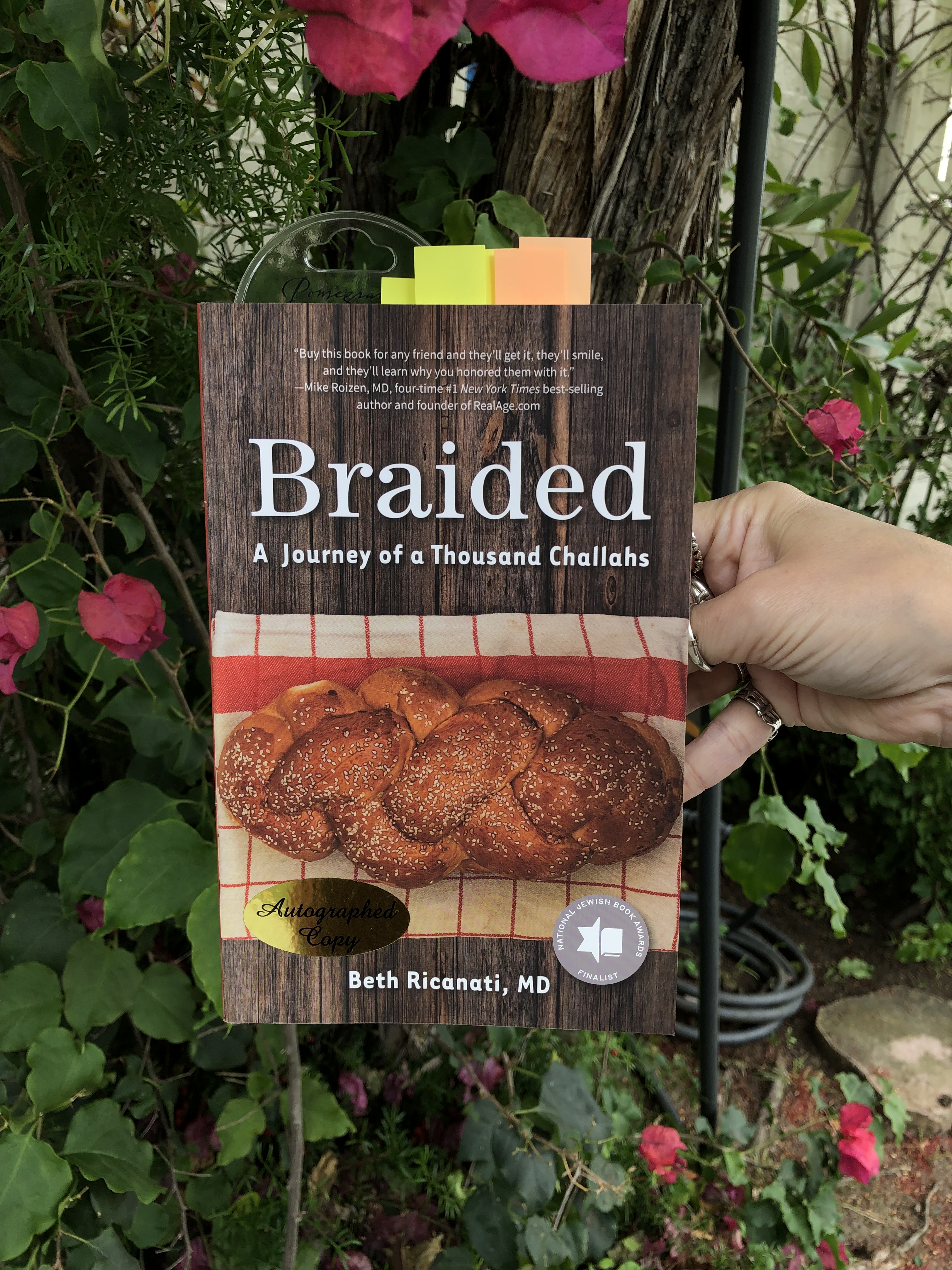
June:  I finished reading Braided by Beth Ricanati at the end of June. It’s a book I’m still thinking about. In fact, I admit to checking out a couple of videos on YouTube featuring Ms. Ricanati not just discussing her book, but baking challah at the same time. 

Readers, any books you’ve read during the first half of 2023 that you loved? Enjoyed? Learned from? Please share!!

Please note: I am including a link to buy the books that I’m mentioning this week.  If you use my link, I do make a small commission on your purchase at no additional cost to you.  I have chosen to affiliate with Bookshop.org, which also sends a portion of the profit to support local, independent bookstores. 

Braided

I am not a baker. Meaning, I’m not a multiple-ingredients, multi-step-recipe kind of baker.

I’m more a Ghirardelli-Dark-Chocolate-Brownie-Mix (which only requires three ingredients) type of baker. 

However, I was so intrigued by the premise of Braided: A Journey of a Thousand Challahs by Beth Ricanati, MD. (And I was tickled to learn that before her challah-baking, Ms. Ricanati counted her brownies, made from a Ghirardelli brownie mix, as her specialty.)

Here’s part of the description from the back cover:

What if you could bake bread once a week, every week? And what if the act of making bread — mixing and kneading, watching and waiting — could heal your sense of being overwhelmed? It can. This is the surprise that physician-mother Beth Ricanati learned when she started baking challah: that simply stopping and baking bread was the best medicine she could prescribe for women in a fast-paced world.”

And here are some of the passages I marked while reading:

“Actions always speak louder than words: our children absorb and learn by watching us, not necessarily listening to us.”

“This was a big lesson for me. It took making challah again and again to realize that when something goes wrong, it is not always because I did something wrong. ‘Sorry’ used to be one of my favorite words. A guy friend of mine bet me in high school that I couldn’t stop saying sorry. ‘Sorry,’ I replied. Alas, reflexively, I still want to blame myself first, to assume that I must have done something wrong.”

“Waiting for the yeast to proof exercises more than patience. Waiting also exercises humility. It’s the greatest of all character traits, according to the Talmud. Humility supplants the ego, pushes away the tendency for self-centeredness. With humility comes the ability to have empathy.” 

“We can’t always be happy. Sometimes happiness is taken from us. Sometimes terrible things really do go bump in the night. While painting challah with a red-tipped brush may seem childish, may seem frivolous, I look forward to this with almost too much glee. In fact, whenever possible, I insist on doing this step myself, instead of handing it over to a child or a friend or anyone else. I want the reminder. I want the physical reminder that when we have the choice to be happy, we have to grab it. We have to take it and own and cherish it. It is not always ours to choose.”

“I found in making challah that the magic for me is in the process of making challah. No ends-justify-the-means here. What happened as I went through the eleven steps each Friday in this challah recipe is where I really learned to be present. To slow down for a moment each week. To appreciate the here and now. To reconnect with women. I found through these eleven steps that challah is the ultimate soul food for me.
“It was here all the time, I just didn’t see it. I was so concerned with doing the right thing all the time, being the right person at the right time, that I had unknowingly lost the enjoyment, the fabulousness of the here and now.”

Please note: I am including a link to buy the book that I’m highlighting this week. If you use my link, I do make a small commission on your purchase at no additional cost to you. I am working with Bookshop.org which also sends a portion of the profit to support local, independent bookstores.

Still Going

One year ago, my family and I were in Maui. (If you missed it, you can read my post about our fantastic trip by clicking here. My son took this photo during our zip lining adventure.)

This year, we’re in the almost-done-planning stage of our summer trip, happening later this summer. (I’ll be writing about this summer’s trip in a blog post next month. Stay tuned!)

If I’m being honest, I do have to admit that I am a bit worried.

The truth is I’m very good at keeping it all together, of making my life, my family’s life, look like everything is under control. Because it is — in many ways. But I’m also dealing with incredible amounts of daily pain. I’m trying to get through my days while struggling with high levels of fatigue, unexpected muscle twitches, and knees that make bending painful.

Will I come home feeling more intense pain than I did before the trip? Maybe. But also, maybe not. 

Will I have hours during our trip when my left leg will feel wobbly and shaky like Jello on a dessert plate? Maybe, but maybe not. 

Two family members have voiced their concerns about the trip. “Won’t it be too much for you?” I was asked.

“Probably,” I answered.

But we’re still going. I am not going to let my chronic illness stop me. 

The Need for Romance Novels

A friend of mine and I were talking about the appeal of reading romance novels. More than the appeal — the need we have to read romance novels. 

There is the teacher in me that sincerely believes almost all reading is beneficial (with the exception of awful, hate-fueled reading material). Pure and simple, just like you know drinking water is good for you, reading is good for you too. Reading keeps your mind working. Reading strengthens your vocabulary. Most importantly, I believe reading helps us learn about others. Reading gives us the opportunity to step into less-familiar worlds, and as a result, we have more understanding, more empathy for others. 

Reading romance does all that and more. 

Here are a few reasons why I read romance novels:

  1. Romance novels are predictable in the best way. I don’t have to worry when reading a romance. I’m not nervous or scared while reading. I know things will work out okay, more-than-okay, for the main characters. I can read in a relaxed way, certain there will be a satisfying, leave-me-smiling type of ending.
  2. Romance novels are not work. Reading some books feels like work. They have statistics and dates. Big words and lengthy chapters. Much symbolism and complicated plot lines. Romance novels are a lot easier in that regard, though I do still sometimes find myself looking up a new-to-me word. In a romance, there is no complicated information to process and keep track of as the story goes on.
  3. Romance novels are an escape. I can take a temporary break from real life — the lightbulb that just went out in the bathroom, the plants that need watering, the prescription I need to refill — and slip into another world where I don’t have to do anything. I can just read. And I can do it anywhere. A few pages while standing in line at CVS. Several pages in the car while waiting for my son to be dismissed from school. A few chapters at my neighborhood cafe. 
  4. Romance novels are reminders.  The specifics vary from novel to novel. The age, race, and gender of the characters may differ from our own. But it doesn’t matter. Because the emotions are the same. Reading a romance is a powerful reminder that human beings are more alike than we are different. 
  5. Romance novels provide the opportunity to reframe our perspective. The truth is the world is scary, unpredictable, and messy. And usually when we think about that, we focus on the negative. But, if you slow down, you realize that opening yourself up to another person, falling in love, and maintaining a romantic relationship can also be described as scary, unpredictable, and messy — in the best possible way.

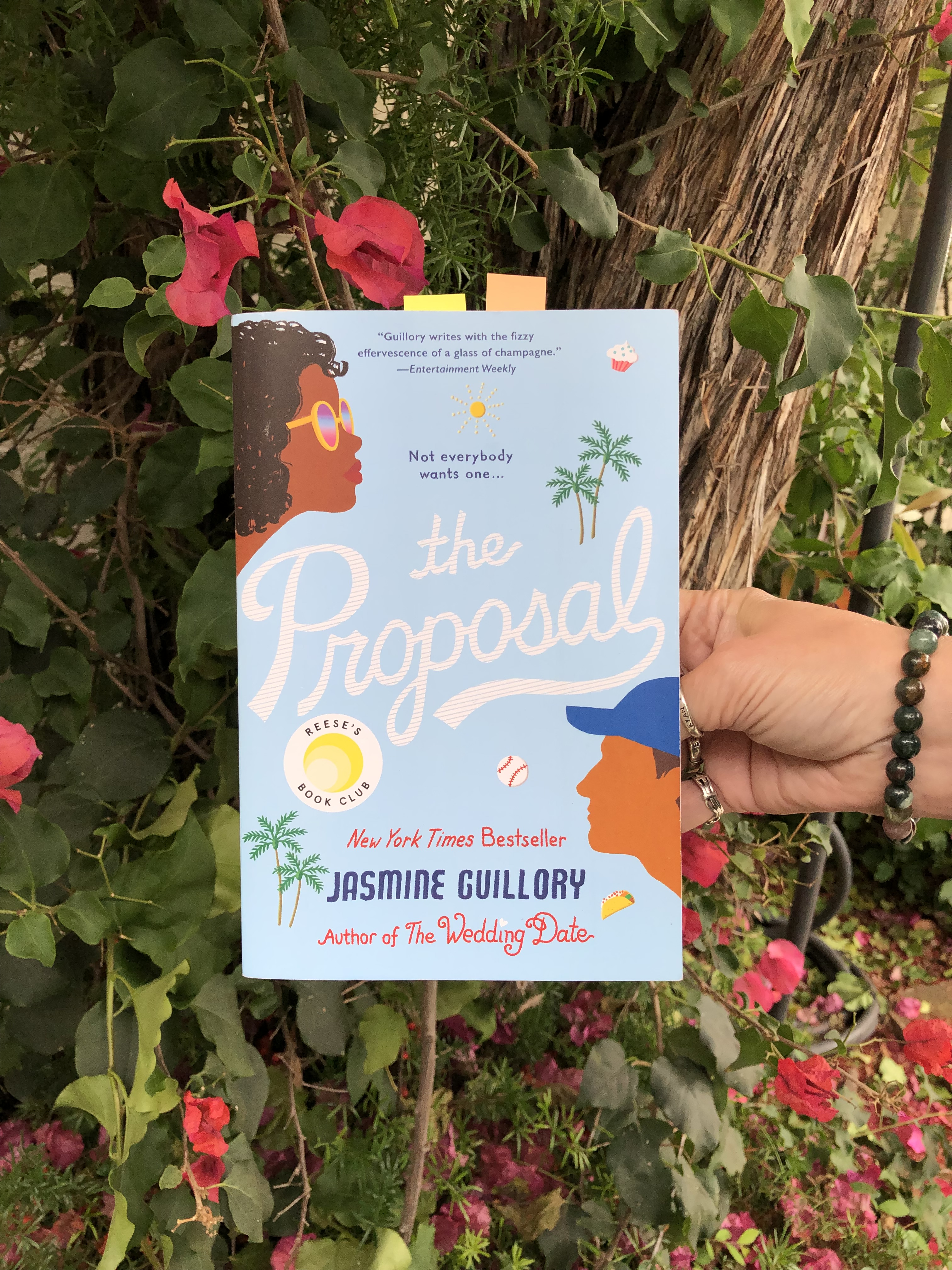
I recently finished reading The Proposal by Jasmine Guillroy and have to share this passage with you:

“WAS THIS WHAT LOVE WAS?

Being happy when you thought about someone; wanting to never stop thinking about them, even when you were fighting; having every damn thing in the grocery store remind you of them, from diapers to sour cream; wanting to be a better writer and friend and person because of how they were and how they made you feel; wanting to be with them, all the time, even though you kept fighting it.”

Readers, I’m curious. Do you read romance novels? 

If you do, feel free to share why you read them. And if you have any favorites you’d like to recommend, please do so.

If you don’t, feel free to share why you don’t read romances and tell me about what you enjoy reading instead.

Affiliate links:  Please note, I have included a link to buy the book that I’m quoting from.  If you do use my link, I will make a small commission on your purchase at no additional cost to you.  I have chosen to affiliate with Bookshop.org, which also sends a portion of the profit to support local, independent bookstores. It is my hope that you will choose to support them in their mission to “help local, independent bookstores thrive in the age of ecommerce.”

My What If Year

Do you ever think about other careers you might have had? Other choices you might have made? Other paths you might have taken?

And what if you had the chance to put much of your current-daily-real-life on pause and try out one of those unchosen careers? Would you take the chance to explore?

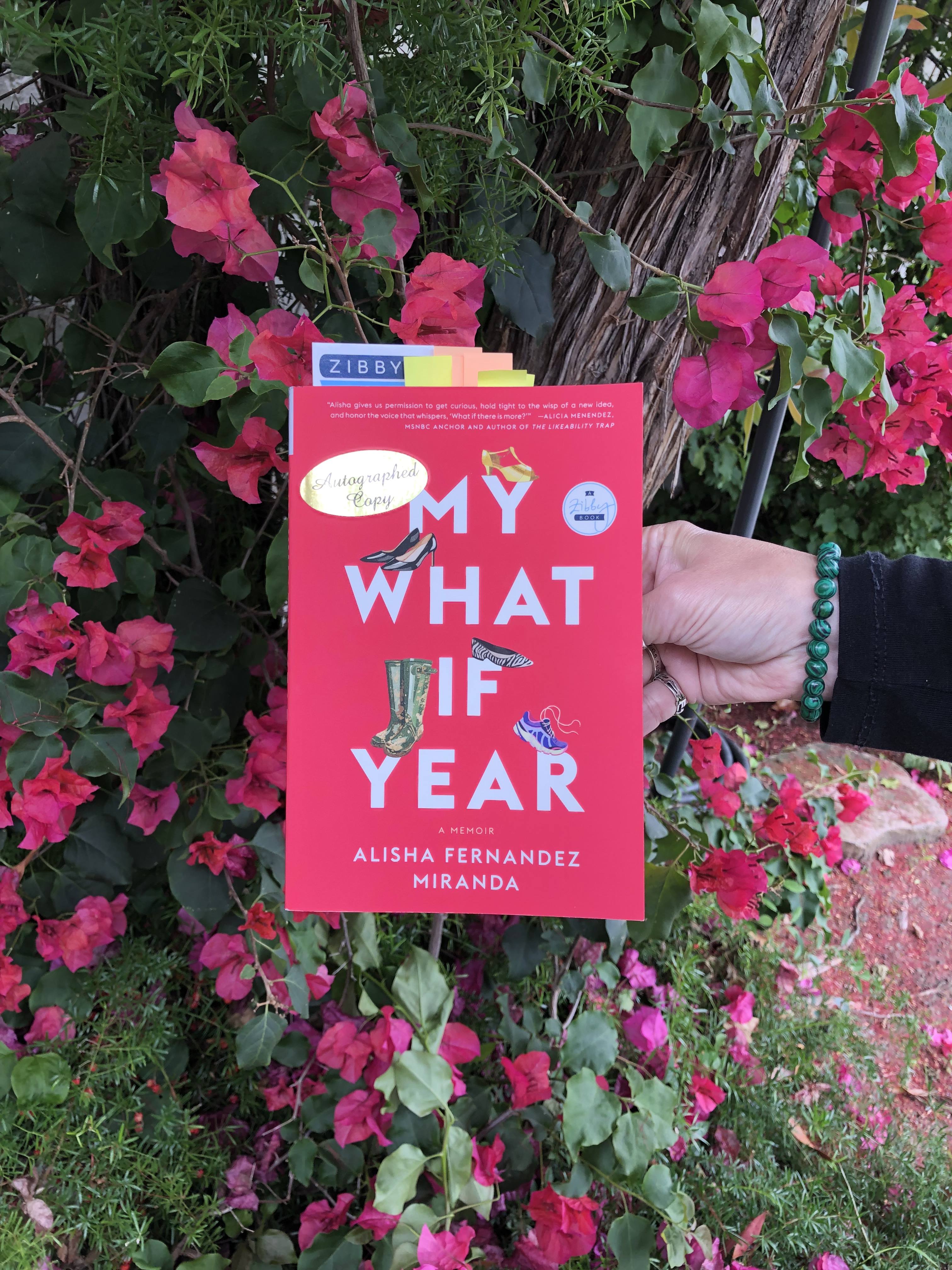
Alisha Fernandez Miranda did! And she wrote a memoir about it called My What If Year

From the back cover of the book:  “Delightfully irreverent, My What If Year recounts the adventures of a successful, Latina CEO and mother of twins who — on the cusp of turning forty — takes a break from her job for one year to explore the dream careers she never pursued. Alisha’s hilarious internship adventure takes her to Broadway, the London art scene, a posh Scottish hotel, and the workout world.”

Such a fun read! Here are a few of my favorite passages:

During her first internship, Ms. Miranda writes:  “How long had it been since I had been happy? For so long I thought the pursuit of happiness had been what was guiding me, but now I wasn’t so sure.” 

“I had no regrets, but it dawned on me that maybe my internship adventure, was, in a way, about revisiting that time of my life, a time when all the pages ahead were blank and unwritten.”

“Leaning into my strengths let me ignore my weaknesses. Yes, it allowed me to achieve and find success in the things I was good at. But I was starting to question whether I needed to be spending more time nurturing those tiny seeds of things I was terrible at — serving dinner, for example — to see if maybe they might blossom into something more, given some effort and some mistakes. Maybe it didn’t matter if it was ‘the best’ if I was doing something I loved. I didn’t even know what being the best meant anymore in this new world.”

“Truthfully, I was looking forward to seeing everyone. I was no longer as afraid of being subsumed in these other identities and knew that the core of who I was, or whoever I was figuring out I wanted to be, at least, was strong enough to stand on its own. In fact, the heft of my obligations no longer seemed overpowering; I had started to feel comforted by them, like a weighted blanket that kept me grounded.”

“ ‘Joy’ — such a simple, small word that holds so much complexity. It’s more than happiness. It’s ebullience. It’s celebration. A party all day, every day, where everyone is invited. People think joy is elusive, and they’re right; its impermanence is what makes it all the more important to cultivate, nurture, and appreciate it whenever it comes your way.” 

“But as I aged, I came to know that nothing is guaranteed. If you wanted to enjoy as much of life as possible, you had to put some intentionality behind seeking joy. You had to pay attention. If you didn’t it was likely to slip through your fingers.” 

“I didn’t want to have to keep taking side paths and then retracing my steps back to the main road. I wanted the detours to be the main road. Over the past few months, I had finally gotten, for brief moments in time, the chance to be the versions of myself I had seen in the shadows of my memories. I loved the chance to step into their shoes, but I didn’t want to be any of them, really. I wanted to be original me, but with the freedom to take the pieces from each and carry them with me as I continued on ahead.”

“One of the things I appreciated most about being an intern was the ability to not feel overwhelmed by my mental load. Making space meant that, all of a sudden, my brain had more room to think about other things and to consider other possibilities. Ideas for new projects sprang up like daffodils in the springtime. There was a lot in there that had been obscured by the constant to-do lists. My internships had given me a chance to see those things clearly.”

“I didn’t know much about what the next chapter of my life would hold, but I knew I needed to embody the spirit of being an intern in whatever I did: be adaptable; learn to fail; be okay with not being the best; let go of the plan sometimes; and above all, listen, learn, and find joy in every day.” 

Please note: I am including a link to buy the book that I’m highlighting this week. If you use my link, I do make a small commission on your purchase at no additional cost to you. I am working with Bookshop.org which also sends a portion of the profit to support local, independent bookstores.

(I apologize if any part of this week’s blog format looks strange. There may be a number or letter randomly showing up. Please, let’s just pretend it’s not there.)


Every Day Resilience

“Living with an autoimmune disease has caused me to re-define words I thought I knew. Words I thought I understood. Words like strength, weakness, and pain don’t mean what they once did. Their definitions have grown and expanded, because living with a chronic illness causing chronic pain is hard. And I’m doing it every day.”

The paragraph above is an excerpt from my personal essay, “Every Day Resilience.” I am pleased to share that my essay has been published in Fahmidan Journal Issue 15: Thyroid and Autoimmune Warriors. You can click here to read it in its entirety.

Saving My Tears

The other morning, as I drove home, I heard the song “Save Your Tears” by The Weeknd on the radio. I had taken myself to my favorite neighborhood cafe for some outdoor reading and writing time. 

“Save Your Tears” is a song I’ve heard a fair amount of times. Usually it’s a song I listen to, a song I enjoy. But this time, it actually brought me to tears. 

I parked the car and sat inside for a bit. I didn’t want to run the risk of seeing any of my neighbors, I didn’t want to have to try and explain why I was crying, because I wasn’t quite sure. 

I don’t think it was any one thing.

Actually, there were a number of reasons I could have been crying. 

For over two weeks now, I’ve been dealing with a pinched nerve, which at its worst led to tingling down my arm, into my right hand and fingers. It has created pain and tightness in my neck/shoulder area. It has made everyday things like brushing my teeth and washing my face harder to do. But that wasn’t why I was crying.

Since my son’s high school hosted Open House, about a month ago, I have had extreme pain in both my knees. It’s difficult to bend and pick up something that I dropped. It’s too painful to squat and pull weeds out of my garden. So I plop down onto the sidewalk and weed my garden and then have to figure out a way to get back up. But that wasn’t why I was crying either.

I think it was the lyrics, the simple repetition of “Save your tears for another day.” 

Because I do that, all the time. I save my tears for another day or another part of the day. I stop myself from crying in the Ralphs parking lot, as I load our bags of groceries into the car. I don’t cry as I unlock our front door, but wait until I get inside where no one can see me or hear me. 

And that is the bottom line — where no one can see me or hear me. Because it’s been my experience that me crying — out of pain, or fear, or frustration, or weariness — makes those around me uncomfortable. Which means on top of me trying to take care of myself and let the tears out, I’m left trying to soothe and reassure my family while downplaying my tears and whatever it was that caused me to cry in the first place.

Except. 

Except the other day during my virtual therapy session. I cried. I cried multiple-Kleenex, nose-running, red-blotchy-eyes kind of crying. Because I generally keep everything in. I am so good at biting my tongue. At keeping my stoic game face on. At not letting on how hurt I really am. How much pain I really feel. And how much help I need.

I wouldn’t say I felt “better” after my crying session. But I definitely didn’t feel worse, either.