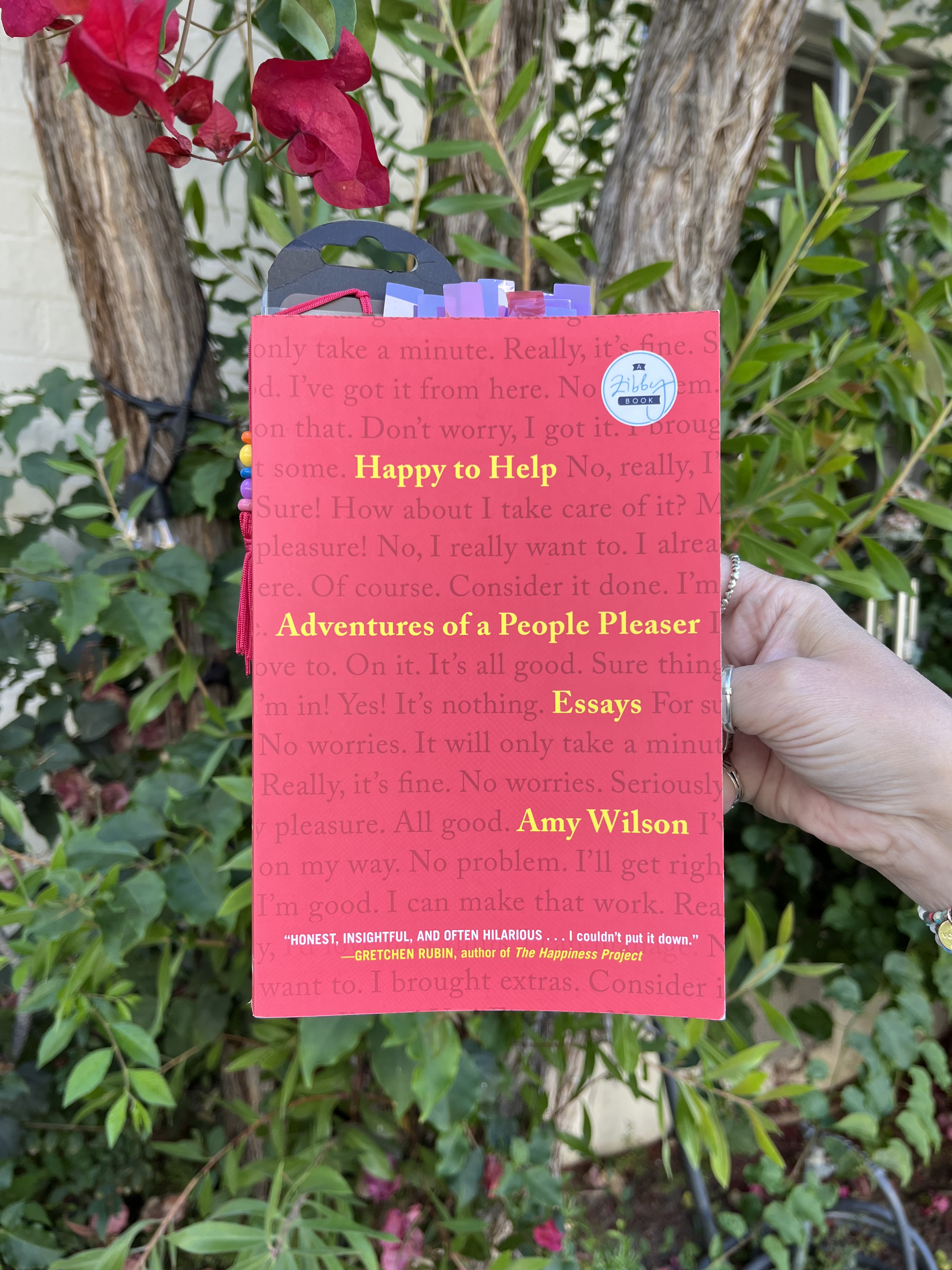
Happy to Help: Adventures of a People Pleaser

I knew I needed to read this book when I saw the title and front cover. The book — Happy to Help: Adventures of a People Pleaser by Amy Wilson. 

The topic of this essay collection is something I can relate to. I am a people pleaser. I am always looking for ways to be of help and make life easier for those around me.

Naturally, I started reading and had my highlighter and sticky notes ready.

This week, I’m sharing some of the passages that I most enjoyed and/or most resonated with:

“You look like you have your act together. Hell, you do. But you’ve got way too much on your plate. You’re waiting for someone, anyone, to notice and say, ‘Hey, let me carry some of that.’ 
“Instead, they say, ‘Why don’t you try carrying less?’
“Or, ‘Hey, I think you dropped something.’
“And they’re so right, they’re so exactly right. You cannot handle it all. You have to let some of it go. But then you look at all the things you’re carrying, and you wonder what exactly it is you’re supposed to put down when the answer feels like nothing.
“I’m here to tell you that you’re right too.
“You do a lot. (Somebody has to.) A lot of it is for other people.” 

“Sociologist Allison Daminger calls it ‘cognitive labor’ and explains that any task a caregiver completes has four steps: anticipating the need, identifying options for meeting the need, making the decision, and, finally, monitoring the progress. Using this math, each ‘invisible’ thing on the list of a woman with too much to do is actually four things. No wonder we can’t seem to shorten our lists.”

“Finding the time to do something this important to me is possible, but only if I make myself invisible while I do it. Only if I take the time that is required away from time I would otherwise be sleeping or exercising or connecting with friends. If I need to find more overhead, my basic needs are where I will trim the fat.” 

“My list isn’t too long because I procrastinate. My list is too long because there are too many things on it.”

“In my household I’m told that I’m ‘just better’ at things than the other people who live here, things like wrapping presents, remembering passwords, and knowing whose clothes are whose when they come out of the dryer. These little tasks — the noticing, the remembering, the ordering, the tracking — are the sort of multitasking most women stuff into the crevices of our attention, adding LEGOs to the online Target cart for an upcoming birthday party present while smiling and nodding on our Microsoft Teams meeting like nothing else is happening.” 

“The problem is that once we as women accept that we are ‘just better’ at doing these small things, we tend to keep doing them; and in order to also keep doing the big things, we have no choice but to multitask.” 

“Studies have shown that mothers are the preferred garbage receptacle. Adolescents of all genders have been shown to be more likely to direct verbal abuse at their mothers than at their fathers, romantic interests, or friends. That might be because most of us believe female parents to be more capable of the self-restraint required in response.” 

“I wasn’t always a perfect Giving Tree. When it would all get to be too much — when my work of worry boiled over into irritability or anger — my family would be baffled by whatever escaped my personal volcano. It hadn’t been apparent I was struggling. I hadn’t asked for support. They weren’t even sure what I was so upset about, since I was usually pretty good at keeping the pattern of their daily lives smooth and undisturbed.” 

“When we have to do the work of worry, hiding it might be a necessary part of the job.
“But am I supposed to hide my work of worry from everyone? Am I always to walk through difficult times acting like what I’m carrying isn’t heavy? I can’t accept that a mother’s true path to a deserving life is always to worry more and show it less. But sometimes I’m not sure what to do instead.”

“When we are in difficult seasons of life, they are hard because they are hard, not because there’s something wrong with us. They are hard because they are real, not because we make them harder on purpose. And if others don’t always perceive us as struggling, it’s because we’ve become quite capable of handling more than should be expected.”

“I can ‘really love’ people without making them happy. Those people never expected me to guarantee them happiness in the first place. And those people get to be loved by me no matter what their emotional states are, no matter what they’re struggling with. It was never mine to ensure that the perfect peace and happiness of my loved ones was achieved. Forever fixing our loved ones’ lives isn’t the point. Our job is to love them while they suffer.”

These next passages are pulled from a chapter mid-way through the book. Sections of a chapter about the health challenges the author’s young son was experiencing were quite reminiscent of my own health challenges and the frustration I have felt when doctors couldn’t provide answers.

“Weird things were happening, things that couldn’t be completely explained by an abnormal EEG, but since they did not seem to be dangerous, it was professionally preferable not to offer an explanation. Assuming nothing meant doctors could allow his condition to remain unexplained and send us home without troubling afterthought.”  

“In modern medical speak, ‘idiopathic’ means ‘we have no idea.’ It doesn’t mean what has been observed is false or manufactured or imaginary, although sometimes of course that might be the physician’s suspicion. But it also doesn’t mean an answer. It means acceptance that there might never be an explanation. It means acceptance that you may never know for sure.” 

Readers who have just navigated your child’s junior or senior year of high school, will find much to relate to in the chapter, “Cherish Every Moment.” Here is one such paragraph:

“Thus begins the rite of passage millions of parents of rising high-school seniors endure each year, bookending the journeys that began when those same children first crossed their doorsteps in carefully chosen infant car seats. And it’s quite a closing act. Before a child leaves home for college, a parent must perform what feels like the most momentous act of service for that child they have completed to date: helping them find a place where they can gain acceptance and then stand a chance of decent happiness as they begin their adult lives.”

How about you, dear readers? Have you read Amy Wilson’s essay collection? Do you consider yourself to be a “people pleaser”?

Please note: I am including a link to buy the book that I’m highlighting this week. If you use my link, I do make a small commission on your purchase at no additional cost to you. I am working with Bookshop.org which also sends a portion of the profit to support local, independent bookstores.

Super Bloom

I recently finished reading Megan Tady’s novel Super Bloom.

It’s a novel about friendship and reinventing yourself when life doesn’t follow the path you thought it would. 

It’s a novel about writers and romance books. 

It’s a novel that offers a behind-the-curtains look at the massage industry as told from the point of view of our main character, Joan, a massage therapist.

It’s one of those novels that keeps you turning pages, because you just have to find out what happens next. And for me, it started with the first sentence — “I harbor a secret fantasy to go apeshit at work.” 

Here are a few of the passages that caused me to pause and mark the page with a sticky note and a yellow highlighter:

“…I love that muscles speak their own language and I can spend hours coaxing them to reveal themselves to me.”

“Instead, I imagine my clients’ private lives and then write down the stories, envisioning their secrets and passions and hurts based on the slope of the lower back, the elasticity of skin, the rigidity of muscles. My hands pass over bodies as if I’m reading braille, and their worlds unfold.”

“My smile is my best asset, looks-wise, though it’s as shy as a shadow-spooked groundhog. When my full smile emerges, it reveals one crooked tooth that appears to be leaning out of a Rockets chorus line to see what everyone else is doing.”

“It’s been sixteen years, but I still remember writing this thing at my parents’ kitchen table. They were both at work, and the house was quiet. As the words flew out of me, I experienced an oncoming rush, as if I were on a roller coaster inching to its highest peak, the noise of the wheels grinding against steel, wind whipping my hair, until I crested, and from there, for a split second, I could see for miles, a perspective where everything made sense, the entire story coming together before I plummeted back toward Earth, my stomach in my chest, my chest in my throat, my thrilled yell not audible from below.”

“I’m fighting for my livelihood by working on The Project — paying off my debt, keeping my day job. But when I write for myself, I’m fighting for my life, because remaining debilitated, angry, or bowled over without a moment’s notice by sadness is no way to exist.”

“Maybe, just maybe, I can still be a writer. Maybe it’s not too late for me. Don’t we all have dormant potential coiled up inside of us? Greatness lying within, waiting to be tapped?
“Just like Samuel’s super blooms. Seeds holding out for perfect conditions: soil, sun, rain.
What I need is a hefty dose of willpower. A readiness to try my hardest and possibly fail. That’s the only way to bloom.”

“Was it the writing?
“Or was it simply that the forces of nature couldn’t destroy me? That nothing could stop me from pushing up to the surface, because something innate in me wanted to survive. Not only survive but transform, so that I was a better copy of my original self.”

Dear Readers, Has anyone else read Super Bloom? Were any of my favorite lines also your favorite lines? Feel free to share passages that you loved!

Please note: I am including a link to buy the book that I’m highlighting this week. If you use my link, I do make a small commission on your purchase at no additional cost to you. I am working with Bookshop.org which also sends a portion of the profit to support local, independent bookstores.


Everyone But Myself

It is absolutely appropriate to judge a book by its cover, especially when it comes to Julie Chavez’s memoir, Everyone But Myself

Between the title and the illustration on the front cover, you have a strong sense of what this book is about. This memoir is another example of an author writing the specifics of her life, and in doing so, making it universally appealing to others who “get it.”

In her note to the reader, Ms. Chavez writes: 

“Although the details vary, I’m not alone in this story. Many women ask the same questions I did: How do I respond to all the asks of the world without losing my sense of self — my interests, my desires, my dreams — in the process? How do I remain whole so that, underneath all the repetitive and the annoying and the boring, I can revel in the privilege and miracle of a perfectly messy life?”

Many moms, and I think women in general, experience this struggle; the need to care for others around us while not caring for ourselves. 

These are just a few of the passages that resonated with me:

“Since those early newlywed days I’d discarded heaps of useless advice and ideas, and I’d also learned the difference between distance and space. Distance grew from the accumulation of tiny resentments, the swallowed frustrations that are an inevitable part of coexistence between two imperfect humans. Space, on the other hand, was a necessity, creating room for our deepest needs: respite, rest, recovery.”

“I believed that I would be most fulfilled by being indispensable, that I was loved because I was needed. Protecting space for ourselves may be an issue for those around us, those who are accustomed to our endless availability. But it’s an act of self-care, of self-love, to say, ‘No, this space — this time — belongs to me.’ ”

“It was quiet. I found momentary respite from my world, from its loss and need and upheaval. It was just me, there with myself, the part of me that exists outside of my disparate pieces and roles and obligations and imagined obligations.
I’m enough, I thought. And I’m okay.
One step forward.”

“ ‘You’re handling a lot right now,’ Kim said. ‘I’m not surprised you’re feeling sad.’
These basic affirmations from Kim were invaluable. It was reassuring to hear her observations that my plate was indeed full, that hard things were justifiably hard, that what I was feeling or experiencing was normal. I’d done years of unappreciated work, and the person who appreciated my efforts least had been me. Kim was training me to see this invisible load, to count it as valid and worthy of attention and accommodation. She reminded me that it was normal to have bad days and normal to be an emotional, feeling person in a fucked-up world. Feelings weren’t an early warning sign I was an unbalanced nut. I was merely responding to the ups and downs of life.”

“The changes I had made were small but impactful. I asked for help slightly more often, and I said no far more often. I embraced rest and put some items on my to-do list purely because they brought me joy.”

“Even though I’d occasionally painted them as insatiable leeches, the people who loved me wanted me to take time for myself. They wanted me to balance my needs with theirs, to be well and whole. I was allowed to hand off responsibilities to my husband, my kids, and others, and I was even allowed to phone it in if that’s what was best for my overall balance and wellness.”

“Therapy with Kim helped me rewrite some of the stories I had grown accustomed to telling myself. She taught me that worrying didn’t necessarily make the future brighter, but it did make the present darker.”

“I was learning to ask myself the question I’d ask someone I love: What do you need? And then whatever answer arrived — be still, exercise, meditate, lie on the couch with a book, text Kim some depressed-looking bitmojis and ask if she has appointments available — I did it.”

Please note: I am including a link to buy the book that I’m highlighting this week. If you use my link, I do make a small commission on your purchase at no additional cost to you. I am working with Bookshop.org which also sends a portion of the profit to support local, independent bookstores.

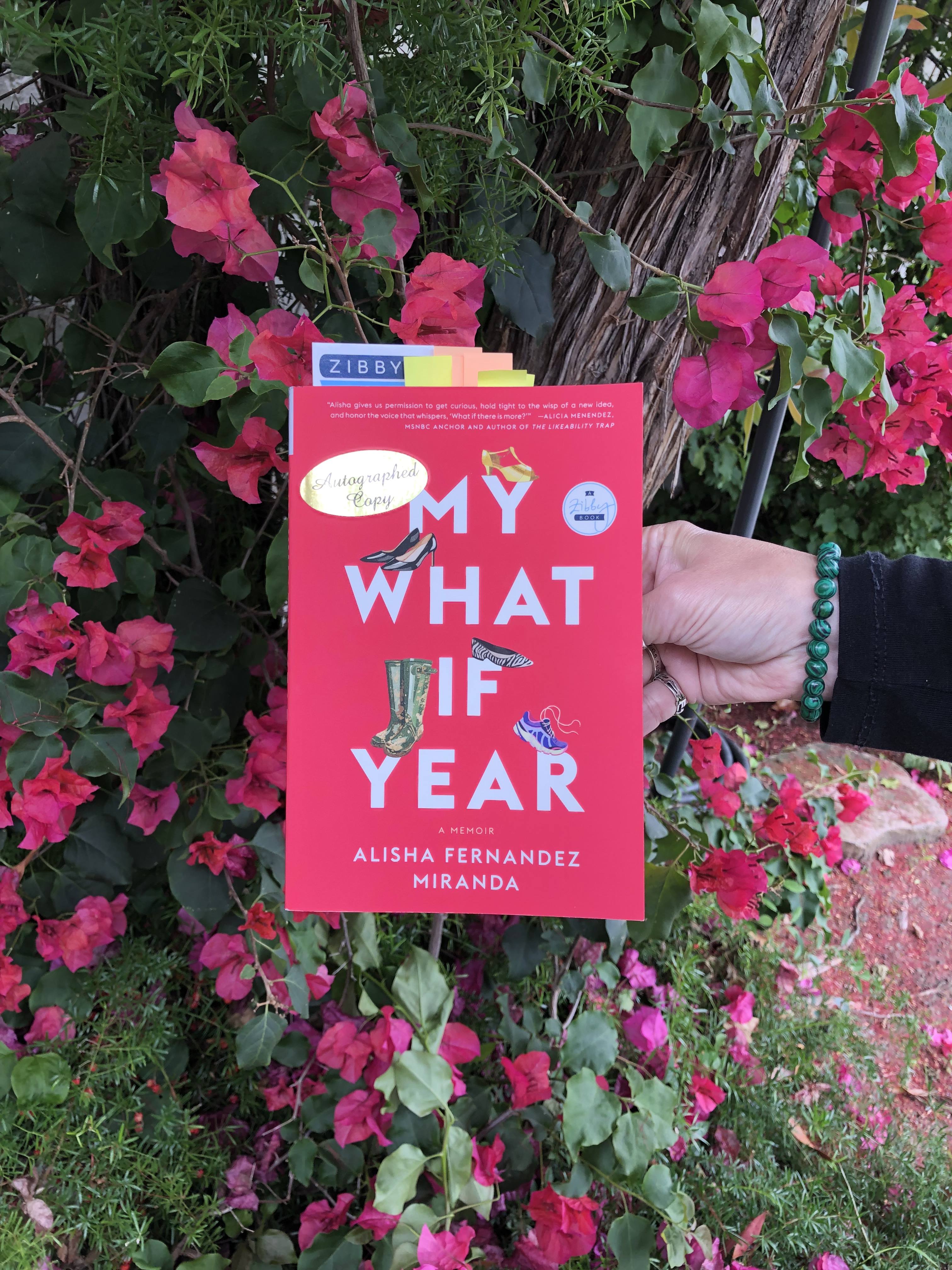
My What If Year

Do you ever think about other careers you might have had? Other choices you might have made? Other paths you might have taken?

And what if you had the chance to put much of your current-daily-real-life on pause and try out one of those unchosen careers? Would you take the chance to explore?

Alisha Fernandez Miranda did! And she wrote a memoir about it called My What If Year

From the back cover of the book:  “Delightfully irreverent, My What If Year recounts the adventures of a successful, Latina CEO and mother of twins who — on the cusp of turning forty — takes a break from her job for one year to explore the dream careers she never pursued. Alisha’s hilarious internship adventure takes her to Broadway, the London art scene, a posh Scottish hotel, and the workout world.”

Such a fun read! Here are a few of my favorite passages:

During her first internship, Ms. Miranda writes:  “How long had it been since I had been happy? For so long I thought the pursuit of happiness had been what was guiding me, but now I wasn’t so sure.” 

“I had no regrets, but it dawned on me that maybe my internship adventure, was, in a way, about revisiting that time of my life, a time when all the pages ahead were blank and unwritten.”

“Leaning into my strengths let me ignore my weaknesses. Yes, it allowed me to achieve and find success in the things I was good at. But I was starting to question whether I needed to be spending more time nurturing those tiny seeds of things I was terrible at — serving dinner, for example — to see if maybe they might blossom into something more, given some effort and some mistakes. Maybe it didn’t matter if it was ‘the best’ if I was doing something I loved. I didn’t even know what being the best meant anymore in this new world.”

“Truthfully, I was looking forward to seeing everyone. I was no longer as afraid of being subsumed in these other identities and knew that the core of who I was, or whoever I was figuring out I wanted to be, at least, was strong enough to stand on its own. In fact, the heft of my obligations no longer seemed overpowering; I had started to feel comforted by them, like a weighted blanket that kept me grounded.”

“ ‘Joy’ — such a simple, small word that holds so much complexity. It’s more than happiness. It’s ebullience. It’s celebration. A party all day, every day, where everyone is invited. People think joy is elusive, and they’re right; its impermanence is what makes it all the more important to cultivate, nurture, and appreciate it whenever it comes your way.” 

“But as I aged, I came to know that nothing is guaranteed. If you wanted to enjoy as much of life as possible, you had to put some intentionality behind seeking joy. You had to pay attention. If you didn’t it was likely to slip through your fingers.” 

“I didn’t want to have to keep taking side paths and then retracing my steps back to the main road. I wanted the detours to be the main road. Over the past few months, I had finally gotten, for brief moments in time, the chance to be the versions of myself I had seen in the shadows of my memories. I loved the chance to step into their shoes, but I didn’t want to be any of them, really. I wanted to be original me, but with the freedom to take the pieces from each and carry them with me as I continued on ahead.”

“One of the things I appreciated most about being an intern was the ability to not feel overwhelmed by my mental load. Making space meant that, all of a sudden, my brain had more room to think about other things and to consider other possibilities. Ideas for new projects sprang up like daffodils in the springtime. There was a lot in there that had been obscured by the constant to-do lists. My internships had given me a chance to see those things clearly.”

“I didn’t know much about what the next chapter of my life would hold, but I knew I needed to embody the spirit of being an intern in whatever I did: be adaptable; learn to fail; be okay with not being the best; let go of the plan sometimes; and above all, listen, learn, and find joy in every day.” 

Please note: I am including a link to buy the book that I’m highlighting this week. If you use my link, I do make a small commission on your purchase at no additional cost to you. I am working with Bookshop.org which also sends a portion of the profit to support local, independent bookstores.

(I apologize if any part of this week’s blog format looks strange. There may be a number or letter randomly showing up. Please, let’s just pretend it’s not there.)


The #22in22 Initiative

Since this is my first post in 2022, I wanted to take this opportunity to tell you about the #22in22 Initiative started by Zibby Books.

Here’s what you need to know:

The idea behind #22in22 is to visit 22 bookstores in 2022. Physically visit (if you’re able) twenty-two bookstores. This can be twenty-two different bookstores, or maybe you just visit your top three bookstores multiple times this year.

Your visits are a way to support bookstores and books. And by extension, you’re supporting authors and booksellers and everyone who works to get books on shelves.

You can sign up at https://www.22in22.net (it’s super easy), and each time you visit a bookstore, return to the website to log your visits. There are different incentives you can earn along the way. But really you’re doing it for yourself (because a visit to a bookstore is a great way to spend part of a day) and the larger book community.

The #22in22 Initiative started on Small Business Saturday, so I got a head start and have logged two visits so far:

Village Well Books and Coffee

and

My local Barnes and Noble

Let’s get reading!!! 

Here’s to a healthy, safe, peaceful, book-filled new year!