Courage & Craft

A month ago, I wrote about one of the bracelets I had recently purchased from the Little Words Project. (If you missed that post, “Strong AF,” you can read it by clicking here.)

Strong AF was only one of the bracelets I had ordered for myself. 

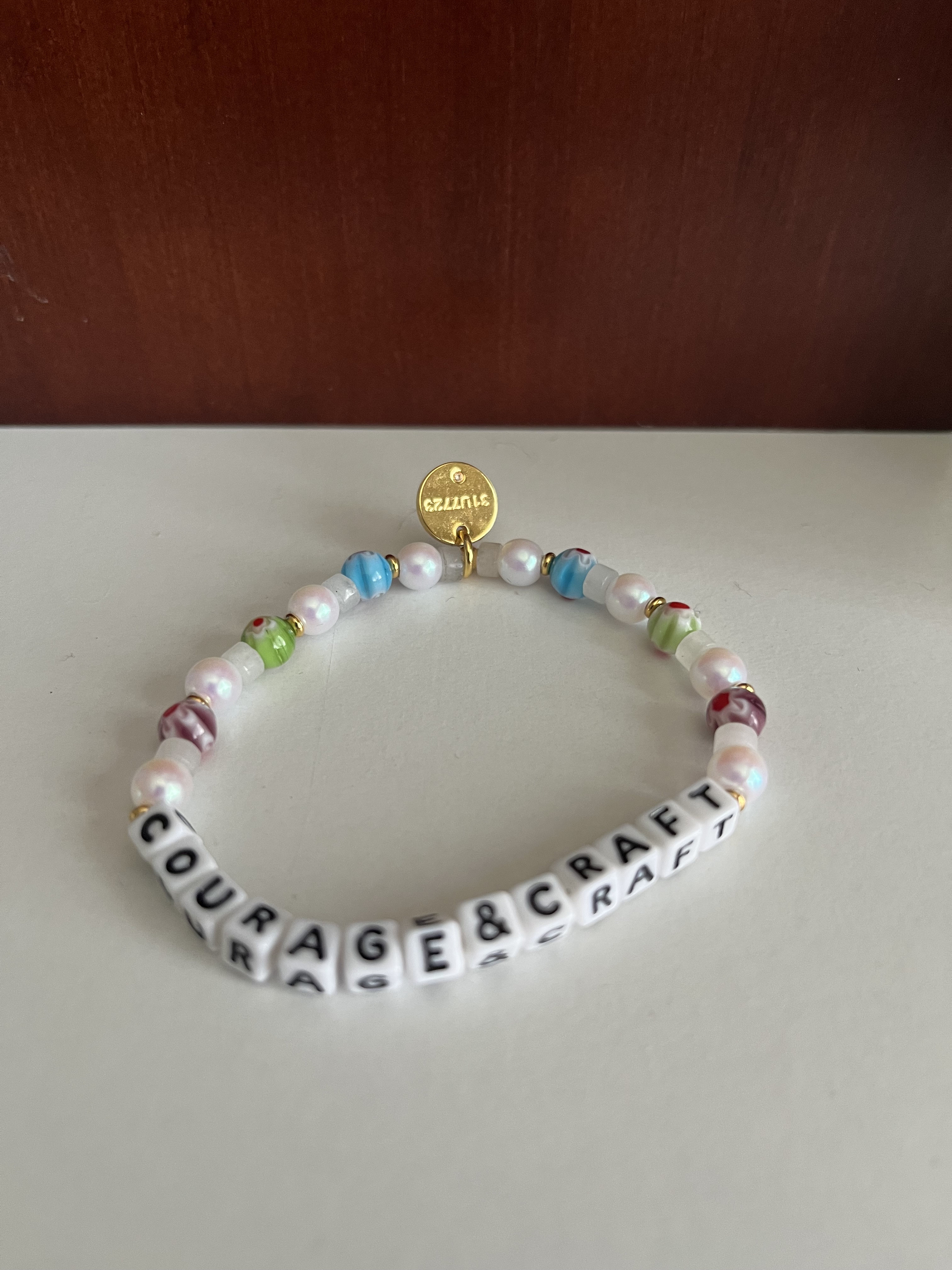
I also bought another bracelet at the time. A custom design. The bracelet reads, “Courage&Craft.”

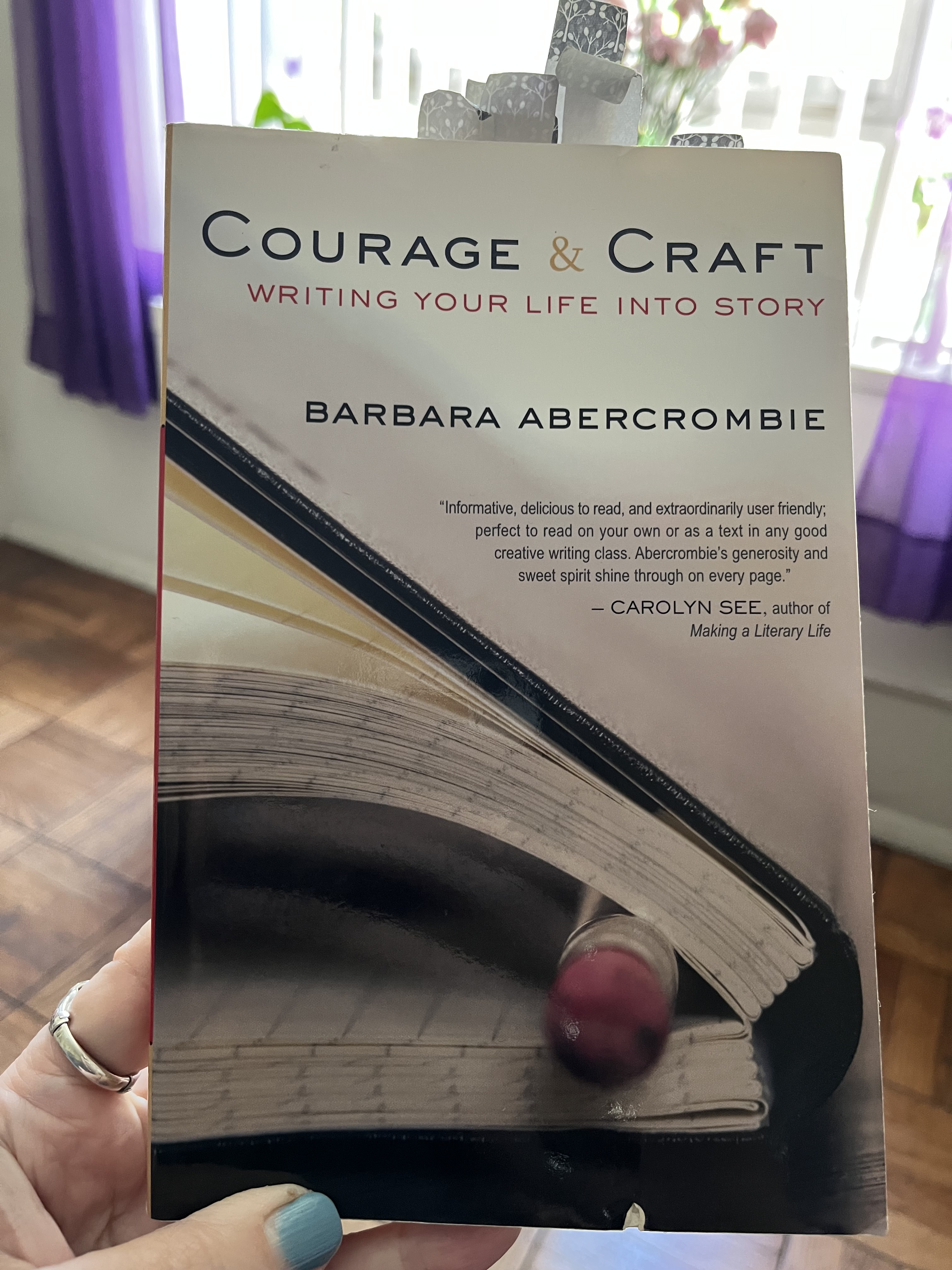
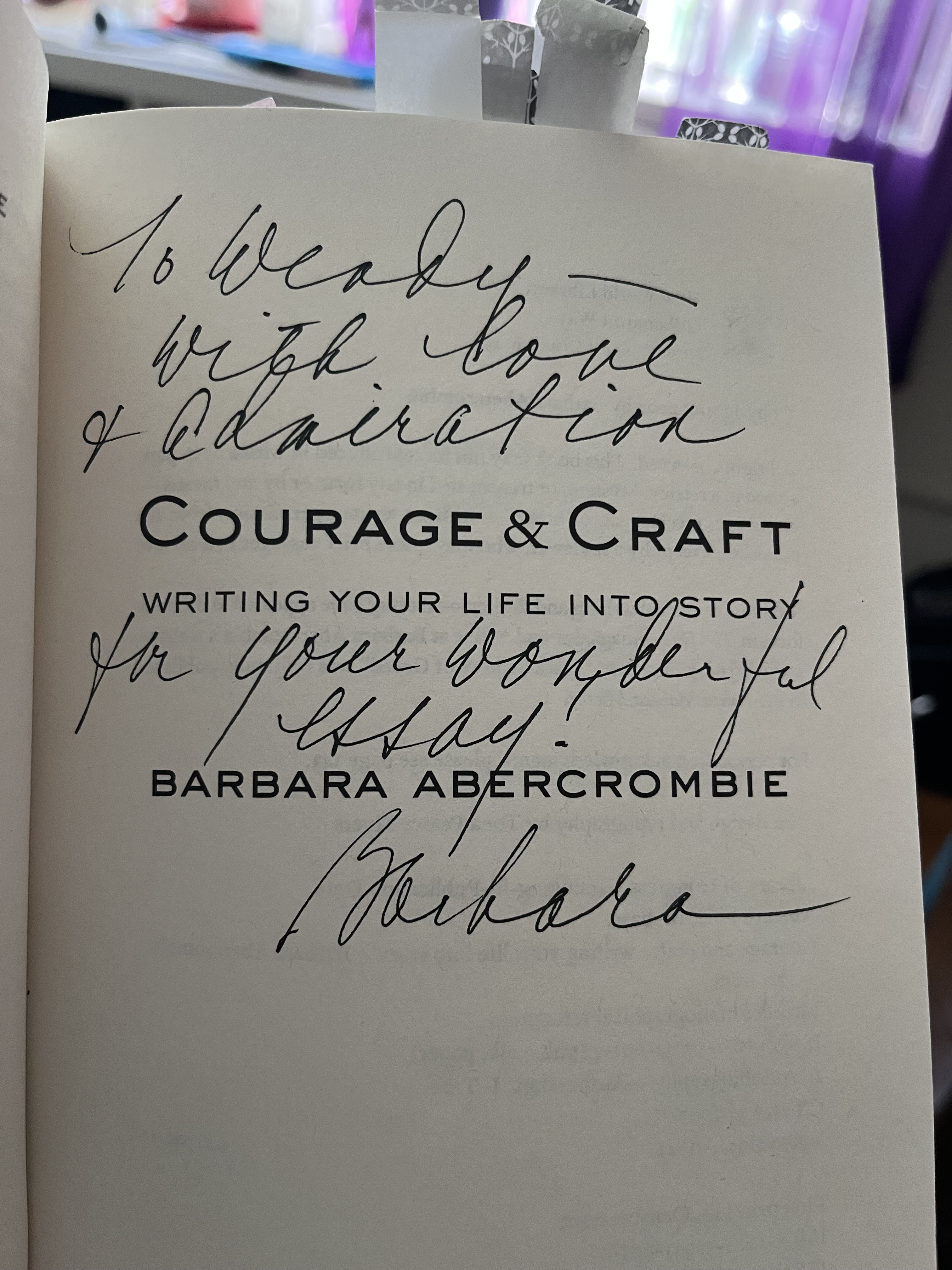
Courage and Craft is the title of a writing craft book written by the late Barbara Abercrombie

I bought the book when it was released in 2007. I was pregnant with my son when my husband and I went to the book launch event at the now-closed Dutton’s Brentwood Books

In the book’s introduction, Barbara wrote:

“Writing is about discovering who you really are, where you’ve been, and where you’re headed. It’s about turning the messy, crazy, wonderful, and sad stuff in your life into something that has order and clarity and meaning — a piece of writing that other people can connect to and be moved by.”

Writing, specifically writing well, requires craft. Understanding how to put words down on a page. How to craft sentences from those words, paragraphs from those sentences, pages from those paragraphs.

And more than that, writing — specifically, writing authentically — requires courage.

Barbara wrote:

“It takes courage to write down what you think and feel. But if you don’t figure out a way to get past the fear and write the truth, what are you ever going to write about? Even if camouflaged by fiction, you’ll be writing some truth of your own reality.”

It is this definition of courage that I keep in my heart:

“Courage doesn’t mean sudden, miraculous strength of character; it means doing something difficult despite the fear.”  

For me, that definition does not only apply to writing, but to life as well. 

My bracelet is a way of honoring Barbara. 

It’s also a way of honoring myself — the hard work I do on a regular basis. The work of taking twenty-six letters (that’s it, just twenty-six letters!) and re-arranging those letters in such a way that an idea that first lived in my heart and my mind can be brought to the page and shared with others. 

Friends, do you have a phrase that helps you stay motivated? A phrase that represents your creative life? I’d love to know!

Please note: I am including a link to buy the book that I’m highlighting this week. If you use my link, I do make a small commission on your purchase at no additional cost to you. I am working with Bookshop.org which also sends a portion of the profit to support local, independent bookstores.
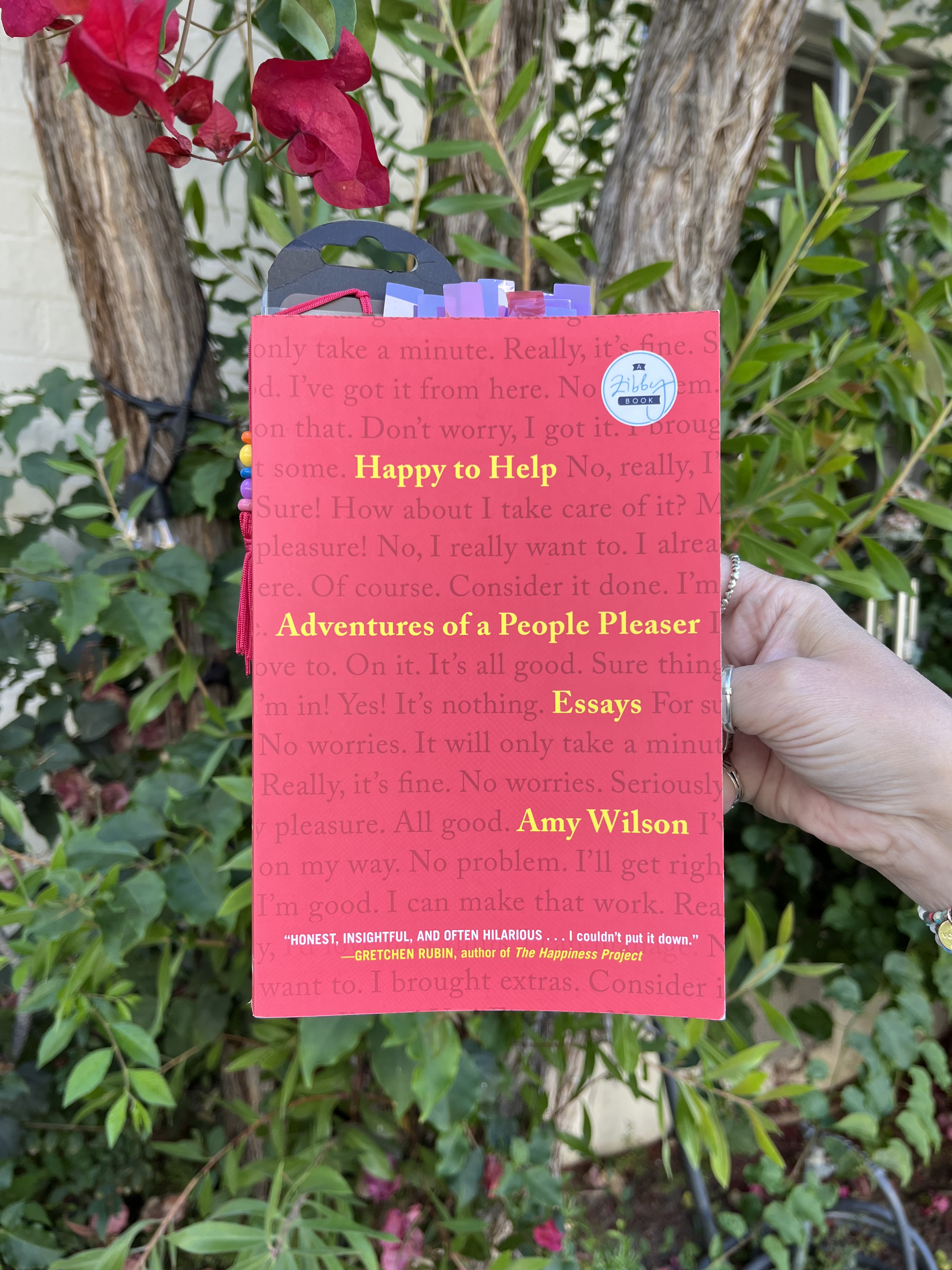
Happy to Help: Adventures of a People Pleaser

I knew I needed to read this book when I saw the title and front cover. The book — Happy to Help: Adventures of a People Pleaser by Amy Wilson. 

The topic of this essay collection is something I can relate to. I am a people pleaser. I am always looking for ways to be of help and make life easier for those around me.

Naturally, I started reading and had my highlighter and sticky notes ready.

This week, I’m sharing some of the passages that I most enjoyed and/or most resonated with:

“You look like you have your act together. Hell, you do. But you’ve got way too much on your plate. You’re waiting for someone, anyone, to notice and say, ‘Hey, let me carry some of that.’ 
“Instead, they say, ‘Why don’t you try carrying less?’
“Or, ‘Hey, I think you dropped something.’
“And they’re so right, they’re so exactly right. You cannot handle it all. You have to let some of it go. But then you look at all the things you’re carrying, and you wonder what exactly it is you’re supposed to put down when the answer feels like nothing.
“I’m here to tell you that you’re right too.
“You do a lot. (Somebody has to.) A lot of it is for other people.” 

“Sociologist Allison Daminger calls it ‘cognitive labor’ and explains that any task a caregiver completes has four steps: anticipating the need, identifying options for meeting the need, making the decision, and, finally, monitoring the progress. Using this math, each ‘invisible’ thing on the list of a woman with too much to do is actually four things. No wonder we can’t seem to shorten our lists.”

“Finding the time to do something this important to me is possible, but only if I make myself invisible while I do it. Only if I take the time that is required away from time I would otherwise be sleeping or exercising or connecting with friends. If I need to find more overhead, my basic needs are where I will trim the fat.” 

“My list isn’t too long because I procrastinate. My list is too long because there are too many things on it.”

“In my household I’m told that I’m ‘just better’ at things than the other people who live here, things like wrapping presents, remembering passwords, and knowing whose clothes are whose when they come out of the dryer. These little tasks — the noticing, the remembering, the ordering, the tracking — are the sort of multitasking most women stuff into the crevices of our attention, adding LEGOs to the online Target cart for an upcoming birthday party present while smiling and nodding on our Microsoft Teams meeting like nothing else is happening.” 

“The problem is that once we as women accept that we are ‘just better’ at doing these small things, we tend to keep doing them; and in order to also keep doing the big things, we have no choice but to multitask.” 

“Studies have shown that mothers are the preferred garbage receptacle. Adolescents of all genders have been shown to be more likely to direct verbal abuse at their mothers than at their fathers, romantic interests, or friends. That might be because most of us believe female parents to be more capable of the self-restraint required in response.” 

“I wasn’t always a perfect Giving Tree. When it would all get to be too much — when my work of worry boiled over into irritability or anger — my family would be baffled by whatever escaped my personal volcano. It hadn’t been apparent I was struggling. I hadn’t asked for support. They weren’t even sure what I was so upset about, since I was usually pretty good at keeping the pattern of their daily lives smooth and undisturbed.” 

“When we have to do the work of worry, hiding it might be a necessary part of the job.
“But am I supposed to hide my work of worry from everyone? Am I always to walk through difficult times acting like what I’m carrying isn’t heavy? I can’t accept that a mother’s true path to a deserving life is always to worry more and show it less. But sometimes I’m not sure what to do instead.”

“When we are in difficult seasons of life, they are hard because they are hard, not because there’s something wrong with us. They are hard because they are real, not because we make them harder on purpose. And if others don’t always perceive us as struggling, it’s because we’ve become quite capable of handling more than should be expected.”

“I can ‘really love’ people without making them happy. Those people never expected me to guarantee them happiness in the first place. And those people get to be loved by me no matter what their emotional states are, no matter what they’re struggling with. It was never mine to ensure that the perfect peace and happiness of my loved ones was achieved. Forever fixing our loved ones’ lives isn’t the point. Our job is to love them while they suffer.”

These next passages are pulled from a chapter mid-way through the book. Sections of a chapter about the health challenges the author’s young son was experiencing were quite reminiscent of my own health challenges and the frustration I have felt when doctors couldn’t provide answers.

“Weird things were happening, things that couldn’t be completely explained by an abnormal EEG, but since they did not seem to be dangerous, it was professionally preferable not to offer an explanation. Assuming nothing meant doctors could allow his condition to remain unexplained and send us home without troubling afterthought.”  

“In modern medical speak, ‘idiopathic’ means ‘we have no idea.’ It doesn’t mean what has been observed is false or manufactured or imaginary, although sometimes of course that might be the physician’s suspicion. But it also doesn’t mean an answer. It means acceptance that there might never be an explanation. It means acceptance that you may never know for sure.” 

Readers who have just navigated your child’s junior or senior year of high school, will find much to relate to in the chapter, “Cherish Every Moment.” Here is one such paragraph:

“Thus begins the rite of passage millions of parents of rising high-school seniors endure each year, bookending the journeys that began when those same children first crossed their doorsteps in carefully chosen infant car seats. And it’s quite a closing act. Before a child leaves home for college, a parent must perform what feels like the most momentous act of service for that child they have completed to date: helping them find a place where they can gain acceptance and then stand a chance of decent happiness as they begin their adult lives.”

How about you, dear readers? Have you read Amy Wilson’s essay collection? Do you consider yourself to be a “people pleaser”?

Please note: I am including a link to buy the book that I’m highlighting this week. If you use my link, I do make a small commission on your purchase at no additional cost to you. I am working with Bookshop.org which also sends a portion of the profit to support local, independent bookstores.
A Podcast, An Essay, And Why I Continue to Submit

Friends, in this week’s blog post I’m pleased to share some writing-related news.

But first — Sunday, May 10th is Mother’s Day, and I understand that it can be a day of difficult emotions for some. If this applies to you, please feel free to skip over the next two paragraphs. I don’t want anything I write to add to your discomfort.

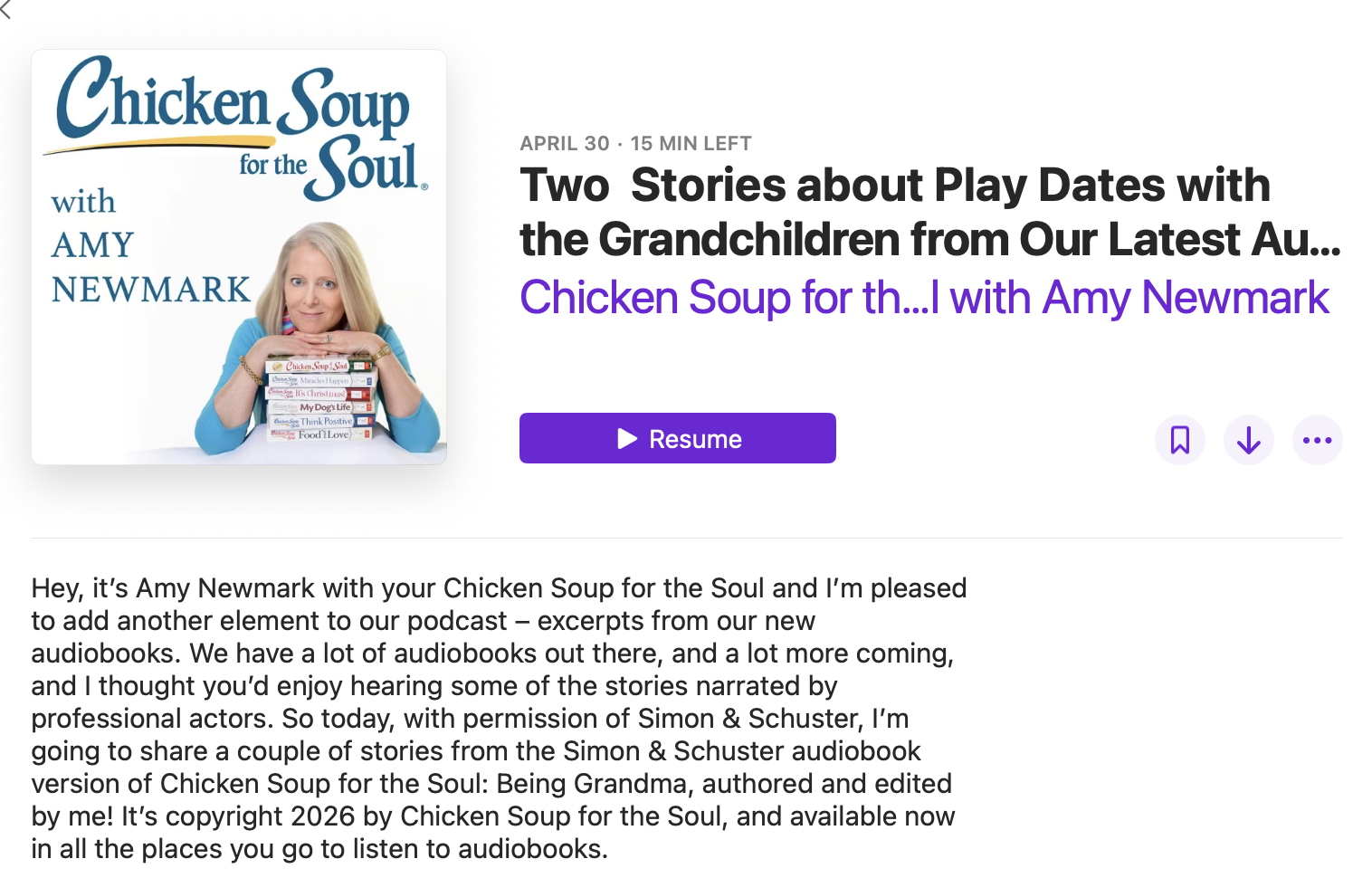
In case you’re looking for a gift for a special grandmother in your life, may I suggest Chicken Soup for the Soul: Being Grandma? You may remember back in March, I shared the good news that my personal essay, Birthday Buddies, is one of the 101 stories included in this heartfelt collection. 

In addition, did you know there is a Chicken Soup for the Soul podcast? I’m so pleased to share that my story, Birthday Buddies, was recently featured on the Chicken Soup for the Soul podcast, in the episode titled, “Two Stories about Play Dates with Grandchildren.” The entire episode is about fifteen minutes long, and my story begins at about 7:05 into the podcast. (You can access the podcast on Apple Podcasts, Google Play, or wherever you get your podcasts. And, please feel free to post a review!)

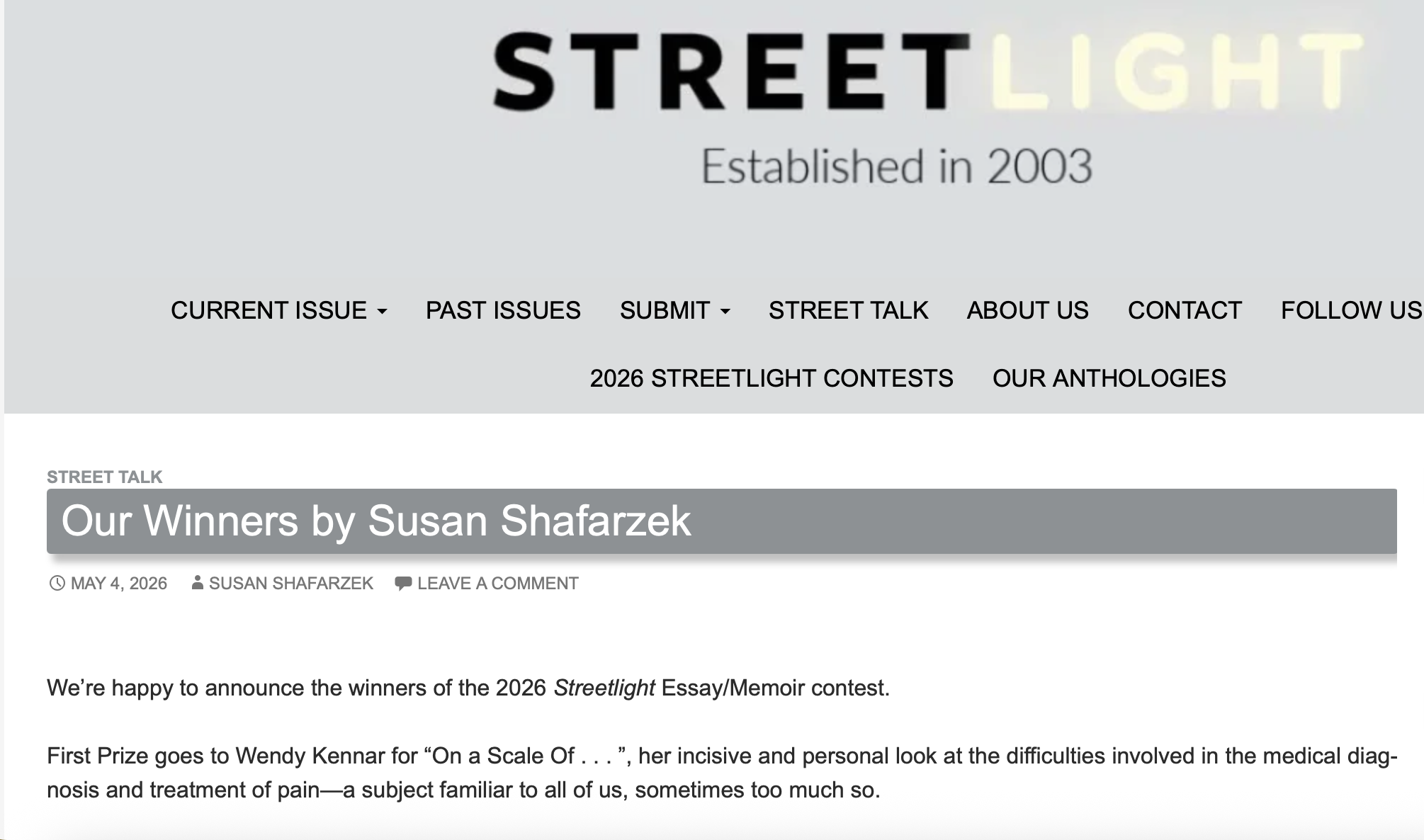
And, I have one more writing-related bit of news to share! I am so delighted and proud to tell you my personal essay, “On a Scale Of…”, has won first place in the 2026 Streetlight Essay/Memoir Contest. My essay, along with the second and third place essays, will be published in the 2026 Summer Issue of Streetlight. I’ll let you know when it’s available. 

Just the other day, I had told my mom I was getting one rejection after the other. Because that’s how it works in the writing-world, at least this is how it generally works for me. 

A partial screenshot of my Submittable page.

I write. I submit. And usually I get rejected. 

Last week, I received an email stating, “Unfortunately, this piece is not the right fit for the anthology at this time,” and three days later another email (for a different submission) telling me, “Unfortunately, the other nonfiction editors and I have decided not to accept your piece for our upcoming issue.” (These are actual quotes I pulled from two different email rejections.) 

So writer friends, keep at it. Keep writing. Keep submitting. 

Honestly, I almost didn’t enter the Streetlight contest. But then again, there is no chance of me winning anything or getting published unless I submit.

Please note: I am including a link to buy the book that I’m highlighting this week. If you use my link, I do make a small commission on your purchase at no additional cost to you. I am working with Bookshop.org which also sends a portion of the profit to support local, independent bookstores.