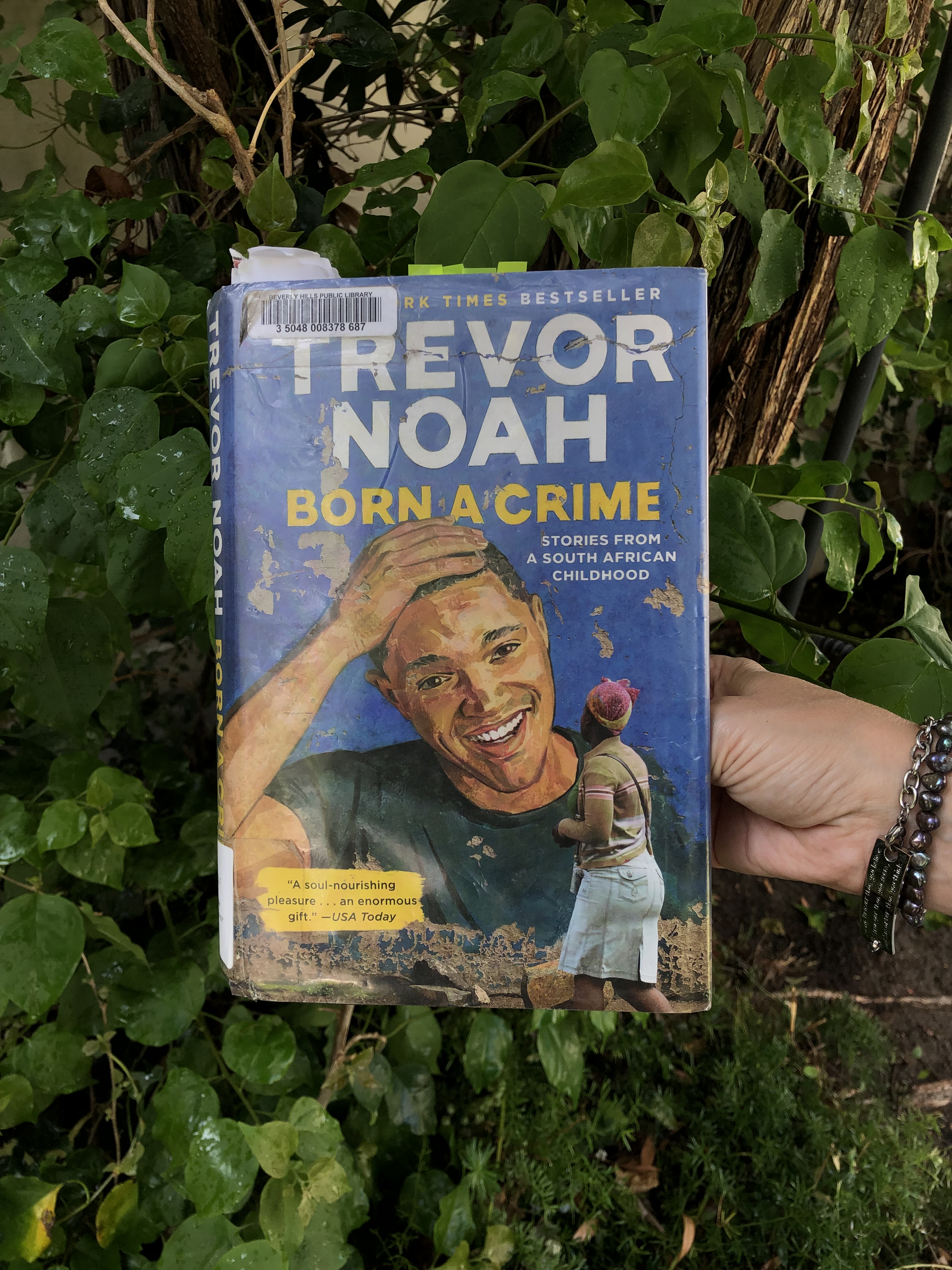
Born a Crime

Confession – I read Trevor Noah’s memoir as much for his story as well as a way for me to study memoir structure. It’s something I am incredibly curious about – how do other authors determine how to best organize their memoir? It’s something I’m trying to figure out as I write my memoir. 

But after reading Mr. Noah’s memoir, Born a Crime: Stories From a South African Childhood, I am just in awe.

And not just by the structure of Mr. Noah’s book, including the historical context for his childhood. Not just for giving me a peek into a world, a lifestyle, a culture I had limited knowledge of. 

I’m also in awe of Mr. Noah. And his powerhouse mother. 

If you haven’t read the book, I highly recommend it. (A few friends have told me they enjoyed the audio version which is read by Mr. Noah.)

This week, please allow me to share with you parts that really stood out to me, parts that made me take notice and grab a sticky note.

“I grew up in South Africa during apartheid, which was awkward because I was raised in a mixed family, with me being the mixed one in the family.” 

“In any society built on institutionalized racism, race-mixing doesn’t merely challenge the system as unjust, it reveals the system as unsustainable and incoherent. Race-mixing proves that races can mix – and in a lot of cases, want to mix. Because a mixed person embodies that rebuke to the logic of the system, race-mixing becomes a crime worse than treason.” 

“Estranged from her family, pregnant by a man she could not be seen with in public, she was alone. The doctors took her up to the delivery room, cut open her belly, and reached in and pulled out a half-white, half-black child who violated any number of laws, statutes, and regulations — I was born a crime.”

“As a kid I understood that people were different colors, but in my head white and black and brown were like types of chocolate. Dad was the white chocolate, mom was the dark chocolate, and I was the milk chocolate. But we were all just chocolate. I didn’t know any of it had to do with ‘race.’ I didn’t know what race was.”

“That, and  so many other smaller incidents in my life, made me realize that language, even more than color, defines who you are to people.

I became a chameleon. My color didn’t change, but I could change your perception of my color. If you spoke to me in Zulu, I replied to you in Zulu. If you spoke to me in Tswana, I replied to you in Tswana. Maybe I didn’t look like you, but if I spoke like you, I was you.” 

“My mom raised me as if there were no limitations on where I could go or what I could do. When I look back I realize she raised me like a white kid — not white culturally, but in the sense of believing that the world was my oyster, that I should speak up for myself, that my ideas and thoughts and decisions mattered.

“We tell people to follow their dreams, but you can only dream of what you can imagine, and, depending on where you come from, your imagination can be quite limited.” 

“But I was blessed with another trait I inherited from my mother: her ability to forget the pain in life. I remember the thing that caused the trauma, but I don’t hold on to the trauma. I never let the memory of something painful prevent me from trying something new. If you think too much about the ass-kicking your mom gave you, or the ass-kicking that life gave you, you’ll stop pushing the boundaries and breaking the rules. It’s better to take it, spend some time crying, then wake up the next day and move on.” 

“I don’t regret anything I’ve ever done in life, any choice that I’ve made. But I’m consumed with regret for the things I didn’t do, the choices I didn’t make, the things I didn’t say. We spend so much time being afraid of failure, afraid of rejection. But regret is the thing we should fear most. Failure is an answer. Rejection is an answer. Regret is an eternal question you will never have the answer to.” 

The Black Friend

I was an elementary school teacher for twelve years. There’s an unfortunate pattern I noticed – the parents you most want to speak with, the students you most want to help – are, often, the ones you can’t reach.

Literally, can’t reach. Parents don’t return phone calls. They don’t show up to Back-to-School Night or attend parent conferences. And it’s not for lack of trying. I used to start my conferences early in the morning, stay late in the afternoon, do everything I could to work around the schedules of the families of my students. After Back-to-School Night, I even sent home a stapled package of all the handouts I had presented the night before, and a note inviting families to come and visit the classroom at a more convenient time.

I kept thinking about all that when I read Frederick Joseph’s powerful book The Black Friend: On Being a Better White Person.

I don’t think I’m the target audience except that I am a white person. My husband is Black. Our son is bi-racial. Yet I acknowledge my own lack of information, lack of understanding. Just because my husband is Black doesn’t mean I have nothing to learn. 

So I read the book. At times it was heartbreaking. At times I just couldn’t believe the things Mr. Joseph heard and experienced. The book is written in a rather conversational style and each chapter ends with a discussion the author had with a different artist or activist.  

The people who most need to read this book, unfortunately, probably won’t.

However, that’s why this book, this powerful tool, should be used in classrooms (middle school and up). 

The problems don’t just go away. The wrongs don’t just get righted. 

They need to be confronted. 

In Possession of the ‘Enough Stuff’

Even if I had pursued my first dream, if I had tried to become a United States astronaut, I wouldn’t have succeeded. Because now I know the truth. Apparently I’m claustrophobic.”

“The first time I had an MRI, I was completely unprepared for it. I thought an MRI would just be a fancy X-ray. Instead, I felt as if I was being swallowed up by a massive machine that slid me inside and wouldn’t let me back out. It was loud, it vibrated, and I felt like the whole thing was a very elaborate plan to see how long it would take until I cracked and pushed the panic button. (I kept it firmly in my grip, my thumb gently hovering above the button. Just in case. And to my credit, I’ve never used it.)”

On the surface you might not think my childhood dream of becoming an astronaut and my current identity as a chronic illness patient have anything in common.

But they do.

I’m proud to share my essay, “In Possession of the Enough Stuff,” has been published in SWFP Quarterly Special Issue 26. You can click here to read the essay in its entirety.

And, fun bonus! On Sunday, August 15th, Santa Fe Writers Project hosted an incredible reading on Zoom. I participated and read a portion of my essay. The whole reading was incredible, and I feel fortunate to have been a part of it. (If you’re pressed for time, I start reading at about 50 minutes in.)

I’ll Be Seeing You

I have a stack of Elizabeth Berg novels on my bookcase. Her non-fiction book, Escaping Into the Open: The Art of Writing True, is on my shelf as well. I have read it more than once, and it has multiple sticky notes in it.

Last year, her memoir I’ll Be Seeing You was published and it was part of my haul from my first in-person visit to a public library. (In case you missed it, you can read about it here.) 

Ms. Berg writes about her parents — their love, their marriage, their aging process, their need to move from a home they loved. 

It was an honest, beautiful, tender read. 

One she was hesitant to write and share with the public. 

“But all that’s happening with my parents now: Is it unfair to publish my thoughts about it, to make it available to anyone who cares to have a look? Would I want someone writing about me losing my facilities? The answer is I don’t know. But I think if it served a larger purpose, I wouldn’t mind.” 

This week, I’d like to share just a few passages that moved me:

“Mostly, I feel grateful to be the age that I am now. You lose some things, growing older, but you gain other, more important things:  tolerance, gratitude, perspective, the unexpected pleasure in doing things more slowly. It’s not a bad trade, except that you are increasingly aware that your number will be up sooner rather than later.”  

“But the women in my group are writers, with an innate understanding of what art demands, requires, and does. They, too, have a reflexive need to document everything that happens to them or to others close to them, one way or another.”

“Yes, life is a minefield at any age. Sometimes we feel pretty certain that we know what’s coming. But really, we never do. We just walk on. We have to. If we’re smart, we count our blessings between the darker surprises. And hope for a fair balance. When I look at my parents’ lives, I know they were lucky. And still are.”

Lost and Found

I lost my teaching career. Teaching was more than my job; it was my passion. My identity. However, the pain and fatigue from my autoimmune disease (Undifferentiated Connective Tissue Disease) made it necessary for me to ‘retire due to a disability.’

I found my second career, as a writer. Since I was no longer teaching full-time, I could write full-time. Personal essays I submit to literary journals and anthologies. Blog posts for my personal website. Assignments as a regularly contributing writer for a popular family-oriented website, MomsLA.com.”

My personal essay, “Lost and Found,” is a series of reflections — about what I have lost as a direct cause of my autoimmune disease and what I have found as a result. It’s a way of acknowledging the ways I have changed, the ways my life has changed. 

Lost and Found,” was recently published in the Summer 2021 issue of Breath and Shadow. You can click here to read the essay in its entirety. 

Surviving and Thriving

When it comes to the most important roles in life (in my opinion – spouse and parent) no one gives you a handbook with practical, helpful tips and tricks.

And so it was when I received my autoimmune disease diagnosis. My rheumatologist gave my illness a name, and started me on medication, but he didn’t provide any advice on what it would mean for me long-term, what I should do that day, and the day after, and the day after that one.

Thankfully there are other patients out there, telling their stories and sharing their experiences. 

I recently read Ilana Jacqueline’s Surviving and Thriving With an Invisible Chronic Illness: How to Stay Sane and Live One Step Ahead of Your Symptoms.

It is the book I wish my doctor had handed me that November morning all those years ago. 

While I admit some of the advice and some of the anecdotes don’t apply to me (I’m not trying to decide if I can move out of my parents’ home, for example) I’m still glad I read it. And as you can see from the photo, I still found a number of passages to highlight and mark with sticky notes.

For example:

“Life with chronic illness is about managing expectations while keeping the hope alive enough to still make plans for the future.” (So beautifully put)

“Chronic illness isn’t something you beat or fight. It isn’t a race or a life-long quest to return to normalcy. You don’t reverse, battle, or spar with it. Chronic illness is something you outsmart.” (I haven’t figured that part out yet. I admit, most of the time I’m still trying to resist my chronic illness, still trying to prove I’m tougher and stronger than it is.)

“Acceptance isn’t defeat: It’s a declaration of self-respect under irrefutable circumstances. This is where you are and you’re going to make the best out of every moment of it.”  (I had never thought of acceptance in terms of self-respect.)

“Learning how and when to ask for help is going to be a huge asset to you in life.” (I continue to struggle with this one.)

“It is your body and your responsibility to treat it with confidence, intelligence, and above all, compassion.” (An important lesson for every human being.)

Prime Time or Off-Peak?

“The other night I sat on the couch as my husband stood behind me and brushed my hair. I told Paul I felt like I was slowly falling apart. I was becoming just like one of my Grandma’s purses.

‘What does that mean?’ Paul asked.

‘My grandma never liked to get rid of a purse. She’d tape the handles, because the rest of it still worked. It wasn’t ripped. The zipper worked. Just the handles were breaking. She’d use a taped-up purse,’ I said. 

‘That’s who I’m becoming,’ I said.

‘No you’re not,’ he said. 

But it’s how I felt just then. And it’s how I feel a lot of the time. Parts of me work just fine. Other parts, specifically my left leg, is more like the taped up handles – kind of working, kind of getting the job done.” 

The paragraphs above are from my recently published essay “Prime Time or Off-Peak?” (It was written last year so I must now let readers know my son is thirteen, and not twelve. Which means I’m forty-five, and not forty-four, as stated in the essay.)

You can click here to be re-directed to Kaleidoscope Magazine Number 83. My essay is on page 62.

There Is No Shame

Did you know July is Disability Pride Month?

I didn’t. 

Maybe it’s because I don’t feel pride when it comes to my invisible disability.

It’s more like resignation. Sometimes.

And sometimes it’s denial.

I don’t really know what it is, honestly, because having an invisible disability means I have a complicated relationship with my body. 

It’s a relationship that requires me to learn, and re-learn, what it means to be brave, to be strong, to be courageous, to ask for help, to say no.

And I have learned that just because it’s complicated and confusing, doesn’t mean it’s something I need to hide. Because the fact is, my invisible disability is a part of who I am. And it’s not going anywhere. And neither am I.

On that note, I’d like to share a link to a post I wrote last year for The Mighty. I think its message is an appropriate way to acknowledge Disability Pride Month. 

Click here to read my essay “There Is No Shame in Life With Chronic Illness.”

Books, Books, and More Books

Last week, I did something I haven’t done since early 2020.

I went inside my public library.

During the pandemic, I was lucky enough to still be checking out books from my library, but through a system of reserving specific titles and arranging a day and time to pick them up.

But the library is open again. Open for leisurely browsing. For stocking up. For being in awe of the sheer number of books I have yet to read.

I first thought I’d go into the library with no plans. Just me, my library card, and my empty tote bag. And I’d stroll among the shelves, picking up books, reading the summaries on the back cover, and bringing home as many books as I wanted. (Or as many as I could carry in my bag.)

But then that thought made me feel a bit overwhelmed. There is such a thing as too much choice. 

So I handled the visit to the library the same way I handle my grocery shopping.

It’s considered foolish to grocery shop on an empty stomach. I thought the same rule should apply to me in a library. I was hungry for books. For the freedom to walk in and pick up books because something — a cover, a title — caught my eye. 

So I made a list.

I went online and accessed the library’s catalog. And wrote down the call numbers for books that had been on my “want-to-read” list. I limited myself to eight books. (I’m not sure how I settled on eight, except that ten seemed too many, and eight seemed close enough to ten.)

I went to the library and made my way around the shelves, gathering my books, until my bag was heavier than I expected (I didn’t realize one book was a hardcover and over 400 pages long). 

And I came home happy. With eight books including memoir (Trevor Noah’s Born a Crime: Stories From a South African Childhood), poetry (Mary Oliver’s Devotions), and fiction (Linda Holmes’s Evvie Drake Starts Over) to name a few.

Libraries are open again, and in case you couldn’t tell, I was smiling under my mask.

(The public library still requires patrons to wear masks in consideration of the younger readers who don’t yet have access to a vaccine.)

A Soft Strength

Fairfax High School Senior Year Photo, Class of 1994

“For years, I used my hair as a diversion.

It began with my ponytail phase. Every picture in my mom’s photo album shows me with my hair pulled back into a ponytail. The photos didn’t capture the back of my head and the way I carefully color-coordinated my ponytail holder with the day’s outfit.

When I entered my teenage years, I attempted to dress my hair with a variety of colorful clips and barrettes. I hoped to turn eyes away from the red pimples on my forehead and cheeks. 

By my senior year in high school, I had grown my brown-M&M-colored hair down to my waist in hopes of distracting from the worsening acne on my face.” 

The paragraphs above are from my most recently published essay, “A Soft Strength.” You can click here to be re-directed to HerStry and read the essay in its entirety.