Will You Join Me, Please?

Hi Friends,

I don’t one-hundred percent know what I’m doing in terms of my writing career. (To be honest, I never dreamed I would even have a “writing career.”) I do know that I’m always learning, I’m always trying to improve — in terms of my writing craft, the way in which I share my writing, and the ways I connect with readers and other writers.

I have written a weekly blog for over a decade. In those very early years, before I invested in my website (www.wendykennar.com), each week’s post was written about any and all subjects. Anything I felt like writing and sharing I did. It was random, and because of the lack of cohesiveness, I think it was harder to find readers who would subscribe and regularly read my posts. It was much more difficult to form a community back then. 

Then, I re-organized my blog and wrote about one of three B’s in my life — Books (because writers are also readers), Boys (I’m the mother of a son and a former elementary school teacher), and Bodies (I live with an invisible disability). 

I have since deleted the “Boys” section, because my son is almost an adult. I don’t write about him and our interactions and relationship in the same way. Plus, I haven’t been a teacher now for twelve years. 

And, in another move that is also related to learning and growing, I have started a Substack account. Some of my blog subscribers have signed up for my Substack, currently known as “Wendy’s Weekly Words.” (wendykennar.substack.com) But for the most part, my Substack subscribers and my blog subscribers function as two distinct groups. 

I would like to change that. Here’s how:

I will continue posting my weekly blog here at www.wendykennar.com . My blog posts will generally be focused on books and bodies. Each week, I’ll continue writing about something I have read or my experiences with a chronic illness, life with chronic pain, and/or living with an invisible disability. 

And, I will be writing a bi-weekly Substack (wendykennar.substack.com), which will not just be a copy of what I have up on my blog. (Which is the way my relatively young Substack has been used up to this point.) 

My bi-weekly Substack will now include:

–  links to my recent blog posts in case you missed them 

– a writing prompt

– a wondering (something I’m confused about or have questions about. Maybe you have the answers.)

– a recommendation (something I read or watched or listened to)

– and when I can, a couple of famous dates in history that are somehow relevant to my writing and what I share. 

That’s what I’m planning to do. 

Here’s what I’m asking of you, please:

If you haven’t already done so, please subscribe to both my Substack (wendykennar.substack.com) and Blog (www.wendykennar.com). If you already are subscribed at both places, please just let me know in the comments section on one of my sites. (It would be great if you also followed me on Instagram @wendykennar. That way you’re sure not to miss out on anything I write or share.)

Those of you who subscribe to both my Substack and Blog, will then have a chance to win a book in a drawing. Names will be placed into a hat and I will randomly draw one reader’s name. As a thank you, I will mail you a personalized copy of Chicken Soup For the Soul: It’s Beginning to Look a Lot like Christmas. (My story, “A Timeless Gift,” is included in this collection.)

October 2019

This is all new to me. I’ve never done anything like this before. Maybe I’ll need to make some changes down the road. But for now, we’re going to give this a try. I hope you will continue being with me on this journey. Living with a chronic illness and writing can both be pretty isolating. I hope you know how much I value your support, how much your being here with me really does help!

Sign up by next week’s blog post on Wednesday, December 17th. That way I can have the drawing on Thursday, December 18th, and I can get your book out in the mail on Friday, December 19th. 

After that you can expect regular blog posts each Wednesday morning. 

And the first issue of my bi-weekly Substack will go out on Sunday, December 28th. (And the next Substack will be in your inbox on Sunday, January 11th, 2026.)

Thank you, friends. Thank you for reading. Thank you for supporting my writing. Thank you for supporting me.

Publication News!

“Mother, wife, daughter, friend. My most important roles. My most meaningful roles. And fifteen years ago, I added ‘spoonie’ to the list when I removed ‘teacher.’ It is a role I didn’t choose, a role I still don’t want, but one that is with me always, lurking like a shadow. Sometimes the spoonie version of me feels larger than all the other parts of my identity, overriding all other aspects of my life, screaming for attention, and unwilling to settle into the background. Sometimes the spoonie me is behind me or next to me, living alongside all my other roles, allowing me to live my life alongside my chronic illness. Rarely the spoonie shadow is not visible at all, and I am gifted precious reminders of the me that used to be — pain-free, illness-free, and free to do what I want, secure in the knowledge that my body would behave as I expected it to.”

The paragraph above is an excerpt from my recently published personal essay, “Attempting to Soar as a Spoonie.”

I’m pleased to share my essay was selected for publication in Issue 17 of Please See Me. The Issue’s theme is “Free,” and the prompts included:

– What does it mean to you to be truly Free – to live your best life no matter your health, life, or caregiving challenges? 

– What does it look like for you when you do not feel free?

The prompts allowed me to write an entirely new piece and include images and feelings I don’t think I’ve shared anywhere else in quite this way. I hope you’ll read it (by clicking here), and while you’re on the website, be sure to check out the other published pieces, including fiction, nonfiction, and poetry. 

An Acrostic Poem for Invisible Disabilities Week

Not all disabilities are immediately visible

Invisible Disabilities Week started on Sunday, October 19th and continues through Saturday, October 25th. 

The goal behind Invisible Disabilities Week is to raise awareness, because not all disabilities are easily recognizable or easily seen. Not all disabilities look the same. Not all people living with disability behave in the same way.

But just because you don’t see it doesn’t mean it’s not there. 

Just because I “look fine,” doesn’t mean I feel fine.

This week, I borrowed an activity from my teaching days — I created an acrostic poem as a way of raising awareness and sharing a bit of my personal experience. (In an acrostic poem, the first letter of each line spells out a word or phrase. I used the word Disability.)

Dinner time is generally hard for me. My family doesn’t know this, but many times I cry while I’m in the kitchen preparing dinner. Sometimes I think it’s because my body is tired after all day. Sometimes it all just feels like too much; I’m hurting so much I don’t know how I’ll keep standing, let alone wash the pot in the sink or cook the rice on the stove. 

Invisible disability means I don’t regularly use an assistive device. So at first glance you may think I’m “fine.” But if you pay attention you’ll notice that instead of climbing the five stairs out front, I walk up the ramp to get into the building where I go for my physical therapy. You may notice I limp sometimes when going for a walk in the neighborhood. Look carefully, and you may see me pause after crossing the street and stepping up onto the sidewalk. (Some of those curbs seem so high!) 

Symptoms vary and are not always a direct result of anything I did or didn’t do. Sometimes I experience a heaviness in my leg, as if I’m walking through mud and just can’t get my feet to move any quicker. Sometimes my left calf feels hard and tight, as if it’s stuck in a charley horse. Sometimes my left leg feels like it’s being squeezed, as if someone has strapped a blood pressure cuff around my leg. 

Ableism is discrimination in favor of non-disabled people. Like when my son’s high school expects all parents to navigate the stairs and hallways during Back to School Night. (You can read about my experience in this blog post.) Or when I used to see someone park their car in a handicap parking spot and exit their car looking “fine,” and I immediately thought they must be faking, using someone else’s placard. It’s embarrassing to admit, but it’s the truth.

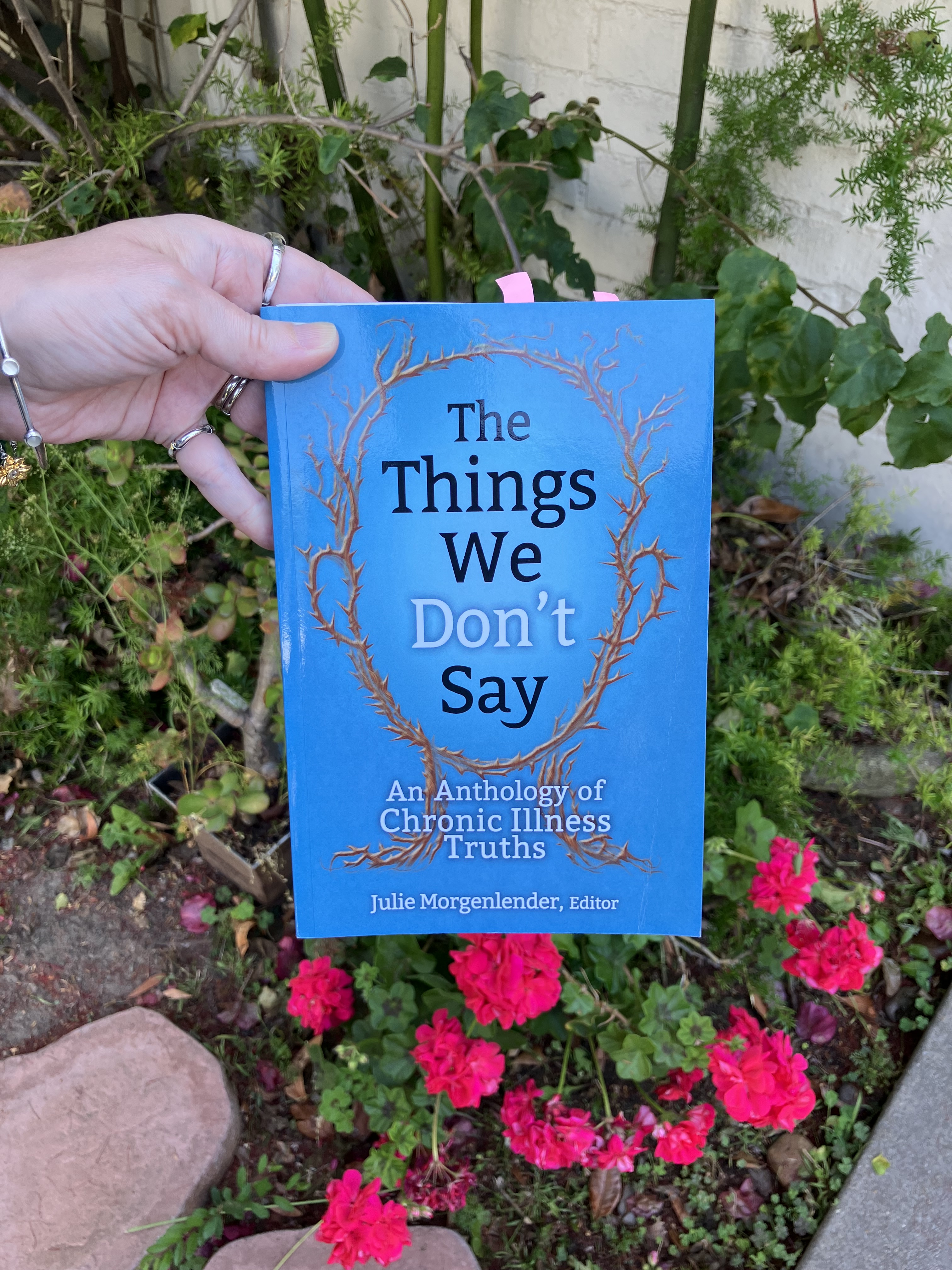
Books. After receiving my diagnosis, I went searching for books on the subject. Then I looked for books written by authors on parallel paths, maybe their diagnosis was different than mine, but the emotions would be similar. I really couldn’t find much. Which is why I’m always recommending The Things We Don’t Say: An Anthology of Chronic Illness Truths. Full disclosure, one of my essays is included in this anthology. (Side note – this is why I believe there is an audience for my as-yet-unpublished memoir.)

Ironic. When I was in high school, I had such a hard time learning to swallow pills. I gagged. I coughed and sputtered, certain I would choke. Yet, here I am all these years later, and I take almost 20 pills a day (both prescription medication and over-the-counter supplements/vitamins). 

Live the life you’ve dreamed of. We had a plaque with that expression hanging on the wall by the staircase. It didn’t happen right after I became ill, but sometime later I came to  realize I no longer liked that wall hanging and I no longer wanted it in our home. In some respects, this is absolutely not the life I dreamed of. I didn’t dream of retiring from teaching because I was physically unable to continue. I didn’t dream of qualifying for a disabled parking placard before my parents. It happened. Period. But I definitely didn’t dream it.

Individual experiences do vary. Each chronically ill patient is dealing with a different set of variables, including different symptoms and different treatments. Which means it’s not helpful when someone (who knows very little of my medical history) makes a general statement trying to convince me that the solution is yoga/green smoothies/becoming gluten-free/fill-in-the-blank because it worked for their friend/neighbor/coworker/relative.

Treatment is challenging. Because what worked for a while (meaning, what kept my inflammation under control) can suddenly stop working. There are so many variables at play, including physical movement, mental health, stress, menopause, and sleep it’s hard to really know which one is the biggest factor in how I feel. 

Yearning to feel like my “old self.” The Wendy who woke up feeling rested. The Wendy who didn’t dread that first walk downstairs. The Wendy who didn’t have to think about her pain and her knees and her sensitive calf. The Wendy who could walk for an hour. The Wendy who could walk to the nearby shopping center without thinking twice about how I’d feel during and after the walk. The Wendy who trusted her body would always work the way I expected it to. 

Please note: I am including a link to buy the book that I’m highlighting this week. If you use my link, I do make a small commission on your purchase at no additional cost to you. I am working with Bookshop.org which also sends a portion of the profit to support local, independent bookstores.

The Last Time

My son helped me out by editing this photo. For privacy reasons, the teacher's name has been blurred.

Somewhere, I once read about a sneaky fact of parenting; the one you didn’t realize happened, until after it happened — the phenomenon known as “The Last Time.”

For instance, the last time I held my son’s hand as we crossed the street.

Or, the last time I helped my son wiggle his feet into his socks and shoes. 

Just a few days ago, there was a last time. Though this “last time” was different because I knew it was coming. More than that, I looked forward to it. 

Last Thursday evening was the last time I will attend a Back-to-School Night. 

As a former teacher and parent, I always appreciated a parent’s attendance at school functions. At the same time, I completely understand why parents can’t always attend these important school events. (In fact, when I was teaching, if a parent missed Back-to-School Night and/or Open House, I always saved any handouts I distributed that evening, and the following day I sent them home with the student whose parents weren’t in attendance.)

So even though my son is a senior and is a strong student and there were no concerns we needed to discuss with his teachers, last Thursday evening, my husband and I attended Back-to-School Night and met seven of my son’s eight teachers. (One was absent.) We briefly chatted with each teacher and thanked them for all they do. In many instances, we were the only parents in the room. 

But oh-my-goodness I am so relieved I won’t have to do that again. Because at my son’s high school, parents follow a very strict schedule during Back-to-School Night. We spend ten minutes in each classroom and have only five minutes to get from one classroom to another. 

This means we went to our son’s first period class for ten minutes (4:00 pm – 4:10 pm) and then had only five minutes to get to my son’s second period class — located on the second floor in a different building. Now, I know I’m not going to get penalized for not being in class before the bell rings. (And yes, bells ring throughout Back-to-School Night.) But I consider it a courtesy and obligation for me to try, as hard as I can, not to be late. (You can imagine our frustration when we made it to our son’s second period class, a minute late, and found a note on the door stating the teacher’s absence.)

Which is a long-winded way of saying our son’s high school operates on an ableist mentality when it comes to Back-to-School Night. Parents are expected to be physically able to navigate the stairs, both inside and outside the buildings. 

For those who don’t know, school elevators are not easily accessible. You don’t just push the up button like you do in an office building. School elevators require a key to operate, which means you have to get in touch with a school staff member who has the key. (Only a select few have the coveted elevator key. I did have an elevator key the last few years of my teaching career.)

Remember, Back-to-School Night operates on a very tight timetable. There is no extra time built in for navigating the elevator situation. Plus, I never wanted to be a distraction, or make more work for anyone else — things I think about, things I know logically aren’t true, but they feel true to me. I wanted Back-to-School Night to be about my son and his experiences in school, not on my weak left leg and my bad knees and my invisible disability. 

Plus, I always feared someone would accuse me of not really needing an elevator. Let’s face it, I don’t look like I “need” an elevator. How best do I explain my invisible-to-others physical limitations?

Now, all that’s behind me. I made it to the finish line — The Last Time I Attended My Son’s Back to School Night. 

Pain Awareness Month. Again.

Oahu, June 2025. This is a photo of a woman in pain.

September is Pain Awareness Month.

I wrote about it last year.

I wrote about it in 2023.

I wrote about it in 2022.

I wrote about it in 2021.

I wrote about it in 2020.

You get the idea. 

Each post shares some variation of the same message:

I live with pain. Every. Single. Day. For fifteen years and counting. 

That’s why it’s called “chronic pain.” It’s long-lasting.

You never know what someone is going through just by looking at them. 

Because during those fifteen years, I have lived. I have made new friends. I have written, and published. I have traveled. I have adventured (horseback riding, hot air ballooning, parasailing – twice, zip lining). I have attended Back to School Nights and Open Houses. I have gone grocery shopping and shoe-shopping for my son. I have attended book launch events and Harlem Globetrotter games. I’ve visited museums and beaches. 

I remember meeting with a neurologist, referred to me by my neurologist-at-the-time. She thought this other doctor could look at my medical records and give us a fresh perspective with another set of eyes. 

Instead, this fresh-set-of-eyes-doctor was condescending and rude and mean. Before leaving the exam room he patted my shoulder and told me my pain really couldn’t be all that bad if I truly did all the things I told him I do each day.

And that, right there, is the purpose of Pain Awareness Month.

Those of us living with chronic pain have figured out how to navigate our days while struggling with pain that doesn’t ever completely go away. We have developed work-arounds and shortcuts when possible. We have learned to bite our tongue or clench our fists or whatever it is we do that helps us push past the limit of what we thought our bodies were capable of. 

Oahu, June 2025. Same day as the picture above. This is also a photo of a woman in pain. Notice my lips. I often do that when in pain.

Which leads me to this — please, be kind and patient and compassionate toward others. That person walking slowly in front of you could be me. Someone who is walking slowly but it’s the best she can do because each step brings a fresh jolt of pain up and down her leg. 

Or maybe it’s someone whose stomach hurts. Or their head. Or their back. Or their feet. Or their shoulder. Or their elbow. 

I could go on, but you get the idea. 

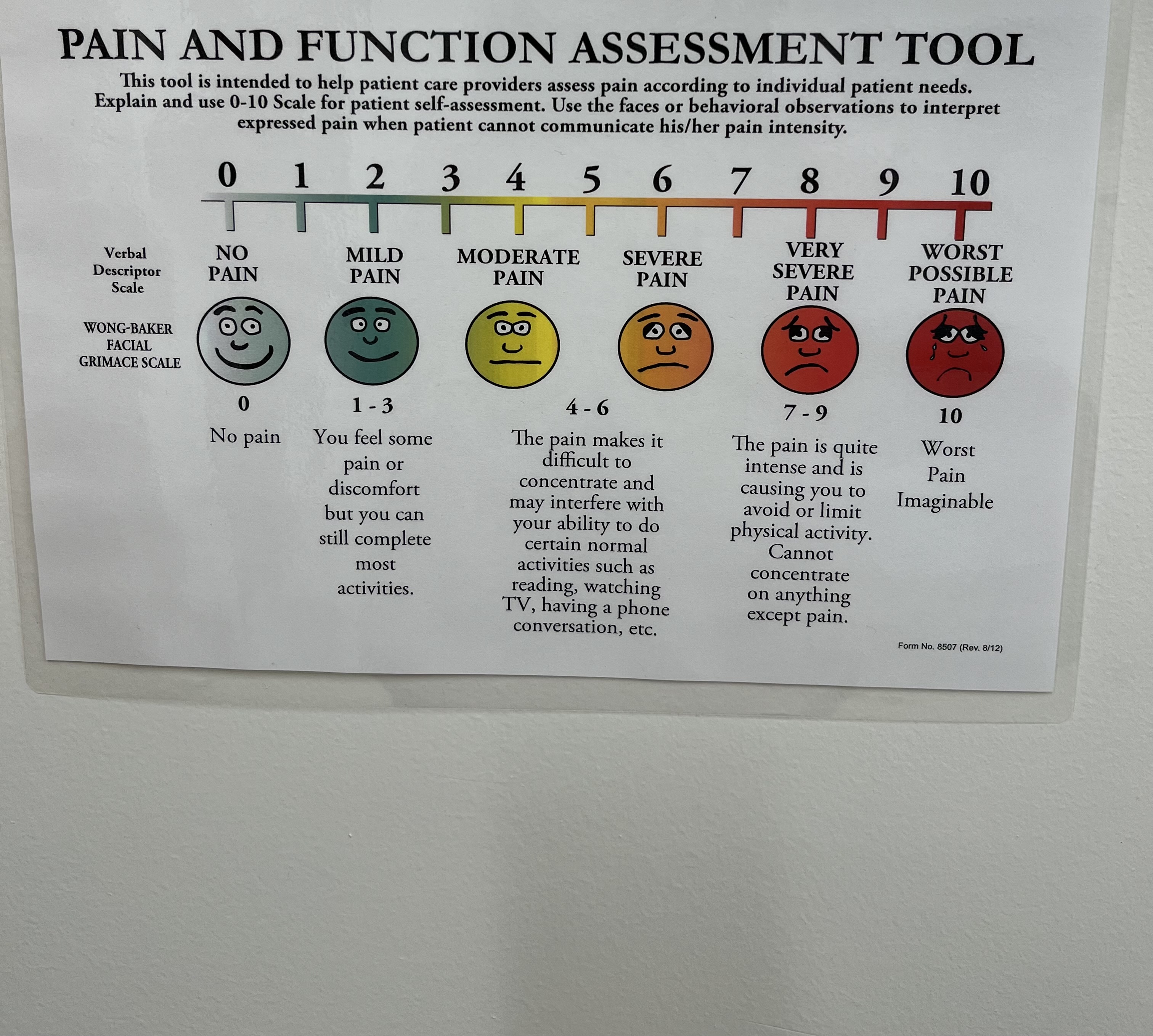
And, one more thing – this year, I wanted to end the post introducing you to an alternative way to talk about pain. Most of us have experience with the (dreaded) pain scale that depicts faces on a 1-10 scale. And if you haven’t had personal experience with this scale (wonderful for you!), it’s most likely you’ve seen it hanging on the wall in an exam room.

Christina Irene, a hidden disability advocate, speaker, and author, has developed what she calls the “Splat” system. As she writes, “Splat is a system of communication for people with chronic illnesses, mental health diagnoses, and other hidden disabilities. Our conditions are often a ‘moving target,’ meaning we never know how we’re going to feel from one day to the next. The one certainty is: Every day, we feel like we’ve been run over by something.” Check out her website where she has a whole page dedicated to the Splat system, with resources you may find helpful.

4 Things Everyone Should Know About Living with Chronic Illness(es)

June 2025 - Oahu. The smile is real. And so was the pain.

Some weeks I know exactly what I want to write for my weekly blog post.

Some weeks I have several ideas for my weekly blog post, and it’s just a matter of deciding which one to choose.

And other weeks, I have no idea what to write for my weekly blog post. I thought that was going to be the case for this week’s post.

But I was wrong. 

Because all of a sudden, on Monday evening, the idea for this post came to me. I could see the post, in a sense. I just had to get it down. 

Barbara Abercrombie, who I have written about before, used to tell our classes that writers don’t just wait for “The Muse” to show up. If you do that, you’re waiting most of the time, and writing almost none of the time. But, she did say, that if you put in the work, if you regularly wrote, if you dedicated yourself to a writing practice, every so often The Muse shows up and gifts you a piece of writing. 

This post is that gift. Here I present:

4 Things Everyone Should Know About Living with Chronic Illness(es):

  1. Crying doesn’t always mean the pain is extreme. Sometimes, I cry out of frustration. Exhaustion. Sadness. Fear. Discouragement. Weariness. 
  2. Not crying doesn’t mean the pain isn’t extreme. Sometimes, crying isn’t an option. Standing in line at Trader Joe’s, it’s best if I can hold the tears back until I get into my car, for at least a bit of privacy. Tears out in public lead to questions. And while those questions may all be well-meaning and may come with offers to help, I just don’t always have the bandwidth to start explaining my specific situation, my pain, to strangers.
  3. Chronic illness is not the same as an illness. Yes, everyone has a story — of a bad flu, a broken bone that didn’t heal properly, an unforeseen side effect after a “routine” procedure. But none of that is the same as living with a chronic illness. (And, just to be clear — I’m not saying one is “worse” than the other. I’m saying one is different than the other.) Living with chronic illness involves a different type of “wear and tear” on your body that most people aren’t experiencing. A different type of tiredness. Think of it this way — me telling you I spent time practicing my three-point shooting is much different than Caitlin Clark telling you she spent time practicing her three-point shooting. 
  4. There is no easy fix. Someone lives with a chronic illness for that very reason — it doesn’t eventually “go away.” Chronic illness patients aren’t being difficult. Or stubborn for not trying the thing that worked and helped you/your relative/your coworker. These chronic illnesses are lifelong conditions because they aren’t curable. No amount of green smoothies, yoga, or vegan-only foods will magically change that. 

Note — several years ago I wrote a similar post, 4 Reasons Why Chronic Pain Sucks. Everything I wrote then is still true. Again, that’s the “chronic” part of it. 

Spoonie friends, what would you add to my list? What do you think more people should know about living with a Chronic Illness?

Defining Disability

The work in my Mastermind program continues. 

Part of our tasks has been to think about what we write and why. (I wrote a bit about this in a May blog post. Click here if you missed it.)

This week, however, I am sharing two photos with you as another example of what I write and why.

The photo shows my seventeen-year-old son and me parasailing, a week-and-a-half-ago during our family trip to Oahu. We calmly dangled 1000 feet above the Pacific Ocean. We talked and marveled at the incredible view below us and around us, noticing the quiet and the sense of peace we felt being that high up.

On that day, in those moments, my body was physically strong enough to climb aboard the boat, maneuver into the harnesses, and smile and wave at those down on the boat looking up at us. 

Yet back at the hotel, my backpack held my blue disabled parking placard. And when I left Los Angeles and arrived in Honolulu I received wheelchair assistance at both airports. (I also had wheelchair assistance at both airports for our return flight.)

Both situations are true. 

I may fit the more narrow, stereotypical idea of a disabled woman when someone sees me sitting in a wheelchair at the airport. 

But, I’m still a disabled woman, even when I’m gliding through the air, with a multi-colored parachute open behind us. 

And that is why I write — to demonstrate there is no definitive, one-and-done definition of disability.

Friends, I’m curious. Have any of you gone parasailing? Where? What was your experience like? Please feel free to share in the comments!

Time to Take a Seat

Image Credit: Wishbone Words Magazine

Friends, I’m pleased to share that my personal essay, Time to Take a Seat, has been published in Wishbone Words Magazine, Issue 15

This piece was a difficult one to write. It’s a personal essay that went through many revisions before I submitted it.  

It’s a personal essay about my decision to purchase a wheelchair. 

I’m grateful Wishbone Words Magazine provides this space for me and other “disabled, chronically ill, and/or neurodiverse writers and artists” to share our experiences and our creations in a safe, inclusive space. 

You can click here to learn more about purchasing Wishbone Words Magazine, Issue 15. 

Image Credit: Wishbone Words Magazine

Am I a Spoonie?

“Choosing to define yourself as a spoonie is an individual decision. It is not a medical term bestowed upon you by someone else. Other terms, such as disabled and chronically ill, are assigned to us by those in the medical field. No one will call you a spoonie, until you decide to call yourself one. Being a spoonie was fine for others, but I didn’t think it applied to me. Until there was no denying that it did.”

The paragraph above is excerpted from my personal essay, “Am I a Spoonie?” which I’m proud to share was recently published in FLARE Magazine. From the website: FLARE was named after autoimmune flares one gets when they are chronically ill and a play on the word “flair” for writers to show their “flair” despite the “flares” they encounter.”

Click here to read “Am I a Spoonie?” in its entirety.

For my chronic illness friends, do you consider yourself a spoonie? Or is there another term your prefer? Please share if you’re comfortable!

It’s a 24/7 Job

It's just me - using my (invisible) superpower

My son returned to school on Monday after his week-long spring break. It was nice to have a change in my routine and be able to sleep past 6 am.

But his spring break, along with my husband’s days off work (timed to coincide with our son’s week off), just amplified what I am always aware of but generally don’t call attention to — when you live with a chronic illness, you never get a day off.

This is not to say that things are all the same, across the board, for everyone who lives with a chronic illness. Because that’s not the case at all. Medical conditions and health histories differ from person to person. 

However, I think it is fair to say that, for the most part, all chronically ill folks are dealing with a lot on a daily basis:

– overseeing medication: keeping track of when to take the meds, refilling the prescriptions, making trips to the pharmacy to pick up prescriptions and/or arranging to be at home to sign for and receive mailed prescriptions. 

– keeping track of symptoms: looking for patterns between what we did and how we feel. Or patterns between what we didn’t do and how we feel. Or patterns between how we slept and how we feel. Or patterns between what we ate and how we feel. Or patterns about what we didn’t eat and how we feel. You get the idea.

–  managing finances: writing checks to cover co-payments. Making credit card payments towards the expensive, insurance-didn’t-cover-the-full-amount, most-recent, doctor-recommended scan. 

– scheduling: consultations, evaluations, and follow-up appointments. Figuring out days and times for routine lab work. Keeping track of what you can and can’t do before each appointment or medical test. Fasting before some labs, but not all labs. 

– fatigue: it’s not feeling tired. It’s not even being exhausted. Because those are temporary. With a good night’s sleep, general tiredness and exhaustion disappear. Chronically ill folks live with fatigue that is not related to the amount of sleep you get each night. It’s the awful feeling of waking up feeling absolutely un-rested and completely drained and knowing you still have the whole day ahead of you.  

– dealing with side effects: every medication comes with a long list of potential side effects. Some are common, such as constipation and diarrhea (for which you may need medication to help with those side effects, even though those symptoms were caused by medication in the first place). Generally, any possible, unpleasant side effects are deemed worth it by the prescribing doctor. In other words, the possible good outweighs the possible bad — including weight gain and hair loss.  

And there’s one more thing. Something I think most people aren’t even aware of. 

Everyone I know who lives with a chronic illness, also lives with a superpower.

What’s the superpower? you wonder. I’ll tell you:

Pretending we’re well, when we’re not. 

Someone living with a chronic illness and/or chronic pain is never faking being sick. Instead, they’re actually faking being well. 

Every day.