“You would think I would have this figured out by now. Figured out how to be me — a wife, a mom, a writer who only became a writer because I had to retire from my teaching career because of my invisible disability. But I haven’t figured it out. There is no manual, no cheat sheet, no YouTube video to watch to give me the summary I need, the way my son watches a YouTube video to review the section of The Odyssey he read for his English class. “I’m making it up as I go along. Engaged in a fight, trying to rebel against this body of mine that is different now. Will always be different.”
The lines above are just a snippet from my recently published essay, When Your Body Rebels With Chronic Illness. You can click here to read the essay in its entirety. (Note: this piece was originally written a couple of years ago. I must point out that my son is now 16 years old.)
Back in January, I wrote about my word for 2024: Share.
(If you missed it, you can click here to read the post.)
And so far, I have done quite a lot of sharing — here on this weekly blog, on Instagram where I mostly share about books and my writing-related life, and in the personal essays which have been published in anthologies and journals, both in print and online.
This week, I am pleased to share my personal essay, There is No Magic Wand, has been published by Yoocan Do Anything.
Here is a snippet:
“I would stop by CVS on my way home and pick up the prescriptions my doctor had called in. I felt confident these new pills would fix the problem because that’s what medication had always done up until that point in my life. “I could not have known that when it comes to a chronic illness, such as my autoimmune disease, there is no such thing as ‘fixing the problem.’ There was no pretend magic wand I could wave and make things all better, like I did with my then-three-year-old son when he bumped into a corner of the coffee table. No one could kiss my left calf and make the hurt be ‘all-gone,’ like a Mommy’s kisses often do for their little ones.”
Last week was a time of big emotions. A lot happened in my world and with it came a lot of mixed feelings.
My mom celebrated her 79th birthday on the same day my son celebrated his 16th birthday.
A former kindergarten student, a child I taught during my first year of teaching, looked me up online, found my website, and reached out with an email that made me cry. She wrote, “I wanted to thank you for being a great teacher and setting a solid foundation for my education.” Did I mention she’s now a teacher?
We had a family outing to The Huntington Library, Art Museum, and Botanical Gardens. A place we hadn’t visited since March 2020, a week before the world shut down because of the coronavirus. Only this time we visited with me in my wheelchair.
Our former next door neighbor, now 89 years old, remembered my son’s sixteenth birthday and called to offer birthday wishes.
So, it’s been a lot.
Something I have learned, through the work with my therapist and my years living with my autoimmune disease, is that it’s possible to feel two very different emotions at the same time. In fact, when you live with chronic illness, it happens quite a lot. At least to me.
This week, I’d like to share a bit of Kate Bowler’s blessing, “For Stretching Your Heart,” which I think explains these mixed emotions so well:
“Yes, I have so much to be thankful for, and this hasn’t turned out like I thought it would. Yes, I feel moments of joy, and I have lost more than I could live without. Yes, I want to make the most of today, and my body keeps breaking. Yes, I am hopeful, and this is daunting. Yes, I am trying to be brave, and I feel so afraid.”
Because the truth is — yes, things could be worse, and things could be better.
Please note: I am including a link to buy the book that I’m highlighting this week. If you use my link, I do make a small commission on your purchase at no additional cost to you. I am working with Bookshop.org which also sends a portion of the profit to support local, independent bookstores.
“In the beginning, it was easier to describe the pain. Because the pain was new. Because the pain was concentrated in my left calf. And, most importantly, because I truly believed the pain was temporary.”
The paragraph above is taken from my personal essay, “It Feels Like…” And I am so proud to share that my essay has been published in The Mersey Review, Issue 2.
I have never had so many personal essays published one-after-the-other, like I have recently. (Five of my personal essays have been published between January 2024 and March 2024! My Published Work page has a complete listing.)
And you can click here to be taken directly to my essay.
Also, be sure to read all the way to the bottom. After my bio, you’ll come to a statement that says: “You can read Wendy Kennar’s Few Words here.” Click on the link and you’ll be taken to another page which includes my answers to a few questions the editor asked me about the writing process. Plus, I answer that “eternal question” — hardback or paperback?
Dear Readers, feel free to share your preference in the comments: hardcover or paperback?
Dear Readers, I have more publication news to share!
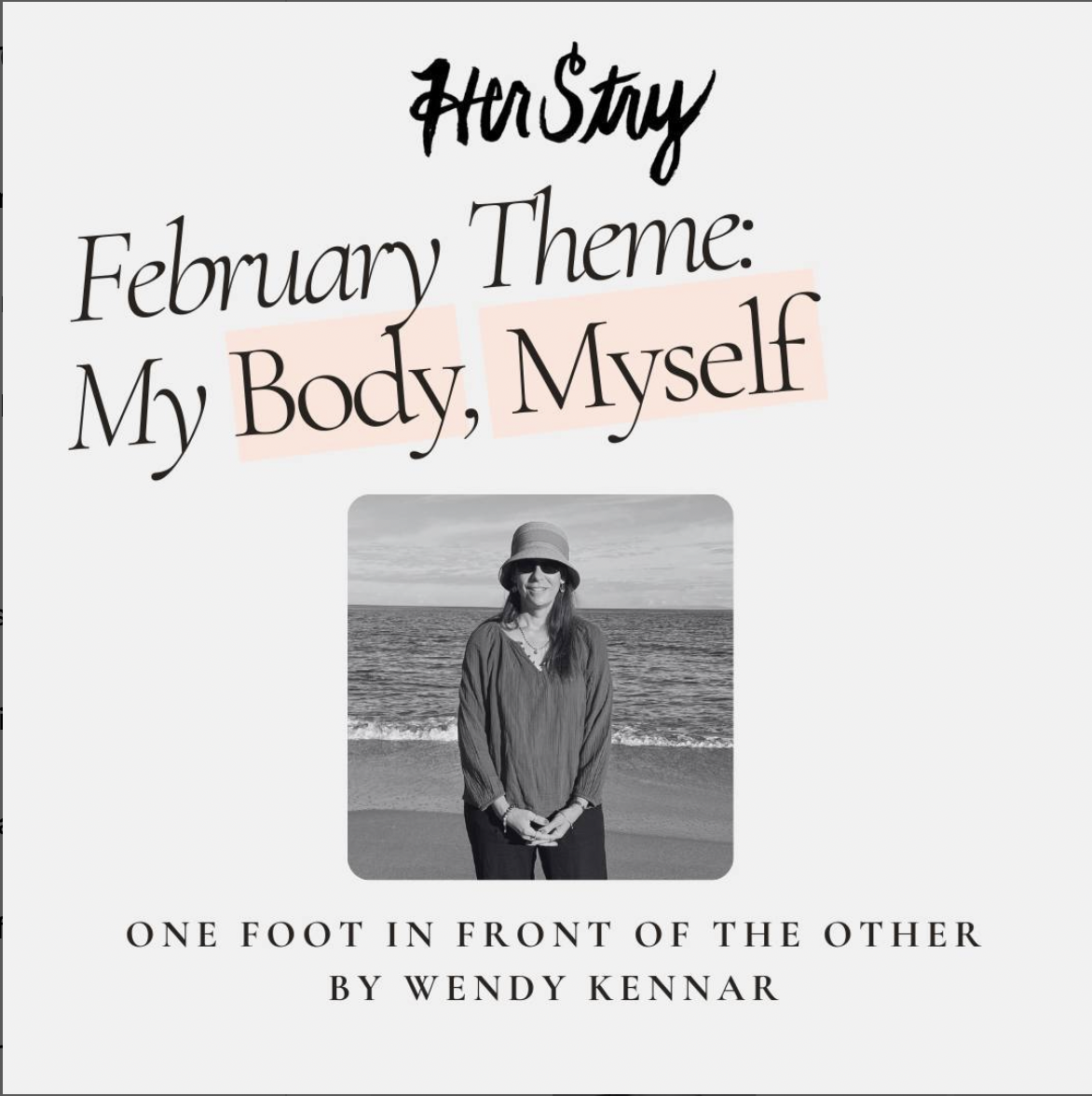
I’m proud to say my personal essay, “One Foot In Front of the Other,” was published by HerStry as part of their Monthly Theme Series. February’s theme was “My Body, Myself.”
Here is just a snippet:
“It’s easy to look at my body and feel disappointed, disheartened, and cheated. I’m in my forties, a time when many women feel empowered, as if they have reached their prime. But that’s not how I feel. I feel like my aging process has been sped up, like a time lapse video. I feel like my body can’t entirely be relied on, as if I’m defective.
“I’m closer to fifty than I am to forty and am trying to make peace with this compromised body of mine. Occasionally I look at myself in the mirror and linger on my face. I think back to all those days when I yearned for clearer skin. Now, an occasional pimple doesn’t even register on my list of things to be concerned about. Now my self-consciousness has transferred to my left leg with its two scars (from two different muscle biopsies) and prominent red, blue, and purple veins.”
You can click here to read the essay in its entirety.
I am pleased to share that my personal essay, “Chronic Illness, Chronic Pain, and Gold Stars,” has been published in a new anthology, Chronic Poetics. “The book contains artwork, essays and poetry written entirely by people who have experience of chronic pain and chronic illness.” Each piece of writing has been “arranged and visually interpreted,” making it possible to create an anthology that tells a “visual story as well as a literary one.”
I’d like to share two excerpts from a section near the end of my essay:
“I wish someone had handed me a manual of some sort. My car came with one. The new little handheld vacuum I recently bought came with one. (I don’t remember the last time my trunk looked so clean.) But no one told me how to navigate living with a chronic illness. No one pointed out that a chronic illness is one thing. A chronic illness causing chronic pain is something else.”
“There are moments I want to cry. Moments I want to scream. Moments I want to throw things and break things. Because this is hard. And it’s tiring. And it often doesn’t feel like it gets any easier or any better.”
You can find more information about the anthology here.
My memoir is divided into three parts. The final essay in this part, and the book, is "Something to Endure."
Super exciting news: my manuscript is complete, and I will now be entering a new stage of the writing process — the querying-agents phase.
But before I got here, when I was revising and rewriting my manuscript, I had to make a decision regarding my final essay. I had three essays that my book coach and I agreed were all possible candidates for that all-important last essay in the book.
It is my hope that my memoir will be read by those living with chronic illnesses, as well as those who know people who are living with chronic illness. I’m hoping that my story can serve as an example. Though the medical specifics may vary, the emotions may be quite similar. So someone who lives with diabetes, for example, could give my book to a loved one, point to one of my essays, and say, “Here. Read this. This is what I feel like sometimes.”
For far too long, terms such as “disability” and “disabled” have been too narrowly defined. I really want my memoir to broaden those definitions, and I would like my story to serve as just one example of what a disabled life looks like.
When I started working with my book coach, I told her I was writing the book I needed to read when I became ill. I hope after reading my memoir that my chronically ill readers feel less alone and more understood. Along those lines, I want my final essay to give readers a sense of comfort, a dose of good-feels.
Before making my final decision, I stopped to reflect and think about how I want my readers to feel when they’re done reading my memoir-in-essays.
These were the adjectives that I came up with:
Hopeful.
Enlightened.
Inspired.
Comforted.
With that in mind, I made my decision (and my book coach agrees). My final essay is titled “Something to Endure.” Because basically that is the bottom line when it comes to chronic illness. You have to endure the illness. You need to stick it out and figure out ways to handle it, to be with it day-in and day-out for the long haul.
But you don’t have to do it alone. Books, including my own, connect us.
Get a Life, Chloe Brown by Talia Hibbert is what some readers would refer to as a rom-com. Some readers may use other terms such as “chick lit” or “women’s fiction,” but I’m not a fan of those terms. You should know that this particular rom-com has quite a high level of “spice,” meaning explicit “steamy” scenes.
But here’s the main thing you should know about Ms. Hibbert’s novel: Chloe Brown, the main character, is a Black woman who lives with fibromyalgia, a chronic illness causing chronic pain. Plus, the book features an interracial relationship. I love this sentence taken from the author’s website: “She writes spicy, diverse romance because she believes that people of marginalised identities need honest and positive representation.”
This week, I share with you just a few of the passages that really stood out to me:
“Most people had trouble accepting the fact that Chloe was ill. Fibromyalgia and chronic pain were invisible afflictions, so they were easy to dismiss. Eve was healthy, so she would never feel Chloe’s bone-deep exhaustion, her agonizing headaches or the shooting pains in her joints, the fevers and confusion, the countless side effects that came from countless medications. But Eve didn’t need to feel all of that to have empathy. She didn’t need to see Chloe’s tears or pain to believe her sister struggled sometimes. Neither, for that matter, did Dani. They understood.”
“It had been a frustrating few days. She’d fallen into an infuriating cycle when she’d climbed that tree. Physical overload led to pain and a complete dearth of spoons, also known as mind-numbing exhaustion; which led to extra meds and insomnia; which led to sleeping pills and too much brain fog; which led to, in a word, misery.”
“…my body was different. The weight on my chest, and the cold — they faded, as I got better. But my bones still felt fragile. It never went away. Over the months, I noticed more and more problems. I was exhausted all the time. I got these awful headaches for no reason. And there was the pain — always, so much pain. I’d go for a walk and feel like I’d worked every muscle to the point of tearing. If I spent too long on my laptop, my hands would hurt so badly I cried. I started feeling afraid of my own body, like it was a torture chamber I’d been trapped inside.”
Please note: I am including a link to buy the book that I’m highlighting this week. If you use my link, I do make a small commission on your purchase at no additional cost to you. I am working with Bookshop.org which also sends a portion of the profit to support local, independent bookstores.
(This photo was taken a couple of months ago. Different doctor. Dreadful pain chart.)
I had a hard doctor’s appointment last week.
Maybe “hard” isn’t the right word. After all, I found parking half-a-block away from the building. The doctor was only running a few minutes behind schedule. And because I had blood work done in December, no additional labs were needed.
In those terms, it was a pretty good appointment.
But it was still a hard appointment. Because I left the appointment feeling weary, disappointed, and dejected. Angry, frustrated, and pissed. Sad, crushed, and dejected.
Later, I told my husband, “No one knows what to do with me.”
My rheumatologist (rheumatologist number three in my life with chronic illness) cannot explain my increased levels of pain and decreased levels of energy. Because the blood work shows my inflammation is under control. Which means my medication is working. But it doesn’t explain why I feel like “I’m going downhill, fast, and no one is able to slow me down.” (I said that same sentence to my doctor. He nodded his head. He said he understood.)
I should point out that I do like this doctor. I like that he looks at me when I speak and really seems to be paying attention to what I have to say. I like that, during past appointments, he seems thoughtful when suggesting new medications to try and shares with me his reasoning behind those medications. (By the way, I have tried every medication he has suggested. A few made me worse than I was to begin with.)
My doctor said he’s concerned about “structural damage” to my body. Which sounded more like a description of a car than a person. My doctor voiced his concern about feelings of depression I may have. I reminded him I regularly speak with my therapist.
He wants me to try physical therapy. Again. (Readers, I have tried physical therapy multiple times over the years. At different locations. Usually I’m told how inflexible I am. How much less range of motion I have in my left leg compared to my right leg.) I have the phone number; I just need to call and make the appointment. I’m procrastinating.
But that wasn’t his only recommendation.
“Do you multi-task?” he asked.
“I’m a mom. Of course I do. Don’t all moms?” I asked.
He didn’t seem amused by my response. Though I wasn’t trying to be amusing.
My doctor says multi-tasking leads to additional stress.
So do less, and eat more whole grains (another one of his suggestions).
But I can tell you right now that won’t help my pain.
The truth is — there is no easy fix. I know that. He knows that.
At the same time, no chronic illness patient wants to be sent on their way having been told to multi-task less.
“It’s the invisible nature of the coronavirus that complicates matters. So many people don’t fear something they can’t see. However, I know how powerful and life-changing invisible forces can be. My autoimmune disease, Undifferentiated Connective Tissue Disease (UCTD), is an invisible disability, causing pain, fatigue, and weakness in my left leg. My rheumatologist described it as sharing overlapping symptoms of lupus, rheumatoid arthritis, and myositis. UCTD is a chronic illness causing chronic pain. “A quick glance, and I look ‘fine.’ No assistive walking device needed on a daily basis. No one can see inflammation by looking at me, especially since my legs are always covered by loose-fitting pants or long flowing skirts. No one can see the pain, the crushing sensation I experience in my leg as if my son has placed his heavy backpack on my lap. No one can see the tightness of my calf, as if it is stuck in a perpetual charley horse. However, just because you can’t see my disability, doesn’t make it any less real.”
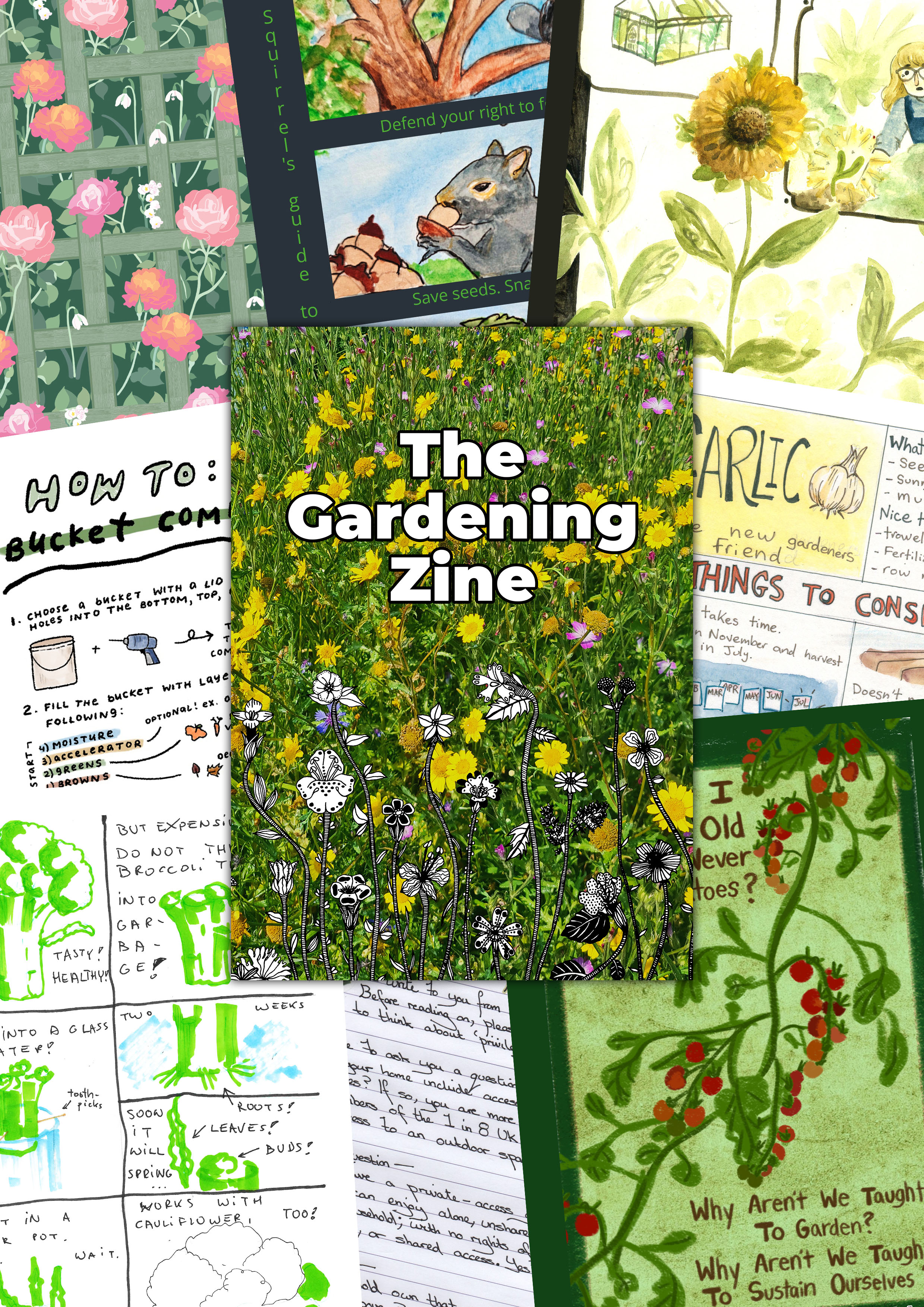
The paragraphs above are an excerpt taken from my personal essay, “Invisible Forces at Work,” which, I’m pleased to say, has recently been published in an anthology titled The Covid Logs. “The Covid Logs provide a space for the disabled and chronically ill communities to share their experiences of navigating the Covid-19 pandemic.” The anthology is available as a PDF and a full-color zine and includes personal essays, visual art, and poetry. You can click here to learn more about this special collection.