An Update on My Memoir

I wanted to use this week’s blog post to give you all an update on my memoir.

I have been querying literary agents on-and-off since March. Some agents respond to your query with either a yes or no, while other agents will only respond if they are interested in reading more from you. I have received some form rejections as well as some very nice, encouraging rejections; however, no literary agent has said yes, or even a variation of yes — as in, I’d like to read more before making up my mind

Which means I now go to plan B — researching smaller publishing houses. These independent presses do not require an author to be represented by a literary agent and accept submissions from the writers themselves.

The bottom line is — I’m not giving up. I’m not stopping. I’m just changing course, because I truly believe in my book and I want to get my book into the hands of readers. 

You may remember my October post when I described my memoir and explained that it’s divided into three parts. (If you missed the post, click here to read it.)

The first piece in the first section is a Letter to the Reader. The letter explains why I eventually felt compelled to write my memoir. For several years I refused to write about my “medical condition.” Notice I used the word condition and not illness or disease. I didn’t think my autoimmune disease was important enough to write about. Surely other people dealt with more life-altering, more painful, more scary health issues. And while that’s definitely true, it doesn’t mean my experiences are any less important or any less book-worthy. 

So this week, I’d like to share a portion of my Letter to the Reader with you. You all are on this journey with me, and knowing you’re here, reading my work week after week, liking, commenting, sending me emails, supporting me is something I don’t take for granted. I appreciate you all. I hope you know that. 

From my Letter to the Reader:

“This book is deeply personal to me. It has lived in my head and my heart for years. I have created it with love and respect, for me — and for you. 
“I was thirty-four years old, a wife, a mother, a daughter, and a teacher, when I became ill. I didn’t comprehend what a rare, autoimmune disease diagnosis would mean. I didn’t realize my life would forever be changed.”

“The book you are reading is the book I wish had been available to me. It is the book I needed to read. 
“It is my hope that readers who don’t live with a chronic illness will finish this book with a different perspective, an adjusted way of looking at people. A bit more patience and understanding for others. A realization that you simply can’t know someone’s hurts just by looking at them.
And for my readers who live with chronic illness and/or chronic pain and/or invisible disabilities, I sincerely hope that you read this book and feel a connection with my words. I hope, in these pages, you see a part of yourself, to the point where you can show an essay to a loved one and say, ‘Here, please read this. This is what I mean. This is how it feels.’ I hope, too, that reading this book brings you comfort in knowing you’re not alone. Many of us feel so desperately isolated with our medical struggles. It is an unbelievable comfort to find someone who ‘gets it.’ 
“I get it.”

My 2nd Spoonie NaNoWriMo

Last year, I wrote about my experience completing a very personalized Spoonie NaNoWriMo. (You can read the post by clicking here.)

Here I must pause to give credit to my friend, Sandra Postma. It was because of Sandra’s Instagram posts that I created my own version of NaNoWriMo last year. I never would have done it without Sandra’s encouragement and her advice that as spoonies we needed to create our own personal versions of NaNoWriMo that work for us.   

So this year, when October wrapped up and we made it through a relatively quiet Halloween (only one trick-or-treater this year), I knew I wanted to do my Spoonie NaNoWriMo this year, too. 

I followed the same format as last year. 

I completed a five-minute writing exercise each day. Sometimes that meant I used the time to generate ideas for an upcoming submissions call. Other days it meant I used a writing prompt to jumpstart my writing. And other days I used my five minutes of writing time like a journal, to record what I was thinking and/or doing that day. 

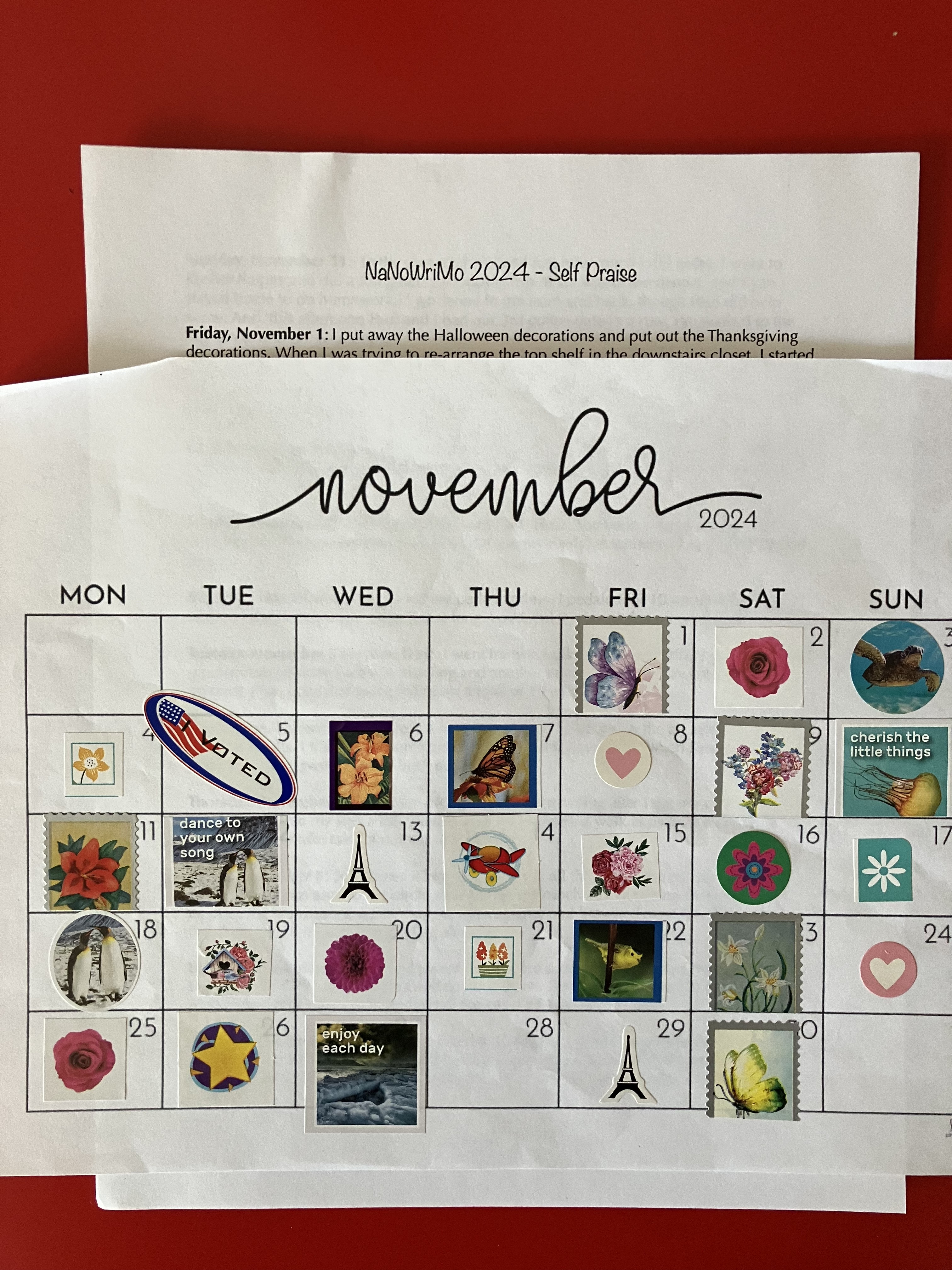
And maybe, even more importantly, was the self-praise component. I took a few minutes each day to reflect on my physical strength and all my body continues to do, even though my levels of pain and fatigue are higher than last year. 

But, if you look closely at the photo of my sticker-decorated November calendar, you’ll notice I missed one day — Thursday, November 28th. Thanksgiving.

I didn’t notice my mistake until the following day, and I must admit, I was disappointed and upset with myself for “messing up.” But it was done. I could have cheated, I guess, and done an extra 5-minutes of writing on Friday, November 29th and written down something my body had done on Thanksgiving Day. Then I could have placed a sticker in that empty calendar box. 

But that wouldn’t have been right. The truth was, in addition to being busy cooking with my family, Thanksgiving was a day of complicated emotions. And painful knees. And somehow I had gotten distracted and forgotten to do my NaNoWriMo activities. 

  And that’s okay. Because I did my best. 

And when I read over the self-praise log I kept throughout the month, there’s no denying I’m doing a lot and trying my best. Every single day. 


Accessing Parenthood

In 2019, I wrote a personal essay titled, “Paying the Price,” and submitted it to the Pen 2 Paper writing contest, a “disability-focused creative writing contest.” That year, in addition to submitting in the Nonfiction category, I also submitted my essay to the Oleb Books Personal Essay category, meaning my essay, if chosen, would be included in an Oleb Books Anthology about parenting and disability. 

Five years later, I am so proud to share my essay, “Growing Up with Me and My Invisible Disability,” has been included in the recently published anthology, Accessing Parenthood: Stories By and About Parents with Disabilities.

During the last five years, my essay has been slightly edited and re-titled. (I admit — titles are not my strength. The editors politely informed me I needed a different title, one that would “add some pizazz that will pull readers in and make them curious enough to read on.”)

A few details are no longer accurate — namely the ages mentioned and the fact that our Los Angeles Clippers now play at Intuit Dome. 

But the emotions and the lessons learned haven’t changed.

Here are just a few passages from my personal essay:

“If I agreed, made the plans, and went horseback riding, would I be demonstrating the valuable life skills of perseverance and resiliency? Was my let’s-do-it attitude fortitude or stubbornness or stupidity? Was my go-getter-ness a refusal to submit to my disease or a life-affirming decision to go out and do things that might seem scary, hard, and uncomfortable?
“I didn’t know.
“I did know I wanted Ryan to grow up believing in himself and believing in the value of trying new things. Many things — food, music, places, experiences. Because they’re new and different. Because he’s curious. Because he wants to find out for himself. 
“I wanted Ryan to grow up living his life.”

“Through my actions and my words, I am trying to teach Ryan the broader definitions of strength, perseverance, and bravery. And along those lines, I’m trying to teach by example broader definitions for disability, pain, and handicap.”

“Maybe I hadn’t planned on being a mother with an inivisible disability, but it doesn’t change the way I love my son. Maybe I am teaching my son lessons I hadn’t expected to teach him. Maybe Ryan’s levels of patience, empathy, and sensitivity have grown exponentially while he’s growing up with me and my invisible disability.”

You can find out more about this unique collection by clicking here

Please note: I am including a link to buy the book that I’m highlighting this week. If you use my link, I do make a small commission on your purchase at no additional cost to you. I am working with Bookshop.org which also sends a portion of the profit to support local, independent bookstores.

My Mind Is Full

I had a “difficult” doctor’s appointment last week. 

Actually, I’m not sure difficult is the right word. 

Let me set the stage:

This was my three-month check-in. Basically, because of the medications I take, I need blood drawn every few months. Though I had a 9:00 am appointment, with an 8:45 check-in, my rheumatologist was running late. 

The doctor asked some general questions, but I had come in with a list of concerns and some questions of my own. 

I told my doctor about my fatigue, about waking up feeling unrested regardless of what time I go to sleep and how many wake-ups I have each night. He told me to go to bed earlier and to keep the same sleep schedule seven days a week. I told him neither one was going to happen. (Why wake up at 6:00 am on a Sunday when we have nowhere we need to be at a specific time?)

I told my doctor about the pain. The pain that I carry around every single day. The pain that slows me down, weighs me down, and often makes me feel like I’ve got a wad of gum stuck to the bottom of my shoe, making it difficult for me to walk as effortlessly or as quickly as I would like. 

I also told my doctor about my physical therapy and the progress my physical therapist says I’m making. 

“He says my endurance has improved since we’ve been working together,” I told my rheumatologist. 

“I go for a daily walk, and I use my pedal machine twice a day now,” I said proudly.

“What are you doing while you’re pedaling?” he asked.

“I read, usually. But sometimes I listen to a podcast or watch something on YouTube,” I said.

“You need to stop multi-tasking,” he said. (You may remember my blog post from January, when I wrote about my doctor’s appointment then and Dr. P’s unhelpful suggestions.)

“You need to really focus in on your leg,” he continued. 

I looked at him. Bit my tongue behind my mask. 

He continued, speaking of the increased benefits I would experience if only I would do less, if only I would really “zero in” on my knee and my calf. 

“I think most families multi-task. I don’t know how to get through my day without multi-tasking,” I said.

I went on. “When I go for my walks, I’m not listening to anything. No AirPods in my ears. I’m just walking and staying focused on my surroundings. But at home, I feel safe in reading or listening or watching something while I pedal,” I said.

“You’re not getting the full benefits you could be getting when you do that,” he said.

“Actually, my physical therapist always talks with me when I’m on the treadmill. He said it helps to be distracted, it makes the time go by faster,” I said.

I tried again. “I am in some level of pain every day, all day. I don’t need to be any more focused in on the pain. In fact, I need a break from it. Reading a book gives me a temporary escape,” I explained.

Ultimately it didn’t matter what I said. Dr. P might be pleasant enough, asking about my family, wishing me a good holiday season. But the fact of the matter is he doesn’t get it. Because he’s not living with pain like I am. 

The appointment left me feeling dismissed and blamed. Like the reason I feel as lousy as I do is because I refuse to go to bed at 9:00 pm, or wake up at 6:00 am, or stop reading my novel while pedaling for nine minutes at a time. 

Even if I did those things, he and I both know my pain wouldn’t magically disappear. 

Daily pain is a fact of life for me. No need to concentrate on that sad fact any more than I already do.

To my chronic illness friends – have any of you had a similar experience? Are your doctors talking to you about multitasking and/or mindfulness? Feel free to share in the comments.

As a side note — the appointment made me think back to an essay I wrote several years ago titled, “This Is What ‘Mindfulness’ Looks Like To Me.” I encourage you to check it out. I’d love to know your thoughts about mindfulness.


About My Memoir-In-Essays

My Memoir-In-Essays is divided into three sections --
The Beginning, After the Very Beginning, and Not the End

This week, I’d like to share a bit about my memoir-in-essays. 

1.  I continue to query literary agents and have not yet had any requests for my manuscript. It’s hard, I admit, not to feel badly about this. At the same time, I know there are multiple ways to get my story out into the world. If it doesn’t work out with an agent, I’ll pursue one of those other possibilities (such as hybrid publishing or publishing with a smaller, independent press). 

2.  I am keeping the title private, for now. Just like when I was pregnant, we announced the gender of our baby, but kept his name private except for family and a few super close friends. So while I’ll tell you I have written a memoir-in-essays, I just don’t feel ready to share the title yet. Though I do realize I shouldn’t get too attached to my working title, because titles are often changed, for many reasons. (This has been the case for many of my personal essays which have been published over the years.) 

3.  Here’s my official pitch:  “… my story of becoming chronically ill, retiring from my teaching career, and living a life I hadn’t planned as a stay-at-home mom. The book is composed of personal essays and micro-essays written as short school assignments.”

One of the things that makes my manuscript unique is the inclusion of these “micro-essays written as short school assignments.” Teaching was a huge part of my life, my identity. And it is because of my chronic illness that I am no longer teaching. Therefore, there’s no way I could write my story about life with an invisible disability without including parts from my teaching life. 

When I taught fourth grade, my students and I completed a getting-to-know you questionnaire during the first week of a new school year. It was a short form that was a quick, fun way to share what made us each unique while also giving students the opportunity to learn about each other, and realize many of them shared common interests. 

I included this questionnaire in my manuscript, and this week I will share a bit of it with you, my readers. 

I Am A Person Who…

By: Mrs. Kennar

Directions: As a way to get to know each other, please fill out this worksheet. By writing honest responses, we will learn about our new classmates. In the process, I think we will come to realize that while we are each unique individuals, we have a lot in common. 

I Am A Person Who…

likes Nutella crepes

dislikes spinach

can recite the Preamble to the Constitution 

cannot throw a spiral

would never watch a horror movie

loves to read

How about you, dear readers? Feel free to leave a comment answering one (or more) of these prompts. 

I Am Tired.

Eleven years ago, my personal essay “Do What You Need To Do” was published in the anthology Lessons From My Parents:100 Shared Moments that Changed Our Lives. I wrote about the example my parents set for me, the idea that sometimes you just have to suck it up, do the hard thing, keep going. 

That’s largely how I have lived my life. Doing the hard thing whenever I have to in order to achieve my goal — whether it was commuting on public buses for most of my college years (a roundtrip commute that took 3.5-4 hours a day, on six buses a day) or working as a kindergarten teacher during the day with an emergency teaching credential and taking online classes at night to earn my full teaching credential. 

It’s pretty much how I go about my day. Things need to be done. I just need to do them. 

Except, I’ve come to the slow realization that I just don’t think I can keep doing that. 

Because — I am so tired. 

I am tired of waking up each morning, feeling unrested. Sticking my feet into my slippers as the alarm goes off, wondering how I’m going to do it. How I’m going to wake up, get dressed, make my son his breakfast, take him to school, and function throughout the day.

I am tired of not reading as much as I’d like to each day. Which as I write that sentence, I realize it’s not completely accurate. I do read a lot each day. I read emails and text messages, newsletters and first drafts. I just don’t always take a half hour and sit and read my book. Sometimes it’s because I’m in pain, and I can’t get comfortable to sit for an extended period of time and lose myself in the words on the page. Sometimes it’s because I feel there’s too much work that needs to be done for me to take a break and read. When I read in bed shortly before I turn off my bedside lamp for sleep, I inevitably start to doze, and the paperback book slips from my fingers and startles me as it falls against me. (One of the reasons why I generally prefer paperbacks to hardcovers.)

I am tired of looking at myself in the mirror and not fully recognizing the woman looking back. I take stock of the physical changes — hair loss, weight gain, swollen ankles — and realize I have no idea which of my ailments is contributing to each symptom. For example, the hair loss I’m noticing could be due to one of my medications, or my longer hair, or menopause. 

I am tired of clicking on my inbox and feeling so far behind in reading my emails. How did I become someone with three hundred unread emails? Seemingly overnight, I have multiple Substack notifications, emails asking for donations for Unicef, Save the Children, and Make-a-Wish Foundation, and emails regarding the latest sale at Bath and Body Works. I want to support other writers and read their newsletters, I want to contribute  funds to worthwhile organizations, and I want to buy candles when they’re on sale. But it’s so much. 

I am tired of feeling like I’ll never catch up. The list I keep of podcasts I want to listen to (Moms Don’t Have Time to Read Books with Zibby (Owens), Kate Bowler’s Everything Happens, Write-Minded with Brooke Warner) just keeps growing. I listen to one episode over the course of a couple of days while I do my physical therapy stretches and exercises, but in that time, I have added another two podcasts to the list. I sit on the floor in my writing room, looking at all the un-read books I have, just waiting for me, and realize this cubby of mine is almost completely out of space. And yet, I came home with another novel I picked up at the Little Free Library I passed yesterday.

I am tired of waiting. Waiting in line at CVS, waiting on hold to speak to a representative regarding my medical insurance, waiting to speak with someone in my doctor’s office to schedule my next appointment. 

I am tired of the bottles of pills on my kitchen counter. Lining up the bottles based on when I take them — breakfast, lunch, and/or dinner. Keeping track of refills, making sure I have enough to get me through the next several days until the law says CVS can refill my pain medication. Tilting my head back so the large calcium supplement, the most recent addition to my daily pills, will slip down. 

I am tired of heating pads and ice packs. I am tired of propping my left leg up on a pillow. 

I am tired of being in pain. Every. Single. Day.

I am tired. 

Friends, I know it’s not just me. I know many of you reading this post have your own laundry list of illnesses, daily stressors, work-related tasks that you’re tired of also. 

What do you do when it continues to build and you feel like you’re standing in quicksand and being swallowed up by it all? 

Please note: I am including a link to buy the book that I’m highlighting this week. If you use my link, I do make a small commission on your purchase at no additional cost to you. I am working with Bookshop.org which also sends a portion of the profit to support local, independent bookstores.

A Book and Its Cover

“Don’t judge a book by its cover.”

We’ve all heard that bit of advice. (And if you’re interested, when I Googled it, I learned the origin of this expression is credited to a longer statement that conveyed the same meaning in George Eliot’s The Mill on the Floss.)

Nowadays, the adage is used broadly and is applied to many things beyond books. For instance, you can’t know a person’s true heart or friendliness by simply looking at them. You don’t always know if you’ll enjoy a meal simply based on how it looks on the plate. 

While I absolutely agree that you can never know someone’s full story or what they’re going through simply based on appearances (including my own invisible disability), when it comes to books, I think you absolutely can, and should, judge a book by its cover. 

When I scroll through books offered in a Goodreads Giveaway, I have limited information available to me. I have the title, a small photo of the book’s cover, and the first few lines of a short summary of each book. And I absolutely look at that cover image first. 

A book’s cover is an advertisement and a promise for what is included within the pages of that book. 

A dark cover featuring a sharp knife? I’ll skip that one, thank you. 

A pink cover with a woman and man facing each other? I’ll stop my scrolling to read the blurb. 

A green cover with holiday decorations? I’ll read that blurb also.

A black and gray cover with a set of eyes peering back at me? That’s one to skip.

While I’m not at that stage yet, I do sometimes think ahead and try to envision the cover of my memoir. I picture lavender or some other shade of purple. I think of sunflowers, my favorite flower, and a symbol for the chronic illness community — something I didn’t know until fairly recently. 

“The Hidden Disabilities Sunflower is a simple tool for you to voluntarily share that you have a disability or condition that may not be immediately apparent – and that you may need a helping hand, understanding, or more time in shops, at work, on transport, or in public spaces.”

I’m curious, readers. How do you decide which book to pick up at the bookstore? To check out at the library? To enter a giveaway for? Does a book’s cover play a part in influencing your decision at all? Let me know in the comments.

And, if you have any thoughts regarding my own future book cover, feel free to leave those in the comments section, too. 

The F Word

I took this picture a few days ago, late afternoon, after doing some of my physical therapy stretches on the bed.

I don’t usually have a problem falling asleep. 

Quite the opposite, actually.

As soon as I turn off the lamp on my bedside table, after another unsuccessful attempt to read a few pages before bedtime (I tend to either drop the book and lose my place or read a bit but then the next day have no memory of what I had read), I fall asleep. 

Usually, I wake up at least a couple of times each night. Though lately, I have experienced a few nights when I only woke up once. And there were even a few nights that I slept straight through. 

Yet, regardless of how many wake-ups I have each night, I am not waking up feeling rested. 

Again, it’s quite the opposite.

I wake up feeling drained. I’m not recharged and ready to take on the day at all. But, I don’t have a choice. The alarm goes off, and it’s time to get going. I need to get up and get dressed and get the show on the road, because my son needs to get to school. I have work to do. Which means I’m forced to function on a blend of automatic pilot and a fight-through, keep-going-no-matter-what, high level of perseverance.

Plus, I have also noticed this unrested feeling isn’t just happening during the week, when wake-ups are earlier and days are busier. Even on a random Sunday, when we have nothing planned and no alarm waking anyone up, I don’t naturally wake up feeling oh-so-rested. 

Doctors don’t often ask about my sleep; however, during my last several follow-up appointments, I have mentioned it to them. I do my best to describe the overall slowness I often feel upon waking. The way my eyelids feel heavy. The feeling of starting the day at a deficit. And because my labs are coming back pretty consistent, because there are no red flag markers, no medical professional seems overly concerned about my tiredness. 

The other day, when I stood in front of the mirror and stared at the dark circles under my eyes, I had an aha moment. 

It seems so obvious, now, but it really didn’t occur to me that this extreme tiredness, this fatigue, is a part of life with chronic pain. This is not unique to me and my UCTD (undifferentiated connective tissue disease). In fact, in terms of my inflammation markers, my numbers have been down. My autoimmune disease is somewhat stabilized, you might say. Which means my medications are working and doing what they’re supposed to do. And yet, I feel awful — every single day.

Because this is not tiredness that goes away with a couple of nights of eight hours of sleep. 

Because this is fatigue, a whole different level of extreme tiredness. 

I don’t usually talk about my exhaustion, and I certainly haven’t written about it. But, I know how important it is to share our authentic experiences, to connect with others who, unfortunately, “get it,” and understand exactly the situation I’m describing.

The other night at dinner, after it was my turn to share some of the highlights from my day, my husband commented that I had gotten a lot done. 

“You’re right,” I said. “Imagine what I could do if I felt rested?”

Pain Awareness Month

You can't see my pain, but it's there.

September is Pain Awareness Month. It’s a topic I have written about before: 

In 2020, I wrote about how common it is for my pain to fluctuate, which is why I so dislike the traditional 1-10 pain scale.

In 2021, I again wrote about the difficulties in using a traditional pain scale to describe my chronic pain. (Plus, this post has one of my favorite pictures of myself – because I’m holding a bunch of bright, beautiful sunflowers – my favorite flower, and because that photo makes me think back to that fun family day.)

In 2022, I wrote about the randomness of my pain; the fact that I can sit and watch my son at his first Rubik’s Cube Competition and out-of-nowhere suddenly need to step outside because of an intense leg cramp.

In 2023, my son inspired my Pain Awareness Month blog post (as he’s inspired many of my blog posts and personal essays over the years).

Which brings us to this year’s post:

For the last year or two, each time I see my rheumatologist I have told him how much I struggle to get through my day. I have given him concrete examples to demonstrate that my chronic pain has worsened, my energy levels have lowered, and my fatigue has increased. I have told him that my current pain medications were not enough, yet he refused to alter my dosage or prescribe anything else. Finally, he referred me to a pain management doctor. (This isn’t the first time I’ve seen a pain management doctor, but it is the first time I have been seen by this particular doctor.)

At the first appointment with the pain doctor, back in April of this year, I walked in with a fair amount of skepticism. How many times have I had to share my story over the years? How many times have I tried to convince doctors that regardless of how I look or how much I tell you I still do each day, I am in considerable pain every single day? I didn’t want to have to sell myself, convince this new doctor that my pain was worsening, that my list of activities I could no longer do was growing, and I was scared because I truly didn’t think my current lifestyle was sustainable.

Something completely unexpected happened during that April appointment — after reviewing my in-take forms and my current medications, the doctor looked up from my chart and looked right at me. 

“You’re not on the right medication. What you’re taking now isn’t going to help with the kind of pain you’re describing. You definitely need something stronger,” he said. 

I was momentarily shocked. Cue the party favors and the large round of applause. The doctor’s statements, his belief in me and my pain, were huge. My chronic illness friends reading this know that this is not always the way a doctor’s visit goes. 

Since that first appointment, we’ve tried different medications and different dosages, and I think we’re getting closer to finding the right combination for me. 

At the same time, the doctor has been honest with me. 

“Nothing is going to completely get rid of your pain. The goal is to bring your pain levels down. Way down,” he said.

We’re working on it. 

So this year during Pain Awareness Month, if I may, I offer this suggestion — believe someone when they tell you about their pain. You cannot always see pain. You don’t always know what someone is going through or dealing with simply by looking at them. So give them the benefit of the doubt. Treat everyone with a bit more patience and care. Because whether it’s physical pain or mental pain, chronic pain or temporary pain, everyone is dealing with something.

Questions and Clues

I sign up for many writing-related webinars (mostly free, though some are fee-based), and I like to watch interviews with authors on YouTube. I consider myself a life-long student, and have found the writing community to be very generous when it comes to sharing information and advice and encouraging other writers. 

I attend these webinars and watch these videos in my quest to learn more about building a writing career. As I continue to query literary agents, I have been learning about establishing and maintaining an author newsletter (something I plan to do in the future, so stay tuned!), creating a readership, and the different types of marketing options available for writers. 

A couple of weeks ago, I watched two different writing-related videos, featuring two different authors, and both videos left me with questions I haven’t been able to stop thinking about.

One author was asked how she shows herself self-compassion. I thought it was an interesting question for an interview. The memoir author spoke first of acknowledging the difficulty in writing about painful experiences. Writing memoir, particularly writing about a traumatic experience, requires a very different mindset than writing a scene in a romantic-comedy, for example. The author spoke of giving herself breaks, and being very intentional when it came to planning her writing time. She knew she would need to strategically plan when and where she’d engage in this writing, and then give herself the space and time needed to rest afterward. 

In another interview, a different author was asked what she does to nurture her resilience.

The questions stumped me. Me, who is seemingly always writing or thinking about writing, was at a loss for words. 

Do I show myself self-compassion? Probably not nearly as much as I should. 

Do I nurture my resilience? Honestly, I’m not a hundred percent certain what that means or how that would look. 

But that’s what I’ve been thinking about. Those are questions that I can’t seem to let go.

Then over the weekend, as I tried to make my way through a full inbox, I read agent Kate McKean’s latest Substack post titled, “Compulsory Rest.” This sentence stood out to me: “The universe is going to do what it’s going to do—and all you can do is make sure you’re taking care of yourself the best you can.”

She’s completely right. I like to think I’m in control, with my lists and schedules and dinner meals planned out a week in advance. But really, the truth is, I’m not at all. There is actually little I can control, and when it comes to my own body, there’s really very little I have control over. 

It’s been hard. “It” meaning life, though I hesitate to put that in writing. Thankfully, my family is healthy and safe. We are not worried about having enough food in the fridge or a roof over our heads. We are lucky, fortunate, blessed in so many ways. 

And yet, life has been hard.

I feel like these interview questions and this Substack statement are like clues. Clues from multiple sources and multiple people. Clues I am paying attention to. 

But, also, clues I’m not  entirely sure what to do with or how to use them as a springboard for changes in my daily life.

Anyone else feel that way?