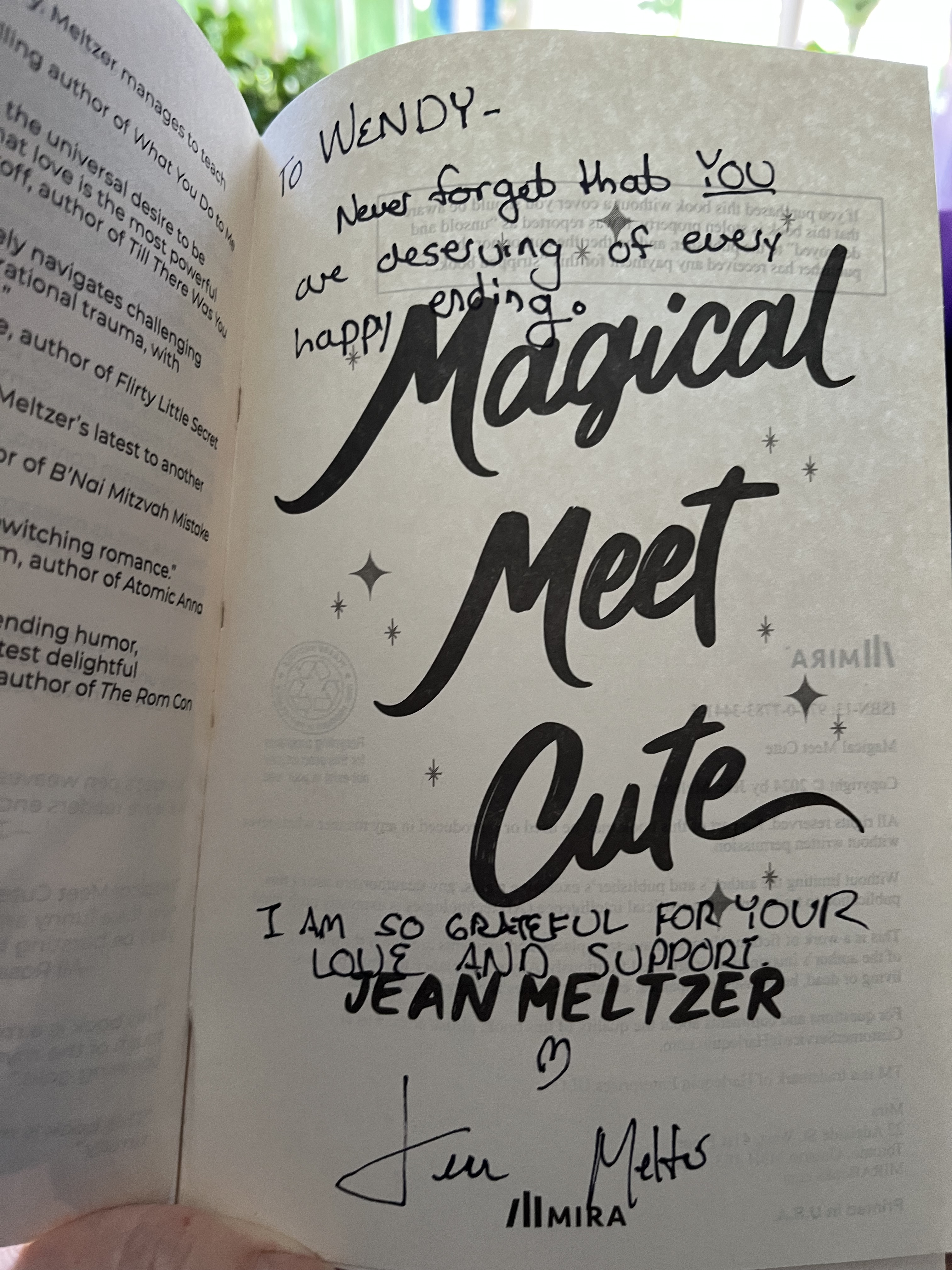
Magical Meet Cute

If you’ve been reading my blog for a while, you know I’m a big Jean Meltzer fan. (If you haven’t been reading my blog for a while, don’t worry. Click here to read my post about Ms. Meltzer’s debut novel, The Matzah Ball. Click here to read my thoughts about her second novel, Mr. Perfect on Paper. And click here to read some of my favorite passages from her third novel, Kissing Kosher.)

And if you have been reading my blog for a while, you also know I don’t usually read books right when they’re published, simply because everyone else is. I like to wait a bit, until the hoopla has settled down. Then, I select the book from the large number of to-be-read-books I currently own. I read the book and post about it here on my blog and on my Instagram. (If you’re not already following me there, why not?)

My system allows me to show the author some love and attention when they’re in-between books and perhaps aren’t being discussed and celebrated like they were immediately upon publication. 

Ms. Meltzer’s fourth novel, Magical Meet Cute (published in August 2024), was not your standard rom-com. The book’s main character is Faiga Kaplan (Faye to her friends), a Jewitch potter living in Woodstock, New York. And while there most definitely is a romance aspect to the story, the book also confronts the ugliness and the reality of blatant anti-Semitism. 

There is so much to say about this book, about Faye and Greg. Allow me to share some of my favorite passages:

“Greg caught on the word. ‘Home.’
“ ‘The place where you belong. The place where people love you.’
“Home felt like Faye.”  (I love this definition of home!)

“Greg didn’t see her broken bits as flaws. If anything, it was the opposite. She was like that one vase in the store she had hidden behind the fancier and more elaborate-looking Seder plate. She saw herself as warped and damaged, undeserving of love and attention. Yet it was all the bubbles in her clay memory, the scratches and scars … that made her unique.”

“And, at the end of the day, none of that making herself smaller mattered. Because nothing about what these people had done to her, chosen for her, was fair. Or right.
Just like it had never, ever been her fault.
“But she was exhausted from a lifetime of making other people feel comfortable. And suddenly, she was done. Straight-up finished with all these less than deserving people arriving to her shoreline. Damn the silence. Damn the consequences. She was ready to live her life without constantly interrupting herself to say that she was sorry.”

“She gave others what she had always needed from them — love and affection, security and protection, a place to land when things got bad — while never demanding the same for herself.”

“We can hold on to memory, bear the things that shape us, but also … write our own story going forward.”

“ ‘You want the truth about settling down, Greg?’ Tom asked. ‘About spending the rest of your life with one woman, raising a family … about giving up the adventure sometimes, just for a quiet boredom?’ “
“ ‘Yeah.’
“ ‘It’s awesome,’ Tom said.
“Greg laughed.
“ ‘I’m serious,’ Tom said, his whole face turning red as he spoke. ‘Every single day, I wake up and go to bed with my best friend in the world. When i’m having a hard day — shit, when I needed neck surgery — she’s there for me. When I’m having a good day, when I want to watch a game or a movie on Netflix with the kids, there’s no one I would rather spend time with more than her. It’s not just that she busts my chops, or has fun with me, or makes me better … it’s that I can’t imagine how there was ever a me without her’.” 

“It was the most remarkable type of magic — falling in love, finding your person, crafting your own life, writing a story where you deserved to be valued.”

FYI – Ms. Meltzer’s fifth novel, The Eight Heartbreaks of Hanukkah, will be available on October 21st. You can pre-order a signed copy now.  

Please note: I am including a link to buy the book that I’m highlighting this week. If you use my link, I do make a small commission on your purchase at no additional cost to you. I am working with Bookshop.org which also sends a portion of the profit to support local, independent bookstores.


There’s A Lot On My Mind

I have a bit of a confession to make, my friends.

This week’s blog post has been a hard one for me to write. And I think it’s because of the date. 

This week is an “anniversary” for me. It was during this week back in 2010, when I woke up unable to get out of bed. I couldn’t stand up. I couldn’t walk. My left calf was swollen like an about-to-burst water balloon and bright red, like my then-two-year-old son’s stuffed Elmo doll.

That day marked both an end and a beginning. I just didn’t know it at the time.

So I’m a bit emotional, and I have all sorts of things going through my head this week. Thoughts about where I am currently — in terms of my physical pain and limitations, but also in terms of my spirit and emotional well-being. 

It’s because I have all these thoughts swirling around, like a soft serve ice cream that mixes chocolate and vanilla into one delicious, twisty dessert, that I initially wasn’t sure what I wanted to write about this week. 

But I think this reflection is fitting for this week:

A few days ago I finished listening to Jessica Fein’s podcast, “I Don’t Know How You Do It.” Her guest was bestselling author Jean Meltzer, someone I happen to just love — for her books and her passion and her message. 

(In case you’ve missed them, you’ll find links to my earlier Jean Meltzer-related posts here.)

On this podcast, Jean explained the twists and turns her life has taken, the many ways she has had to completely reinvent herself. 

There were a couple of things Jean said that I haven’t been able to stop thinking about. Maybe they’ll be helpful to you, too:

–  One: Jean talked about the years she spent ignoring her illness. Her determination to continue on, pretending as if she wasn’t ill. Until she couldn’t. Until she became so ill, she was housebound. In all honesty, I have heard Jean speak of this before, but this time I really heard her. And it scared me. Because one of the things I’m actively working on is truly acknowledging my own illness and physical limitations. I often do try to push through and act stoically. What if I’m headed on the same path? What if you only get a certain number of “passes” to act as if you aren’t chronically ill, and then your body comes to a full and complete stop? (Which is actually what happened to me back in 2010. I wasn’t physically ill at that time, but I was going through an incredibly hard time emotionally. I kept trying to push through, until I literally couldn’t. That swollen left calf kept me hospitalized for four days, and my leg was never again the same.)

– Two: Jean also spoke of her decision to live a joyful life. If her body would no longer allow her to do all she wanted, if her body made it necessary for her to re-invent herself and give up her career, then she was going to do everything she could to seek out joy in this new life of hers. Lately, I have been more aware that I tend to spend some of my days as if the prime objective is to cross off as many items on my to-do list as I can. And while these are not necessarily unpleasant (water the plants, sweep the patio, do my physical therapy stretches), they’re not necessarily joyful either. I often give myself one task to do after the other, without giving myself the time and grace to simply sit and read, for example. 

So that’s my self-appointed homework: being more honest about what my body can and cannot do and to actively seek out and infuse my days with joy. 

Thank you, friends, for reading. I realize this week’s post was a bit longer. Thank you for being with me on this journey. 

Chronically Parenting

I don’t listen to many podcasts, but I do make a point to listen to Jean Meltzer’s monthly podcast, Chronically Fabulous. (I wrote about her podcast back in January. If you missed that blog post, you can read it here.)

Her third episode featured special guest, Heidi Shertok. Like Jean, Heidi is also a Jewish author, writing rom-coms, and living with chronic illness. Their conversation focused on parenting when you’re chronically ill. 

Jean, Heidi, and I all have different perspectives based on our different life experiences when it comes to parenting. Jean and her husband made the decision not to have children. Heidi entered into marriage and parenthood as a chronically ill woman. And I become ill when my son was two years old. 

There were several moments when I paused the podcast so I could jot down a note, because I knew I would want to write about their conversation and share it with you, readers. Because finding your community is so important, especially when your body doesn’t behave the way you’d like it to. And when I come across something — a podcast, a book, a line in an article — that allows me to feel seen and understood, it’s something I want to share with you as well. 

With that in mind, here are just a few of the highlights from their podcast conversation: 

– Jean and Heidi spoke of the idea of “masking.” I’ve always referred to it as putting on my game face, others might say it’s like having your poker face on and not letting your true emotions out. It’s the idea that on the surface no one can tell how you’re really feeling inside. You keep your pain, your discomfort, your worry out of sight. You present as healthy — because, at least for me, sometimes it’s just easier. It’s easier not to have to explain why I can’t sit on a tall bar stool, for example. (It’s really painful for me.)

– Something Heidi said really stood out to me. She said she believed her kids were lucky, growing up with a mom who is chronically ill. Her kids have learned/are learning there are all sorts of “normals” within families. There is not one right way for a family to be. Likewise, I hope that by growing up with a mom who has an invisible disability, my son has learned that you often can’t tell what someone is going through just by looking at them; that many people are out and about in the world, dealing with pain we can’t see. 

– Heidi also shared something her rheumatologist told her when she was young: A lot of people are like most flowers, you can put them anywhere and they’ll thrive. While people like Jean, Heidi, and myself, and others with chronic illness, are like orchids; we can only thrive in very specific environments. I love that analogy. 

Dear readers, any podcast recommendations you’d like to share? I also sometimes listen to The Shit No One Tells You About Writing (such a great title!) or an episode of Moms Don’t Have Time to Read Books when I’m doing my daily physical therapy exercises/stretches at home.

Chronically Fabulous

Chronically Fabulous is the name of author Jean Meltzer’s new podcast. It’s an interesting combination of words. (And if you’re not familiar with Jean Meltzer’s books, be sure to check out my posts about her first novel The Matzah Ball, her second novel Mr. Perfect on Paper, and her third novel Kissing Kosher. They all feature main characters who are Jewish women living with chronic illnesses and chronic pain.)

The podcast aims to be a safe space for listeners, and function like a conversation with your chronically ill friends. 

While I acknowledge my chronic illness, I don’t think it’s fabulous in any way. Actually I don’t even use the word “fabulous” all that much.

But, put together – Chronically Fabulous. I kind of like the idea. 

2023 was one of my toughest health years in terms of intense pain. It was the year of admitting it’s too hard to grocery shop by myself. The year we rented a wheelchair for our family summer trip to Washington, D.C. The year I bought a wheelchair to have for those special occasions when I’ll need it (such as attending a performance at the Hollywood Bowl). 

And while those were all super tough things, they’re also things I’m proud of. I didn’t cancel our summer trip after I began researching museums and monuments in D.C., knowing I wouldn’t be strong enough to walk them all. I found a way for our family to take the trip and that, I think, is an example of being chronically fabulous.

So far, Ms. Meltzer has released one episode of her podcast, and the part that most stood out to me was the discussion regarding “pacing.” No doctor has ever spoken to me about pacing — the idea that certain activities are more energy-intensive, so a person living with chronic pain has to figure out rest days (usually before and after the event). Pacing is a tool; a tool I haven’t regularly used. But it’s time. Because I simply can’t keep up anymore. Listening to the podcast, I realized I don’t do what Ms. Meltzer spoke of — creating boundaries and making myself, my health the priority. She wants listeners to “live your best, most valuable life.” 

And I want that too. 

Something I came to acknowledge this past year was my tendency to do everything possible to fight my pain; trying to pretend like there’s nothing wrong. Trying to act as if I can keep up with my same-age-as-me husband and high-school-age son. I have kept up the act for years, because I didn’t want to miss out on any shared family experiences. Because I didn’t want my illness to hold me back, or take any more from me than it already had, most heart-breaking of all being my teaching career. 

But 2023 was the year I saw I just can’t keep doing it. Something shifted. I am not waiting for some cure or major fix. It’s not coming. Instead, I’m searching for small, but mighty, tweaks. “Little” things that make a big difference in how I get through my days. And something I need to consciously work on is pacing. Learning to give myself permission to sit and read. Not pushing myself to plan big outings both weekend days. Trying to build in rest times the day before and the day after a big event. Trying to treat myself with the same compassion and kindness I so easily share with those I love.

Kissing Kosher

Here’s what you should know about Kissing Kosher by Jean Meltzer.

It’s a rom-com. A delightful rom-com.

But even more than that — the protagonist, Avital Cohen, happens to be a Jewish woman who lives with a chronic illness and chronic pain. And for that I applaud Ms. Meltzer. (I have written about Ms. Meltzer’s first two books in previous blog posts, which you can read here and here.)

While the rom-com was fun to read and provided me with a fantastic escape from real life, it was the very real, very relatable aspects of Avital’s chronic illness that I most resonated with. 

Here are just a few of the passages I marked with sticky notes:

“She got used to disappearing into the ceiling while doctors poked and prodded. That was the funny thing about chronic pain. It didn’t disconnect her from her body. Instead, it made every single second of her life about her body. She couldn’t escape the never-ending reminders of her pain if she tried.”

“Like many folks dealing with the onset of chronic illness, she had hope — this great and unfettered optimism — that she would one day wake up normal again if she could just find the right treatment.
“There was no cure. While some of the treatments helped, nothing completely eradicated the constant ache she lived with. There were bad days and better days, but rarely did she experience pain-free days.
“Despite all her best efforts to win the war against her own failing body — despite the fact that she was trying not to make her disease her identity — she kept getting worse. Some nights, the fear that accompanied the realization that nothing she did was working was more awful than the pain itself.”

“People always say, Don’t make your disease your identity. And you know what, Josh? I hate that statement. I think it’s the most ableist thing I’ve ever heard. The very definition of chronic is that it’s every day. It’s something I will have to negotiate, and manage, for the rest of my life. It touches everything.”

“But mainly, the most important thing I’ve realized is that if I’m going to be in pain the rest of my life, then it’s even more important that I hold on to my joy. I need to create the life that makes me happy. So that when the bad days come, because they will keep coming, Josh … they don’t hurt me as much.”

Please note: I am including a link to buy the book that I’m highlighting this week. If you use my link, I do make a small commission on your purchase at no additional cost to you. I am working with Bookshop.org which also sends a portion of the profit to support local, independent bookstores.

Monthly Book Highlights of 2022

As we approach the last week-and-a-half of 2022, I find myself reflecting on the year and thinking about the books I have read. As of this post, I have read 50 books this year, though that is short of my Goodreads Reading Challenge of 57 I had optimistically set back in January. 

This week, rather than focus on the books I didn’t read, I’m going to highlight one book from each month of 2022.

January

The first book I finished this year was Claire Cook’s Life Glows On. I felt like I was starting the year on the right foot, reading about creativity — the ways we demonstrate creativity, the reasons why we need to dedicate time and energy to creative endeavors.

February

During the shortest month of the year, I read Moms Don’t Have Time to Have Kids: A Timeless Anthology edited by Zibby Owens. As I wrote in my blog post: “I found myself relating to so many of the authors. The specifics may differ (where we live, how many kids we have, the ages of our kids) but the emotions are universal.”

March

In March, I read First Lady Dr. Jill Biden’s memoir Where the Light Enters: Building a Family, Discovering Myself. I loved reading about Dr. Biden’s passion for teaching, because I know that passion.

April

I picked up Just Haven’t Met You Yet by Sophie Cousens because I wanted a fun, entertaining read. This novel was that, and more. (Which reminds me, I still haven’t read her other novels.)

May

Jane Goodall’s The Book of Hope: A Survival Guide for Trying Times was a powerful book with a powerful message.

June

We’re a basketball family. And while our team will always be the L.A. Clippers, we respect and appreciate many players on many different teams. The “Greek Freak,” aka Giannis Antetokounmpo of the Milwaukee Bucks is one such player, and why I was interested in reading Giannis.

July

Brighter By the Day: Waking Up to New Hopes and Dreams is the third book I have read by Robin Roberts. The book feels like a pep talk Robin Roberts is sharing with you, simply because she believes in you and just wants the best for you.

August

Weather Girl by Rachel Lynn Solomon is much more than a rom-com. Plus, there’s that exciting feeling knowing an author you have recently discovered has written other books you have yet to read.

September

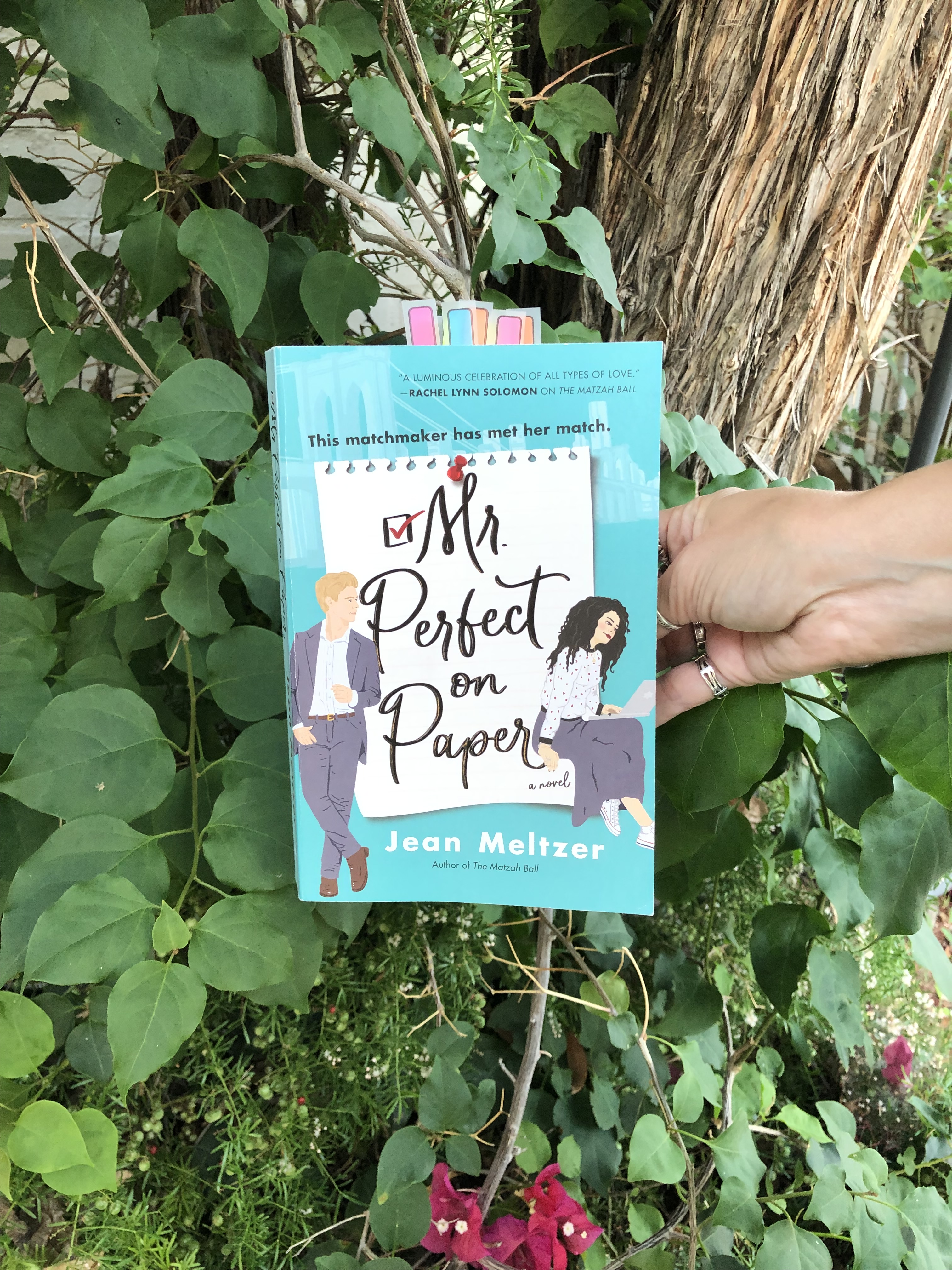
Jean Meltzer’s Mr. Perfect on Paper was such a great read. I love that Ms. Meltzer writes books featuring a protagonist who is not only Jewish, but who also lives with an invisible chronic illness. (Be sure to also check out her first novel, The Matzah Ball, perfect for reading during Hanukkah.)

October

Love and Saffron by Kim Fay was a story told through the letters two women write to each other during the 1960s. I was instantly intrigued because I have a pen pal. We have been exchanging letters for almost thirty years!

November

Book Lovers by Emily Henry is a special book, for a couple of reasons. First, I bought it during our family trip to Maui. And secondly, it earned five stars on my Goodreads review. 

December

Jasmine Guillory’s Royal Holiday was an entertaining holiday romance. It was a fun escape to be able to open the book and slip into this other world.

Readers, feel free to share some of your favorite books that you read during 2022!

Mr. Perfect on Paper

There aren’t many books written by an author who has earned a daytime Emmy, “and spent five years in rabbinical school before her chronic illness forced her to withdraw.” 

That author is Jean Meltzer.

(You might remember I raved about Ms. Meltzer’s first novel, The Matzah Ball, in a blog post from several months ago. Click here if you missed it.)

And as was the case in her first novel, Ms. Meltzer’s second book also features a main character who is a Jewish woman living with an invisible chronic illness. 

The book is Mr. Perfect on Paper. The character is Dara Rabinowtiz.  

Mr. Perfect on Paper was such an enjoyable read. Smart, funny, heartfelt. Plus, it gave readers a chance to learn about Jewish holidays in an easy-to-understand manner. Most of all, it gave us characters we cared about.

Here are a few of the passages I marked during my reading:

“He beamed as he entered, a bounce in his step, offering a hearty good morning to each person he passed. He was a champ at this. Faking it. Looking happy. Smiling through whatever pain was threatening to drown him.”

“There were days when Dara was so exhausted from her struggles that she could barely find the courage to get out of bed. It was then that her mother would show up, standing over her — and sometimes tearing off her covers — demanding that she fight. Fight, Dara. Her mother would repeat it like a mantra on her bad days. You’re allowed to be afraid, you’re allowed to be anxious, but you have to fight.” 

“There isn’t one way to be Jewish,” she said, finally. “Some people are very observant. Some people aren’t. Some people fall in the middle of the spectrum, or have different philosophies behind the reasons for their observance. Some people don’t do anything. When two Jews marry, they have to negotiate these religious choices. For example, will they keep a kosher home? Will they observe Shabbat? Will you cover your hair, or go to mikvah? Those are some of the big ones…”

“But,” Dara said thoughtfully, “you learn to live with it. The sadness never goes away. Maybe it never gets smaller, either. But after a time, you learn to hold both. You learn that joy still exists … there’s still laughter, and falling in love, and —“ she smiled, glancing down at the crumbs of her pizza “—there’s still jalapeño-and-pineapple pizza. You learn that good things still happen. You meet someone. You fall in love. Maybe you even get married. And when you walk down that aisle, you hold both. You hold the joy of the moment alongside your sadness for the one who can’t be there.” 

“But what I learned from this journey, from finding my real-life Mr. Perfect on Paper, is that love isn’t something that can be quantified on a list. Love is messy. And terrifying. It shows up when you least expect it, and complicates your life in every way. But it’s also … safe. And comforting. It allows you to be yourself completely, without judgment or fear, and it feels right. I don’t know how something so incredibly scary can also feel right, but I need to give this inkling in my heart —in my soul—a chance.”

“I know you think…because you have anxiety, that you’re not brave. But that’s not true. I’ve been thinking about it a lot, actually, and here’s what I want to tell you. Courage ins’t about jumping out of airplanes or building businesses from scratch. Real courage is showing up, even when you’re afraid. Real courage is putting yourself out there, even when you fail — especially when you fail. Courage is saying, this is who I am, standing up, allowing yourself to be vulnerable. And you are brave, Dara. You’re the bravest person I have ever met.”

The Matzah Ball

Sometimes you find a book, or a book finds you, and you just want to tell everyone about it. You want to grab the pom-poms you never owned and create a cheer for this book. Then you want to place the book into the hands of readers everywhere. 

That’s how I feel about The Matzah Ball by Jean Meltzer.

The Matzah Ball is a holiday romance with a twist. It’s a Hanukkah romance, and our main character, Rachel, lives with a chronic illness. Right away I was intrigued, and the book did not disappoint. (Additionally, the author is a Jewish woman living with a chronic illness — myalgic encephalomyelitis.)

I loved getting a glimpse into some of the Jewish traditions I’m less familiar with. I loved seeing Rachel and all the messiness that comes with a chronic illness depicted on the page. And, I loved that this book gave Rachel, and by extension – me as the reader, the happy ending I was hoping for. 

I read a library copy which I tagged with many sticky notes, which means I now need to buy my own copy at my next bookstore visit. 

This week, I’m excited to share just a few of the passages that stood out to me:

“Turning beneath the covers, she blinked and took a careful accounting of how she was feeling. Would it be a good day or a bad day? She could never be certain.
Some mornings she woke up feeling well, only to find herself completely depleted two hours later. Sometimes it was the opposite. She would crash for days at a time, with no ability to do even the most menial tasks. Her disease was constant but fluid. It peaked and ebbed with only one discernible pattern. Everything she did, everything, from writing two pages to carrying the groceries one block to her apartment, came with a kickback.
It was her normal.”

“There was no way to know how long these crashes would last. It could be hours, days, weeks…or even years. The only way to avoid the flare-ups was through a very unscientific method of pacing oneself and rest.
The problem was, of course, that Rachel was awful at pacing herself or resting.
On good days, she pushed even harder. On bad days, she still pushed…usually making herself way worse in the process.”

“She wasn’t ‘out’ about her disease. She wasn’t out about …anything. Sitting in a wheelchair meant accepting you were disabled and dealing with awkward stares from healthy people.
Most of all, and because she had a disease with a name like chronic fatigue syndrome, there was always a fear tucked away inside of her that someone would look at her and say she was doing this for attention. That she really wasn’t that sick. And so, though a wheelchair would certainly make her more mobile and give her a higher quality of life, she often chose to stay home.”