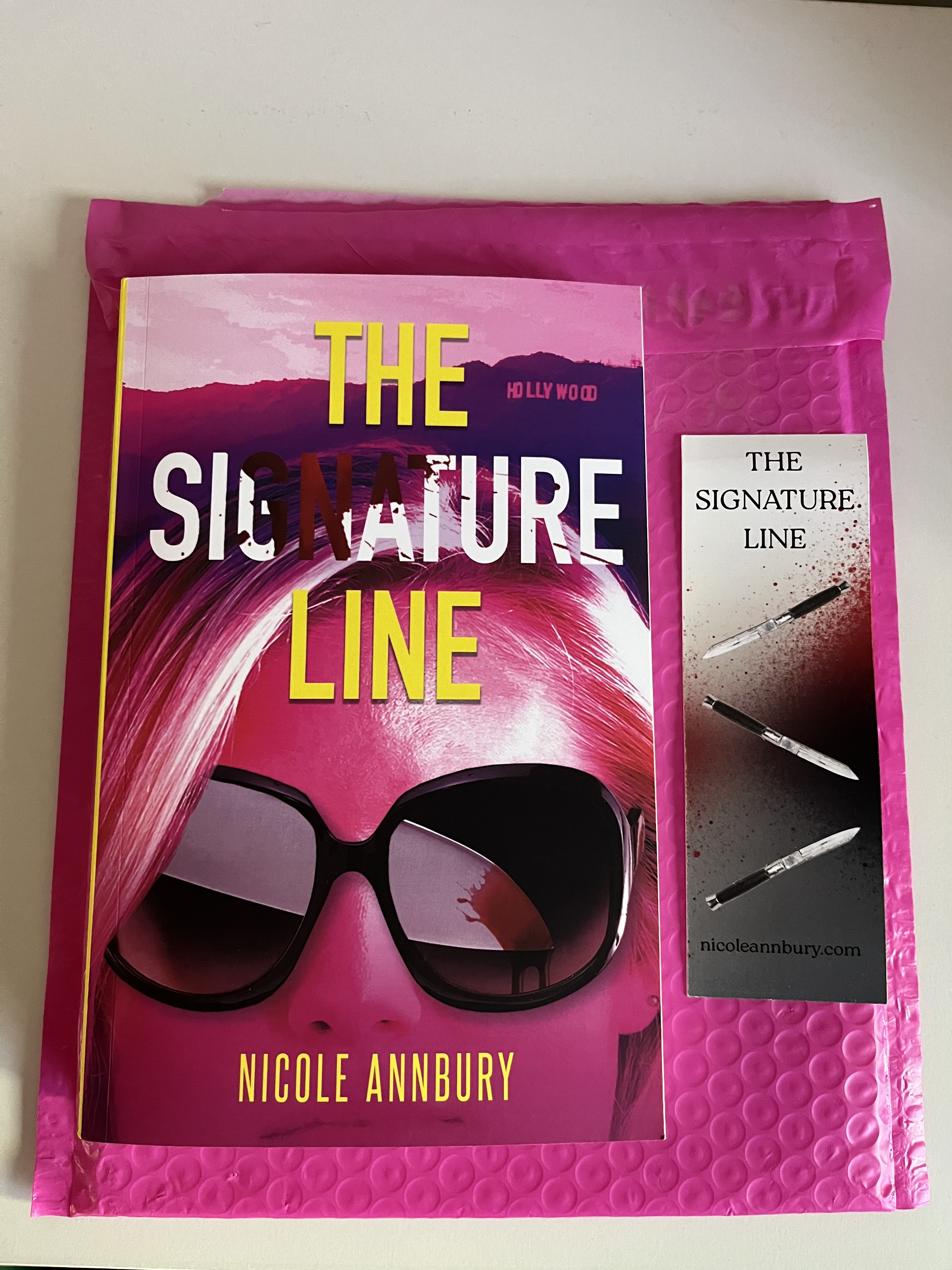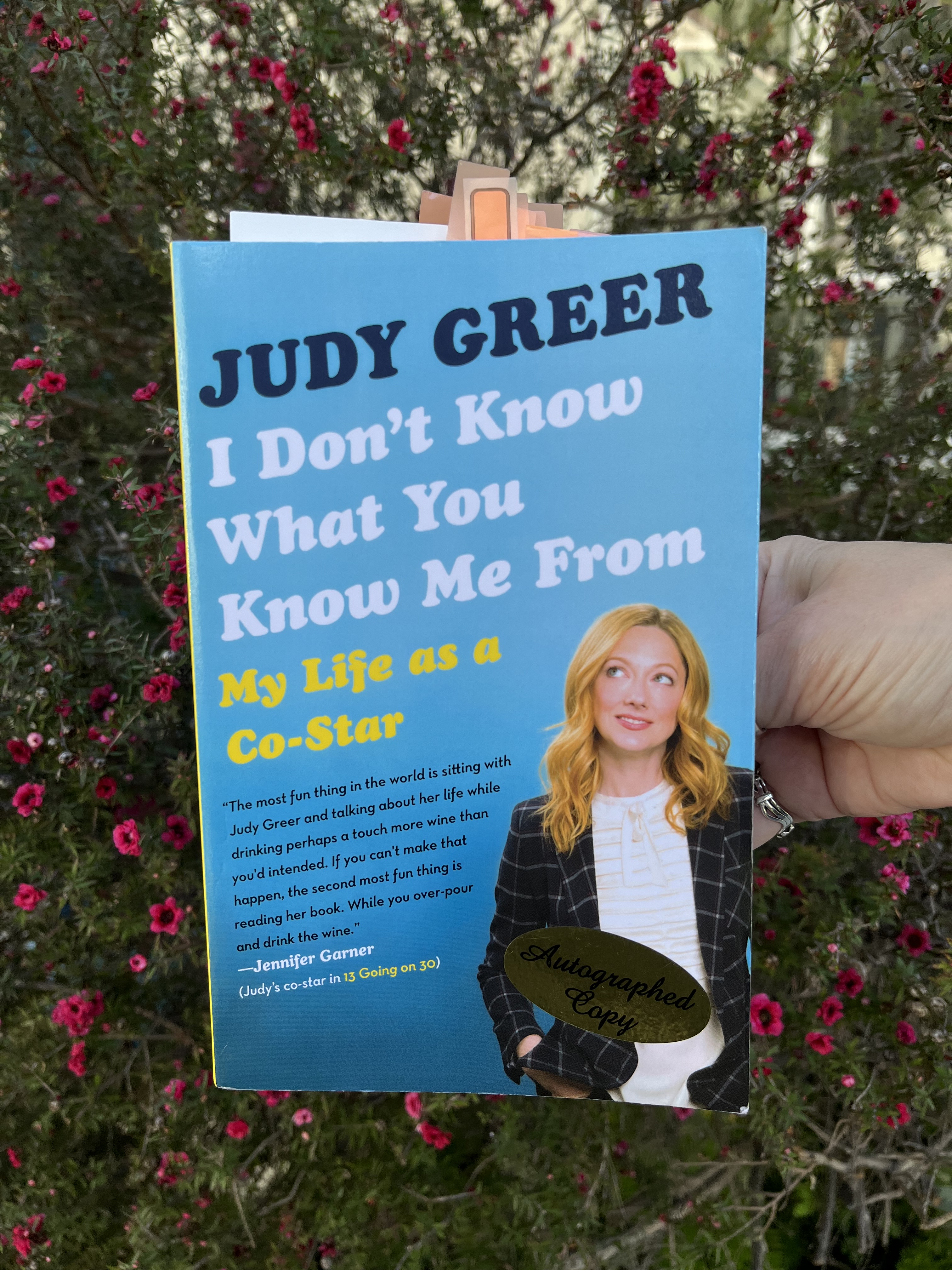
Broken (in the best possible way)

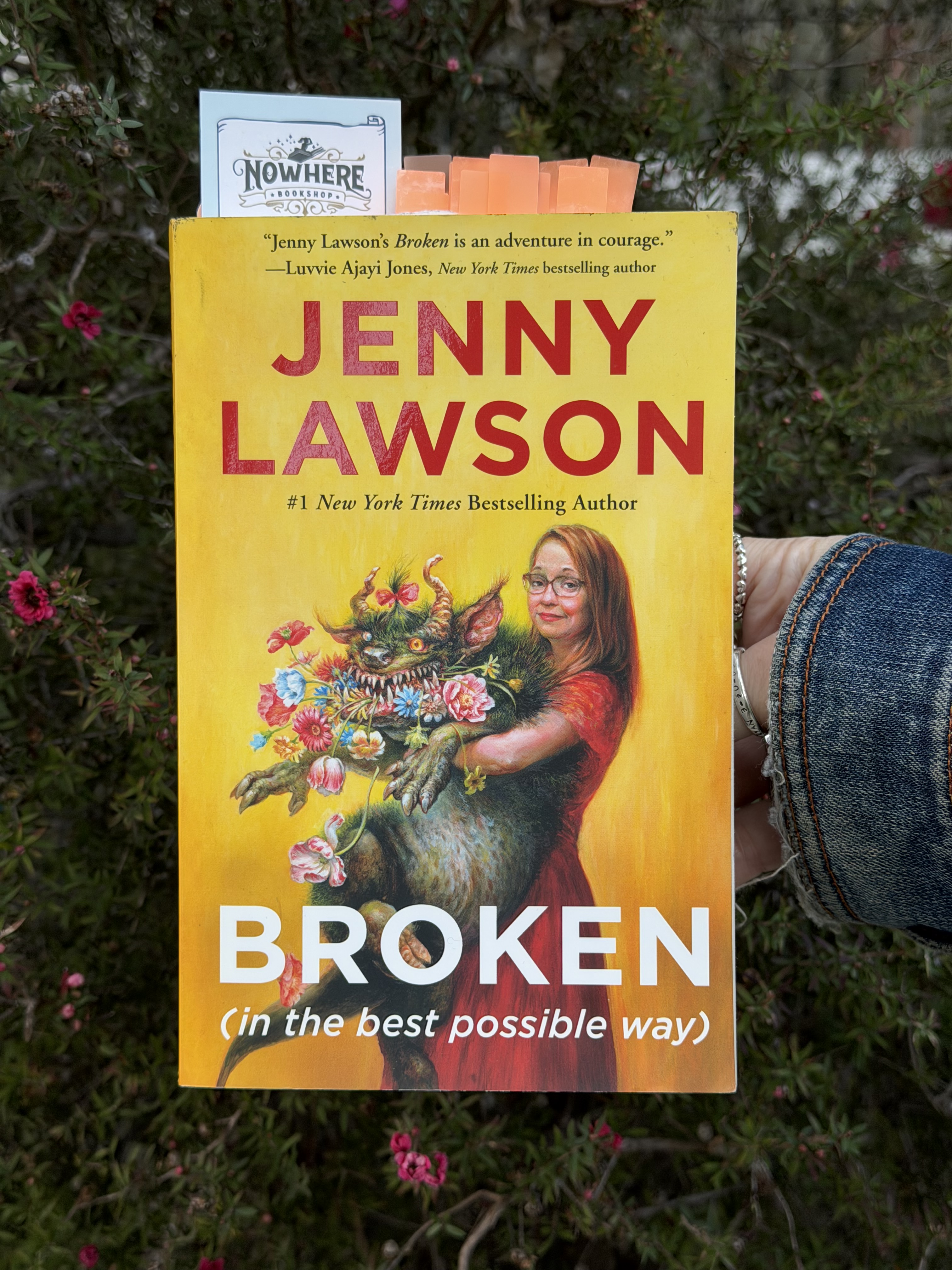
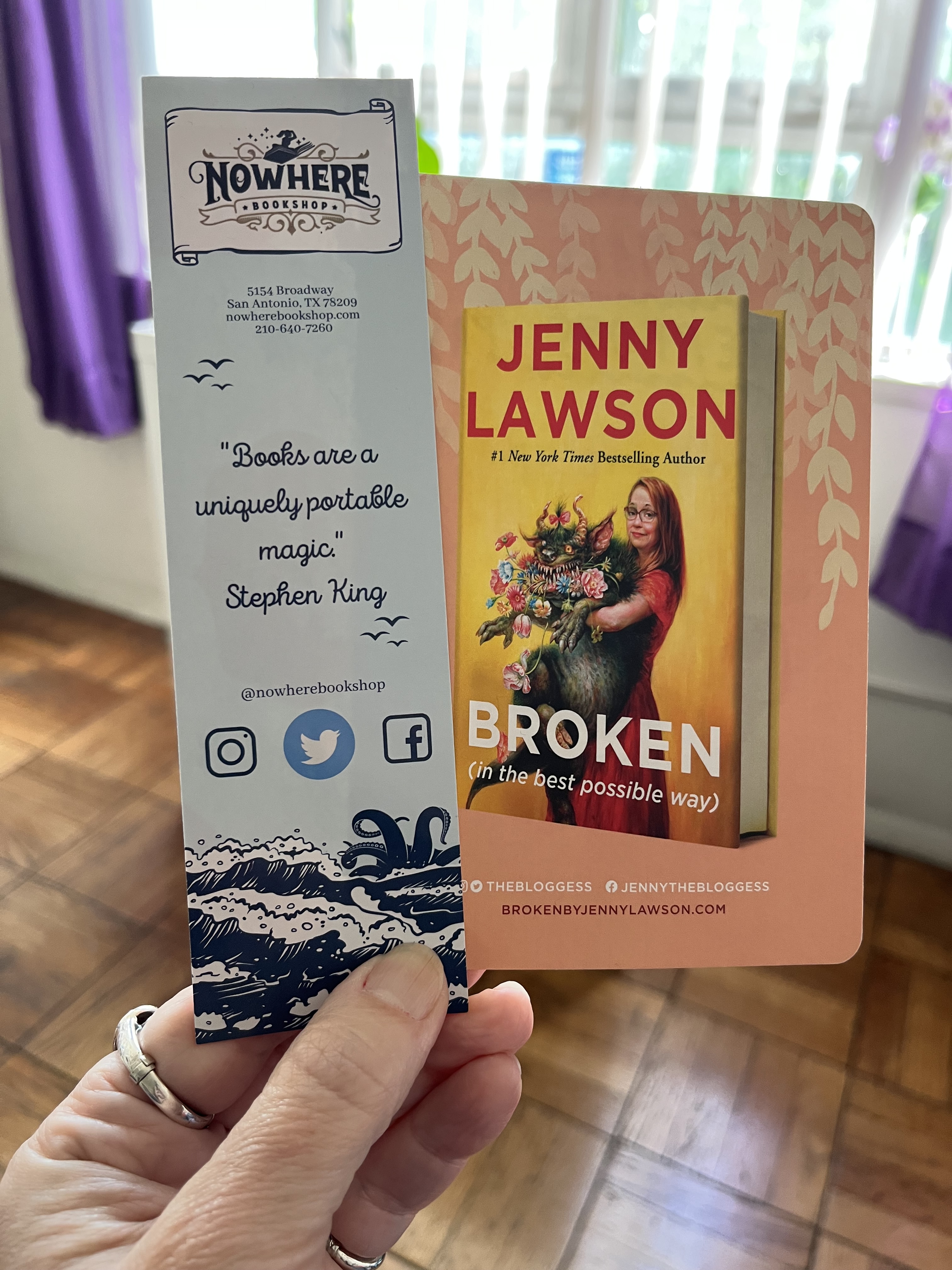
Jenny Lawson has been an author on my want-to-read list for a while now. I had seen, and remembered, her books — mainly because her covers are incredibly unique and absolutely do stand out and you can’t easily forget a cover that features a taxidermic roadkill raccoon. (That’s the cover of her nonfiction book, Furiously Happy.) I subscribe to Jenny’s blog, where she is known as “The Bloggess.” And, if I ever get to San Antonio, Texas I plan on visiting Nowhere Bookshop, the independent bookstore Ms. Lawson founded. 

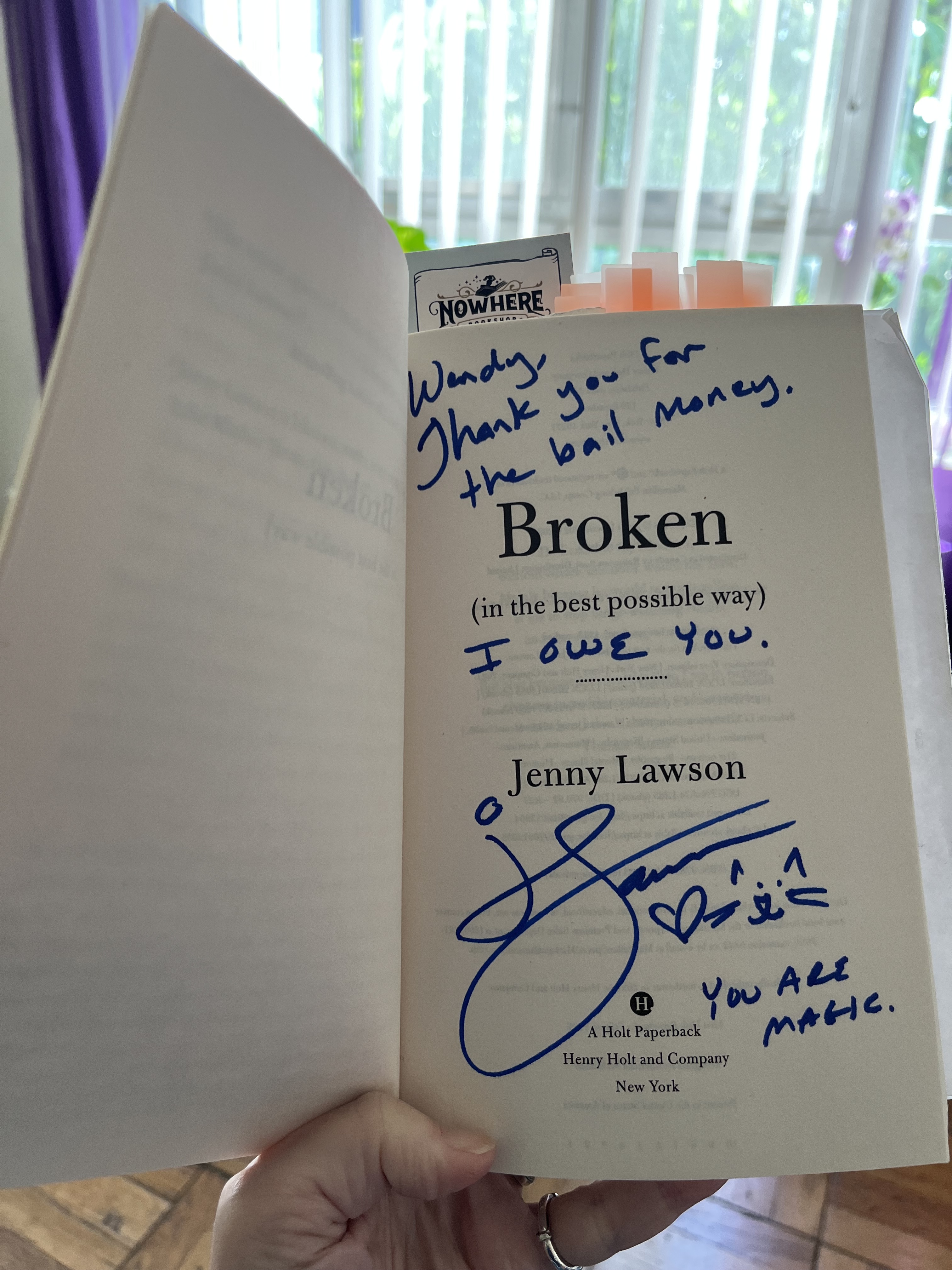
In fact, I purchased Broken (in the best possible way) near the end of 2024, complete with one of Ms. Lawson’s well-known personalized messages. A year later, I read the book and only have positive things to say (I mean, write) about it. 

From the back of the book: “In Broken, Jenny brings readers on her mental and physical health journey, offering heartbreaking and hilarious anecdotes along the way.” 

Not only did I place a sticky note on many pages of the book, I actually laughed out loud several times, too! (The chapter, “Six Times I’ve Lost My Shoes While Wearing Them: A List that Shouldn’t Exist,” is absolutely laugh-out-loud-funny!) 

This week, I share with you some of my favorite passages. (Keyword – some; I simply con’t include them all.)

“It’s weird because we often try to present our fake, shiny, happy selves to others and make sure we’re not wearing too-obvious pajamas at the grocery store, but really, who wants to see that level of fraud? No one. What we really want is to know we’re not alone in our terribleness. We want to appreciate the failure that makes us perfectly us and wonderfully relatable to every other person out there who is also pretending that they have their shit together and didn’t just eat that onion ring that fell on the floor. Human foibles are what make us us, and the art of mortification is what brings us all together.” 


“Be good. Be kind. Love each other. Fuck everything else. The only thing that matters is how you feel and how you’ve made others feel. And I feel okay (for the moment), and I make others feel okay by being a barometer of awkwardness and self-doubt.” 

“I try to look on the bright side. If I were still working in HR I’d have to be on disability now, but since I work from home I can adjust my schedule to my broken body and my mind. I can still afford the expensive medications and doctors’ bills and there are a lot of people who can’t. I’m lucky. I could be sicker. I could be dead.”

“But I’ll keep going. And I’ll keep fighting. And I’ll keep forgiving myself for being flawed and human, and if I can’t write a funny chapter I’ll write a chapter like this. One that might be a little pathetic, might not make sense to anyone but me, but is still true. Exactly like me.” 

I highly recommend the chapter, “These Truisms Leave Out a Lot of the Truth.” Ms. Lawson talks about those books “filled with small phrases and truisms that are supposed to be inspirational. And they were. In that I read them all and promptly added the parts that the authors had left out.” Ms. Lawson explains, “people tell you to ‘take the bull by the horns,’ but why? It’s a bull. Where are you taking it? And if you are going to take it somewhere I’m pretty sure you don’t drag it by the horns. The rule of bulls is avoid the horns. They aren’t bicycle handlebars.” 

Additionally, the chapter, “An Open Letter to My Health Insurance Company” is heartbreaking and honest and hilarious. This chapter needs to be given and read by every pharmacy. Every doctor. Every hospital. Every insurance company. Taken from the first paragraph: “It was a mistake to think that an insurance company claiming to want to help you in your sickest hours was anything other than a scam … after all, you are here to make money. And I am here to live. And it seems those things are sometimes mutually exclusive.”

“I don’t think I’m alone in this. I think many of us struggle with the thought that it’s okay to take care of ourselves, and it’s strange that it’s a struggle to treat ourselves as kindly as we treat the dog. The dog needs walks and healthy choices and water and play and sleep and naps and bacon and more naps. And love. I need that too. And so do you. It’s not just a gift we give to ourselves … it’s a duty.”

“… we are changed by life… it puts its teeth in us, it leaves its handprints and marks and scars on us. And as much as we try to ignore those things, in the end they make us who we are. For good or for bad, we are changed and touched and broken and mended and scarred. And those marks (inside and out) tell a story. They tell our story.” 

Also, the whole “Souls” chapter. Beautiful! That’s all I’m going to say. You really have to read it yourself.

And I’ll end this post with the sentences Ms. Lawson wrote to end her book: “Good night. Be safe. Be kind to each other. Be kind to yourself. And if no one else has said it yet, thank you for being you. You are magic. Never doubt it, my friend.”

Friends, have you read Broken? Or any of Jenny Lawson’s books? 

You can pre-order signed copies of Jenny’s new book How to Be Okay When Nothing Is Okay: Tips and Tricks That Kept Me Alive, Happy, and Creative in Spite of Myself from Nowhere Bookshop. The book publishes on March 31st, 2026.

Wishing you all a peaceful, joyful New Year! May it be filled with light, love, laughter, and books. And lots of reading time!

Please note: I am including a link to buy the book that I’m highlighting this week. If you use my link, I do make a small commission on your purchase at no additional cost to you. I am working with Bookshop.org which also sends a portion of the profit to support local, independent bookstores.
Thankful for Memoirs

Because November is National Memoir Writing Month and since tomorrow is Thanksgiving, this week’s blog post is dedicated to some of the memoirs I proudly count as part of my personal library. I think memoirs are vital to humankind. And I’m not just saying this because I write memoir and personal essay.

Memoirs are more than books — they are lenses, they are keys, they are light. They help us see, they open doors, they make visible what we didn’t notice and/or understand.

Readers of memoir gain insights and knowledge about situations and experiences they otherwise may never have known about. 

Memoirs promote empathy, allowing readers to get a closer look at diverse author backgrounds and life situations. 

Memoirs can inspire and motivate, comfort and reassure. Within its pages, a memoir speaks to a reader of shared challenges and journeys — you are not alone.

Consider this post, my heartfelt thank you note to the talented authors who bravely shared their stories with the world. 

Some of the memoirs I read this year include:

You Could Make This Place Beautiful by Maggie Smith

Your True Self is Enough by Susanna Peace Lovell

Glow in the F*cking Dark by Tara Schuster 

Suddenly Silent and Still by Nin Mok

In the photograph above, there are a couple of memoirs I purchased earlier this year but have not yet read:

26 Seconds: Grief and Blame in the Aftermath of Losing My Brother in a Plane Crash by Rossana D’Antonio and

Sit, Cinderella, Sit: A Mostly True Memoir by Lisa Cheek.

 And one memoir, The Taste of Anger by Diane Vonglis Parnell, I read last year when it was published. But, I remember reading early pages of Diane’s manuscript and am so very proud of Diane for getting her story out into the world, that I wanted to include her memoir in this list.

Friends, have you read any memoirs this year? I invite you to share the memoirs you keep thinking about, the memoirs you recommend to readers on a regular basis. I’m always adding to my want-to-read list and would love recommendations.

Please note: I am including a link to buy the books that I’m highlighting this week. If you use my link, I do make a small commission on your purchase at no additional cost to you. I am working with Bookshop.org which also sends a portion of the profit to support local, independent bookstores.

Dear Writer

A few weeks ago, I wrote a blog post about the “pep talks” portion of Maggie Smith’s Dear Writer: Pep Talks & Practical Advice for the Creative Life. (If you missed the post, click here to read it.)

This week, I’d like to share some more, because Dear Writer is one special book. In fact, I think Dear Writer is one of those books that won’t just sit on the shelf with other writing-related books. Dear Writer will be read and re-read. 

The book is organized into “ten essential elements”: attention, wonder, vision, surprise, play, vulnerability, restlessness, connection, tenacity, and hope. Within each section, readers will find craft-centered essays, writing prompts, and suggestions for related reading. 

But, I don’t think this book is only for writers. Or artists. I think the inspiring words found within this book, could really be applied to any area of life.

Here are some of the passages I marked with a sticky note. What do you think — only for writers or all humans?

“Although my work has changed over time, the act of writing feels no different to me than it did five or ten or twenty years ago. I’m still gathering, still collecting, still trying to make a garment from these scraps. The pleasure in the writing is the surprise — having no idea what you’re making as you’re making it.”

“When you try something new, whether it’s writing or baking or running, you’re in a period of apprenticeship to that art or activity. You’re a beginner, a novice, an amateur. But the root of amateur is the Latin amare, meaning ‘to love.’ An amateur does something for the love of it. And when you love something, you stick with it.
“When you stick with something out of love, you grow in it and with it. Each day, truly.”

“I don’t go to literature for comfort, as a writer or as a reader — I read and write to be changed, to see anew, to revise my own thinking. Actually, change is the opposite of comfort. But change invigorates. It stretches muscles you might not have known you had. It might hurt a little, that strain, but ultimately it strengthens. 
“I want to write and read pieces that lean toward wonder and rediscovery — toward questioning rather than knowing, toward authenticity and sincerity rather than irony and cynicism. Art is a site of wonder and discover — or rediscovery. Art is a place where we might learn what we think, not a place where we teach the reader what we’ve already processed.”


“The discovery doesn’t end when the piece is published. Sometimes readers will point things out that surprise you. Sometimes you’ll be reading a piece aloud in front of an audience, and something will strike you differently. The piece isn’t static, because you aren’t static. You change, your perspective changes, your experiences pile up, and you engage with the piece differently because of it.” 

“Creativity is artistic mischief. As writers and artists, our work is play. We come to the page — to the canvas, to the stage, to the studio — with trickster energy and a sense of daring. We’re working, but we’re delighting in the work.” 

“When we create, we choose the openness, the exposure, the risk — and that takes courage and nerve.
“There is no vulnerability without courage. They travel together, and I don’t think you can create without them both.” 

“I got ordained on the Internet for the same reasons I write poems. To marry two people is an act of hope, optimism, and connection. To write is an act of hope, optimism, and connection.”

“I’ve said for years that what every writer needs is a combination of tenacity — fierce, bulldog-like tenacity — and patience. The two go hand in hand. Tenacity is stick-to-it-ive-ness: part perseverance, part stubborn persistence, part fortitude, part endurance, part determination, part mettle (I love that word: mettle), and part drive.” 

“To make things that don’t exist yet — and don’t need to exist, because that is the very definition of art — and to send them out into the world is wildly, impractically, gorgeously hopeful.
“This is my way of saying there is no creativity without hope. Creativity is inherently hopeful, and the reverse is also true: Hope is inherently creative. Hope is imaginative; it allows you to envision what might be up ahead, even when you see nothing.”

“Remember: You are a writer if you write. You’re succeeding if you answer when the idea knocks — if you let it in, and pay attention to it, and see it through. If you don’t half-ass it. WHOLE-ASS IT. Your creative life deserves all of you. The whole you.”

Please note: I am including a link to buy the book that I’m highlighting this week. If you use my link, I do make a small commission on your purchase at no additional cost to you. I am working with Bookshop.org which also sends a portion of the profit to support local, independent bookstores.

107 Days — More Than Just a Book

When I click on the Dictionary app at the bottom of my laptop, and search the word book, here’s what I read: 

1. “A written or printed work consisting of pages glued or sewn together along one side and bound in covers.” 

2. “A literary composition that is published or intended for publication as a book.”

So, when is a book more than a book?

When it’s 107 Days by Kamala Harris. 

And purchasing the book did not mean visiting one of my favorite independent bookstores. Instead, I purchased a ticket for “A Conversation with Kamala Harris” at The Wiltern Theater in Los Angeles, which also included a copy of the book! (The event was held just a few days ago, on Monday, September 29th.) 

I attended the event with one of my closest friends which made it even more special. Before and after the discussion, my friend and I talked about what we already knew about the book, about the heartbreak of this last presidential election, about our concern/anger/frustration/sadness/dismay at the current state of our country. 

And then, up on stage, standing before us was Madame Vice President. She talked about why she chose to write the book, even sharing that she and her husband, former Second Gentleman Doug Emhoff, had never spoken about election night until she wrote about that night for this book. 

Completely unexpected!! -- The Former Second Gentleman graciously posed for pictures shortly before the conversation began.

I consider this book to be a historic document. A primary account of an unparalleled time in our country’s history. Many years from now, my copy of 107 Days will be passed down to future generations of my family. By then, I’m sure the book will have sticky notes on many pages. Maybe notes in the margins. Maybe a sentence underlined. 

Years from now, I’ll share my memories of this time. How close our country came to doing something groundbreaking, (or ceiling-breaking, I should say). Something already being done in other countries — electing a female to the highest office in the land. 

“Kamala Harris, for the people.” 

And Monday night the people in Los Angeles were there for Kamala Harris and her book. 

Love this photo on the back cover of the book!

Please note: I am including a link to buy the book that I’m highlighting this week. If you use my link, I do make a small commission on your purchase at no additional cost to you. I am working with Bookshop.org which also sends a portion of the profit to support local, independent bookstores.

Suddenly Silent and Still

I recently finished reading Suddenly Silent and Still: Finding Joy and Meaning Through Illness, a memoir written by Nin Mok. From the back cover: “In a life-changing instant, Nin is thrown into chaos by the onset of sudden hearing loss and violent vertigo.” 

Because Nin and I are Instagram friends, reading this book felt even more like a conversation between the two of us. This is not just a memoir written by some unknown author. This is the story of another woman, another mother, whose life was forever changed by a sudden illness.
 
My copy of Nin’s book is full of sticky notes. Because though our medical conditions vary, though our life circumstances differ, many of the emotions she wrote about really resonated with me. 
This week I’m pleased to share some of the excerpts that most touched me:

“I have no idea why I was certain my turn would come at the end of my life. I imagined being old and frail before discovering I had an incurable disease. I would then be afforded a moment of introspection before being shown the exit, like a happy-go-lucky partygoer who leaves when the music and fun are over. Never once did I imagine that I would have to stick around after the celebration for the long and arduous clean-up.”

“Jet and Jade were five and three when I got ill. They don’t remember their healthy mother, the one who chased them through the parks, raced them to the car, and sang aloud, albeit out of tune. They just know this mother. The one who struggled to make it through the day. Jet and Jade constantly needing my help and attention made my recovery more challenging, but at the same time, they made my recovery possible.”

“And what about all the other vital organs that I had only one of, such as the heart, liver, and brain? What if they suddenly failed too? My once safe world now felt fraught with unavoidable threats.”

“Why me? What did I do to deserve this?”

“My family relied on me as a co-breadwinner to keep a roof over our heads. This was a matter of survival. I was also our home’s central processor, who organised and coordinated our activities. Lives would fall into disarray if I remained incapacitated.” 

“It was this attitude that made me feel insecure about writing this memoir. I questioned whether my suffering was big enough, whether my misfortune was dramatic enough to warrant a book. Ridiculous, really.”

“Trauma has no size. Rather, trauma is like light, capable of filling the entire room regardless of its wattage.”

“I now lived in a world that was no longer made for me; it was made for the able. I no longer felt normal here.”

“The life I had planned, was looking forward to and counting on, was upended for real.” 

“Returning to work would have rubbed the comparison in my face. By keeping every facet of my life exactly as before, I would know for certain that my life had got worse. I would lead the same life, but now as a disabled person. Returning to work would make the downhill trajectory obvious.” 

“Young people were supposed to recover from illness, not remain ill indefinitely. Worse, I couldn’t rest as one might expect a sick person to. I was not retired; my children had not left home. I couldn’t curl up with a good book all day. I still had to put food on the table and my children through school, all while being sick.” 

“I could see the date creeping in from a distance. It marked the unhappy anniversary of my downfall. That date took the life I loved, chewed it up and spat back out something unrecognisable. It was the day I took a tumble and never stood back upright. That dreaded date will forever be remembered.”

“I no longer compared myself to the previous Nin, nor did I keep measuring up to her. I only cared about where I was now, and where I wanted to be, not where the former me wanted to be.”

“I went from feeling unlucky that this happened to me to feeling lucky that only this happened to me.”

Please note: I am including a link to buy the book that I’m highlighting this week. If you use my link, I do make a small commission on your purchase at no additional cost to you. I am working with Bookshop.org which also sends a portion of the profit to support local, independent bookstores.


Time to Take a Seat

Image Credit: Wishbone Words Magazine

Friends, I’m pleased to share that my personal essay, Time to Take a Seat, has been published in Wishbone Words Magazine, Issue 15

This piece was a difficult one to write. It’s a personal essay that went through many revisions before I submitted it.  

It’s a personal essay about my decision to purchase a wheelchair. 

I’m grateful Wishbone Words Magazine provides this space for me and other “disabled, chronically ill, and/or neurodiverse writers and artists” to share our experiences and our creations in a safe, inclusive space. 

You can click here to learn more about purchasing Wishbone Words Magazine, Issue 15. 

Image Credit: Wishbone Words Magazine

Glow in the F*cking Dark

Two years ago (yikes! already?) I wrote a blog post in praise of Tara Schuster’s Buy Yourself the F*cking Lilies. (In case you missed it, click here to read that blog post.)

This week’s blog post is in praise of Ms. Schuster’s second book, Glow in the F*cking Dark: Simple Practices to Heal Your Soul from Someone Who Learned the Hard Way

Once again, I found so many statements that caused me to pause my reading. Sometimes I re-read those statements. Other times, I sat and thought about what I had read and thought about how that applied to my life or why that statement resonated with me. 

This week, I’m sharing some of those statements with you:

“We are stars. I mean that quite literally. Most of the elements that make up our bodies came from the Big Bang, from the very things that make up stars. I think you’ve probably heard that before and it isn’t a fable, it’s true. Isn’t that just about the most enchanting thing to think about? That you are made of stars?”

I know you have the power to glow because you already do. The human body is bioluminescent. It glows on its own. Ultrasensitive cameras can photograph our natural radiance. So, you glow already, whether you like it or not. Now is the time to clear off the dirt, the cobwebs, and the ghosts that are obscuring the shine within you and set that glow free.”

This book, Ms. Shuster writes, is “… for anyone who is tired, hurting, and feeling like their shine is gone.”

This statement is listed as one of Ms. Schuster’s life truths:  “When we try to fight reality, we lose. The more we reject how we actually feel, and the real circumstances of our lives, the more pain we put ourselves in. I’ve come to realize that the distance between how things are and how I want them to be is the exact measure of my suffering.” 

“My life is boring and predictable and because of that it’s easier to be creative and content. BEING BORING IS AMAZING! I spend almost no time thinking about how I will structure the ‘free’ blocks in my day because the rituals I have created have taken the heavy lifting out of the mundane.” 

“One of my favorite quotes in the whole wide world comes from the author Annie Dillard — she wrote, ‘How we spend out days is, of course, how we spend our lives.’ Spend your days living what you care about and feel yourself light up with life. Your life.” 

And since I find it way too easy to find fault with my body (how it looks, how it does and doesn’t function), I loved this: “… now I see my body for what it is — a living, breathing, moving sculpture, one of a kind and priceless, worthy of my absolute care and adoration.”
“What about body gratitude? What about the fact that if you have a body, even if it comes with complications and pain, you can ultimately be glad to be on earth?”

I think this fear of making ‘bad’ choices is why we very often end up on our ‘Good Enough Plateaus,’ where it’s safe and comfy and there’s a Starbucks around the corner and we know exactly what we can get.”
“… but we get into real trouble when we start believing that’s it, when we stop expanding, growing, and shoving off on new adventures. Then we deprive ourselves of the opportunity not only to mature and taste a richer life but also to deepen our experience by knowing what it means to come up short.”

“… if you truly appreciate the unbelievably precious gift of your being, you will do everything to live it to its very fullest. That’s how we show gratitude for our existence, damn it!”  

My dear readers, have any of you read Ms. Schuster’s book(s)? I’d love to hear your thoughts.

Please note: I am including a link to buy the book that I’m highlighting this week. If you use my link, I do make a small commission on your purchase at no additional cost to you. I am working with Bookshop.org which also sends a portion of the profit to support local, independent bookstores.
You Could Make This Place Beautiful

The cover of Maggie Smith’s memoir is stunning, and the words inside are no less striking. You Could Make This Place Beautiful is a memoir written by a poet, meaning readers will encounter sentences and images that you’ll need to read more than once, just to soak in the beauty (or “savor the flavor” as we say in our family). This is a memoir with an unconventional structure, a memoir that gives readers a glimpse inside to the end of Ms. Smith’s marriage and the beginning of what comes next.


From the book flap: “With a poet’s attention to language and a transformation of the genre, Smith reveals how, in the aftermath of loss, we can discover our power and make something new. Something beautiful.”

Here are a few of the passages, that for one reason or another, I marked with a highlighter and sticky note. Some of these passages are beautifully written. Some passages resonated with me, though on the surface it would seem Ms. Smith and I lead very different lives. But that’s one of the reasons I enjoy reading memoir — I learn about another person while also learning about myself, because it really is true — what we, as humans, have in common is so much more than our differences.

“How I picture it: We are all nesting dolls, carrying the earlier iterations of ourselves inside. We carry the past inside us. We take ourselves — all of our selves — wherever we go.
“Inside forty-something me is the woman I was in my thirties, the woman I was in my twenties, the teenager I was, the child I was.”

“Being married isn’t being two columns, standing so straight and tall on their own, they never touch. Being married is leaning and being caught, and catching the one who leans toward you.”

“For most of my life, I’d been a planner — driven and organized in my work; wedded to a schedule as a parent. But both the divorce and the pandemic meant a loss of control. So many of the things I had planned for were no longer possible, and I had to let go. I loosened my white-knuckled grip on my life and instead of feeling panicked, I found myself being more playful, more spontaneous, less tethered to order for order’s sake.”

“What I want to remember about that time — and what I want my kids to remember — is unselfconscious joy, tenderness, and togetherness. I want them to remember that their mother was happy, not that she had dinner on the table at 6:00 every night, or that bedtime was always at 8:00. I want to remember all the things we did, not the things we weren’t able to do.
“Sometimes
yes looks like reminding yourself of what is still possible.”

“I’ve wondered if I can even call this book a memoir. It’s not something that happened in the past that I’m recalling for you. It’s not a recollection, a retrospective, a reminiscence. I’m still living through this story as I write it. I’m finding mine, and telling it, but all the while, the mine is changing.”

“The way you’ll be remembered is the way you’re living now, I tell myself. If you don’t like it, change it.”

“I’ve tried to love them as if there is a right way. No, I’ve loved them without having to try at all, because I’m their mother, and the love is not work. Parenting is work: the cooking of meals, the washing of clothes, the tending of wounds, the taming of cowlicks, the helping with homework, the driving to soccer, the packing of lunches, the finding of missing things (water bottle lids, baseballs, library books, mittens), the consoling to sleep. The love? It’s not work.”

“How I picture it: We are nesting dolls, carrying all of our earlier selves inside us. I feel so full of the life I had before — the life I have already lived — how is there room for anything new?
“We feel and feel, and live and live, but somehow we’re never full. This life is elastic, impossibly elastic. There is always room for more experience. Our lives expand to accommodate anything.”

“ ‘Wish for more pain,’ a friend’s therapist advised, if you want to change. If you’re in enough pain, you won’t be able to continue living the way you’ve been living; you’ll have to do something differently. But be careful what you wish for, because you just might get it — and then what? Then the pain is yours. The pain is yours and it will change you.”

“Now I see the title as a call to action — a promise I’d made not only to this book, and to you, but to myself. A promise I intend to keep.” 

“I keep thinking that this story, this life, could’ve happened another way. In some parallel universe, maybe it did, but here it happened like this — or, rather, it’s happening like this. How will it end? I don’t know. Every ending is one of many possibilities, one of many unknowns. Every ending is secret until it happens.”

Please note: I am including a link to buy the book that I’m highlighting this week. If you use my link, I do make a small commission on your purchase at no additional cost to you. I am working with Bookshop.org which also sends a portion of the profit to support local, independent bookstores.

Somehow

It feels only fitting, that my day-before-Thanksgiving blog post features Anne Lamott’s Somehow: Thoughts on Love.

The book was a birthday gift, given to me by one of my closest friends. I don’t know how you manage your books, but most of the time, the books that are most recently added to my want-to-read shelves (whether they be library books, or gifts, or books I bought or picked up at a Little Free Library), I don’t immediately read. When I select a book to read, it’s a bit like shopping from my own little library. And not until a few weeks ago, did I select Anne Lamott’s most recent nonfiction book.

My copy is full of sticky notes. This is a beautiful book, and if you enjoy Anne Lamott, I think it’s safe to say you will love this special collection.

Some of my sticky notes were placed because of the subject matter, because I found something Ms. Lamott wrote to be so true or touching. Other sticky notes were placed because I truly was amazed by the way she combined words; I don’t think anyone but Anne Lamott could have constructed some of these sentences. 

Here are just a few of my favorite passages:

“Love is caring, affection, and friendliness, of course, compassion and a generous heart. It is also some kind of energy or vibration, because everything is — the same stuff moving at different speeds, from glaciers to six-year-old boys.
“I wish the movement of love in our lives more closely resembled the grace of a ballerina, but no, love mainly tromps and plops, falls over and tip-toes through our lives.
“Love looks like us, and that can be a little daunting. Love is why we are here at all, on the couch and in the world with a heart for the common good, why we have hope, and a lifeline when we don’t.” 

“Usually grace in its guise as spiritual WD-40 gets in and loosens the tight knot that has formed in the tangled gold chain of my best thinking.”

“The reason I was nobody’s priority was that I wasn’t my own and never had been. It was time to lavish on myself the kind of focused care and affection I shone on everyone else.”

“Life becomes a lava lamp of memories of happier and sadder times, of what might have been, and of a fearful future, accompanied by the burbling sound of advancing time, of which one friend has almost run out, and of which I will too someday (supposedly).” 

“I have stated elsewhere that hope is believing this one thing: that love is bigger than any grim, bleak shit anyone can throw at us. And I believe.”

“If I can get word to my grandson from the other side when I am gone, I will whisper to him when he is in trouble to make a gratitude list – no snakes in the room, yay! – then do his chores, be kind to himself, be of service, get outside, and breathe. This is the launch code when under attack: gratitude, chores, chocolate, service, breath, nature.” 

“Love is how hope takes flight, in swamps and barren fields, arising in different frequencies, blending the way sound vibrations of different pitches organize music. With my failing hearing in our failing world, I try to listen for this song underneath the river of incoming date and my pinball machine mind and I find that it is always playing.” 

“Attics are so spooky, and I had to remind myself that courage is fear that has said it’s prayers.” 

“The sky takes you out into the cosmos, reminding you that you are very tiny but can experience celestial wonders and oceans of love here, even just slogging along together beneath a perfectly ordinary sky.”

Friends, tomorrow is Thanksgiving in the United States. Without a doubt, it can be a holiday with complicated emotions. To all my reader friends, those in the U.S. and those abroad, know that I am so very thankful you’re here, reading my words each week. Thank you!

Please note: I am including a link to buy the book that I’m highlighting this week. If you use my link, I do make a small commission on your purchase at no additional cost to you. I am working with Bookshop.org which also sends a portion of the profit to support local, independent bookstores.

The Lives We Actually Have

Last week I wrote a personal essay for a submissions call. The prompt was New Year-related — about starting a new project, developing new habits, of making plans to live your dream life.

That last one — making plans to live your dream life — was the one that hurt the most. 

Because that doesn’t apply to those of us living with a chronic illness. 

Because no one dreams of a life with a forever-illness.

No one aspires to live each day with an incurable illness. 

And yet, that is my life. 

And though it isn’t what I dreamed of or what I would have chosen, it is my reality. And mixed in with the medications and heating pads, doctors appointments and physical therapy sessions are also moments of beauty and calm, of belonging and wonder, of a glorious full moon and a sink that isn’t draining.

Which brings me to the book The Lives We Actually Have: 100 Blessings for Imperfect Days by Kate Bowler and Jessica Richie.

You may remember that I’m a Kate Bowler fan. I wrote about her book Everything Happens For a Reason (And Other Lies I’ve Loved) back in March 2023. And I wrote about her book No Cure For Being Human (And Other Truths I Need to Hear) back in April 2022.

This book is different. The Lives We Actually Have is a collection of blessings. 

From the introduction:

“If we are very lucky, we have days lit up with fireworks. We have powerful moments of connection — to the world, to each other, and even to God — that dazzle us. Suddenly, beauty and possibility are everywhere. We thought we were living any old day, but no. We find ourselves amazed by the truths we didn’t set out to learn.”

“Contrary to most of the advice of the self-help and wellness industry, our days are not simply a reflection of our choices. We are not a tally sheet of all our yes and no decisions. We like to imagine that we are built out of every small choice we made.”

“We need a language of acknowledgment for the lives we have, not simply the lives we wish for. We need a spiritual account of time that is rich enough to name the breadth of our experience. Good. Bad. Difficult. Sublime. Mundane.”

“When I bless the actual days I am living, I suddenly find I have a great deal more to say that is honest. I am mourning. I am bored. I am exhausted. I am apathetic. I discover that I am freed from the need to declare everything #blessed. Good or bad, I don’t have to wait to say something spiritually true. I can simply bless it all instead.”

The book is a special collection, with some blessings that really touched me and others not-so-much. 

Dear readers, have any of you read this book? Was there a particular blessing that most touched you/moved you/comforted you? Feel free to share it in the comments.

Here’s a part of just one of the blessings that spoke to me:

Please note: I am including a link to buy the book that I’m highlighting this week. If you use my link, I do make a small commission on your purchase at no additional cost to you. I am working with Bookshop.org which also sends a portion of the profit to support local, independent bookstores.