Chronically Parenting

I don’t listen to many podcasts, but I do make a point to listen to Jean Meltzer’s monthly podcast, Chronically Fabulous. (I wrote about her podcast back in January. If you missed that blog post, you can read it here.)

Her third episode featured special guest, Heidi Shertok. Like Jean, Heidi is also a Jewish author, writing rom-coms, and living with chronic illness. Their conversation focused on parenting when you’re chronically ill. 

Jean, Heidi, and I all have different perspectives based on our different life experiences when it comes to parenting. Jean and her husband made the decision not to have children. Heidi entered into marriage and parenthood as a chronically ill woman. And I become ill when my son was two years old. 

There were several moments when I paused the podcast so I could jot down a note, because I knew I would want to write about their conversation and share it with you, readers. Because finding your community is so important, especially when your body doesn’t behave the way you’d like it to. And when I come across something — a podcast, a book, a line in an article — that allows me to feel seen and understood, it’s something I want to share with you as well. 

With that in mind, here are just a few of the highlights from their podcast conversation: 

– Jean and Heidi spoke of the idea of “masking.” I’ve always referred to it as putting on my game face, others might say it’s like having your poker face on and not letting your true emotions out. It’s the idea that on the surface no one can tell how you’re really feeling inside. You keep your pain, your discomfort, your worry out of sight. You present as healthy — because, at least for me, sometimes it’s just easier. It’s easier not to have to explain why I can’t sit on a tall bar stool, for example. (It’s really painful for me.)

– Something Heidi said really stood out to me. She said she believed her kids were lucky, growing up with a mom who is chronically ill. Her kids have learned/are learning there are all sorts of “normals” within families. There is not one right way for a family to be. Likewise, I hope that by growing up with a mom who has an invisible disability, my son has learned that you often can’t tell what someone is going through just by looking at them; that many people are out and about in the world, dealing with pain we can’t see. 

– Heidi also shared something her rheumatologist told her when she was young: A lot of people are like most flowers, you can put them anywhere and they’ll thrive. While people like Jean, Heidi, and myself, and others with chronic illness, are like orchids; we can only thrive in very specific environments. I love that analogy. 

Dear readers, any podcast recommendations you’d like to share? I also sometimes listen to The Shit No One Tells You About Writing (such a great title!) or an episode of Moms Don’t Have Time to Read Books when I’m doing my daily physical therapy exercises/stretches at home.

There Is No Magic Wand

Image Credit: Yoocan Do Anything

Back in January, I wrote about my word for 2024: Share.

(If you missed it, you can click here to read the post.)

And so far, I have done quite a lot of sharing — here on this weekly blog, on Instagram where I mostly share about books and my writing-related life, and in the personal essays which have been published in anthologies and journals, both in print and online.

This week, I am pleased to share my personal essay, There is No Magic Wand, has been published by Yoocan Do Anything

Here is a snippet:

I would stop by CVS on my way home and pick up the prescriptions my doctor had called in. I felt confident these new pills would fix the problem because that’s what medication had always done up until that point in my life. 
“I could not have known that when it comes to a chronic illness, such as my autoimmune disease, there is no such thing as ‘fixing the problem.’ There was no pretend magic wand I could wave and make things all better, like I did with my then-three-year-old son when he bumped into a corner of the coffee table. No one could kiss my left calf and make the hurt be ‘all-gone,’ like a Mommy’s kisses often do for their little ones.”

Click here to read the essay in its entirety.

Yes, And

Last week was a time of big emotions. A lot happened in my world and with it came a lot of mixed feelings.

My mom celebrated her 79th birthday on the same day my son celebrated his 16th birthday.

A former kindergarten student, a child I taught during my first year of teaching, looked me up online, found my website, and reached out with an email that made me cry. She wrote, “I wanted to thank you for being a great teacher and setting a solid foundation for my education.” Did I mention she’s now a teacher?

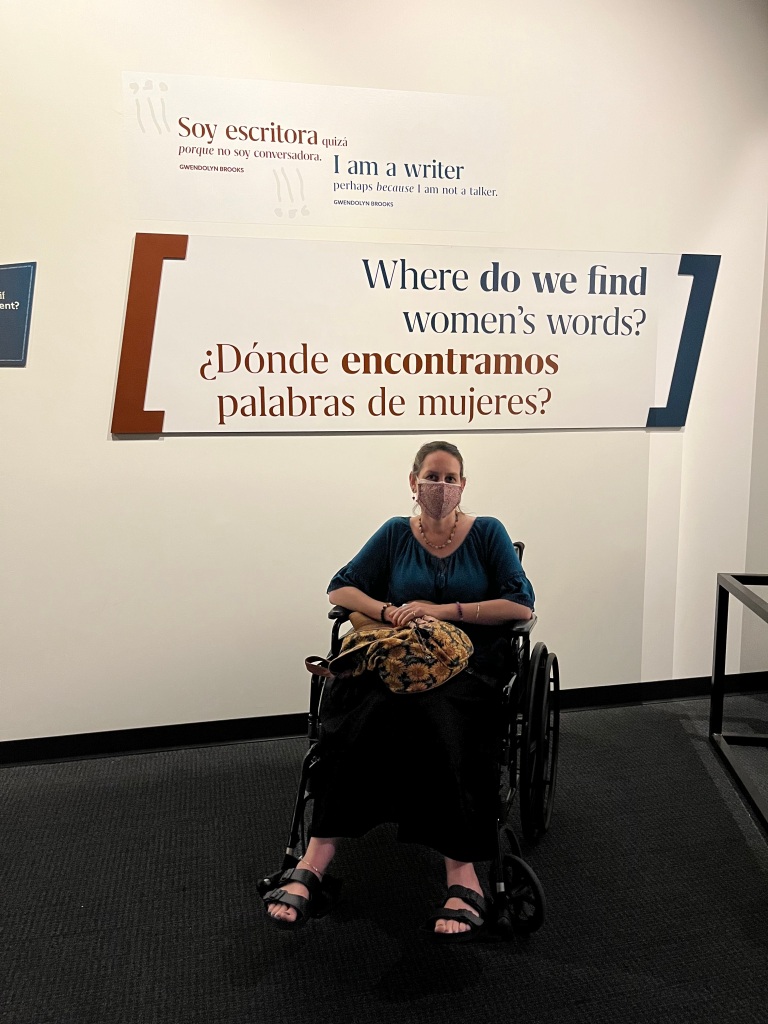
We had a family outing to The Huntington Library, Art Museum, and Botanical Gardens. A place we hadn’t visited since March 2020, a week before the world shut down because of the coronavirus. Only this time we visited with me in my wheelchair.

Our former next door neighbor, now 89 years old, remembered my son’s sixteenth birthday and called to offer birthday wishes. 

So, it’s been a lot. 

Something I have learned, through the work with my therapist and my years living with my autoimmune disease, is that it’s possible to feel two very different emotions at the same time. In fact, when you live with chronic illness, it happens quite a lot. At least to me.

I am currently reading The Lives We Actually Have: 100 Blessings for Imperfect Days by Kate Bowler and Jessica Richie. I try to read one blessing a day, though, I admit I sometimes forget and miss a day (or two).

This week, I’d like to share a bit of Kate Bowler’s blessing, “For Stretching Your Heart,” which I think explains these mixed emotions so well:

Yes, I have so much to be thankful for,
and this hasn’t turned out like I thought it would.
Yes, I feel moments of joy,
and I have lost more than I could live without.
Yes, I want to make the most of today,
and my body keeps breaking.
Yes, I am hopeful, and this is daunting.
Yes, I am trying to be brave, and I feel so afraid.”

Because the truth is — yes, things could be worse, and things could be better.

Please note: I am including a link to buy the book that I’m highlighting this week. If you use my link, I do make a small commission on your purchase at no additional cost to you. I am working with Bookshop.org which also sends a portion of the profit to support local, independent bookstores.

Chronic Illness, Chronic Pain, and Gold Stars

I am pleased to share that my personal essay, “Chronic Illness, Chronic Pain, and Gold Stars,” has been published in a new anthology, Chronic Poetics. “The book contains artwork, essays and poetry written entirely by people who have experience of chronic pain and chronic illness.” Each piece of writing has been “arranged and visually interpreted,” making it possible to create an anthology that tells a “visual story as well as a literary one.”

I’d like to share two excerpts from a section near the end of my essay:

“I wish someone had handed me a manual of some sort. My car came with one. The new little handheld vacuum I recently bought came with one. (I don’t remember the last time my trunk looked so clean.) But no one told me how to navigate living with a chronic illness. No one pointed out that a chronic illness is one thing. A chronic illness causing chronic pain is something else.”

“There are moments I want to cry. Moments I want to scream. Moments I want to throw things and break things. Because this is hard. And it’s tiring. And it often doesn’t feel like it gets any easier or any better.” 

You can find more information about the anthology here.

The visual interpretation of my personal essay.

Unhelpful Advice

(This photo was taken a couple of months ago. Different doctor. Dreadful pain chart.)

I had a hard doctor’s appointment last week. 

Maybe “hard” isn’t the right word. After all, I found parking half-a-block away from the building. The doctor was only running a few minutes behind schedule. And because I had blood work done in December, no additional labs were needed. 

In those terms, it was a pretty good appointment. 

But it was still a hard appointment. Because I left the appointment feeling weary, disappointed, and dejected. Angry, frustrated, and pissed. Sad, crushed, and dejected.

Later, I told my husband, “No one knows what to do with me.”

My rheumatologist (rheumatologist number three in my life with chronic illness) cannot explain my increased levels of pain and decreased levels of energy. Because the blood work shows my inflammation is under control. Which means my medication is working. But it doesn’t explain why I feel like “I’m going downhill, fast, and no one is able to slow me down.” (I said that same sentence to my doctor. He nodded his head. He said he understood.)

I should point out that I do like this doctor. I like that he looks at me when I speak and really seems to be paying attention to what I have to say. I like that, during past appointments, he seems thoughtful when suggesting new medications to try and shares with me his reasoning behind those medications. (By the way, I have tried every medication he has suggested. A few made me worse than I was to begin with.)

My doctor said he’s concerned about “structural damage” to my body. Which sounded more like a description of a car than a person. My doctor voiced his concern about feelings of depression I may have. I reminded him I regularly speak with my therapist.

He wants me to try physical therapy. Again. (Readers, I have tried physical therapy multiple times over the years. At different locations. Usually I’m told how inflexible I am. How much less range of motion I have in my left leg compared to my right leg.) I have the phone number; I just need to call and make the appointment. I’m procrastinating. 

But that wasn’t his only recommendation. 

“Do you multi-task?” he asked.

“I’m a mom. Of course I do. Don’t all moms?” I asked.

He didn’t seem amused by my response. Though I wasn’t trying to be amusing. 

My doctor says multi-tasking leads to additional stress. 

So do less, and eat more whole grains (another one of his suggestions).  

But I can tell you right now that won’t help my pain. 

The truth is — there is no easy fix. I know that. He knows that. 

At the same time, no chronic illness patient wants to be sent on their way having been told to multi-task less.

Chronically Fabulous

Chronically Fabulous is the name of author Jean Meltzer’s new podcast. It’s an interesting combination of words. (And if you’re not familiar with Jean Meltzer’s books, be sure to check out my posts about her first novel The Matzah Ball, her second novel Mr. Perfect on Paper, and her third novel Kissing Kosher. They all feature main characters who are Jewish women living with chronic illnesses and chronic pain.)

The podcast aims to be a safe space for listeners, and function like a conversation with your chronically ill friends. 

While I acknowledge my chronic illness, I don’t think it’s fabulous in any way. Actually I don’t even use the word “fabulous” all that much.

But, put together – Chronically Fabulous. I kind of like the idea. 

2023 was one of my toughest health years in terms of intense pain. It was the year of admitting it’s too hard to grocery shop by myself. The year we rented a wheelchair for our family summer trip to Washington, D.C. The year I bought a wheelchair to have for those special occasions when I’ll need it (such as attending a performance at the Hollywood Bowl). 

And while those were all super tough things, they’re also things I’m proud of. I didn’t cancel our summer trip after I began researching museums and monuments in D.C., knowing I wouldn’t be strong enough to walk them all. I found a way for our family to take the trip and that, I think, is an example of being chronically fabulous.

So far, Ms. Meltzer has released one episode of her podcast, and the part that most stood out to me was the discussion regarding “pacing.” No doctor has ever spoken to me about pacing — the idea that certain activities are more energy-intensive, so a person living with chronic pain has to figure out rest days (usually before and after the event). Pacing is a tool; a tool I haven’t regularly used. But it’s time. Because I simply can’t keep up anymore. Listening to the podcast, I realized I don’t do what Ms. Meltzer spoke of — creating boundaries and making myself, my health the priority. She wants listeners to “live your best, most valuable life.” 

And I want that too. 

Something I came to acknowledge this past year was my tendency to do everything possible to fight my pain; trying to pretend like there’s nothing wrong. Trying to act as if I can keep up with my same-age-as-me husband and high-school-age son. I have kept up the act for years, because I didn’t want to miss out on any shared family experiences. Because I didn’t want my illness to hold me back, or take any more from me than it already had, most heart-breaking of all being my teaching career. 

But 2023 was the year I saw I just can’t keep doing it. Something shifted. I am not waiting for some cure or major fix. It’s not coming. Instead, I’m searching for small, but mighty, tweaks. “Little” things that make a big difference in how I get through my days. And something I need to consciously work on is pacing. Learning to give myself permission to sit and read. Not pushing myself to plan big outings both weekend days. Trying to build in rest times the day before and the day after a big event. Trying to treat myself with the same compassion and kindness I so easily share with those I love.

My Spoonie NaNoWriMo

If you’re a fiction writer, or live with a fiction writer, you’re most likely familiar with NaNoWriMo, which is the abbreviation for National Novel Writing Month. NaNoWriMo takes place each November, with writers committing to work towards the goal of writing the draft of an entire novel (50,000 words) in one month. 

NaNoWriMo started back in 1999, and since then it has become a worldwide phenomenon. Writers find community, encouragement, resources, and support by participating and connecting with other writers going through the same process.

I don’t write fiction, and the sheer number of daily words required (50,000 words over 30 days works out to about 1,667 words a day) didn’t feel attainable for me, so I never participated in NaNoWriMo.

Until this year.

And it’s all because of Sandra Postma. (You may remember I wrote about Sandra and the incredible work she does as a Book and Spoonie Coach  in a blog post back in October. In case you missed it, you can click here to read the post.)

On her Instagram, Sandra encouraged spoonie writers to participate in NaNoWriMo in a way that worked for each of us. She pointed out that as people who live with chronic illness, we’re accustomed to modifying a variety of activities. Why should NaNoWriMo be any different? Sandra encouraged us to participate in a Spoonie NaNoWriMo — one with individual goals that work for each writer. That I could do. 

Being a former teacher, I printed out the goals I set for my NaNoWriMo, as well as a November calendar. Each day I met my goal, I put a sticker in the calendar box. (Again, former teacher. Plus I had all these cute stickers on-hand.)

My Spoonie NaNoWriMo Goals, as I printed them out:

Each day in November I will:

Complete a 5-minute writing exercise.

Write down one statement, acknowledging something I did, 

something my body was strong enough to do.

And I did it! (Note all the stickers!)

It certainly wasn’t easy. There were days I was tempted to skip the whole thing, but I’m glad I didn’t. The hardest part was the daily statement, a note of appreciation and gratitude for things my body is still strong enough to do, because I’m not used to highlighting myself in this way.

My statements tended to acknowledge a “bigger” outing or activity — taking down and putting away our Halloween decorations, decorating for Thanksgiving, grocery shopping (though I no longer do that by myself), a longer walk in the neighborhood. 

While those “bigger” activities were worth documenting, writing this list helped me see how hard I work each day, how much I continue to do each and every day, and all while my pain has consistently been more and more intense.

For instance: I make the bed each morning. I pick up my own prescriptions at CVS. I shower each night. I never skip brushing my teeth. I get dressed each day, complete with my daily jewelry (nine rings on eight fingers, bracelets, earrings, necklace). 

The unexpected result of my Spoonie NaNoWriMo is the feeling of achievement and pride — in my writing, yes, but also in myself! 

Dear Readers, anyone else participate in a version of NaNoWriMo? How did it go for you? Let me know in the comments.

I Bought Something

This picture was taken at the National Museum of American History during our summer trip to Washington, D.C .

I have some news to share.

But first, for readers who may not know, a little background.

When I first became ill in 2010, and diagnosed late in 2011, I was determined my autoimmune disease wouldn’t greatly impact my life. 

I didn’t know it then, but that really wasn’t my decision to make. My body was doing its own thing, which is how autoimmune diseases work. Your body attacks itself.

I retired from my twelve-year teaching career in 2013. It was a heartbreaking decision to make, but at the same time, I really didn’t feel I had a choice. My body was breaking down, and I was finding it harder and harder to keep my head above water between teaching elementary school, parenting my young son (he was two when I became ill), and trying to maintain my other roles as wife, daughter, and friend. 

Since that time, there have been ups and downs, or medically speaking, flares and periods of remission. 

But now I’m in a new place. My leg is weaker than it has ever been. Daily intense pain, though my body currently shows no signs of active inflammation.  

Which brings me to my news. 

I ordered a wheelchair. 

You may remember my blog post about my decision to rent a wheelchair for our summer trip to Washington, D.C. (If you missed it, you can read it here.)

Since then there have been other times when a wheelchair would have helped. Seeing Return of the Jedi in concert at the Hollywood Bowl. Taking a family walk. And there are other outings I have avoided, such as visiting The Huntington, simply because I didn’t think my legs were strong enough.

But, I’m scared. 

I don’t know if I am just stuck in a really long, really bad flare that will eventually ease up. I don’t know if better days are ahead once I can get past this rough patch.

Or, is this just the beginning? Am I headed to a reality that finds me increasingly dependent on a wheelchair and needing someone to push it, to push me.

No one knows. 

I’m trying not to let the purchase of a wheelchair make me sad. I’m trying to remind myself how helpful it was in D.C. How having a wheelchair allowed our family to see and do as much as we did. 

I’m trying to think of the wheelchair the same way Michelle Obama wrote about her dad’s cane in her book The Light We Carry: Overcoming in Uncertain Times.

“As we saw it in my family, that cane symbolized nothing. It was just a tool, the same way my mother’s spatula was a tool in the kitchen, or my grandfather’s hammer got used any time he came over to fix a broken shelf or curtain rod. It was utilitarian, protective, something to lean on when needed.” 

I’m trying. But it’s not easy.

Please note: I am including a link to buy the book that I’m highlighting this week. If you use my link, I do make a small commission on your purchase at no additional cost to you. I am working with Bookshop.org which also sends a portion of the profit to support local, independent bookstores.

Trying to Figure Out This Spoonie Life

Lately, I have been thinking a lot about the term “spoonie.” 

The term “spoonie” comes from the Spoon Theory, both of which are familiar terms if you’re a member of the chronic illness community. Basically, the Spoon Theory is an analogy used to describe the amount of physical and mental energy a person has available each day. The theory was developed by Christine Miserandino. While out to lunch with a friend, Ms. Miserandino used the spoons on the table to explain to her friend what it’s like to live with a chronic illness, in her case lupus. Each spoon represents a finite amount of energy. Each day you may wake up with a different amount of spoons, yet there are still certain tasks that are expected to be completed on a regular basis — showering, getting dressed, preparing a meal. While a healthy person may begin the day with an unlimited amount of spoons and uses only one spoon at a time for the most basic tasks of the day, a spoonie may start the day with only five total spoons and has to make decisions about which tasks absolutely must be completed that day and which tasks can be skipped. Because when the spoons are gone, so too, is a person’s energy to do anything else. 

For a long time, I didn’t consider myself a spoonie simply because I didn’t have the option of paying attention to my lack of spoons. My son still needed to be picked up from school, library books needed to be returned, dinner needed to be prepared. 

Though I have spent more than a decade as a chronic illness patient, I still haven’t figured out when to push through and do something despite my pain and fatigue and when to pay attention to my body and acknowledge I just can’t do something.

It’s not easy navigating this life. Thankfully, I have help.  

Last week, I had a Zoom conversation with Sandra Postma, a Book and Spoonie Coach, offering “guidance for writers with a chronic or mental illness or disability.” This was our second session, and as with my first session, I left this session thinking about a couple of re-framing statements Sandra shared with me. 

This week, I’d like to share two of Sandra’s brilliant statements with you:

“I am not a burden, my illness is.”

“Alongside my illness I am ..”

I’m thinking a lot about these statements. Thinking about how I can use these statements to help me be more kind and gentle with myself. 

Maybe they will help you, too. 

(Just so you know – Sandra knows I’m sharing this information and has given her consent for this blog. You can learn more about Sandra and the work she does on her website.)