There’s A Lot On My Mind

I have a bit of a confession to make, my friends.

This week’s blog post has been a hard one for me to write. And I think it’s because of the date. 

This week is an “anniversary” for me. It was during this week back in 2010, when I woke up unable to get out of bed. I couldn’t stand up. I couldn’t walk. My left calf was swollen like an about-to-burst water balloon and bright red, like my then-two-year-old son’s stuffed Elmo doll.

That day marked both an end and a beginning. I just didn’t know it at the time.

So I’m a bit emotional, and I have all sorts of things going through my head this week. Thoughts about where I am currently — in terms of my physical pain and limitations, but also in terms of my spirit and emotional well-being. 

It’s because I have all these thoughts swirling around, like a soft serve ice cream that mixes chocolate and vanilla into one delicious, twisty dessert, that I initially wasn’t sure what I wanted to write about this week. 

But I think this reflection is fitting for this week:

A few days ago I finished listening to Jessica Fein’s podcast, “I Don’t Know How You Do It.” Her guest was bestselling author Jean Meltzer, someone I happen to just love — for her books and her passion and her message. 

(In case you’ve missed them, you’ll find links to my earlier Jean Meltzer-related posts here.)

On this podcast, Jean explained the twists and turns her life has taken, the many ways she has had to completely reinvent herself. 

There were a couple of things Jean said that I haven’t been able to stop thinking about. Maybe they’ll be helpful to you, too:

–  One: Jean talked about the years she spent ignoring her illness. Her determination to continue on, pretending as if she wasn’t ill. Until she couldn’t. Until she became so ill, she was housebound. In all honesty, I have heard Jean speak of this before, but this time I really heard her. And it scared me. Because one of the things I’m actively working on is truly acknowledging my own illness and physical limitations. I often do try to push through and act stoically. What if I’m headed on the same path? What if you only get a certain number of “passes” to act as if you aren’t chronically ill, and then your body comes to a full and complete stop? (Which is actually what happened to me back in 2010. I wasn’t physically ill at that time, but I was going through an incredibly hard time emotionally. I kept trying to push through, until I literally couldn’t. That swollen left calf kept me hospitalized for four days, and my leg was never again the same.)

– Two: Jean also spoke of her decision to live a joyful life. If her body would no longer allow her to do all she wanted, if her body made it necessary for her to re-invent herself and give up her career, then she was going to do everything she could to seek out joy in this new life of hers. Lately, I have been more aware that I tend to spend some of my days as if the prime objective is to cross off as many items on my to-do list as I can. And while these are not necessarily unpleasant (water the plants, sweep the patio, do my physical therapy stretches), they’re not necessarily joyful either. I often give myself one task to do after the other, without giving myself the time and grace to simply sit and read, for example. 

So that’s my self-appointed homework: being more honest about what my body can and cannot do and to actively seek out and infuse my days with joy. 

Thank you, friends, for reading. I realize this week’s post was a bit longer. Thank you for being with me on this journey. 

My Rebellious Body

“You would think I would have this figured out by now. Figured out how to be me — a wife, a mom, a writer who only became a writer because I had to retire from my teaching career because of my invisible disability. But I haven’t figured it out. There is no manual, no cheat sheet, no YouTube video to watch to give me the summary I need, the way my son watches a YouTube video to review the section of The Odyssey he read for his English class.
“I’m making it up as I go along. Engaged in a fight, trying to rebel against this body of mine that is different now. Will always be different.”

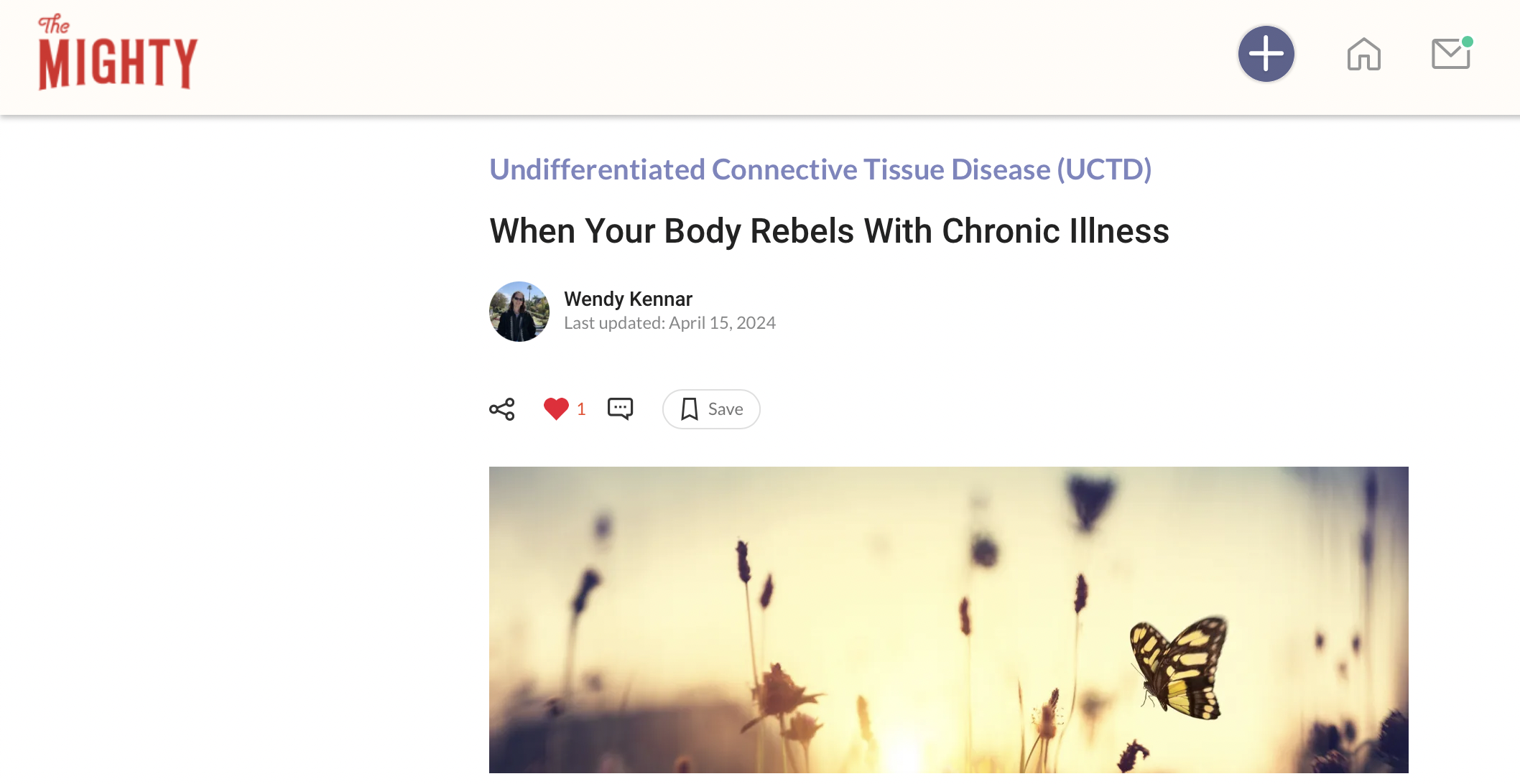
The lines above are just a snippet from my recently published essay, When Your Body Rebels With Chronic Illness. You can click here to read the essay in its entirety. (Note: this piece was originally written a couple of years ago. I must point out that my son is now 16 years old.)

Chronic Illness, Chronic Pain, and Gold Stars

I am pleased to share that my personal essay, “Chronic Illness, Chronic Pain, and Gold Stars,” has been published in a new anthology, Chronic Poetics. “The book contains artwork, essays and poetry written entirely by people who have experience of chronic pain and chronic illness.” Each piece of writing has been “arranged and visually interpreted,” making it possible to create an anthology that tells a “visual story as well as a literary one.”

I’d like to share two excerpts from a section near the end of my essay:

“I wish someone had handed me a manual of some sort. My car came with one. The new little handheld vacuum I recently bought came with one. (I don’t remember the last time my trunk looked so clean.) But no one told me how to navigate living with a chronic illness. No one pointed out that a chronic illness is one thing. A chronic illness causing chronic pain is something else.”

“There are moments I want to cry. Moments I want to scream. Moments I want to throw things and break things. Because this is hard. And it’s tiring. And it often doesn’t feel like it gets any easier or any better.” 

You can find more information about the anthology here.

The visual interpretation of my personal essay.

Something to Endure

My memoir is divided into three parts.
The final essay in this part, and the book, is
"Something to Endure."

Super exciting news:  my manuscript is complete, and I will now be entering a new stage of the writing process — the querying-agents phase. 

But before I got here, when I was revising and rewriting my manuscript, I had to make a decision regarding my final essay. I had three essays that my book coach and I agreed were all possible candidates for that all-important last essay in the book.

It is my hope that my memoir will be read by those living with chronic illnesses, as well as those who know people who are living with chronic illness. I’m hoping that my story can serve as an example. Though the medical specifics may vary, the emotions may be quite similar. So someone who lives with diabetes, for example, could give my book to a loved one, point to one of my essays, and say, “Here. Read this. This is what I feel like sometimes.” 

For far too long, terms such as “disability” and “disabled” have been too narrowly defined. I really want my memoir to broaden those definitions, and I would like my story to serve as just one example of what a disabled life looks like.

When I started working with my book coach, I told her I was writing the book I needed to read when I became ill. I hope after reading my memoir that my chronically ill readers feel less alone and more understood. Along those lines, I want my final essay to give readers a sense of comfort, a dose of good-feels. 

Before making my final decision, I stopped to reflect and think about how I want my readers to feel when they’re done reading my memoir-in-essays. 

These were the adjectives that I came up with:

Hopeful.

Enlightened.

Inspired.

Comforted. 

With that in mind, I made my decision (and my book coach agrees). My final essay is titled “Something to Endure.” Because basically that is the bottom line when it comes to chronic illness. You have to endure the illness. You need to stick it out and figure out ways to handle it, to be with it day-in and day-out for the long haul.

But you don’t have to do it alone. Books, including my own, connect us.

Chronic Illness at Midlife

“I’m in my forties, yet when I climb the stairs to our bedroom each night my knees creak as if I’m walking on the hardwood floors in my parents’ nearly-hundred-year-old house. I have a disabled parking placard in the car, something my dad didn’t qualify for until he was seventy-five. Acquaintances may tell me I look fine, but I don’t feel fine. I feel worn-out and weary.

“It’s hard to know which parts of my life are impacted by natural aging and which parts have been impacted by my autoimmune disease. Is my lack of energy and lack of flexibility a result of my body simply not being twenty-one anymore? Or have all these changes somehow been sped up, as if I’m rolling along downhill, the brakes have gone out, and not only can’t I stop, I can’t even slow it down?

“I don’t know. I’ll never know. Because there’s no way to separate the naturally-aging me from the chronic patient me.”

I’m pleased to share that the paragraphs above are an excerpt from my recently published essay “Prime Time or Off-Peak? LIfe with Chronic Illness at Midlife.” You can click here to be re-directed to Midstory Magazine to read the essay in its entirety.

(By the way, long-time readers may recognize this essay. It had been published on a different site quite some time ago. That site is no longer active, which is why I chose to lightly edit and re-submit the essay.)

Hiding My Realness

This photo was taken a few years ago in Cambria, CA.

Last week I highlighted some of my favorite passages from part one of Michelle Obama’s The Light We Carry.

This week, it’s one sentence I want to highlight. One sentence I cannot stop thinking about.

“We only hurt ourselves when we hide our realness away.”

In many areas of my life, I am unapologetically real. I don’t color my hair. I allow my definitely-non-brown strands to commingle with my very-brown strands.

I don’t wear make-up. What you see is what you get.

If my purse ever matches my shoes, it was purely coincidental. I don’t have enough purses, or shoes for that matter, to make that particular accessory match happen on a regular basis.

I do, however, change my necklace and earrings each day, and do my best to match those with the top I’m wearing. 

I realize most people don’t wear nine rings on eight fingers. But I do. And I’m okay with not being like everyone else.

Aside from all that; however, I do hide my realness away. 

Often. 

And, if you’re chronically ill, a.k.a a “spoonie,” you probably do, too.

(If you missed it, you can click here to read my blog, “Trying to Figure Out This Spoonie Life.”)

Because when you’re chronically ill and experiencing chronic pain, you have learned to put on, what I call, your “game-face.” Living with a chronic illness is sometimes like being in a high-stakes poker game that doesn’t end. You can’t let on how bad the pain is. For a number of reasons you mask your pain so you look “fine.”

Sometimes I do that because I don’t want any more suggestions about medicinal cannabis or green smoothies or compression socks. 

Sometimes I wear my game face because it’s just easier. Showing my pain often makes those around me uncomfortable. And if I’m already feeling bad, I don’t need to add to the situation by making those around me feel bad, too. 

There are more reasons. But I’ll stop there, because it brings me back to Mrs. Obama’s statement:  “We only hurt ourselves when we hide our realness away.”

That’s the part I haven’t completely figured out. I’m certainly not trying to hurt myself. Yet I am very much trying to protect my near and dear ones. 

The work on myself continues.

Please note: I am including a link to buy the book that I’m highlighting this week. If you use my link, I do make a small commission on your purchase at no additional cost to you. I am working with Bookshop.org which also sends a portion of the profit to support local, independent bookstores.

Trying to Figure Out This Spoonie Life

Lately, I have been thinking a lot about the term “spoonie.” 

The term “spoonie” comes from the Spoon Theory, both of which are familiar terms if you’re a member of the chronic illness community. Basically, the Spoon Theory is an analogy used to describe the amount of physical and mental energy a person has available each day. The theory was developed by Christine Miserandino. While out to lunch with a friend, Ms. Miserandino used the spoons on the table to explain to her friend what it’s like to live with a chronic illness, in her case lupus. Each spoon represents a finite amount of energy. Each day you may wake up with a different amount of spoons, yet there are still certain tasks that are expected to be completed on a regular basis — showering, getting dressed, preparing a meal. While a healthy person may begin the day with an unlimited amount of spoons and uses only one spoon at a time for the most basic tasks of the day, a spoonie may start the day with only five total spoons and has to make decisions about which tasks absolutely must be completed that day and which tasks can be skipped. Because when the spoons are gone, so too, is a person’s energy to do anything else. 

For a long time, I didn’t consider myself a spoonie simply because I didn’t have the option of paying attention to my lack of spoons. My son still needed to be picked up from school, library books needed to be returned, dinner needed to be prepared. 

Though I have spent more than a decade as a chronic illness patient, I still haven’t figured out when to push through and do something despite my pain and fatigue and when to pay attention to my body and acknowledge I just can’t do something.

It’s not easy navigating this life. Thankfully, I have help.  

Last week, I had a Zoom conversation with Sandra Postma, a Book and Spoonie Coach, offering “guidance for writers with a chronic or mental illness or disability.” This was our second session, and as with my first session, I left this session thinking about a couple of re-framing statements Sandra shared with me. 

This week, I’d like to share two of Sandra’s brilliant statements with you:

“I am not a burden, my illness is.”

“Alongside my illness I am ..”

I’m thinking a lot about these statements. Thinking about how I can use these statements to help me be more kind and gentle with myself. 

Maybe they will help you, too. 

(Just so you know – Sandra knows I’m sharing this information and has given her consent for this blog. You can learn more about Sandra and the work she does on her website.)

My Current Reality Scares Me

During the last several months, I have come to a difficult-to-accept realization. Physically, I am not doing well. Honestly, this may be the worst I have felt for a considerable length of time, not counting the times immediately after a medical procedure (like my muscle biopsy). 

Last year, on our family trip to Maui, I reluctantly agreed to use a wheelchair in the airports. A good friend had advised me not to waste my legs walking through an airport and standing in line at security. She was absolutely right. But there was no question that I would walk, hike, and participate in everything my husband and son wanted to do — including parasailing and zip lining with my son.

This year, though, not only did I use a wheelchair in the airports, I also rented one to use during our summer trip to Washington, D.C

Since our July D.C. trip, there have been two other occasions when having a wheelchair would have made my life a lot easier. One was seeing Return of the Jedi in Concert at the Hollywood Bowl. The other was attending Back-to-School Night at my son’s high school. Both occasions were incredibly painful for me. Both occasions left no doubt that my legs can no longer do what, up until this point, they have been able to do.

A decade ago, I retired from teaching. And I think one of the reasons I have held on so tightly to all my other roles, all my I’ve-always-done-it, of-course-I’ll-still-do-it instances is because I’m terrified of having to give up something else. I am so frightened that my physical disability is worsening and the invisibility aspect of it will soon no longer exist,  and there will be no doubt in someone’s mind if they see me park in a handicapped parking space that I do indeed need that spot. 

I don’t know if this is true. No one does. In October, I’m scheduled to begin treatment for my knee that may (or may not) help my overall left leg pain. 

Meanwhile, each day feels a bit like an endurance test. A test I’m scared I won’t pass.  

It’s Pain Awareness Month

This picture was taken in July 2023, when our family was in Washington, D.C. I was super excited to explore the National Air and Space Museum, a museum I had wanted to visit since I was an elementary school student. And if you look closely, you’ll see I’m using my rented wheelchair as a walker. I didn’t cancel this trip because of my pain, because for me, that was “not an option.” (Taken from the famous words “Failure is not an option” spoken by Gene Kranz during the Apollo 13 Mission.)

September is Pain Awareness Month.

I’ve written about Pain Awareness Month before, last year in 2022 and back in 2021

This year, though, I don’t know what I can write that is new or offers a fresh take on chronic pain. I think that’s largely because I have been trying to deal with increasing pain. Basically, my pain is worse — in intensity and in location. (For many years, pain was limited to my left calf. That is no longer the case. Now, it’s my left calf, my left thigh, both knees, and since about two weeks ago, my left foot.)

This could very easily be a glass-is-half-empty type of blog post. 

But it’s not.

Because my son (now a sophomore in high school) shared something with me the other day that I think is defining worth writing about here.

On the drive home from school, my son told me about what he had to do that day during his Physical Education class. The laps around the track he ran. The stadium stairs he had to climb up and down, up and down, multiple times. 

By the time class was done, he was super uncomfortable. Sweaty. Slightly out of breath. All of which is to be expected.

“I know it’s not the same thing, but my knees were really hurting. It was hard to get dressed and then climb the stairs to my next class. And it made me think that this must be like what it is for you. But like, all the time,” he said. 

And I think my son’s comments truly illustrate the concept of Pain Awareness. No one can ever truly know my pain, but me. But this connection my son made, this attempt at putting himself in my shoes, was a beautiful gift he gave me. 

A Safe Space

“I foolishly thought having an autoimmune disease would be no big deal. I thought it was something that would fade into the background, behind more important things like my family and career. I thought Undifferentiated Connective Tissue Disease (UCTD) would be another footnote in my medical history, along the lines of my allergy to penicillin. I disclose my allergy any time it’s relevant, explain about the hives that develop, and when necessary, wear a hospital bracelet identifying “allergy.” But on a daily basis, my allergic reaction to penicillin isn’t a big deal. I don’t give it much thought. I assumed having UCTD would work the same way.

Wrong.”

The paragraphs above are excerpts from my personal essay, “A Safe Space.” And I’m proud to share “A Safe Space” has recently been published in Wishbone Words, Issue 11. You can access the issue by clicking here.  (Just a note – there is a slight fee to download the issue.)