My Mind Is Full

I had a “difficult” doctor’s appointment last week. 

Actually, I’m not sure difficult is the right word. 

Let me set the stage:

This was my three-month check-in. Basically, because of the medications I take, I need blood drawn every few months. Though I had a 9:00 am appointment, with an 8:45 check-in, my rheumatologist was running late. 

The doctor asked some general questions, but I had come in with a list of concerns and some questions of my own. 

I told my doctor about my fatigue, about waking up feeling unrested regardless of what time I go to sleep and how many wake-ups I have each night. He told me to go to bed earlier and to keep the same sleep schedule seven days a week. I told him neither one was going to happen. (Why wake up at 6:00 am on a Sunday when we have nowhere we need to be at a specific time?)

I told my doctor about the pain. The pain that I carry around every single day. The pain that slows me down, weighs me down, and often makes me feel like I’ve got a wad of gum stuck to the bottom of my shoe, making it difficult for me to walk as effortlessly or as quickly as I would like. 

I also told my doctor about my physical therapy and the progress my physical therapist says I’m making. 

“He says my endurance has improved since we’ve been working together,” I told my rheumatologist. 

“I go for a daily walk, and I use my pedal machine twice a day now,” I said proudly.

“What are you doing while you’re pedaling?” he asked.

“I read, usually. But sometimes I listen to a podcast or watch something on YouTube,” I said.

“You need to stop multi-tasking,” he said. (You may remember my blog post from January, when I wrote about my doctor’s appointment then and Dr. P’s unhelpful suggestions.)

“You need to really focus in on your leg,” he continued. 

I looked at him. Bit my tongue behind my mask. 

He continued, speaking of the increased benefits I would experience if only I would do less, if only I would really “zero in” on my knee and my calf. 

“I think most families multi-task. I don’t know how to get through my day without multi-tasking,” I said.

I went on. “When I go for my walks, I’m not listening to anything. No AirPods in my ears. I’m just walking and staying focused on my surroundings. But at home, I feel safe in reading or listening or watching something while I pedal,” I said.

“You’re not getting the full benefits you could be getting when you do that,” he said.

“Actually, my physical therapist always talks with me when I’m on the treadmill. He said it helps to be distracted, it makes the time go by faster,” I said.

I tried again. “I am in some level of pain every day, all day. I don’t need to be any more focused in on the pain. In fact, I need a break from it. Reading a book gives me a temporary escape,” I explained.

Ultimately it didn’t matter what I said. Dr. P might be pleasant enough, asking about my family, wishing me a good holiday season. But the fact of the matter is he doesn’t get it. Because he’s not living with pain like I am. 

The appointment left me feeling dismissed and blamed. Like the reason I feel as lousy as I do is because I refuse to go to bed at 9:00 pm, or wake up at 6:00 am, or stop reading my novel while pedaling for nine minutes at a time. 

Even if I did those things, he and I both know my pain wouldn’t magically disappear. 

Daily pain is a fact of life for me. No need to concentrate on that sad fact any more than I already do.

To my chronic illness friends – have any of you had a similar experience? Are your doctors talking to you about multitasking and/or mindfulness? Feel free to share in the comments.

As a side note — the appointment made me think back to an essay I wrote several years ago titled, “This Is What ‘Mindfulness’ Looks Like To Me.” I encourage you to check it out. I’d love to know your thoughts about mindfulness.


About My Memoir-In-Essays

My Memoir-In-Essays is divided into three sections --
The Beginning, After the Very Beginning, and Not the End

This week, I’d like to share a bit about my memoir-in-essays. 

1.  I continue to query literary agents and have not yet had any requests for my manuscript. It’s hard, I admit, not to feel badly about this. At the same time, I know there are multiple ways to get my story out into the world. If it doesn’t work out with an agent, I’ll pursue one of those other possibilities (such as hybrid publishing or publishing with a smaller, independent press). 

2.  I am keeping the title private, for now. Just like when I was pregnant, we announced the gender of our baby, but kept his name private except for family and a few super close friends. So while I’ll tell you I have written a memoir-in-essays, I just don’t feel ready to share the title yet. Though I do realize I shouldn’t get too attached to my working title, because titles are often changed, for many reasons. (This has been the case for many of my personal essays which have been published over the years.) 

3.  Here’s my official pitch:  “… my story of becoming chronically ill, retiring from my teaching career, and living a life I hadn’t planned as a stay-at-home mom. The book is composed of personal essays and micro-essays written as short school assignments.”

One of the things that makes my manuscript unique is the inclusion of these “micro-essays written as short school assignments.” Teaching was a huge part of my life, my identity. And it is because of my chronic illness that I am no longer teaching. Therefore, there’s no way I could write my story about life with an invisible disability without including parts from my teaching life. 

When I taught fourth grade, my students and I completed a getting-to-know you questionnaire during the first week of a new school year. It was a short form that was a quick, fun way to share what made us each unique while also giving students the opportunity to learn about each other, and realize many of them shared common interests. 

I included this questionnaire in my manuscript, and this week I will share a bit of it with you, my readers. 

I Am A Person Who…

By: Mrs. Kennar

Directions: As a way to get to know each other, please fill out this worksheet. By writing honest responses, we will learn about our new classmates. In the process, I think we will come to realize that while we are each unique individuals, we have a lot in common. 

I Am A Person Who…

likes Nutella crepes

dislikes spinach

can recite the Preamble to the Constitution 

cannot throw a spiral

would never watch a horror movie

loves to read

How about you, dear readers? Feel free to leave a comment answering one (or more) of these prompts. 

I Am Tired.

Eleven years ago, my personal essay “Do What You Need To Do” was published in the anthology Lessons From My Parents:100 Shared Moments that Changed Our Lives. I wrote about the example my parents set for me, the idea that sometimes you just have to suck it up, do the hard thing, keep going. 

That’s largely how I have lived my life. Doing the hard thing whenever I have to in order to achieve my goal — whether it was commuting on public buses for most of my college years (a roundtrip commute that took 3.5-4 hours a day, on six buses a day) or working as a kindergarten teacher during the day with an emergency teaching credential and taking online classes at night to earn my full teaching credential. 

It’s pretty much how I go about my day. Things need to be done. I just need to do them. 

Except, I’ve come to the slow realization that I just don’t think I can keep doing that. 

Because — I am so tired. 

I am tired of waking up each morning, feeling unrested. Sticking my feet into my slippers as the alarm goes off, wondering how I’m going to do it. How I’m going to wake up, get dressed, make my son his breakfast, take him to school, and function throughout the day.

I am tired of not reading as much as I’d like to each day. Which as I write that sentence, I realize it’s not completely accurate. I do read a lot each day. I read emails and text messages, newsletters and first drafts. I just don’t always take a half hour and sit and read my book. Sometimes it’s because I’m in pain, and I can’t get comfortable to sit for an extended period of time and lose myself in the words on the page. Sometimes it’s because I feel there’s too much work that needs to be done for me to take a break and read. When I read in bed shortly before I turn off my bedside lamp for sleep, I inevitably start to doze, and the paperback book slips from my fingers and startles me as it falls against me. (One of the reasons why I generally prefer paperbacks to hardcovers.)

I am tired of looking at myself in the mirror and not fully recognizing the woman looking back. I take stock of the physical changes — hair loss, weight gain, swollen ankles — and realize I have no idea which of my ailments is contributing to each symptom. For example, the hair loss I’m noticing could be due to one of my medications, or my longer hair, or menopause. 

I am tired of clicking on my inbox and feeling so far behind in reading my emails. How did I become someone with three hundred unread emails? Seemingly overnight, I have multiple Substack notifications, emails asking for donations for Unicef, Save the Children, and Make-a-Wish Foundation, and emails regarding the latest sale at Bath and Body Works. I want to support other writers and read their newsletters, I want to contribute  funds to worthwhile organizations, and I want to buy candles when they’re on sale. But it’s so much. 

I am tired of feeling like I’ll never catch up. The list I keep of podcasts I want to listen to (Moms Don’t Have Time to Read Books with Zibby (Owens), Kate Bowler’s Everything Happens, Write-Minded with Brooke Warner) just keeps growing. I listen to one episode over the course of a couple of days while I do my physical therapy stretches and exercises, but in that time, I have added another two podcasts to the list. I sit on the floor in my writing room, looking at all the un-read books I have, just waiting for me, and realize this cubby of mine is almost completely out of space. And yet, I came home with another novel I picked up at the Little Free Library I passed yesterday.

I am tired of waiting. Waiting in line at CVS, waiting on hold to speak to a representative regarding my medical insurance, waiting to speak with someone in my doctor’s office to schedule my next appointment. 

I am tired of the bottles of pills on my kitchen counter. Lining up the bottles based on when I take them — breakfast, lunch, and/or dinner. Keeping track of refills, making sure I have enough to get me through the next several days until the law says CVS can refill my pain medication. Tilting my head back so the large calcium supplement, the most recent addition to my daily pills, will slip down. 

I am tired of heating pads and ice packs. I am tired of propping my left leg up on a pillow. 

I am tired of being in pain. Every. Single. Day.

I am tired. 

Friends, I know it’s not just me. I know many of you reading this post have your own laundry list of illnesses, daily stressors, work-related tasks that you’re tired of also. 

What do you do when it continues to build and you feel like you’re standing in quicksand and being swallowed up by it all? 

Please note: I am including a link to buy the book that I’m highlighting this week. If you use my link, I do make a small commission on your purchase at no additional cost to you. I am working with Bookshop.org which also sends a portion of the profit to support local, independent bookstores.

The F Word

I took this picture a few days ago, late afternoon, after doing some of my physical therapy stretches on the bed.

I don’t usually have a problem falling asleep. 

Quite the opposite, actually.

As soon as I turn off the lamp on my bedside table, after another unsuccessful attempt to read a few pages before bedtime (I tend to either drop the book and lose my place or read a bit but then the next day have no memory of what I had read), I fall asleep. 

Usually, I wake up at least a couple of times each night. Though lately, I have experienced a few nights when I only woke up once. And there were even a few nights that I slept straight through. 

Yet, regardless of how many wake-ups I have each night, I am not waking up feeling rested. 

Again, it’s quite the opposite.

I wake up feeling drained. I’m not recharged and ready to take on the day at all. But, I don’t have a choice. The alarm goes off, and it’s time to get going. I need to get up and get dressed and get the show on the road, because my son needs to get to school. I have work to do. Which means I’m forced to function on a blend of automatic pilot and a fight-through, keep-going-no-matter-what, high level of perseverance.

Plus, I have also noticed this unrested feeling isn’t just happening during the week, when wake-ups are earlier and days are busier. Even on a random Sunday, when we have nothing planned and no alarm waking anyone up, I don’t naturally wake up feeling oh-so-rested. 

Doctors don’t often ask about my sleep; however, during my last several follow-up appointments, I have mentioned it to them. I do my best to describe the overall slowness I often feel upon waking. The way my eyelids feel heavy. The feeling of starting the day at a deficit. And because my labs are coming back pretty consistent, because there are no red flag markers, no medical professional seems overly concerned about my tiredness. 

The other day, when I stood in front of the mirror and stared at the dark circles under my eyes, I had an aha moment. 

It seems so obvious, now, but it really didn’t occur to me that this extreme tiredness, this fatigue, is a part of life with chronic pain. This is not unique to me and my UCTD (undifferentiated connective tissue disease). In fact, in terms of my inflammation markers, my numbers have been down. My autoimmune disease is somewhat stabilized, you might say. Which means my medications are working and doing what they’re supposed to do. And yet, I feel awful — every single day.

Because this is not tiredness that goes away with a couple of nights of eight hours of sleep. 

Because this is fatigue, a whole different level of extreme tiredness. 

I don’t usually talk about my exhaustion, and I certainly haven’t written about it. But, I know how important it is to share our authentic experiences, to connect with others who, unfortunately, “get it,” and understand exactly the situation I’m describing.

The other night at dinner, after it was my turn to share some of the highlights from my day, my husband commented that I had gotten a lot done. 

“You’re right,” I said. “Imagine what I could do if I felt rested?”

Pain Awareness Month

You can't see my pain, but it's there.

September is Pain Awareness Month. It’s a topic I have written about before: 

In 2020, I wrote about how common it is for my pain to fluctuate, which is why I so dislike the traditional 1-10 pain scale.

In 2021, I again wrote about the difficulties in using a traditional pain scale to describe my chronic pain. (Plus, this post has one of my favorite pictures of myself – because I’m holding a bunch of bright, beautiful sunflowers – my favorite flower, and because that photo makes me think back to that fun family day.)

In 2022, I wrote about the randomness of my pain; the fact that I can sit and watch my son at his first Rubik’s Cube Competition and out-of-nowhere suddenly need to step outside because of an intense leg cramp.

In 2023, my son inspired my Pain Awareness Month blog post (as he’s inspired many of my blog posts and personal essays over the years).

Which brings us to this year’s post:

For the last year or two, each time I see my rheumatologist I have told him how much I struggle to get through my day. I have given him concrete examples to demonstrate that my chronic pain has worsened, my energy levels have lowered, and my fatigue has increased. I have told him that my current pain medications were not enough, yet he refused to alter my dosage or prescribe anything else. Finally, he referred me to a pain management doctor. (This isn’t the first time I’ve seen a pain management doctor, but it is the first time I have been seen by this particular doctor.)

At the first appointment with the pain doctor, back in April of this year, I walked in with a fair amount of skepticism. How many times have I had to share my story over the years? How many times have I tried to convince doctors that regardless of how I look or how much I tell you I still do each day, I am in considerable pain every single day? I didn’t want to have to sell myself, convince this new doctor that my pain was worsening, that my list of activities I could no longer do was growing, and I was scared because I truly didn’t think my current lifestyle was sustainable.

Something completely unexpected happened during that April appointment — after reviewing my in-take forms and my current medications, the doctor looked up from my chart and looked right at me. 

“You’re not on the right medication. What you’re taking now isn’t going to help with the kind of pain you’re describing. You definitely need something stronger,” he said. 

I was momentarily shocked. Cue the party favors and the large round of applause. The doctor’s statements, his belief in me and my pain, were huge. My chronic illness friends reading this know that this is not always the way a doctor’s visit goes. 

Since that first appointment, we’ve tried different medications and different dosages, and I think we’re getting closer to finding the right combination for me. 

At the same time, the doctor has been honest with me. 

“Nothing is going to completely get rid of your pain. The goal is to bring your pain levels down. Way down,” he said.

We’re working on it. 

So this year during Pain Awareness Month, if I may, I offer this suggestion — believe someone when they tell you about their pain. You cannot always see pain. You don’t always know what someone is going through or dealing with simply by looking at them. So give them the benefit of the doubt. Treat everyone with a bit more patience and care. Because whether it’s physical pain or mental pain, chronic pain or temporary pain, everyone is dealing with something.

My Word For the Year – An Update

Photos allow us to choose what we share. What you don't see in this photo is my wheelchair. It was the first time I had visited The Huntington Library, Art Museum, and Botanical Gardens using my wheelchair.

Back in January, I wrote a blog post about my word for the year — Share. (If you missed it, you can click here to read the post.) 

2024 certainly isn’t wrapping up just yet, though 2025 calendars keep arriving in the mail. However, we are about three-quarters of the way through the year, and it occurred to me that now would be a good time for a check-in of sorts.

In terms of my writing, I absolutely do share. I consistently write this weekly blog. I regularly write personal essays and submit them for publication. I began querying literary agents in March and continue to do so, searching for that one yes from the right person who will serve as an advocate for my memoir-in-essays and assist me in the publication of my first book. 

When it comes to other areas of my life, my sharing is less consistent. Oftentimes, I revert back to predictable patterns of behavior of holding my tongue and trying not to make things more difficult/complicated/unsettling for those around me. I admit I don’t always honestly, and completely, share how I’m feeling — physically or emotionally. 

Like many people who live with chronic illness and chronic pain, I have learned how to fake it. I know how to downplay my pain so as not to make those around me uncomfortable. I know how to present as a person fully in control of a situation, even though most of the time my body feels very much out of my control. 

Because let’s face it. I don’t often have good news to share when it comes to my pain level or energy level. And I realize it’s frustrating for my loved ones to know I’m uncomfortable (which is putting it mildly, again me not completely sharing) yet there’s not a whole lot they can do to make it better. 

I think that’s one of the reasons I’m a writer. Generally speaking, I have always found it so much easier to share through my writing than through conversations. 

So I continue to write and am grateful I can share here and on my Instagram account, which I have found has an incredibly supportive chronic illness community. Thank you, readers, for being on this journey with me. 

How are you doing, dear readers, with your words for the year? Feel free to share in the comments. 

A Bit of Serendipity

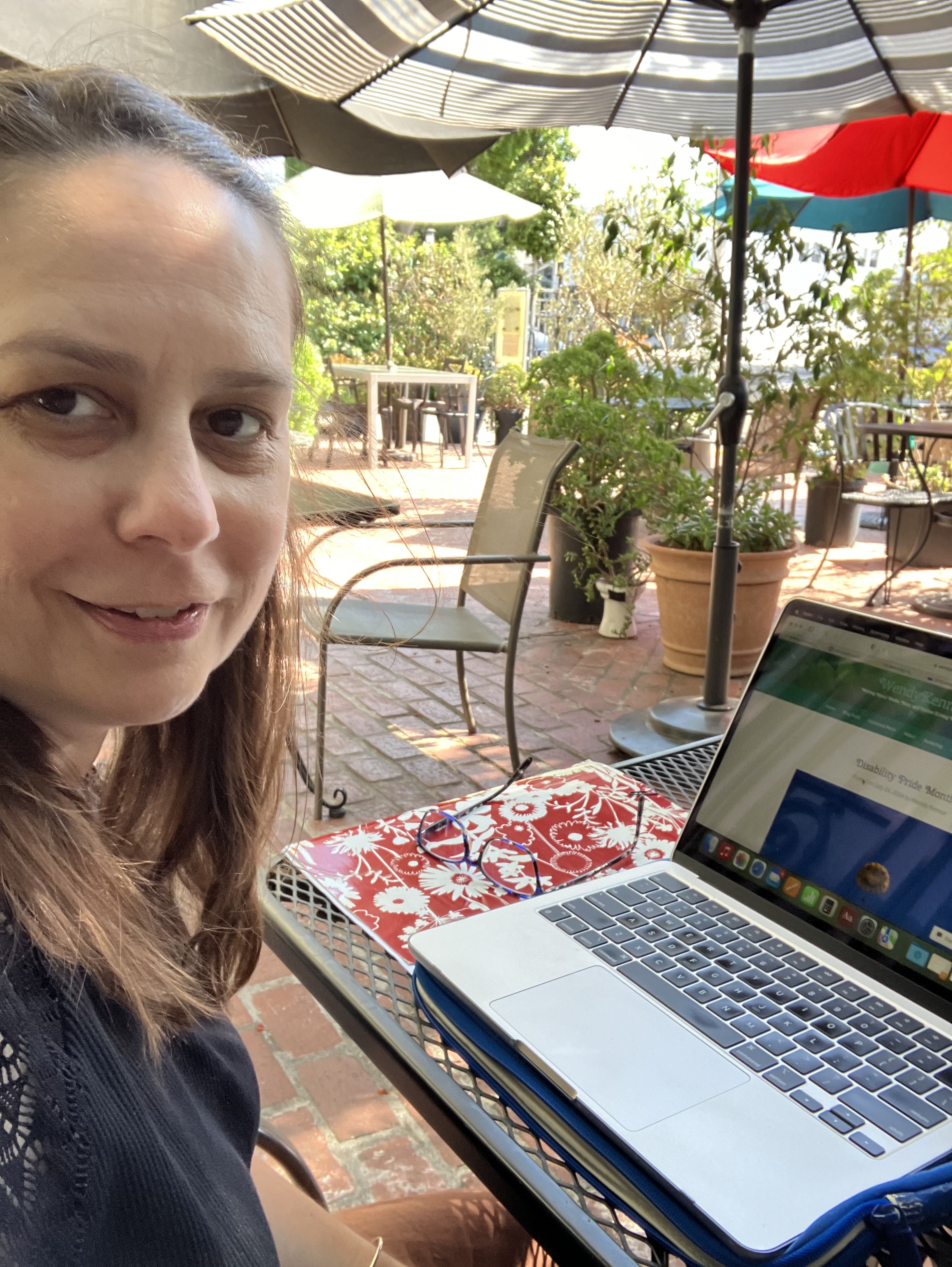
I took this photo during last week's writing session.

Last week I spent time at one of my favorite not-at-home writing spaces; a cafe serving a yummy ice blended mocha, and providing many tables and chairs on a large patio with plenty of shade. 

This week, I wanted to share something that happened during last week’s visit.

Two women sat at a table close enough to me that I could overhear bits and pieces of their conversation without even trying. It felt serendipitous that of all the available tables, these two women sat near me. After all, I was sitting off to the side, near a wall, trying to distance myself from any loud chatter and distractions. 

Within a few minutes, I learned the two women were middle school science teachers. I heard them talking about sixth grade, about sedimentary rocks and fossils, about a project requiring a long roll of adding machine paper. (And I admit to feeling old when one of the teachers had no idea what adding machine paper even was.)

These two teachers spent their own time lesson planning. These were “off-the-clock” conversations. Because that’s what teachers who are passionate about teaching do. Your teacher brain is never really off, and teachers don’t actually get “the whole summer off,” as many non-teachers believe. Teachers are always working in some shape or form. It brought back memories of my own lesson planning days and the blended mochas my closest teacher friend and I used to enjoy while brainstorming and planning for our fourth graders. (I’m thinking of you, Nance!)

As if that wasn’t enough, after a bit of quiet individual work time, the two teachers began chatting again. I heard different phrases this time — it’s so lonely, I look fine on the outside, many people don’t get it.  

I learned that one of the teachers lives with an invisible illness. The other teacher’s partner lives with an invisible illness and was asking questions about how to best support a chronically ill loved one. 

I momentarily sat there in shock. 

What were the odds? 

Not only were these two women teachers, they were also among the target audience for my memoir! (My target audience includes those living with chronic illness, especially invisible illnesses, both physical and mental, as well as friends and families of those living with chronic illness.)

That day at that cafe, I had spent a portion of my writing time researching literary agents to query my memoir-in-essays. 

And then these two women entered the outer edges of the writing cocoon I create for myself at this cafe. 

I took it as a sign.

Disability Pride Month

Parasailing in Maui with my son, June 2022

July is Disability Pride Month. The designation coincides with the anniversary of the Americans with Disabilities Act (ADA) being signed into law, thirty-four years ago. 

In prior years, I’ve written about Disability Pride Month. (You can click here to read my post “There Is No Shame” from July 2021, and click here to read “Disability Pride Month Reading” from July 2022.)

This year, however, I’m having a really hard time putting into words how I feel about this month and how it impacts me. Partly because within the last couple of years, my physical abilities have decreased, and my dis-abilities — things I can no longer do or only do with extreme pain — have increased. 

I live with an autoimmune disease that most people have never heard of, that most healthcare providers don’t fully understand. A chronic illness that has no cure. And it is this part of my identity that is the catalyst for my currently-querying memoir-in-essays. 

One day, when you pick up my memoir in your local independent bookstore or public library or multi-floor Barnes and Noble and begin reading it, you will find that my disability identity is only a part of my story. I’m so much more than my body and how it can and cannot function. 

I am Wendy Kennar.

I am a white woman married to an African-American man. 

I am the mother of a mixed-race son.

I am a college graduate, the first in my family.

I am a ketchup-using tomato-disliker.

I am a morning apple juice drinker.

I am a night shower-er.

I am a handwritten list maker.

I am an envelope decorator. (Which means I am someone who still mails cards and letters the old fashioned way, with a stamp on the envelope.)

I am a save-the-avocado-for-last salad eater.

I am a chocolate ice cream only consumer (except if I’m eating a Vanilla Soft Serve ice cream at McDonald’s, which is the only thing I eat from McDonald’s.)

I am a daughter. A pen pal. A friend. A neighbor. 

I am a Los Angeles native.

I am generally a no-crust-for-me pizza-eater.

I am a woman who has never spent any time in the snow. 

I am a woman who owns more pairs of earrings than shoes. 

I am a curious person, who wonders about all sorts of things. (Why do you walk a red carpet at awards shows? Why red? Why not blue? Or purple?)

I am adventurous. (I have gone parasailing twice, ridden in a hot air balloon twice, and gone zip lining once.) 

I am a disabled woman. 

But that’s not all I am. 

There’s A Lot On My Mind

I have a bit of a confession to make, my friends.

This week’s blog post has been a hard one for me to write. And I think it’s because of the date. 

This week is an “anniversary” for me. It was during this week back in 2010, when I woke up unable to get out of bed. I couldn’t stand up. I couldn’t walk. My left calf was swollen like an about-to-burst water balloon and bright red, like my then-two-year-old son’s stuffed Elmo doll.

That day marked both an end and a beginning. I just didn’t know it at the time.

So I’m a bit emotional, and I have all sorts of things going through my head this week. Thoughts about where I am currently — in terms of my physical pain and limitations, but also in terms of my spirit and emotional well-being. 

It’s because I have all these thoughts swirling around, like a soft serve ice cream that mixes chocolate and vanilla into one delicious, twisty dessert, that I initially wasn’t sure what I wanted to write about this week. 

But I think this reflection is fitting for this week:

A few days ago I finished listening to Jessica Fein’s podcast, “I Don’t Know How You Do It.” Her guest was bestselling author Jean Meltzer, someone I happen to just love — for her books and her passion and her message. 

(In case you’ve missed them, you’ll find links to my earlier Jean Meltzer-related posts here.)

On this podcast, Jean explained the twists and turns her life has taken, the many ways she has had to completely reinvent herself. 

There were a couple of things Jean said that I haven’t been able to stop thinking about. Maybe they’ll be helpful to you, too:

–  One: Jean talked about the years she spent ignoring her illness. Her determination to continue on, pretending as if she wasn’t ill. Until she couldn’t. Until she became so ill, she was housebound. In all honesty, I have heard Jean speak of this before, but this time I really heard her. And it scared me. Because one of the things I’m actively working on is truly acknowledging my own illness and physical limitations. I often do try to push through and act stoically. What if I’m headed on the same path? What if you only get a certain number of “passes” to act as if you aren’t chronically ill, and then your body comes to a full and complete stop? (Which is actually what happened to me back in 2010. I wasn’t physically ill at that time, but I was going through an incredibly hard time emotionally. I kept trying to push through, until I literally couldn’t. That swollen left calf kept me hospitalized for four days, and my leg was never again the same.)

– Two: Jean also spoke of her decision to live a joyful life. If her body would no longer allow her to do all she wanted, if her body made it necessary for her to re-invent herself and give up her career, then she was going to do everything she could to seek out joy in this new life of hers. Lately, I have been more aware that I tend to spend some of my days as if the prime objective is to cross off as many items on my to-do list as I can. And while these are not necessarily unpleasant (water the plants, sweep the patio, do my physical therapy stretches), they’re not necessarily joyful either. I often give myself one task to do after the other, without giving myself the time and grace to simply sit and read, for example. 

So that’s my self-appointed homework: being more honest about what my body can and cannot do and to actively seek out and infuse my days with joy. 

Thank you, friends, for reading. I realize this week’s post was a bit longer. Thank you for being with me on this journey. 

P.T.

I call this my pedal machine. My physical therapist encouraged me to try it, since we usually start our sessions with me on an exercise bike. I started pedaling for 5 minutes each day, and have slowly increased my time. I'm now up to 10 minutes daily! Generally, I use the time to read.

I have lived with chronic illness and chronic pain for almost fourteen years. 

During this time, I have tried physical therapy. Many times. 

It never worked out for me. For instance:

–   One of my first attempts at physical therapy ended shortly after it started. The physical therapist told me he would no longer work with me, because, “There’s no point. Nothing we do can help you.”


–  Another therapist, in a different location, always made me feel as if I couldn’t do much, and what I could do wasn’t anywhere close to being enough. I left our sessions feeling worse than I started. Worse in terms of higher pain levels and worse in terms of self-confidence.

–  There was the physical therapy group with a close-to-my-home location. I quit that one, after having four appointments with three different therapists, each one giving me some contradictory information.

Based on my previous experiences, you can understand my hesitation when my rheumatologist didn’t just suggest physical therapy, he strongly encouraged it.

This time I’m pleased to say my physical-therapy-is-not-beneficial streak is now over. 

I finally am working with a physical therapist who speaks kindly and smiles. A physical therapist who celebrates my effort, who acknowledges just how hard some stretches are for me, who encourages me to try, who modifies as needed. 

Plus, during last week’s physical therapy session, my therapist did something no other therapist has done before — he made me laugh.

Now, most people know PT is shorthand for Physical Therapy. 

But there’s another meaning for that acronym. 

Let me give you a bit of context — my therapist had demonstrated a new stretch, something that would work my quadriceps. It hurt when I tried it, so we modified it, with me not stretching quite as hard or quite as much. 

That’s when my physical therapist told me one of his patients invented a different meaning for PT: Pleasant Torture.

It was so unexpected, I couldn’t help but laugh out loud.

I have never thought of PT like that before. 

While it’s not torture, physical therapy is hard work. Each time I leave, I am tired and worn out. The following day I’m usually sore. 

Yet even with all of that, overall, the process, this time, is pleasant.

Readers, do you have any physical therapy experiences you want to share? Have you been fortunate to work with someone who makes the process pleasant? I hope so!