Pep Talks

I’m at the halfway-ish point of Maggie Smith’s wonderful book, Dear Writer: Pep Talks and Practical Advice For the Creative Life

First, I must admit, I love the “Pep Talks” part of the sub-title.

Many books offer “practical advice.” Some include “Tips and tricks.” And still other books may have “Steps and suggestions.” 

But “pep talks”? That’s a new one, at least for me. (And if I’m overlooking another writing craft book offering pep talks, please, friends, let me know.)

And there will definitely be a blog post dedicated to Ms. Smith’s book once I finish reading it.

This week, at the halfway-ish point of the book, I wanted to pause and share some of Ms. Smith’s “pep talks,” because maybe you’re needing them as much as I am. 

Because, let’s be honest, most of the time, us writers aren’t working each day with someone giving us a pat on the back, or a back rub, or even a set of new file folders. (Is it just me that enjoys looking at all the stationery supplies at Dollar Tree?)

We write, not because anyone is necessarily cheerleading us on (though, that is one of the wonderful benefits of working with a Book Coach). We write, day after day, not because anyone will ask us at dinner about the progress we made on the fourth draft of the new personal essay we’re working on. 

We write simply because we have to. We have to get words down on the page — whether those words are fiction or nonfiction. Whether they rhyme or not. Whether a day’s work will stand alone or be a part of a much larger piece. 

But, it’s hard work. And I have found non-writers generally don’t understand just how hard this writing work is. Not physically hard like a landscaper, down on their knees under a fiercely bright sun. And not hard like needing an entire chalkboard to work out one math equation. (Anyone else think of the film Hidden Figures here?) 

But, still, hard. Hard because we don’t always know where the writing is going. The words I got down today may be the same words I delete four days from now in a later draft. And the words I wrote and then spoke out loud to hear the rhythm of the language may be the words some faceless person on the other side of the country will declare “not a good fit for us at this time.”

So, yes, I’ll take a pep talk. Thank you.

And if you’re needing a pep talk, or four, allow me to share some pep talks from Ms. Smith’s Dear Writer:

“Taking care of yourself is taking care of your creativity. Taking care of yourself as a whole human being is taking care of the writer in you.”

“Any piece of writing is a time capsule. It reflects the choices — and the abilities, and the limitations — of the writer we are at the time.”

“Being true to your own vision as a writer or an artist means doing your work, the work that only you can do. Your memories, your point of view, your observations and metaphors — everything about you that you bring to bear when you write — is a combination that no one else has.
“If you don’t write your poems, your stories, your plays and essays and scripts, they won’t exist. No one else can do it for you.”

“Be for you first. Create for you first. Trust your own vision.” 

Please note: I am including a link to buy the book that I’m highlighting this week. If you use my link, I do make a small commission on your purchase at no additional cost to you. I am working with Bookshop.org which also sends a portion of the profit to support local, independent bookstores.
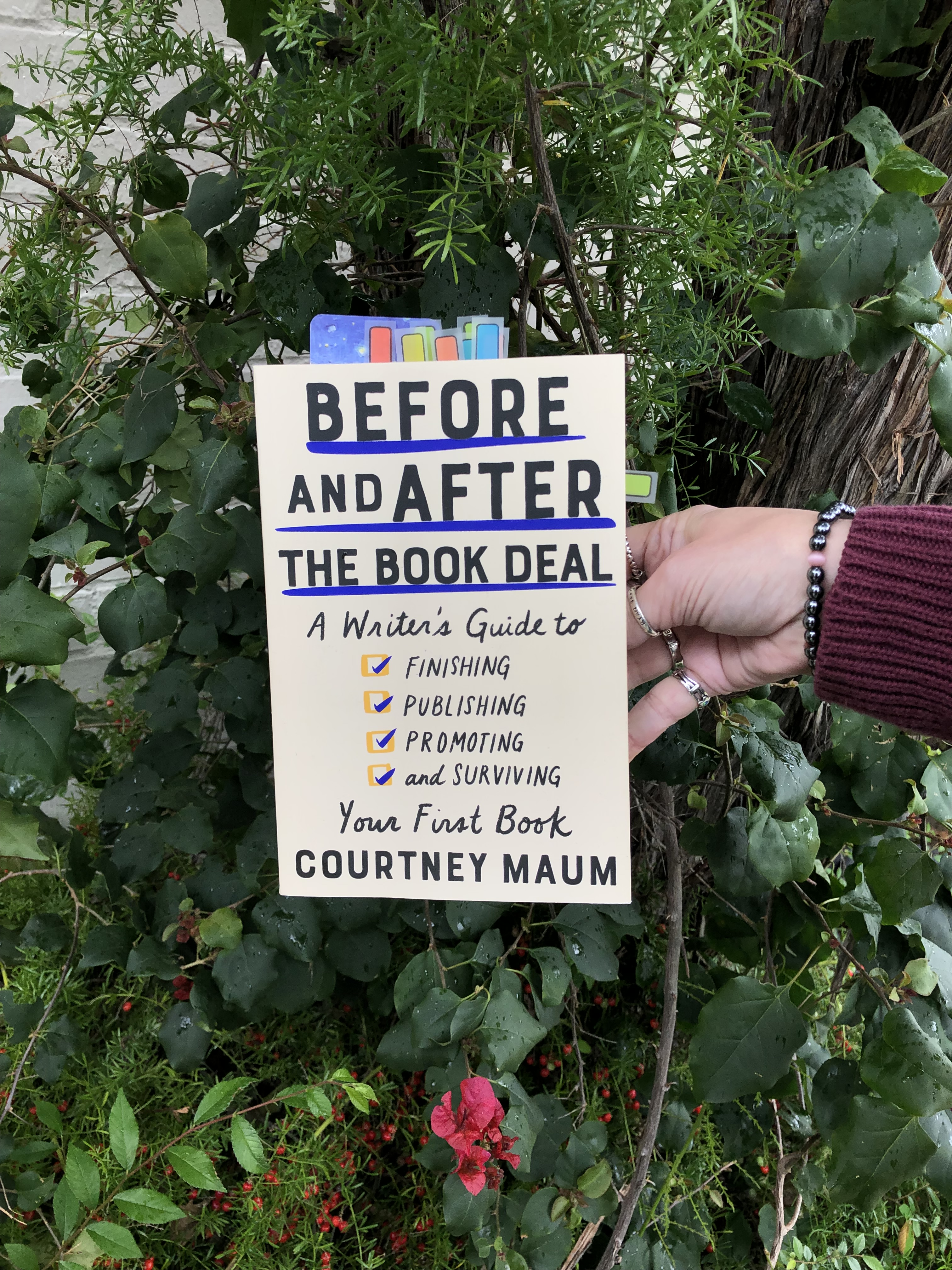
Before and After the Book Deal

Before and After the Book Deal: A Writer’s Guide to Finishing, Publishing, Promoting, and Surviving Your First Book by Courtney Maum is one of those books you don’t necessarily read from start to finish. It’s a book that has been on my bedside table for a while now. I pick it up and read a few pages, mark meaningful paragraphs with a yellow highlighter and sticky notes, and then put the book down again until the next time.

Ms. Maum has crafted a well-written and, at-times, humorous book. It is an incredibly valuable resource for writers who are looking to “finish, publish, promote and survive” their first book. Which I am.

Yet, even if you’re not a writer, if you create in a different medium, there are useful tidbits for all artists and creators. Here are just a few:

“Narrative voice is your literary aura, your essence, the thing that allows writers the world over to write about the same topics in thrillingly different ways. Even though it’s yours, your voice can take a long, long time to find.”

“Get excited by your rejections. They are road maps toward the kind of work that you were born to write.”  (It’s a good reminder. Although they are a part of the writing process, some rejections sting more than others.)

In addition to writer-specific advice, I love these reminders about the power of expressing gratitude:

“Set some money aside for thank-you tokens for your editorial team and agents at pub time. (A heartfelt, handwritten card is thoughtful, but some authors also send on gifts, flowers, alcohol [when appropriate], or something handmade.)”

“At some point after the book contract is finalized, if you live close enough to your publishing house to make this happy event possible, you will meet the people who are going to publish your first book.
“Within twenty-four hours, send a group email to everyone you met expressing how great it was to meet them, how lucky you are to be working with them, and why [enter name of publisher] is simply the best house for your book. Then send a handwritten note to your editor, reiterating the same.” 

Dear readers-who-are-also-writers, have you read this book? Do you have paragraphs or pages you have marked with your own sticky notes? 

Write On, Sisters!

Write On, Sisters!: Voice, Courage, and Claiming Your Place at the Table by Brooke Warner is more than a writing book. It’s also a look into the uneven playing field that women encounter in most careers and fields. It’s a close-up look at the ways in which women often hold themselves back, and not just when it comes to writing. 

I’ll be honest — the first half of the book has a lot of statistics and was rather slow reading for me. But the second half of the book has quite a few nuggets that were worthy of my sticky notes.

Here are a few:

“Writing is self-expression, and as such, when we write we give voice to what we think, what we care about, and who we are. When we read a book —or even a post —we take a walk inside the innermost recesses of the author’s mind, welcomed into a place so private that the words we read on the page may be words the author has never uttered aloud. How powerful — and intimate — is that?”

“To put your voice out into the world is to both believe and demand that what you have to say matters. We are our best selves when we assert our independence and self-reliance, our strength and toughness. The very qualities our culture values least in women are the ones women need to succeed.”

“… you don’t need to heed warnings from the jaded that failure is imminent or inevitable. It is. The work is in getting back up on the horse, rising from the fall, and the way you handle the fall.”

“Few events are more life-changing and soul-affirming than offering up your work in the form of a published book. The act of creating a story, honing your words into a message that matters to readers, or honoring your truth by recording your experience in memoir form is a way of telling the world, I am here. I have something to say. I have something to impart. I want to share with you a story, a message, a truth. You are passing feelings from one human heart to another.”