For about a year now, in addition to writing my weekly blog, I have also written a Substack. If you’re a Substack subscriber, you know my Substack would arrive in your inbox every other Sunday. I called it Substack Sunday.
This week, I’m using this blog post to tell you about some of the changes I’ve made to my Substack.
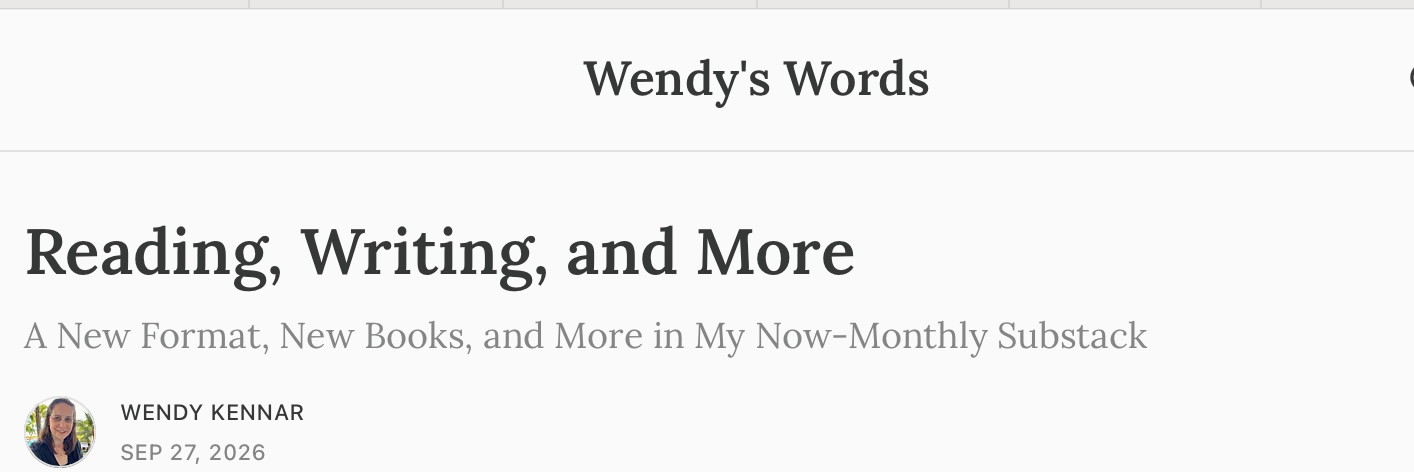
My Substack is called “Wendy’s Words,” and I will now publish it on the last Sunday of each month. Think of my Substack as my author newsletter, a format that will allow me to share more widely than I share here on my weekly blog.
This past Sunday, September 27th was the first re-imagined issue of “Wendy’s Words.”
But there’s something missing — many of you, my blog readers.
I invite you, my blog readers, to subscribe and also become my Substack readers.
All you have to do is sign up with your email address, and once a month you’ll receive Wendy’s Words in your inbox.
– Book-related news (which may include information about my memoir-in-essays and/or book events I went to/watched/am looking forward to)
– A writing prompt
– A peek into Wendy’s World (which may be something chronic illness-related, something writing-related, and/or something just Wendy-related)
– Something to watch (such as a video or interview that caught my attention)
Friends, I appreciate your support here on my blog. Please join me on Substack — it will be another way we can connect and share.
Thank you!
I almost forgot — I like to do book giveaways for my Substack subscribers. I will now be doing at least one giveaway a month. To celebrate the new format of my monthly Substack, I will randomly draw a subscriber’s name on Sunday, October 4th. Be sure to subscribe so you’ll have a chance to win a free book — The Taste of Anger, a memoir by my friend Diane Vonglis Parnell.
Please note: I am including a link to buy the book that I’m mentioning this week. If you use my link, I do make a small commission on your purchase at no additional cost to you. I am working with Bookshop.org which also sends a portion of the profit to support local, independent bookstores.
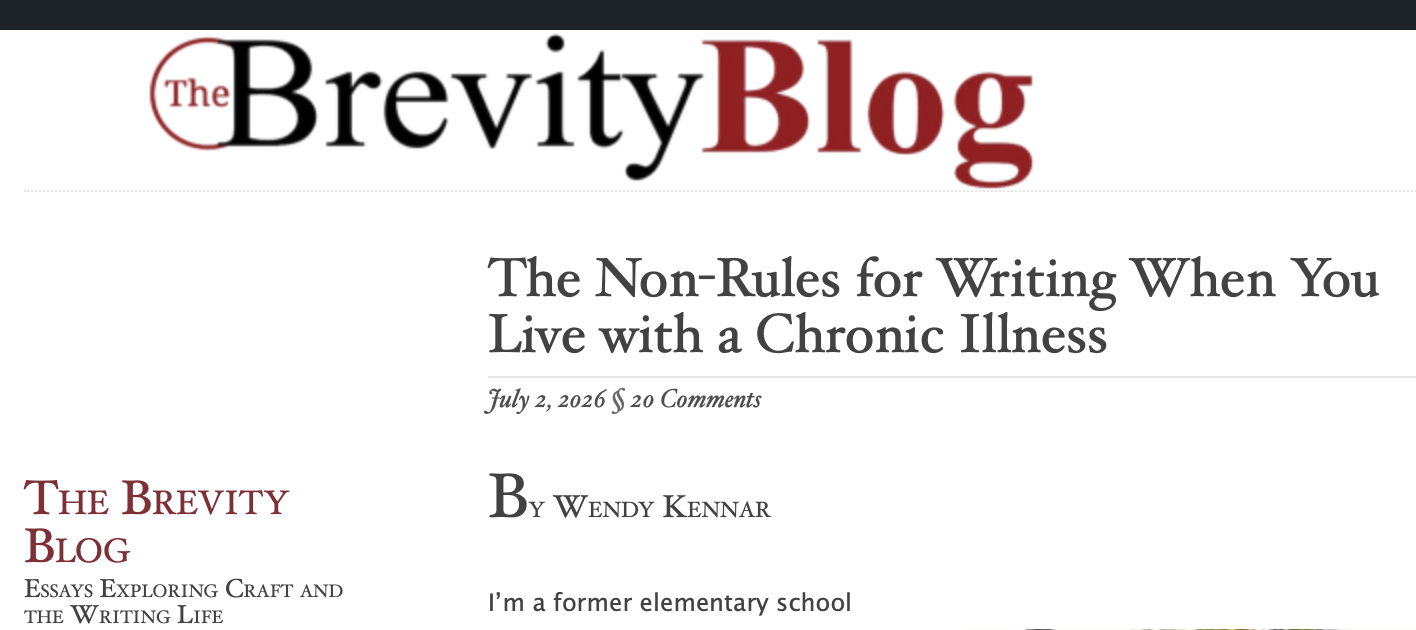
A screenshot of my published essay on The Brevity Blog
“So what happens when you’re chronically ill and you can’t sit upright at a desk? Or you can’t always write at the same time every day? What happens when one day you can’t remember the name of the tool people use for eating and twirling spaghetti though you remember the scene in Disney’s Little Mermaid when Ariel used it to brush her hair? “What happens is we make our own ‘rules.’ (And maybe we don’t call them rules. How about — Suggestions? Techniques? Process? Routine?) We expand the definition of writing.”
The paragraphs above are an excerpt taken from my essay, “The Non-Rules for Writing When You Live with a Chronic Illness.” I’m pleased to share my essay has been published on The Brevity Blog. The essay has resonated with readers — you’ll see several comments on the post itself. I have also received DMs and an email from readers. And really, that’s all I could ever hope for — that something I wrote touched a reader and made a reader feel seen. (You can click here to read my essay in its entirety.)
One more thing:
Thank you, my dear friends. After last week’s post about the passing of my dad (you can read it here), so many of you reached out with comments, emails, DMs, and texts. Several of my close friends sent cards in the mail. Your kind words brought tears to my eyes and truly touched me.
Thank you, thank you, thank you for your support. Thank you for holding my family in your hearts. Thank you for being here with me. I am truly grateful.
It’s not easy living with an invisible disability.
That’s an understatement, for sure.
At the same time, it is also a sentence with multiple meanings.
For example, if I had to rely on a walker or a wheelchair all the time, it would be easier in the sense that what I could and could not physically do would be a lot more obvious to, not just those around me, but myself.
I became sick in 2010. I received my diagnosis in late 2011. (Which is actually kind of fast for autoimmune diseases, but I didn’t know that then.)
In the years since, I have retired from teaching, and have begun a new career as a writer.
But, I still haven’t figured out how to do this — how to be in the world as a woman who lives with a chronic illness causing chronic pain. I don’t always know how to make decisions about my activities. When do I push myself? When do I admit something is just too hard? And not just too hard in that moment, but usually, physically taxing activities can wipe me out for days after the event.
This was the situation I found myself in recently.
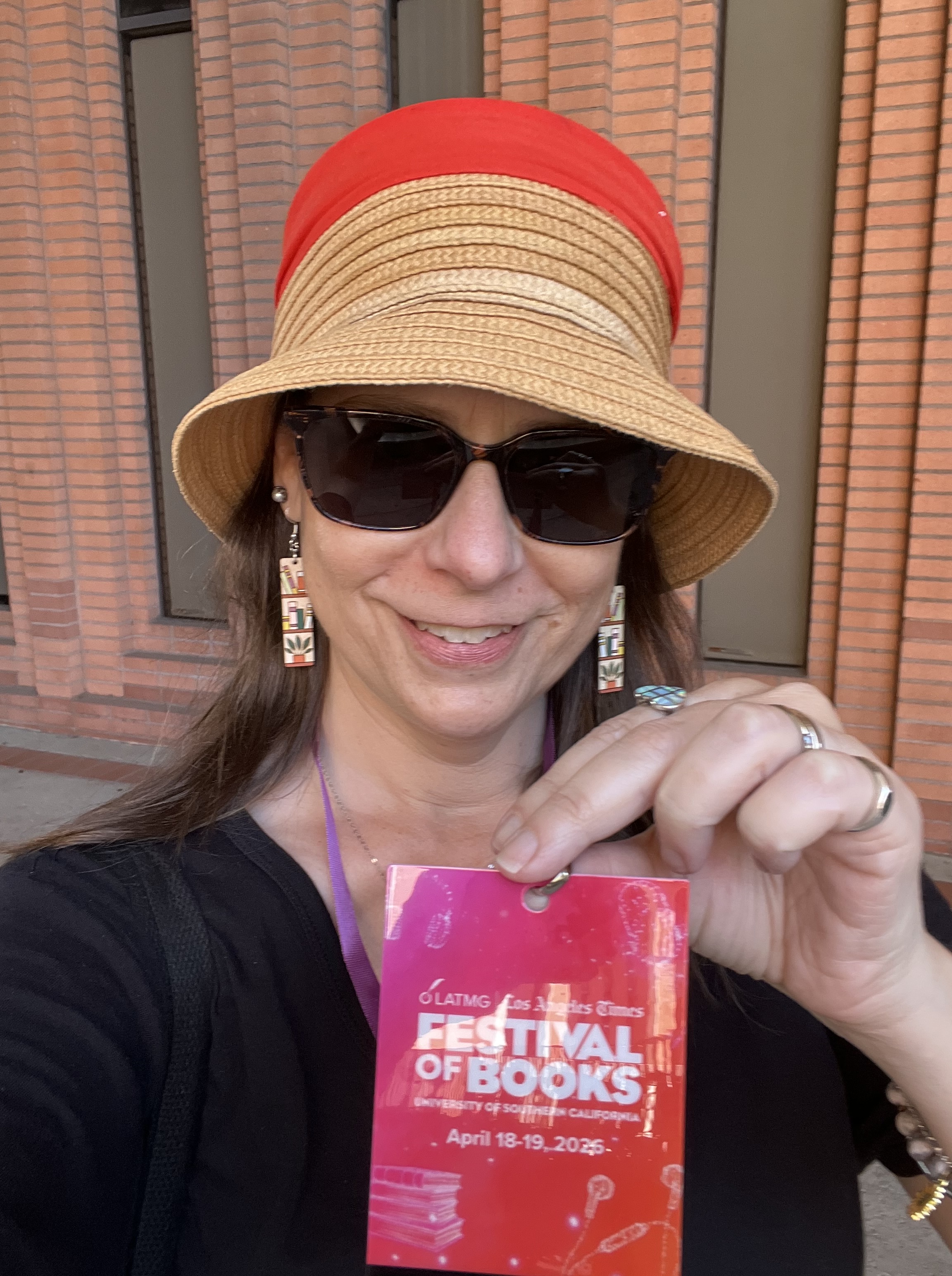
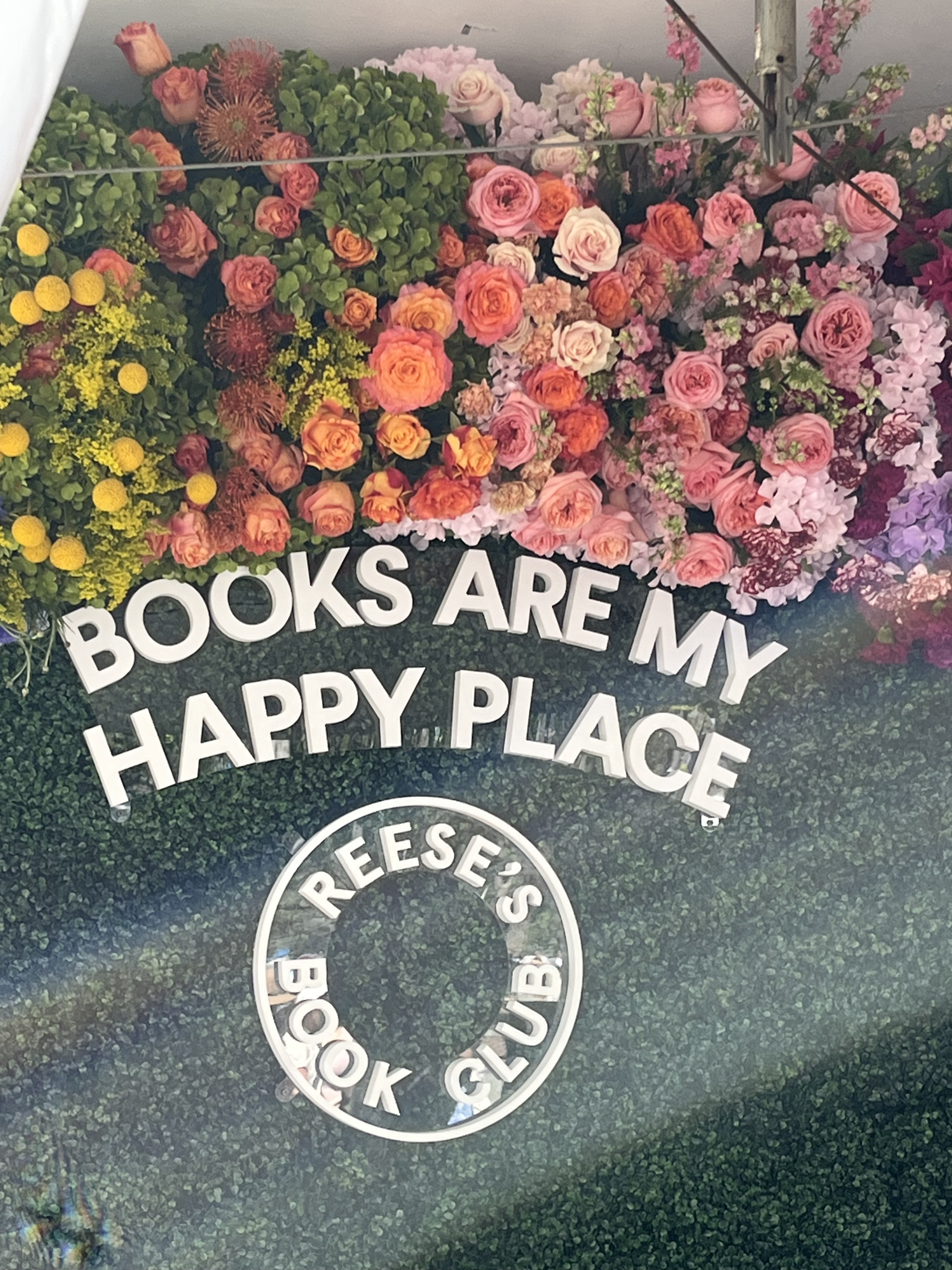
If you follow me on Instagram (and if you’re on Instagram, I hope you do follow me. I’ll follow you back, and it will be another way we can support each other!) you saw my posts from my Saturday adventure. I attended the annual Los Angeles Times Festival of Books on the campus of USC.
I wanted to attend because I’m a reader and a writer. Because I am actively seeking publication of my memoir. Because I want to connect with other readers and writers.
So here are a few things you should know about Saturday:
– Parking is an issue. There were very few handicap parking spots in the parking structure I used. I ended up parking on level 5 and then had to decide if I wanted to use the elevator or take the stairs. It wasn’t an obvious decision, because I have used this elevator before, in previous visits to the Book Festival. It’s a small elevator, and it makes me nervous. I opted to take the stairs.
– The walk from the parking structure to the exhibit area is quite substantial. With each step I took, my frustration grew. I felt like I was wasting my energy, wasting my legs, before I even reached the main event.
– I wanted to see and do as much as I could. I had a list of certain exhibitors I wanted to visit (including Village Well Books and Coffee, She Writes Press, and the opening-in-September Lucas Museum of Narrative Art, to name a few). They weren’t all near each other, which meant I had to walk to different “zones,” spread out throughout the Festival.
– My work, the writing I do for MomsLA.com , made me eligible for a Media Pass, which was easy enough to apply for, and not so easy to actually pick up. I asked Festival volunteers and security guards for guidance about where I could find the Media Center and no one I asked could help me. (Because it’s been a couple of years since I’ve attended the Festival, I didn’t remember where this mystery room was. Hence the need for me to ask others.) More walking, more wandering, until I eventually found it. Not that I minded, necessarily, because I got to explore some more, but it was additional walking that would contribute to my fatigue. (I wound up not really needing the Media Pass since I did not attend any ticketed events or panel discussions; however, it makes a nice souvenir.)
– I stayed at the Festival for a few hours. The walk back to the parking structure was slower and harder for me. And once I reached it, I had another difficult decision to make — take the elevator or climb the stairs to reach my car on level 5. By this time, I had finished up my water bottle, and all I could think about was the possibility of getting stuck in the elevator, feeling hot and sweaty, and having no water with me. My heart started beating faster, and my fear of getting stuck in the elevator won out. (This isn’t a completely irrational fear — before I left teaching, I spent almost an hour stuck in our school’s elevator early one morning.) I climbed the stairs to level 5. Slowly. Gripping the handrail. Pausing for a few minutes on level 3, before continuing and eventually making my way to my car on level 5.
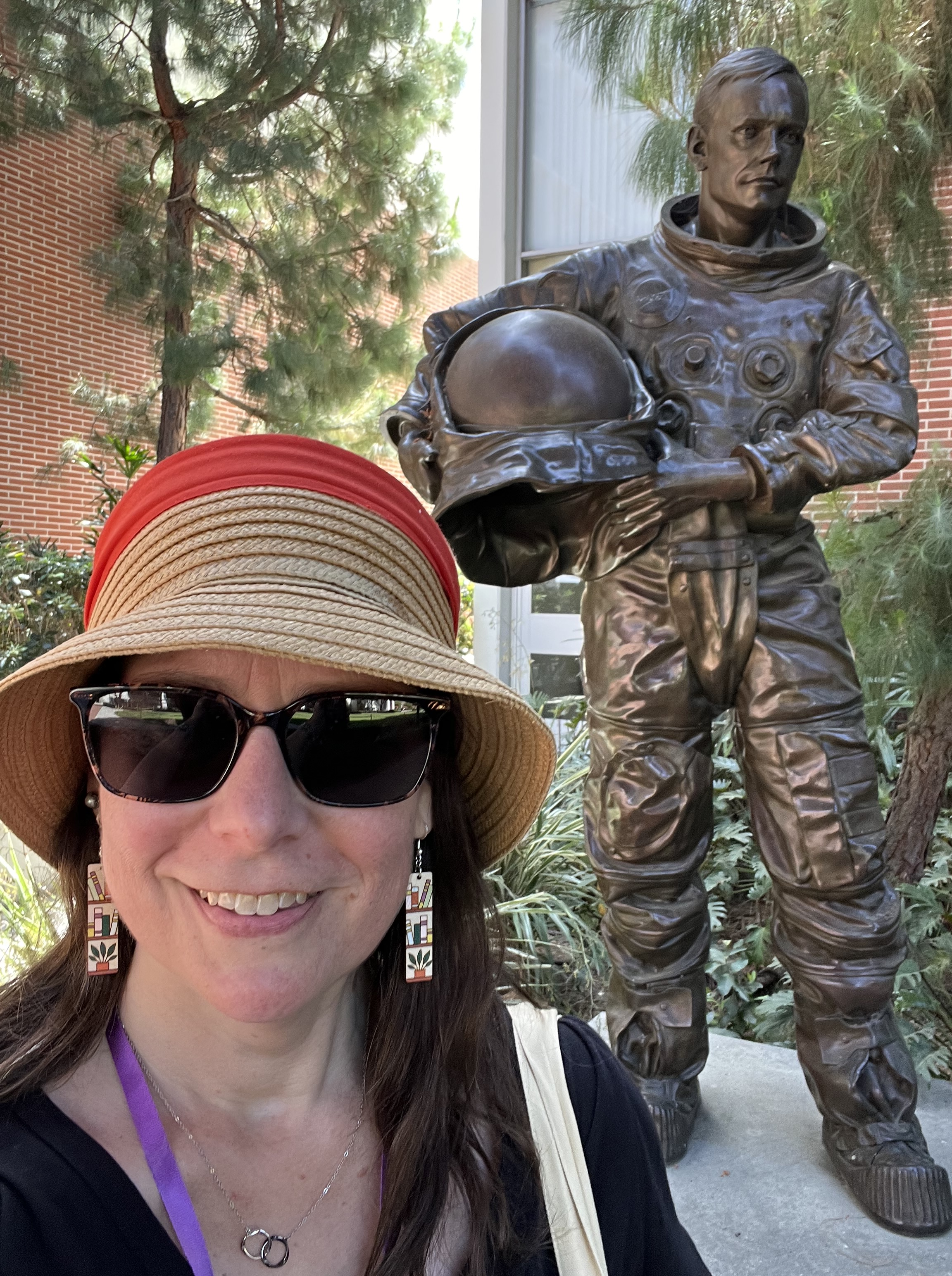
On my slow walk back to the parking garage, I stopped to pose with this sculpture of astronaut Neil Armstrong, the first human to walk on the moon. He received his Master's degree in aerospace engineering from USC.
So I did it. I drove myself to the Festival. I wandered and chatted and took photos and purchased books. I loved being among the positive energy from other book lovers. (I have found the writing community and fellow readers to be generous, uplifting folks. I felt that on Saturday.)
However, if I absolutely needed a wheelchair, climbing the five flights wouldn’t have been an option for me. And even now, days later, I’m still not certain I made the right decision. My knees are in bad shape. Doctors agree my left leg is weaker than my right. And I think it’s fair to say that climbing five flights of stairs, twice, isn’t easy for many people.
But for me, a girl with an invisible disability, who could “kind-of do it” (there’s a wishy-washy phrase for you), it was another example of me not knowing, still not knowing, when to push and when to ease up. When to acknowledge my physical limitations and when to seize an opportunity.
Spoonie friends, does this resonate with you? Anyone else struggle in a similar way?
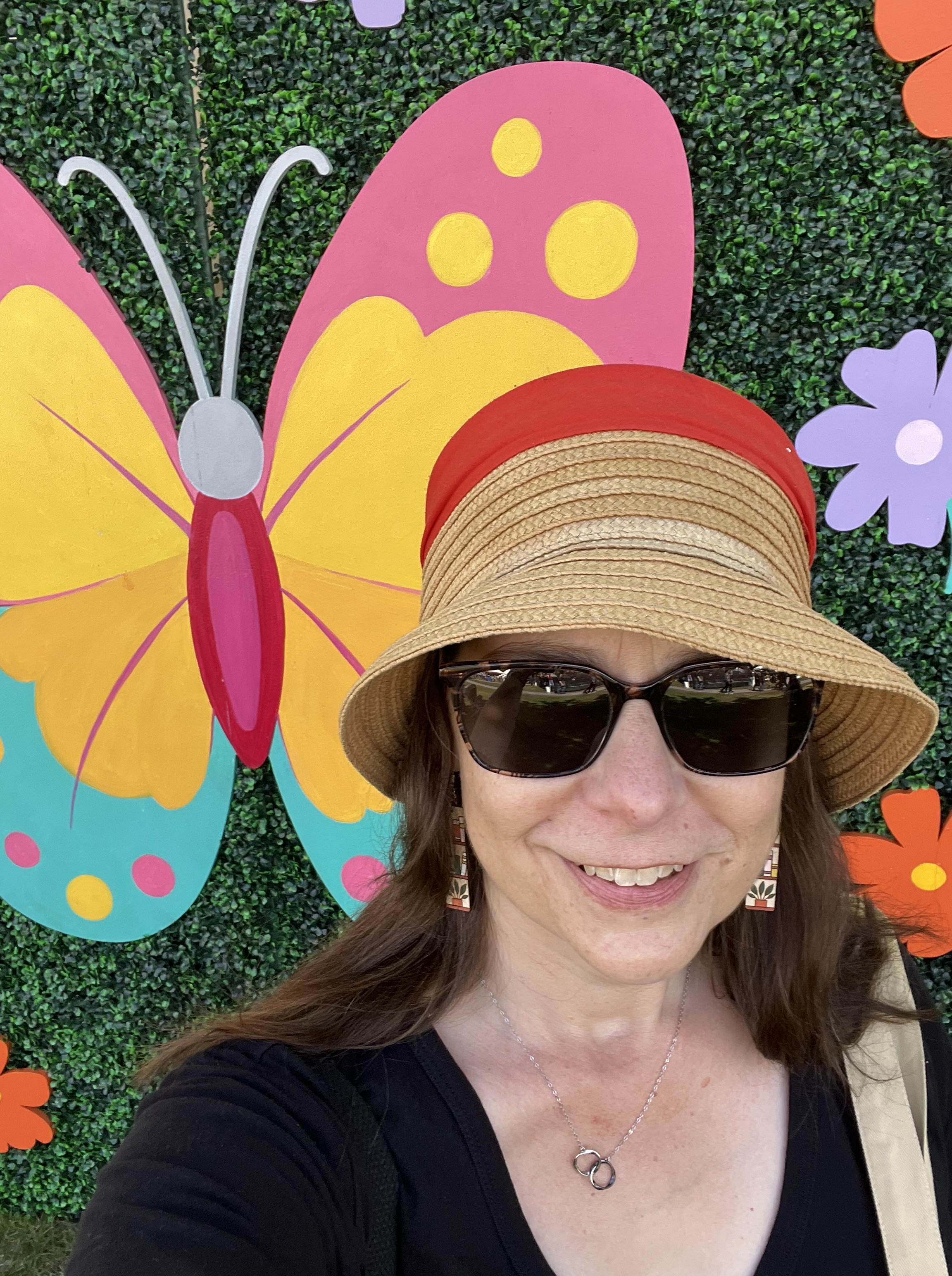
Friends, a reminder that author Joanna Monahan is generously offering a giveaway to my Substack subscribers. All you have to do is subscribe to my Substack no later than Thursday, April 23rd. Then on Friday the 24th, I’ll pull a name from my sun hat (the same hat you see here), and one lucky subscriber will win a signed copy of Joanna’s just-published novel, WELCOME TO BLOOMS!! 🌸🌺🌼 I can’t wait to read it— the book features a main character named Daisy whose family owns a flower shop! Be sure you have subscribed to my Substack so you can participate in this special giveaway opportunity.
First, I must admit, I love the “Pep Talks” part of the sub-title.
Many books offer “practical advice.” Some include “Tips and tricks.” And still other books may have “Steps and suggestions.”
But “pep talks”? That’s a new one, at least for me. (And if I’m overlooking another writing craft book offering pep talks, please, friends, let me know.)
And there will definitely be a blog post dedicated to Ms. Smith’s book once I finish reading it.
This week, at the halfway-ish point of the book, I wanted to pause and share some of Ms. Smith’s “pep talks,” because maybe you’re needing them as much as I am.
Because, let’s be honest, most of the time, us writers aren’t working each day with someone giving us a pat on the back, or a back rub, or even a set of new file folders. (Is it just me that enjoys looking at all the stationery supplies at Dollar Tree?)
We write, not because anyone is necessarily cheerleading us on (though, that is one of the wonderful benefits of working with a Book Coach). We write, day after day, not because anyone will ask us at dinner about the progress we made on the fourth draft of the new personal essay we’re working on.
We write simply because we have to. We have to get words down on the page — whether those words are fiction or nonfiction. Whether they rhyme or not. Whether a day’s work will stand alone or be a part of a much larger piece.
But, it’s hard work. And I have found non-writers generally don’t understand just how hard this writing work is. Not physically hard like a landscaper, down on their knees under a fiercely bright sun. And not hard like needing an entire chalkboard to work out one math equation. (Anyone else think of the film Hidden Figures here?)
But, still, hard. Hard because we don’t always know where the writing is going. The words I got down today may be the same words I delete four days from now in a later draft. And the words I wrote and then spoke out loud to hear the rhythm of the language may be the words some faceless person on the other side of the country will declare “not a good fit for us at this time.”
So, yes, I’ll take a pep talk. Thank you.
And if you’re needing a pep talk, or four, allow me to share some pep talks from Ms. Smith’s Dear Writer:
“Taking care of yourself is taking care of your creativity. Taking care of yourself as a whole human being is taking care of the writer in you.”
“Any piece of writing is a time capsule. It reflects the choices — and the abilities, and the limitations — of the writer we are at the time.”
“Being true to your own vision as a writer or an artist means doing your work, the work that only you can do. Your memories, your point of view, your observations and metaphors — everything about you that you bring to bear when you write — is a combination that no one else has. “If you don’t write your poems, your stories, your plays and essays and scripts, they won’t exist. No one else can do it for you.”
“Be for you first. Create for you first. Trust your own vision.”
Please note: I am including a link to buy the book that I’m highlighting this week. If you use my link, I do make a small commission on your purchase at no additional cost to you. I am working with Bookshop.org which also sends a portion of the profit to support local, independent bookstores.
This week’s blog post is related to the week-long project I started on Instagram. If you’re not on Instagram or just haven’t checked it for a while, let me briefly explain.
Life has gotten busy and full, and one of the things I have let slip is my daily five-minute writing practice. (I’ve written about my five-minute writing exercises before. Here’s a link to one such post.)
Since the new school year starts on Thursday, August 14th (at least, schools in the Los Angeles Unified School District begin then, other schools in other districts may have different start dates), I thought this week would be the perfect time for me to begin doing my five-minute writing exercises again.
Except, I needed some help, some way to be held accountable so I wouldn’t brush it off when I felt too tired or felt like I had “more important” things to do. So here’s the plan — Monday, August 11th through Friday, August 15th I am posting a reel a day on my Instagram account. In that reel, I read aloud a writing prompt — either one from Kicking in the Wall by Barbara Abercrombie or Rupi Kaur’s Writing Prompts – Self Love.
And me, being a former teacher, decided to keep track of my progress by placing a sticker on the calendar for each day I completed my five-minute writing exercise.
Today, I am sharing with you what I wrote in response to Tuesday’s prompt — Write about a name that creeps into your heart. The name of someone or something you love — an animal, a place, weather, a song.
Growing up, my mom’s family called her Honey. In a family of five children, she was the only girl. They called her Honey, even into adulthood, but everything I know about my mom’s childhood doesn’t match with the way they treated her. It doesn’t seem like she was ever treated like a Honey. In the stories she tells and the memories she shares it feels as if her years at home were missing a sweetness and tenderness and love, both explicitly expressed and implicitly felt.
My mom, now 80 years old, has always spoken fondly of her maternal grandmother. A woman who wore lots of jewelry (like me). A woman who, when visiting California from New York, would ask my mom to polish her nails for her. A woman who called my mom Honeycakes.
Honeycakes. I love that name. It sounds like a delightful dessert. Like something you eat with your fingers and when you’re done eating, you lick your fingers clean, one-by-one, because you’re trying to savor every little bit of the sweetness. It warms my heart, knowing my mom’s grandma spent time with my mom — hugging, being affectionate, letting my mom know she was a special girl.
After 50 years of marriage, my 79-year-old dad, still calls my mom Honey. The red heart tattoo on his right arm has the name Honey written inside.
My mom is Honey.
And because it’s my mom’s name, I don’t call my husband Honey.
He’s Honeypie.
Readers, please let me know if you’re completing these five-minute writing exercises. I’d love to cheer you on!
Please note: I am including a link to buy the book that I’m highlighting this week. If you use my link, I do make a small commission on your purchase at no additional cost to you. I am working with Bookshop.org which also sends a portion of the profit to support local, independent bookstores.
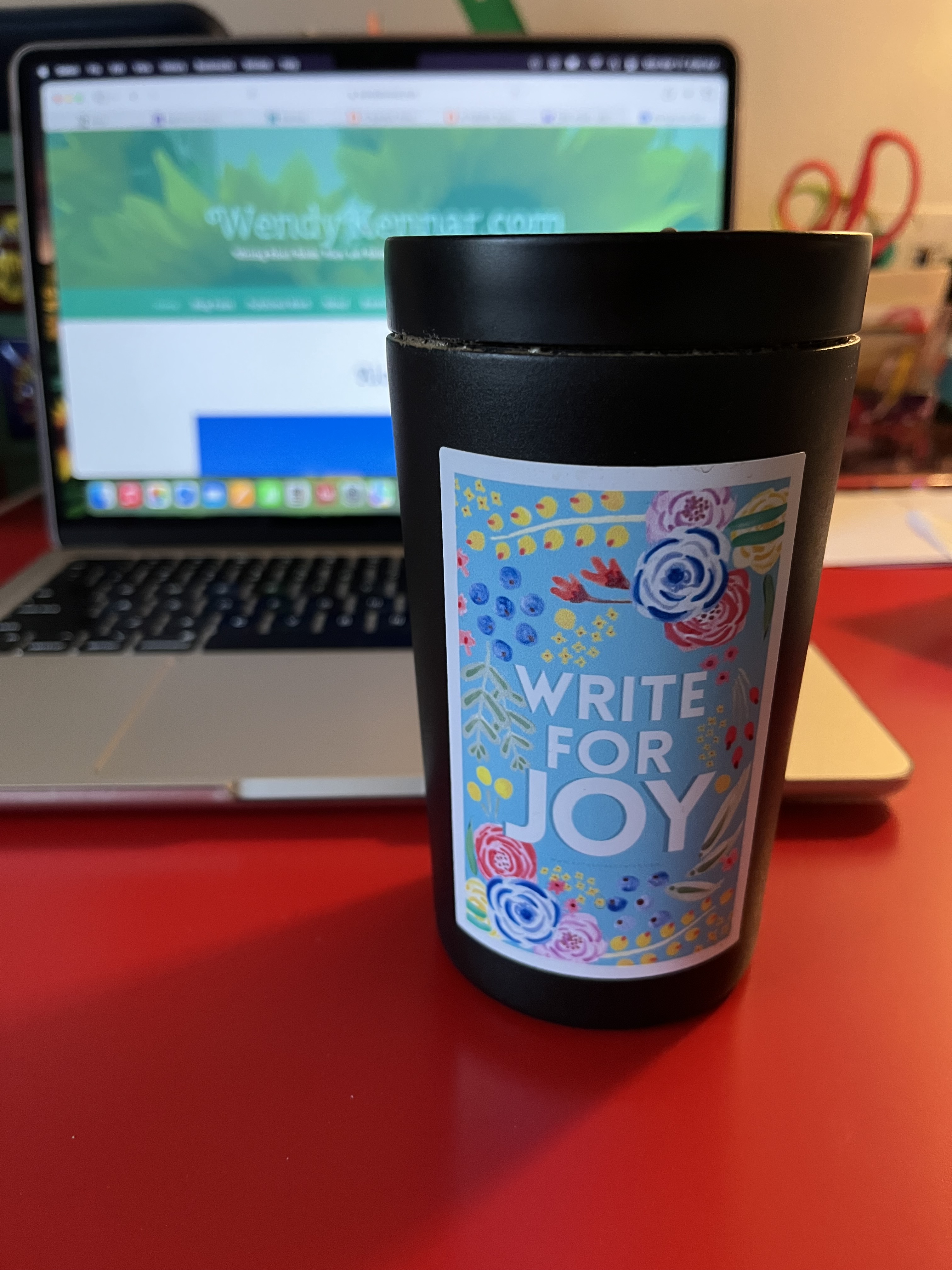
My reusable coffee tumbler is decorated with stickers designed by Katherine Center.
I am in the middle of a three-month online program called The Creative Shift Mastermind with Dan Blank. (I have taken several webinars with Dan and always come away having learned something new to apply to my writing and how I share my writing.)
Each week throughout The Mastermind, we focus on a different aspect of our creative life. Recently, our activities centered on our “Creative Identity.”
Taken from our syllabus:
“Define Your Creative Identity. Have confidence in your creative identity, and know how to talk about what you create and why. The result of this is your ability to share more frequently and authentically, and greater ability to engage others.”
During one of my daily five-minute writing exercises, I wrote a series of “I believe…” statements that all had something to do with what I write, why I write, and why I share what I write.
My dear readers, you are an important part of my writing. Therefore, for this week’s blog post, I would like to share my “I believe” statements with you. Thank you for your support and being with me on my writing journey.
I believe… (as it pertains to my writing):
I believe everyone is walking around with pain of some sort.
I believe everyone has scars, whether we can see them or not.
I believe writing is another way of teaching.
I believe writing is one way to help make the invisible visible.
I believe chronic illness can be lonely and isolating.
I believe writing is one way to find connection with others who “get it.”
I believe writing is a way to share our stories and our hearts and realize that we’re not alone.
I believe my story is worthy of sharing.
I believe I continue to teach through my writing.
I believe I have much to learn and writing helps me make sense of things.
I believe one way I sort things out, one way I figure out how I feel about things is by writing about it.
I believe my book is a book I would have loved to read when I first became ill.
I believe I don’t talk about my writing enough.
I believe kindness and compassion and patience are so very important.
I sign up for many writing-related webinars (mostly free, though some are fee-based), and I like to watch interviews with authors on YouTube. I consider myself a life-long student, and have found the writing community to be very generous when it comes to sharing information and advice and encouraging other writers.
I attend these webinars and watch these videos in my quest to learn more about building a writing career. As I continue to query literary agents, I have been learning about establishing and maintaining an author newsletter (something I plan to do in the future, so stay tuned!), creating a readership, and the different types of marketing options available for writers.
A couple of weeks ago, I watched two different writing-related videos, featuring two different authors, and both videos left me with questions I haven’t been able to stop thinking about.
One author was asked how she shows herself self-compassion. I thought it was an interesting question for an interview. The memoir author spoke first of acknowledging the difficulty in writing about painful experiences. Writing memoir, particularly writing about a traumatic experience, requires a very different mindset than writing a scene in a romantic-comedy, for example. The author spoke of giving herself breaks, and being very intentional when it came to planning her writing time. She knew she would need to strategically plan when and where she’d engage in this writing, and then give herself the space and time needed to rest afterward.
In another interview, a different author was asked what she does to nurture her resilience.
The questions stumped me. Me, who is seemingly always writing or thinking about writing, was at a loss for words.
Do I show myself self-compassion? Probably not nearly as much as I should.
Do I nurture my resilience? Honestly, I’m not a hundred percent certain what that means or how that would look.
But that’s what I’ve been thinking about. Those are questions that I can’t seem to let go.
Then over the weekend, as I tried to make my way through a full inbox, I read agent Kate McKean’s latest Substack post titled, “Compulsory Rest.” This sentence stood out to me: “The universe is going to do what it’s going to do—and all you can do is make sure you’re taking care of yourself the best you can.”
She’s completely right. I like to think I’m in control, with my lists and schedules and dinner meals planned out a week in advance. But really, the truth is, I’m not at all. There is actually little I can control, and when it comes to my own body, there’s really very little I have control over.
It’s been hard. “It” meaning life, though I hesitate to put that in writing. Thankfully, my family is healthy and safe. We are not worried about having enough food in the fridge or a roof over our heads. We are lucky, fortunate, blessed in so many ways.
And yet, life has been hard.
I feel like these interview questions and this Substack statement are like clues. Clues from multiple sources and multiple people. Clues I am paying attention to.
But, also, clues I’m not entirely sure what to do with or how to use them as a springboard for changes in my daily life.