Oh, He’s Going Places!

This is a big week for our family.

My son’s middle school culmination is tomorrow. 

Which means he’ll soon be a freshman in high school. 

When I was pregnant, and right after Ryan was born, everyone told me his childhood would pass by quickly. “They grow too fast,” my mom often said.

My mom, as she tends to be, was right.

High school will be a new experience. And what is new can also be intimidating and scary. Yet I have no doubt that my son is ready. He has a good head on his shoulders and a kind heart. Plus, he and his classmates have done something never before done — they spent their middle school years in the middle of a global pandemic. (Ryan was sent home in March of 2020, as a sixth grader. He returned to campus in August 2021, as an eighth grader.)

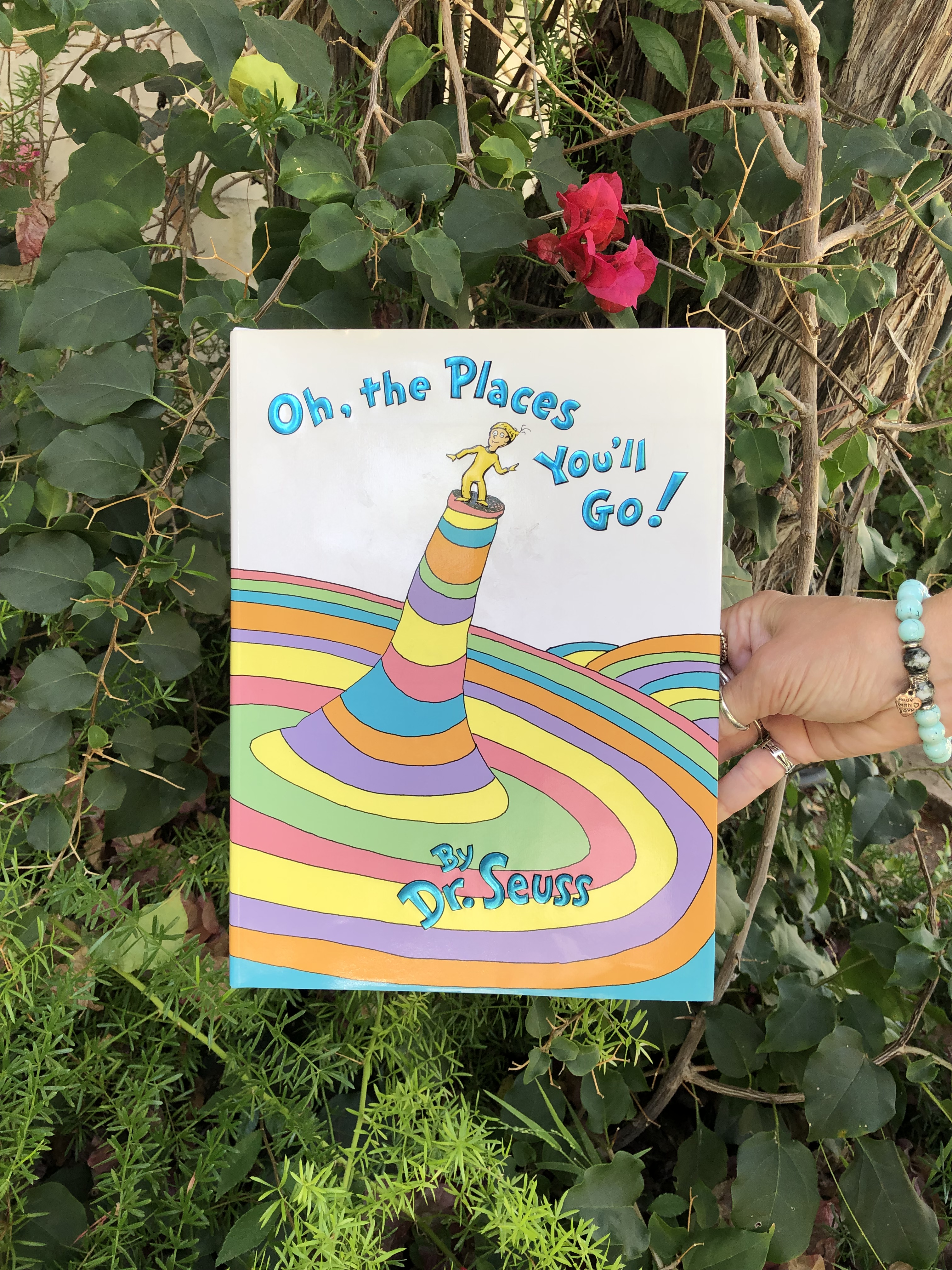
Yet, in case he, and other graduating students, need some encouragement, I offer these famous words from Oh, the Places You’ll Go! by Dr. Seuss.

“You have brains in your head.
You have feet in your shoes. 
You can steer yourself 
any direction you choose.
You’re on your own. And you know what you know.
And YOU are the guy who’ll decide where to go.”

“You’ll look up and down streets. Look ‘em over with care. 
About some you will say, ‘I don’t choose to go there.’ 
With your head full of brains and your shoes full of feet, 
you’re too smart to go down any not-so-good street.”

“Out there things can happen
and frequently do
to people as brainy
and footy as you.
And when things start to happen,
don’t worry. Don’t stew.
Just go right along.
You’ll start happening too.”

“You’ll get mixed up, of course,
as you already know.
You’ll get mixed up
with many strange birds as you go.
So be sure when you step.
Step with care and great tact
and remember that Life’s 
a Great Balancing Act.
Just never forget to be dexterous and deft.
And never mix up your right foot with your left.”

“And will you succeed?
Yes! You will, indeed!
(98 and 3/4 percent guaranteed.)
KID, YOU’LL MOVE MOUNTAINS!”

Giannis

“How’s the book?”

“It’s good,” I said as I held it up and showed it to the barista. He had just brought out my blended mocha and set it down on the table for me.

“It’s about Giannis, the basketball player,” I said.

“Oh, basketball,” he said it with a bit of a question in his voice.

It might not seem like a book I would pick up. Especially if you checked out my Goodreads record and saw the last book I read was Jasmine Guillory’s The Wedding Date.

I try to alternate, reading fiction and nonfiction. And when it comes to nonfiction, I enjoy reading memoirs and biographies. Because I believe everyone has a story. The specifics may vary, but in those specifics you tend to find the universal.

So now I’m reading Giannis: The Improbable Rise of an NBA MVP by Mirin Fader. (In case you don’t know, Giannis Antetokounmpo plays for the Milwaukee Bucks. In 2021, they won the NBA Championship.)

On the surface, Giannis and I don’t have much in common. 

But that’s okay. That’s more than okay. That’s why books are so valuable. They give us the chance to take a peek at someone else’s life. To realize the many ways we are similar. To acknowledge that what you see on the surface is rarely the full story.

My family and I are basketball fans. While we always root for our Los Angeles Clippers, we are admirers of the game and those that play with heart and soul. 

Players like Giannis. 

The Book of Hope

How do you explain “hope”?

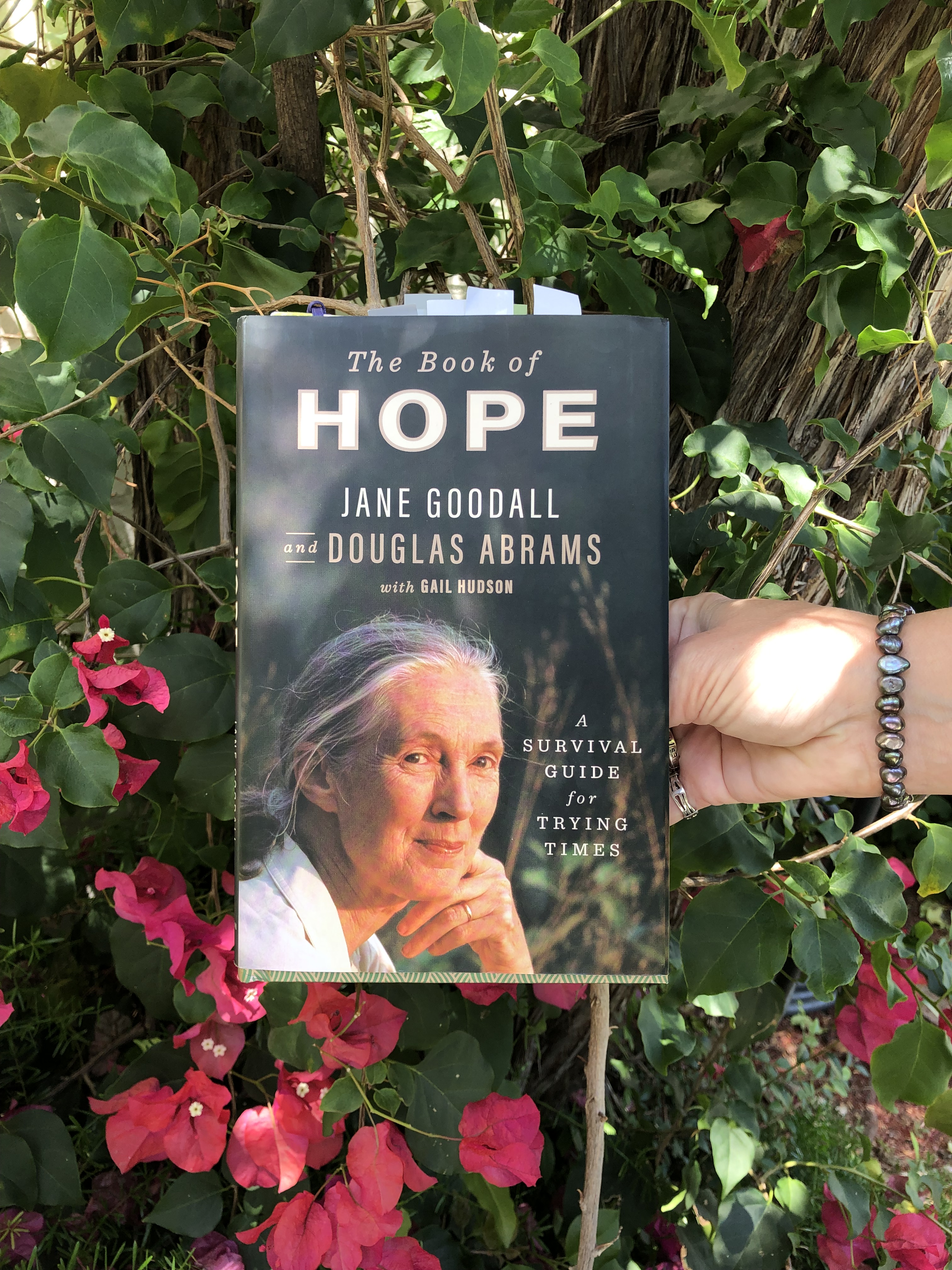
In The Book of Hope by Jane Goodall and Douglas Abrams with Gail Hudson, Dr. Goodall describes hope as “what enables us to keep going in the face of adversity. It is what we desire to happen, but we must be prepared to work hard to make it so.”

This book was written during the pandemic, a time when it sometimes felt like all we could do was hope; hope to stay healthy, hope to stay safe, hope for a vaccine. 

This is a powerful book with a powerful message, and this week I’m sharing some of my favorite passages.

“You won’t be active unless you hope that your action is going to do some good. So you need hope to get you going, but then by taking action, you generate more hope. It’s a circular thing.”

From Douglas Abrams, “I was surprised to learn that hope is quite different from wishing or fantasizing. Hope leads to future success in a way that wishful thinking does not. While both involve thinking about the future with rich imagery, only hope sparks us to take action directed toward the hoped-for goal.”

“The trouble is that not enough people are taking action,” Douglas Abrams said. “You say more people are aware of the problems we face — so why aren’t more trying to do something about it?”

“It’s mostly because people are so overwhelmed by the magnitude of our folly that they feel helpless,” Jane Goodall replied. “They sink into apathy and despair, lose hope, and so do nothing. We must find ways to help people understand that each one of us has a role to play, no matter how small. Every day we make some impact on the planet. And the cumulative effect of millions of small ethical actions will truly make a difference. That’s the message I take around the world.”

“Jane’s stories affirmed that when we feel we can make a difference, and we’re given the means to do so, positive outcomes can happen that in turn allow hope to prevail. It was a powerful example of what the research had found contributes to hope: clear and inspiring goals, realistic ways to realize those goals, a belief that one can achieve those goals, and the social support to continue in the face of adversity.”

“From talking with Jane and doing my own research, I was starting to see that hope is an innate survival trait that seems to exist in every child’s head and heart; but even so, it needs to be encouraged and cultivated. If it is, hope can take root, even in the grimmest of situations…” from Mr. Abrams.

“Well, I always knew I had a gift for writing,” Jane added. “From an early age I was writing — stories, essays, poems. But I never thought I had a gift for speaking. It wasn’t until I was forced to make that first speech, and found that people were listening, and heard their applause at the end, that I realized I must have done okay. I think many people have gifts that they don’t know about because nothing forces them to use them.”

“That when the trials of life come, you’ll be given the strength to cope with them, day by day. So often I’ve thought at the start of a dreaded day — having to defend my Ph.D. thesis, giving a talk to an intimidating audience, or even just going to the dentist! — ‘Well, of course, I shall get through this because I have to. I will find the strength. And, anyway, by this time tomorrow it will be over’.”

Readers – I wrote this blog post before the horrific school shooting in Texas. I wrote this blog and now am re-reading it with a broken heart. Hope — it’s more than just wanting things to change. I hope my son will grow up reading about gun violence in history books, as something that used to happen, not reading about it in the newspaper because gun violence remains a current event. Hope involves action. For me, now, that takes the form of voting. Continuing to Vote in Every Single Election. And I hope my readers feel the same way.

Words Have Power

Words are powerful. What you say, and how you say it, have lingering effects. And I’m not just talking about words spoken to someone else. Also included in this list are the words we speak out loud to ourselves (I’m not the only one who talks to herself, am I?) and the words we think to ourselves. 

We know this. 

But sometimes, something happens that serves as a flashing-light reminder of just how true that is.

Last week, I had two such incidents.

My neighbor and I were chatting and catching up. She’s almost forty years older than me and was talking about some new pain she’s experiencing in her lower back/side area. Thankfully, all x-rays came back fine, no problems identified. She found herself in a situation that I know all too well. Tests are negative, big problems ruled out, but still no answers about what’s causing the pain and no clear direction given on how to alleviate the pain. 

“I tell you, living with chronic pain is no fun,” she said. 

I know.

“I don’t know how you do it,” she said.

I bit my tongue.

She went on a bit, describing the discomfort, and again said, “I really don’t know how you do it.”

I looked at her and said, “I don’t have a choice.”

I do it, I live with chronic pain, because I have to. Because there is no alternative.

And though not her intention at all, and though I’m not fully sure why, her words got under my skin and bothered me. 

The second conversation occurred the next day, during a telehealth appointment with my rheumatologist. Near the end of our conversation, I asked her about a trip my family and I are thinking of taking. 

“We’re thinking about going to Hawaii,” I said. “But I haven’t flown since before my son was born, and he’s 14. I haven’t flown since I have this condition. And I’m worried, because of the blood clot I had after my biopsy.”

(In case you missed it, I had a second biopsy in September 2020. A “routine” procedure that was supposed to provide some answers to my rheumatology team. No answers, and I developed a “very rare” blood clot in my left calf. You can read about it here.)

She answered my questions, told me some things I could do before, during, and after flying. And then she said something that has been on repeat in my head since she said it.

“Oh, go, you need to have some fun.”

And that advice, given with a smile through a screen, was encouragement and validation I hadn’t realized I needed. 

In the Words of Michelle Obama

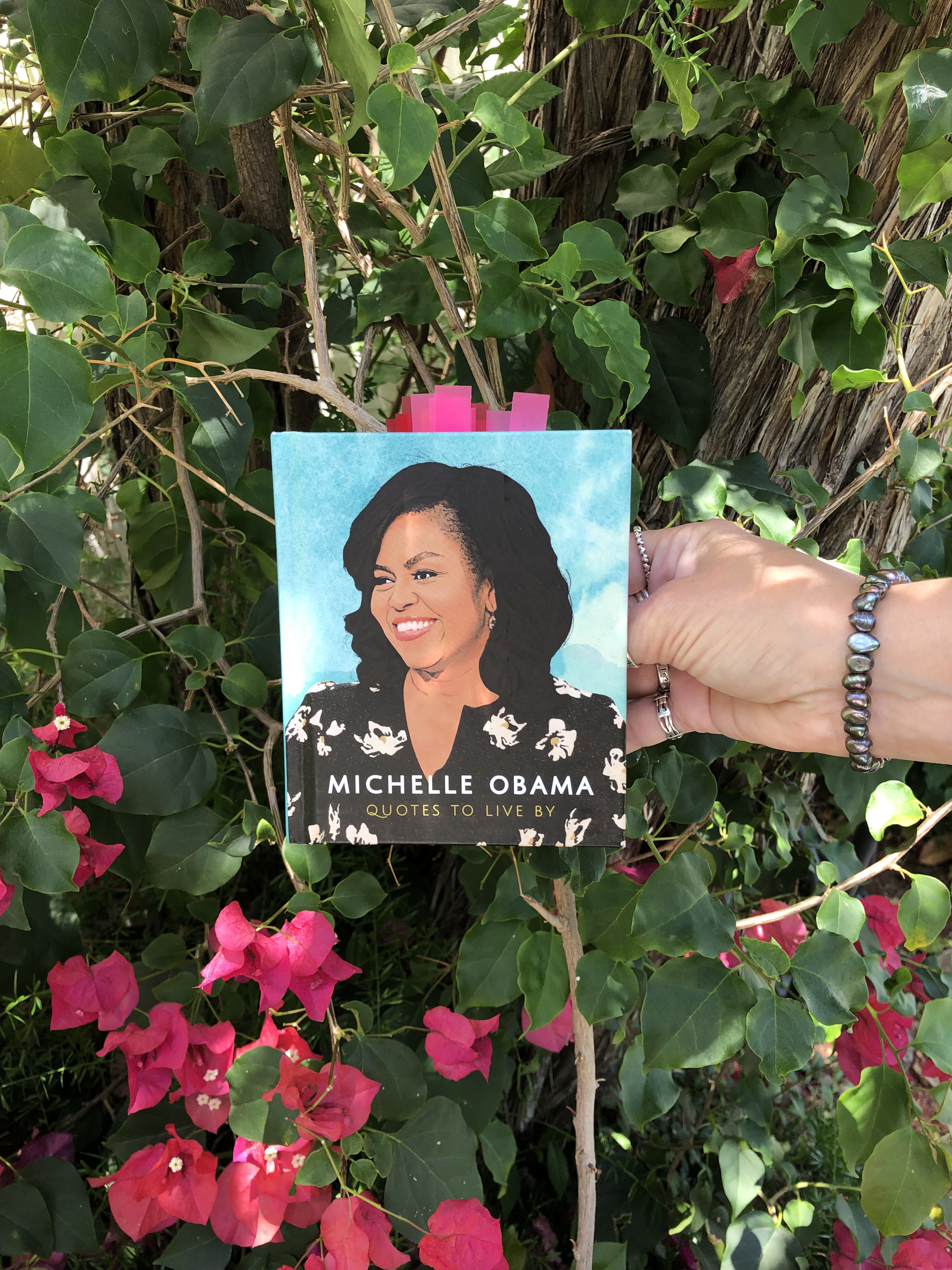
Michelle Obama: Quotes to Live By was a gift to myself. It’s a small book, containing a collection of over 170 quotations.

And my copy is full of sticky notes. 

Here are some of the quotations that stood out to me:

Every single child has boundless promise, no matter who they are, where they come from, or how much money their parents have. We’ve got to remember that.
– National Arts and Humanities
Youth Program Awards, November 2016

“I never cut class. I loved getting As. I liked being smart. I liked being on time. I thought being smart is cooler than anything in the world.”
– Elizabeth Garrett Anderson School, London, April 2009

“We can’t afford not to educate girls and give women the power and the access that they need.”
– Mulberry School for Girls Skype conversation, June 2015

“Women in particular need to keep an eye on their physical and mental health because … we don’t have a lot of time to take care of ourselves. We need to do a better job of putting ourselves higher on our own to-do list.”
Real Health magazine interview, November 2007

“You can’t make decisions based on fear and the possibility of what might happen.”
60 Minutes interview, February 2007

“You don’t come up with the right answer if everyone at the table looks the same and thinks the same and has the same experience.”
– White House screening of Hidden Figures, December 2016

“In those darkest moments, you will have a choice: do you dwell on everything you’ve lost, or do you focus on what you still have and find a way to move forward with passion, with determination, and with joy?”
– Oregon State University commencement, June 2012

“What matters are the true friends you make, the activities you throw yourself into, the books you read, the skills and knowledge you acquire. Those experiences — the ones that make you stronger, smarter, and braver — are what really matter.”
– People Magazine essay, October 2014

Just Haven’t Met You Yet

Sometimes I read for information. 

Sometimes I read for inspiration.

Sometimes I read for pure enjoyment.

Just Haven’t Met You Yet by Sophie Cousens is a novel I picked up because I wanted something fun and entertaining.

Sophie Cousens wrote that book. Just Haven’t Met You Yet is the delightful escape I was hoping it would be. But it’s also more than that.

This week, I wanted to share some of the passages that really moved me.

“Ted looks thoughtful for a moment, then he says, ‘Someone told me that growing up feeling loved allows you to go on to love other people. Maybe love is simply a huge chain letter, passed down through the generations. The details of the stories begin not to matter’.”

“ ‘She was a part of me,’ he says softly, the pain palpable in his voice. ‘When you are with someone for a long time, you grow into each other, like adjoining trees with tangled roots. It’s hard to extricate yourself and find the part that’s left — who you were before’.”

“ ‘This is not something that gets better,’ Gerry says with a calm smile. ‘So, if I can’t look back, and I can’t look forward, I’m forced to live here, right now. Today I can sit around a campfire and talk to my friends. Today I can watch the sunset, even if the outline is getting hazy. Today I have made a new friend and I’m enjoying her company and her vibrant conversation.’ He makes a single, slow nod in my direction. ‘The Roman poet Horace said Don’t hope or fear, but seize today, you must! And in tomorrow put complete mistrust.’ All any of us have is today’.”

“People like to fill in the gaps, to paint their own picture, but no one really knows the truth of someone else’s story.”

“I have no illusions about happily ever afters — I know life will bring its challenges and nothing is forever — but I hope we might be happy today, and for as many todays as we are lucky enough to have.”

My Son’s Optimism For the Future Continues to Amaze Me

“Ryan didn’t know it, but his response soothed my heart and made me feel good. Here was a flashing neon sign that our son was okay — more than okay. Here was the confirmation I needed that despite all the changes and the scary situations, Ryan felt safe and secure. After a year-and-a-half of distance learning, masked walks to our favorite neighborhood cafe for smoothies to go, and celebrating holidays with grandparents over FaceTime, Ryan was okay. More than that: he was optimistic, positive, and confident.”

I’m proud to share the news that the paragraph above is taken from a recently published essay, “My Son’s Optimism For the Future Continues to Amaze Me.” 

You know how, as parents, you often wonder if you’re doing enough? If you’re handling a difficult situation well-enough? 

This was my son’s way of saying, “Yep. You’re doing enough.”

You can click here to be re-directed to Moms Don’t Have time to Write to read the essay in its entirety.

Waves, Walking, and Pain

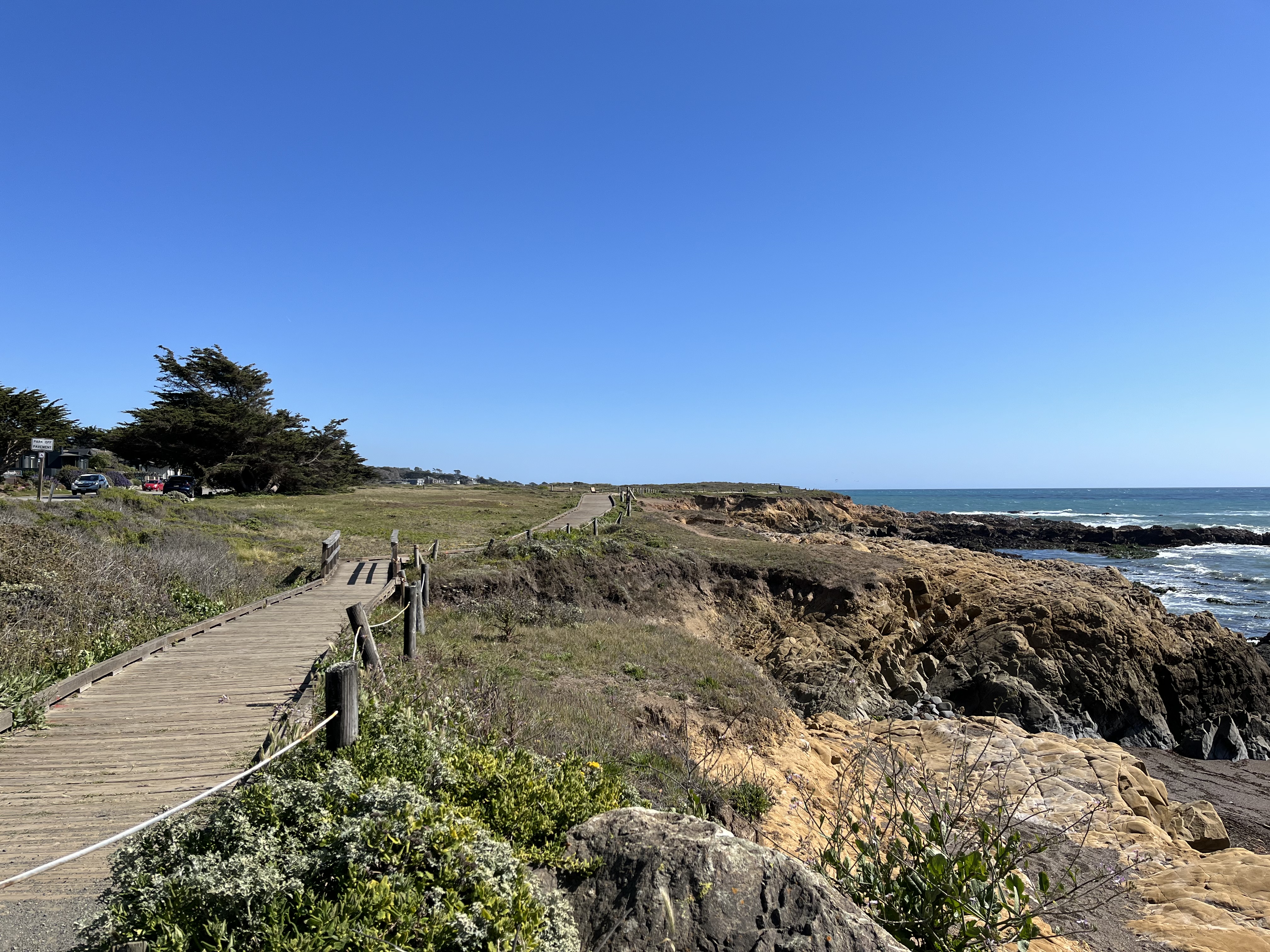
The boardwalk along Moonstone Beach – Cambria, California

Spring break.

My husband, my son, and me.

A road trip to one of our favorite spots on the California coast.

4 days, 3 nights.  

And pain. Lots and lots of pain.

I started the week with high hopes and lots of gratitude. Last year’s spring break was spent at home. This year, fully vaccinated and boosted, it was possible for us to spend time in one of my favorite places — Cambria, California.

Being in Cambria is good for my soul. Away from my daily responsibilities, away from the noise of the big city (no helicopters, no sirens, no car alarms), I feel calm. Serene.  

The whole time we were there, I kept waiting for the good vibes to kick in. I was waiting for the pain to decrease and fade into the background all together. 

It never happened.

By the time we got home, I was in agony. My legs were beyond hurting. My legs felt weak, as if any moment I might topple over or my knees might suddenly decide to buckle.

Almost 500 miles roundtrip with me as the driver.

Walks and hikes, up to 5 miles each day.

Back at home, back to the responsibilities of bills, laundry, and watering my plants, I felt so disappointed. 

Why can’t my body just work the way I want it to? 

That question came to mind on our first night home, as I stood under our shower, thankful I no longer had to make due with the barely-there water pressure of our hotel. 

A few days later, the answer came to me.

My body did do everything I wanted it to do.

I planned and packed.

I drove and sang. (It doesn’t get any better than driving along a stretch of the 101 while my husband, my fourteen-year-old son, and I all sang along to Hey Jude.

I walked and watched. (We saw elephant seals up close and dolphins from a distance.)

My body did do everything I wanted it to do. 

I have to keep repeating that to myself. 

It might not have been easy or pain-free, and it might never again be. That’s the big difference when you live with a chronic illness and chronic pain. 

But, you make the decision to do it anyway. 

No Cure For Being Human

No Cure For Being Human (And Other Truths I Need to Hear) by Kate Bowler. 

Wow.

And then after the initial “wow,” several adjectives come to mind — beautiful, heartbreaking, touching, profound, funny, moving.

I am blown away by the incredible way in which Ms. Bowler wrote her story — being diagnosed with stage 4 colon cancer in her 30s. She didn’t just write about it, she invited readers in. And along the way, shared some truths I know I needed to hear.

Here are just some of the passages that moved me:

“Before when I was earnest and clever and ignorant, I thought, life is a series of choices. I curated my own life until, one day, I couldn’t. I had accepted the burden of limitless choices only to find that I had few to make.”

“From my hospital room, I see no master plan to bring me to a higher level, guarantee my growth, or use my cancer to teach me. Good or bad, I will not get what I deserve. Nothing will exempt me from the pain of being human.”

“It’s easy to imagine letting go when we forget that choices are luxuries, allowing us to maintain our illusion of control. But until those choices are plucked from our hands — someone dies, someone leaves, something breaks — we are only playing at surrender.”

“The problem with aspirational lists, of course, is that they often skip the point entirely. Instead of helping us grapple with our finitude, they have approximated infinity. With unlimited time and resources, we could do anything, be anyone. We could become more adventurous by jumping out of airplanes, more traveled by visiting every continent, or more cultured by reading the most famous books of all time. With the right list, we would never starve with the hunger of want.
But it is much easier to count items than to know what counts.”

“I did not understand that one future comes at the exclusion of all others.
I had wanted two kids.
I had wanted to travel the world.
I had wanted to be the one to hold my mother’s hand at the end.
Everybody pretends that you only die once. But that’s not true. You can die to a thousand possible futures in the course of a single, stupid life.”

“The terrible gift of a terrible illness is that it has, in fact, taught me to live in the moment. Nothing but this day matters: the warmth of this crib, the sound of his hysterical giggling. And when I look closely at my life, I realize that I’m not just learning to seize the day. In my finite life, the mundane has begun to sparkle. The things I love — the things I should love — become clearer, brighter.
Burdened by the past, preoccupied by the present, or worried about the future, I had failed to appreciate the inestimable gift of a single minute.”

“It takes great courage to live. Period. There are fears and disappointments and failures every day, and, in the end, the hero dies. It must be cinematic to watch us from above.” 

“It became clearer than ever that life is not a series of choices. So often the experiences that define us are the ones we didn’t pick. Cancer. Betrayal. Miscarriage. Job loss. Mental illness. A novel coronavirus.”  

“Time really is a circle; I can see that now. We are trapped between a past we can’t return to and a future that is uncertain. And it takes guts to live here, in the hard space between anticipation and realization.”

And the book’s appendix is brilliant. Ms. Bowler has written a list of “clichés we hear and truths we need,” including:

Things People Say: Make every minute count. 

A More Complicated Truth: Life is unpredictable. You’re a person, not a certified account.

Call Us What We Carry

April is National Poetry Month which means today is the perfect time for a post about Amanda Gorman’s collection Call Us What We Carry

This was a book I read slowly, little by little, to savor the rhythm and eloquence of the words. My copy is full of sticky notes, marking the pages where I felt especially moved. Here are just a few such passages:

From “At First”:

“We became paid professionals of pain,

Specialists in suffering,

Aces of the ache,

Masters of the moan.

March shuddered into a year,

Sloshing with millions of lonely,

An overcrowded solitude.”

From “& So”:

“Since the world is round,

There is no way to walk away

From each other, for even then

We are coming back together.”

From “Fury & Faith”:

But the point of protest isn’t winning;

It’s holding fast to the promise of freedom,

Even when fast victory is not promised.

Meaning, we cannot stand up to police

If we cannot cease policing our imagination,

Convincing our communities that this won’t work,

When the work hasn’t even begun,

That this can wait.

When we’ve already waited out a thousand suns.

By now, we understand

That white supremacy

& the despair it demands

Are as destructive as any disease.” 

From “The Miracle of Morning”:

“While we might feel small, separate & all alone,

Our people have never been more closely tethered.

The question isn’t if we can weather this unknown,

But how we will weather this unknown together.

So, on this meaningful morn, we mourn & we mend.

Like light, we can’t be broken, even when we bend.”

And, in case you missed it, you can click here to read my post about Ms. Gorman’s collectible gift edition of The Hill We Climb