Inspiring Words From Inspiring Women

I have taken my time, reading and appreciating Words to Live By: 50 Inspiring Quotes by 50 Inspiring Women illustrated by Jade Purple Brown. (I first wrote about this book, and specifically one quote, a month ago. If you missed that post, you can read it here.)

I have now completed the book, and this week, I am sharing a few of my favorite quotes with you:

“Figure out what you need to do to be the heroine of your own story.” – Ava DuVernay

“Do ordinary things with extraordinary love.” – Mother Teresa

“What you do makes a difference, and you have to decide what kind of difference you want to make.” – Jane Goodall

“Real change, enduring change, happens one step at a time.” – Ruth Bader Ginsburg 

“You are powerful and your voice matters.” – Kamala Harris

“It is never too late to be what you might have been.” – George Eliot

Dear Readers, do any of these quotes resonate with you? Or, do you have a favorite quote? Feel free to share in the comments.

Please note: I am including a link to buy the book that I’m highlighting this week. If you use my link, I do make a small commission on your purchase at no additional cost to you. I am working with Bookshop.org which also sends a portion of the profit to support local, independent bookstores.

Hiding My Realness

This photo was taken a few years ago in Cambria, CA.

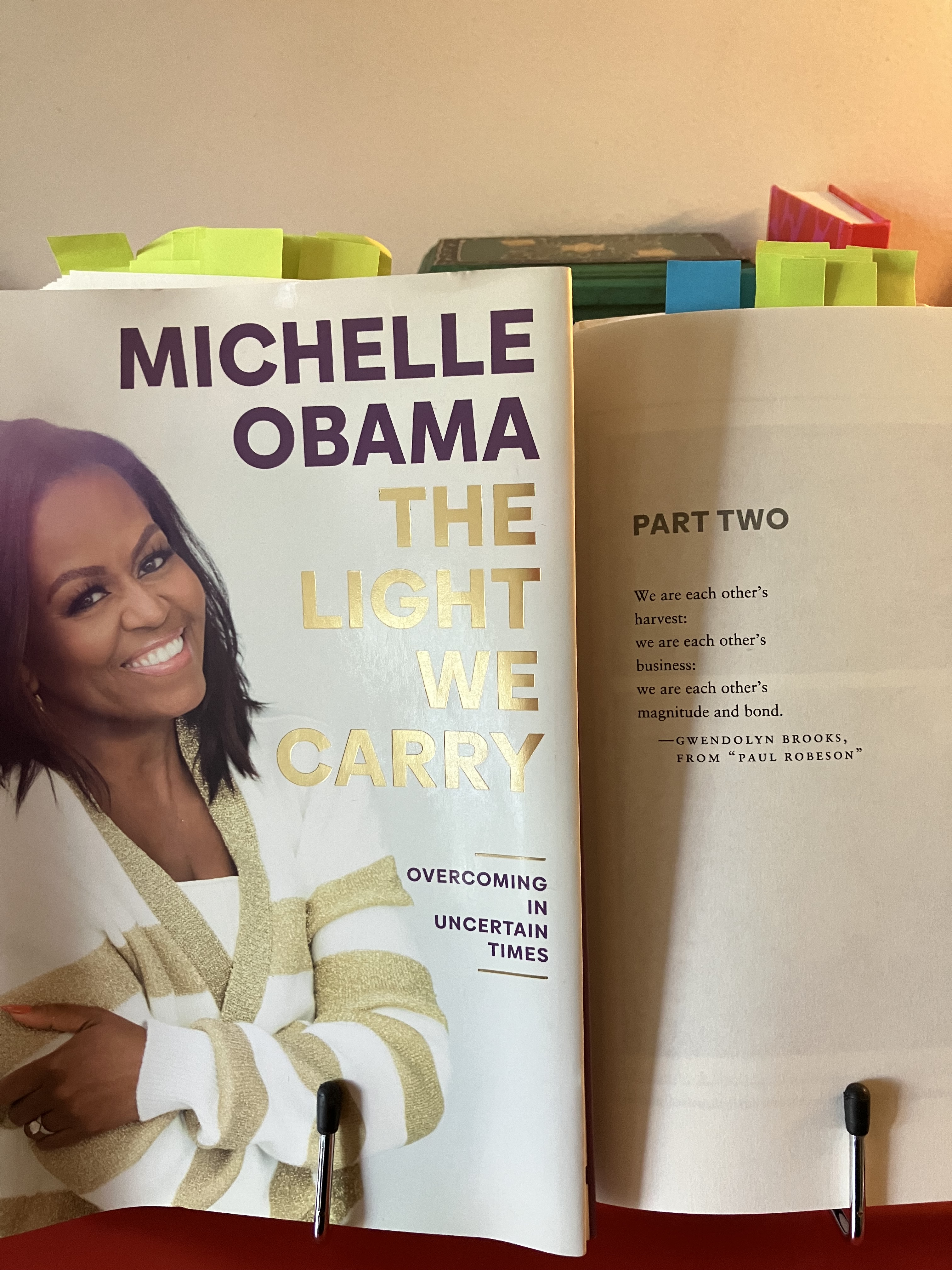
Last week I highlighted some of my favorite passages from part one of Michelle Obama’s The Light We Carry.

This week, it’s one sentence I want to highlight. One sentence I cannot stop thinking about.

“We only hurt ourselves when we hide our realness away.”

In many areas of my life, I am unapologetically real. I don’t color my hair. I allow my definitely-non-brown strands to commingle with my very-brown strands.

I don’t wear make-up. What you see is what you get.

If my purse ever matches my shoes, it was purely coincidental. I don’t have enough purses, or shoes for that matter, to make that particular accessory match happen on a regular basis.

I do, however, change my necklace and earrings each day, and do my best to match those with the top I’m wearing. 

I realize most people don’t wear nine rings on eight fingers. But I do. And I’m okay with not being like everyone else.

Aside from all that; however, I do hide my realness away. 

Often. 

And, if you’re chronically ill, a.k.a a “spoonie,” you probably do, too.

(If you missed it, you can click here to read my blog, “Trying to Figure Out This Spoonie Life.”)

Because when you’re chronically ill and experiencing chronic pain, you have learned to put on, what I call, your “game-face.” Living with a chronic illness is sometimes like being in a high-stakes poker game that doesn’t end. You can’t let on how bad the pain is. For a number of reasons you mask your pain so you look “fine.”

Sometimes I do that because I don’t want any more suggestions about medicinal cannabis or green smoothies or compression socks. 

Sometimes I wear my game face because it’s just easier. Showing my pain often makes those around me uncomfortable. And if I’m already feeling bad, I don’t need to add to the situation by making those around me feel bad, too. 

There are more reasons. But I’ll stop there, because it brings me back to Mrs. Obama’s statement:  “We only hurt ourselves when we hide our realness away.”

That’s the part I haven’t completely figured out. I’m certainly not trying to hurt myself. Yet I am very much trying to protect my near and dear ones. 

The work on myself continues.

Please note: I am including a link to buy the book that I’m highlighting this week. If you use my link, I do make a small commission on your purchase at no additional cost to you. I am working with Bookshop.org which also sends a portion of the profit to support local, independent bookstores.

The Light We Carry, Part One

I am currently reading Michelle Obama’s The Light We Carry: Overcoming In Uncertain Times. And let me say, I am about halfway through the book and have many pages flagged with sticky notes. 

So rather than have one super-long post, I decided to share some of my favorite passages one part at a time. (The book is split into three parts.)

(Last week I wrote about buying a wheelchair and referenced a little bit from Mrs. Obama’s book. If you missed last week’s post, you can read it here.)

This week, allow me to share some of my favorites from Part One:

“That’s what tools are for. They help keep us upright and balanced, better able to coexist with uncertainty. They help us deal with flux, to manage when life feels out of control.” 

“What does it mean to be comfortably afraid? For me, the idea is simple. It’s about learning to deal wisely with fear, finding a way to let your nerves guide you rather than stop you. It’s settling yourself in the presence of life’s inevitable zombies and monsters so that you may contend with them more rationally, and trusting your own assessment of what’s harmful and what’s not. When you live this way, you are neither fully comfortable nor fully afraid. You accept that there’s a middle zone and learn to operate inside of it, awake and aware, but not held back.”

“Our hurts become our fears. Our fears become our limits.”

“Because what my mother showed me is that if you try to keep your children from feeling fear, you’re essentially keeping them from feeling competence, too.”

“The unknown is where possibility glitters. If you don’t take the risk, if you don’t ride out a few jolts, you are taking away your opportunities to transform.”

“What [Toni] Morrison was doing for her kids is what my own parents did for me: She was giving them a simple message of enoughness. She was validating their light, that unique bit of brightness inside each of them — literally showing them it was there and it belonged to them, a power they could carry for themselves.”

“My father, whose shaky demeanor and foot-dragging limp sometimes caused people to stop and stare at him on the street, used to tell us, with a smile and a shrug, ‘No one can make you feel bad if you feel good about yourself.’ “

Please note: I am including a link to buy the book that I’m highlighting this week. If you use my link, I do make a small commission on your purchase at no additional cost to you. I am working with Bookshop.org which also sends a portion of the profit to support local, independent bookstores.

I Bought Something

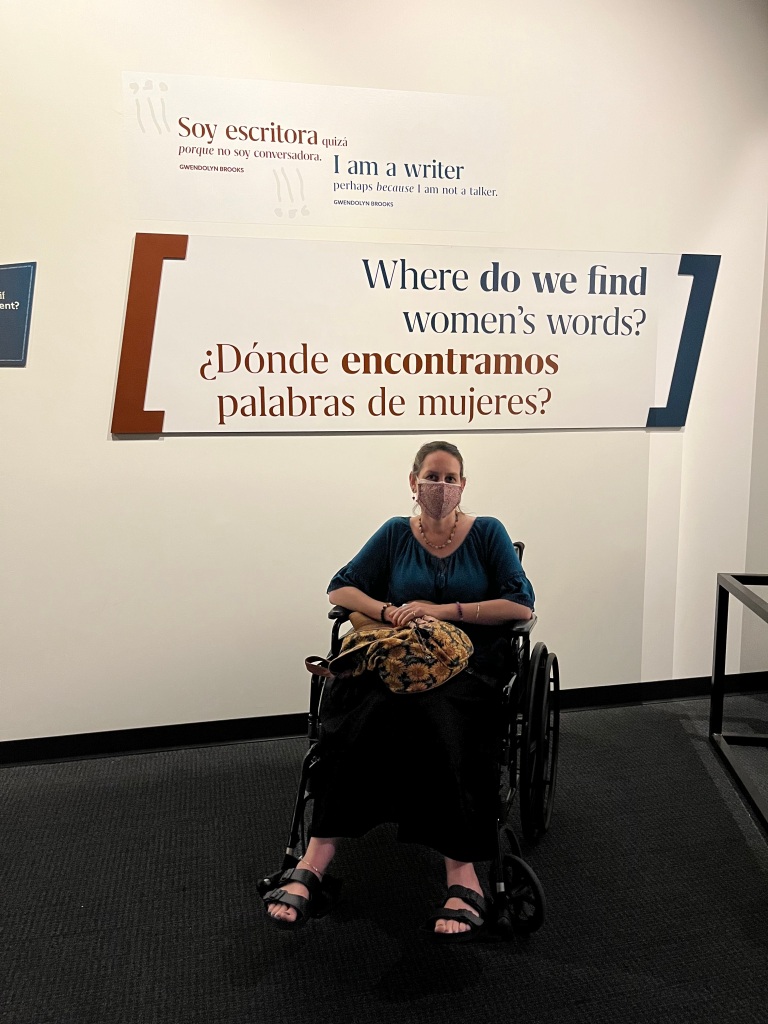
This picture was taken at the National Museum of American History during our summer trip to Washington, D.C .

I have some news to share.

But first, for readers who may not know, a little background.

When I first became ill in 2010, and diagnosed late in 2011, I was determined my autoimmune disease wouldn’t greatly impact my life. 

I didn’t know it then, but that really wasn’t my decision to make. My body was doing its own thing, which is how autoimmune diseases work. Your body attacks itself.

I retired from my twelve-year teaching career in 2013. It was a heartbreaking decision to make, but at the same time, I really didn’t feel I had a choice. My body was breaking down, and I was finding it harder and harder to keep my head above water between teaching elementary school, parenting my young son (he was two when I became ill), and trying to maintain my other roles as wife, daughter, and friend. 

Since that time, there have been ups and downs, or medically speaking, flares and periods of remission. 

But now I’m in a new place. My leg is weaker than it has ever been. Daily intense pain, though my body currently shows no signs of active inflammation.  

Which brings me to my news. 

I ordered a wheelchair. 

You may remember my blog post about my decision to rent a wheelchair for our summer trip to Washington, D.C. (If you missed it, you can read it here.)

Since then there have been other times when a wheelchair would have helped. Seeing Return of the Jedi in concert at the Hollywood Bowl. Taking a family walk. And there are other outings I have avoided, such as visiting The Huntington, simply because I didn’t think my legs were strong enough.

But, I’m scared. 

I don’t know if I am just stuck in a really long, really bad flare that will eventually ease up. I don’t know if better days are ahead once I can get past this rough patch.

Or, is this just the beginning? Am I headed to a reality that finds me increasingly dependent on a wheelchair and needing someone to push it, to push me.

No one knows. 

I’m trying not to let the purchase of a wheelchair make me sad. I’m trying to remind myself how helpful it was in D.C. How having a wheelchair allowed our family to see and do as much as we did. 

I’m trying to think of the wheelchair the same way Michelle Obama wrote about her dad’s cane in her book The Light We Carry: Overcoming in Uncertain Times.

“As we saw it in my family, that cane symbolized nothing. It was just a tool, the same way my mother’s spatula was a tool in the kitchen, or my grandfather’s hammer got used any time he came over to fix a broken shelf or curtain rod. It was utilitarian, protective, something to lean on when needed.” 

I’m trying. But it’s not easy.

Please note: I am including a link to buy the book that I’m highlighting this week. If you use my link, I do make a small commission on your purchase at no additional cost to you. I am working with Bookshop.org which also sends a portion of the profit to support local, independent bookstores.

Kissing Kosher

Here’s what you should know about Kissing Kosher by Jean Meltzer.

It’s a rom-com. A delightful rom-com.

But even more than that — the protagonist, Avital Cohen, happens to be a Jewish woman who lives with a chronic illness and chronic pain. And for that I applaud Ms. Meltzer. (I have written about Ms. Meltzer’s first two books in previous blog posts, which you can read here and here.)

While the rom-com was fun to read and provided me with a fantastic escape from real life, it was the very real, very relatable aspects of Avital’s chronic illness that I most resonated with. 

Here are just a few of the passages I marked with sticky notes:

“She got used to disappearing into the ceiling while doctors poked and prodded. That was the funny thing about chronic pain. It didn’t disconnect her from her body. Instead, it made every single second of her life about her body. She couldn’t escape the never-ending reminders of her pain if she tried.”

“Like many folks dealing with the onset of chronic illness, she had hope — this great and unfettered optimism — that she would one day wake up normal again if she could just find the right treatment.
“There was no cure. While some of the treatments helped, nothing completely eradicated the constant ache she lived with. There were bad days and better days, but rarely did she experience pain-free days.
“Despite all her best efforts to win the war against her own failing body — despite the fact that she was trying not to make her disease her identity — she kept getting worse. Some nights, the fear that accompanied the realization that nothing she did was working was more awful than the pain itself.”

“People always say, Don’t make your disease your identity. And you know what, Josh? I hate that statement. I think it’s the most ableist thing I’ve ever heard. The very definition of chronic is that it’s every day. It’s something I will have to negotiate, and manage, for the rest of my life. It touches everything.”

“But mainly, the most important thing I’ve realized is that if I’m going to be in pain the rest of my life, then it’s even more important that I hold on to my joy. I need to create the life that makes me happy. So that when the bad days come, because they will keep coming, Josh … they don’t hurt me as much.”

Please note: I am including a link to buy the book that I’m highlighting this week. If you use my link, I do make a small commission on your purchase at no additional cost to you. I am working with Bookshop.org which also sends a portion of the profit to support local, independent bookstores.
Everyone Has a Story

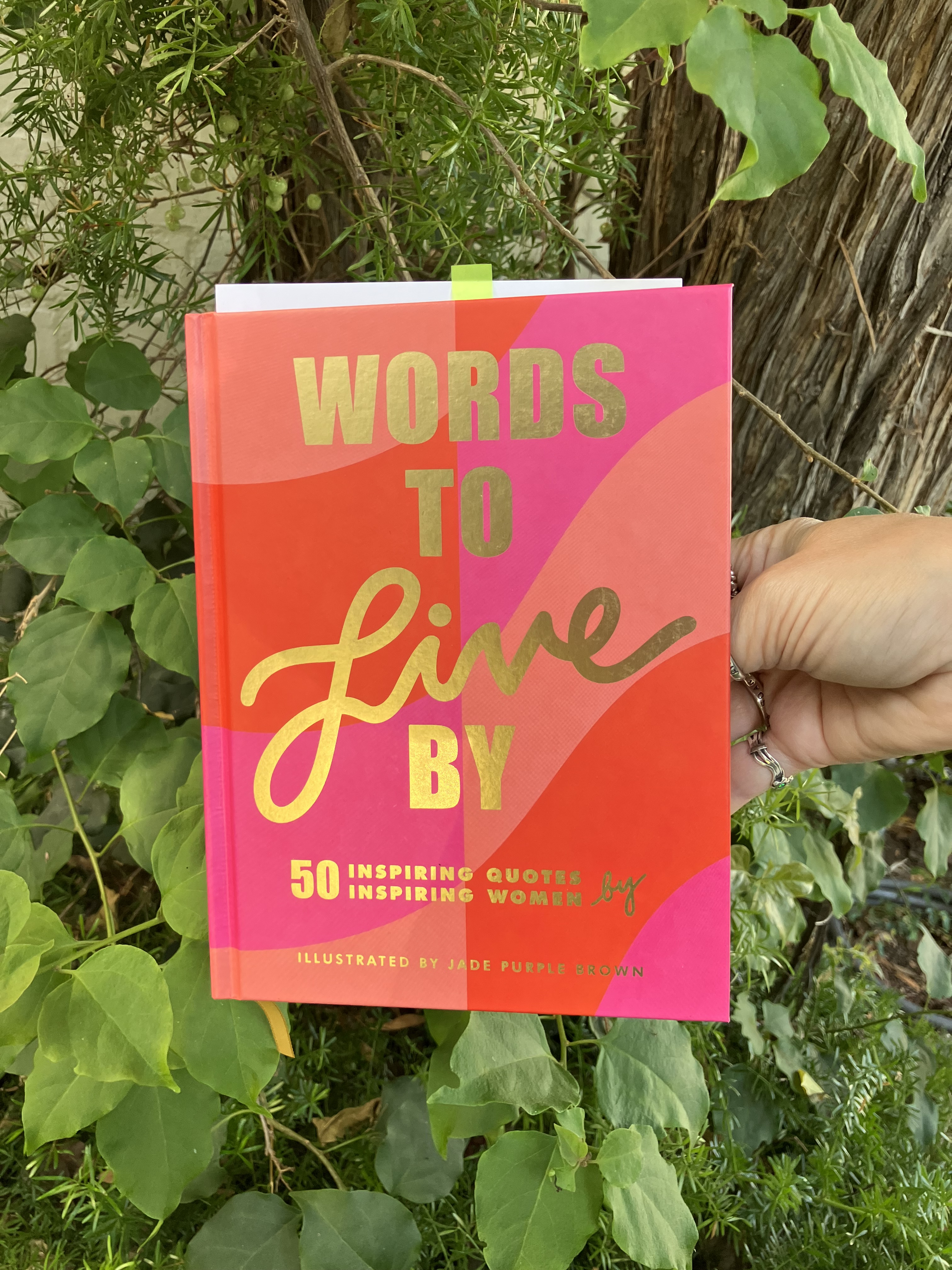
I am currently reading Words to Live By: 50 Inspiring Quotes by 50 Inspiring Women illustrated by Jade Purple Brown.

I bought this book back in July, on our last day in Washington, D.C. We had spent the morning exploring the National Portrait Gallery, and I found this book in the gift shop. (Truth be told, several books in the gift shop caught my eye. But I had to consider our limited luggage space.) 

I just started reading the book this past week. A few pages a day. Thought-provoking quotations accompanied by vibrant illustrations.  

This week I’d like to share a quote attributed to Frances Hodgson Burnett:

“Everything’s a story —

You are a story —

I am a story.”

I believe that everyone has a story to tell. It’s one of the reasons I read memoir. And it’s one of the reasons I’m writing a memoir. I can no longer teach in a classroom, but hopefully, I can continue to teach through my writing.

Question, dear readers:  Have you read any memoirs lately? Any recommendations?  

Please note: I am including a link to buy the book that I’m highlighting this week. If you use my link, I do make a small commission on your purchase at no additional cost to you. I am working with Bookshop.org which also sends a portion of the profit to support local, independent bookstores.

Trying to Figure Out This Spoonie Life

Lately, I have been thinking a lot about the term “spoonie.” 

The term “spoonie” comes from the Spoon Theory, both of which are familiar terms if you’re a member of the chronic illness community. Basically, the Spoon Theory is an analogy used to describe the amount of physical and mental energy a person has available each day. The theory was developed by Christine Miserandino. While out to lunch with a friend, Ms. Miserandino used the spoons on the table to explain to her friend what it’s like to live with a chronic illness, in her case lupus. Each spoon represents a finite amount of energy. Each day you may wake up with a different amount of spoons, yet there are still certain tasks that are expected to be completed on a regular basis — showering, getting dressed, preparing a meal. While a healthy person may begin the day with an unlimited amount of spoons and uses only one spoon at a time for the most basic tasks of the day, a spoonie may start the day with only five total spoons and has to make decisions about which tasks absolutely must be completed that day and which tasks can be skipped. Because when the spoons are gone, so too, is a person’s energy to do anything else. 

For a long time, I didn’t consider myself a spoonie simply because I didn’t have the option of paying attention to my lack of spoons. My son still needed to be picked up from school, library books needed to be returned, dinner needed to be prepared. 

Though I have spent more than a decade as a chronic illness patient, I still haven’t figured out when to push through and do something despite my pain and fatigue and when to pay attention to my body and acknowledge I just can’t do something.

It’s not easy navigating this life. Thankfully, I have help.  

Last week, I had a Zoom conversation with Sandra Postma, a Book and Spoonie Coach, offering “guidance for writers with a chronic or mental illness or disability.” This was our second session, and as with my first session, I left this session thinking about a couple of re-framing statements Sandra shared with me. 

This week, I’d like to share two of Sandra’s brilliant statements with you:

“I am not a burden, my illness is.”

“Alongside my illness I am ..”

I’m thinking a lot about these statements. Thinking about how I can use these statements to help me be more kind and gentle with myself. 

Maybe they will help you, too. 

(Just so you know – Sandra knows I’m sharing this information and has given her consent for this blog. You can learn more about Sandra and the work she does on her website.)

The Book of Delights

While I read The Book of Delights by Ross Gay, it occurred to me that I don’t often use the word “delight.” It seems unfortunate, especially since I am delighted on a regular basis — a tight hug from my son, a smile and a hand squeeze from my husband, the flickering candlelight creating shadows that dance on the walls, a hummingbird drinking from our bottlebrush tree right outside our dining room window.

From the beginning of the book’s preface:

One day last July, feeling delighted and compelled to both wonder about and share that delight, I decided that it might feel nice, even useful, to write a daily essay about something delightful. I remember laughing to myself for how obvious it was. I could call it something like The Book of Delights.”

From the end of the book’s preface:

“It didn’t take me long to learn that the discipline or practice of writing these essays occasioned a kind of delight radar. Or maybe it was more like the development of a delight muscle. Something that implies that the more you study delight, the more delight there is to study.”

Here are just a few of the book’s delights I would like to share with you:

“…So today I’m recalling the utility, the need, of my own essayettes to emerge from such dailiness, and in that way to be a practice of witnessing one’s delight, of being in and with one’s delight, daily, which actually requires vigilance. It also requires faith that delight will be with you daily, that you needn’t hoard it. No scarcity of delight.”

“… when I saw the announcement on the church’s marquee (somehow I think marquee is the wrong word) FORBIDDEN FRUIT CREATES MANY JAMS, I did not for even half a second consider jam meaning problem, jam meaning blockage, jam meaning trouble (nor did I immediately consider jam meaning party or celebration). I thought they were having a jam sale fundraiser. Which, in retrospect, I’ve never seen, though it’s a good idea.”

“Books are lovely. I love books. And libraries are among my favorite places on Earth, especially the tiny hand-built take-one-leave-ones like book birdhouses popping up in the last five or ten years. That’s a delight.”

My dear readers, what delights have you recently experienced or witnessed? Please share!

Please note: I am including a link to buy the book that I’m highlighting this week. If you use my link, I do make a small commission on your purchase at no additional cost to you. I am working with Bookshop.org which also sends a portion of the profit to support local, independent bookstores.
Be the Gateway

Over the years, my writing goals have changed. At first, I just wanted to write. Back in elementary school I wrote short stories with girls named Jill and Amy. Names that weren’t also shared with a character in Peter Pan or a fast-food hamburger place.

A bit older, and I experimented with poetry and found myself trying to write poems about the moon, like a giant silver dollar so bright, up in the sky.

Then I moved on to nonfiction, writing pieces about things that happened to me. I discovered the personal essay before I learned its name, and since college, I have only written personal essays. 

Once I knew what I wanted to write, I wanted to be published which isn’t unique to me. Publication is a worthy goal, shared by many writers. 

However, I soon learned publication isn’t enough. I wanted my published personal essays to be read. I wanted to reach readers — to make them smile, or pause and reflect. To touch a reader with my words was, is, a gift. 

But that connection with a reader can only happen if I identify my intended audience, my ideal readers, and they have access to my writing.

Be the Gateway: A Practical Guide to Sharing Your Creative Work and Engaging an Audience by Dan Blank is exactly what it sounds like. A book whose purpose is to provide steps and suggestions for sharing your creative work and having a meaningful connection with your audience. 

Mr. Blank’s book isn’t just for writers. It’s for artists and creators of any kind who are looking to share their art and creations.

Mr. Blank and his company, We Grow Media, are all about human-centered marketing. I have taken a few of his webinars and found them to be quite helpful. 

I won’t go into the specifics, but I would like to share a few of the passages that spoke to me, passages that I think are broad and general enough to speak to many of my readers as well:

“Instead of framing the value of your work by how it performs in the market, you define it by how other people experience the world through your creative work — the stories and experiences you share, and the topics you talk about.”

“It is about understanding the connection between what you create, why you create it, and how it will engage others.”

“When you share your journey, you are building advocates in the process; those who aren’t just aware of what you are doing, but feel connected to it in a personal way.”

“So much of success is about sheer persistence, and believing in yourself and your work.”

“Tennis legend Arthur Ashe once said, ‘To achieve greatness, start where you are, use what you have, do what you can.’ “

Please note: I am including a link to buy the book that I’m highlighting this week. If you use my link, I do make a small commission on your purchase at no additional cost to you. I am working with Bookshop.org which also sends a portion of the profit to support local, independent bookstores.
My Current Reality Scares Me

During the last several months, I have come to a difficult-to-accept realization. Physically, I am not doing well. Honestly, this may be the worst I have felt for a considerable length of time, not counting the times immediately after a medical procedure (like my muscle biopsy). 

Last year, on our family trip to Maui, I reluctantly agreed to use a wheelchair in the airports. A good friend had advised me not to waste my legs walking through an airport and standing in line at security. She was absolutely right. But there was no question that I would walk, hike, and participate in everything my husband and son wanted to do — including parasailing and zip lining with my son.

This year, though, not only did I use a wheelchair in the airports, I also rented one to use during our summer trip to Washington, D.C

Since our July D.C. trip, there have been two other occasions when having a wheelchair would have made my life a lot easier. One was seeing Return of the Jedi in Concert at the Hollywood Bowl. The other was attending Back-to-School Night at my son’s high school. Both occasions were incredibly painful for me. Both occasions left no doubt that my legs can no longer do what, up until this point, they have been able to do.

A decade ago, I retired from teaching. And I think one of the reasons I have held on so tightly to all my other roles, all my I’ve-always-done-it, of-course-I’ll-still-do-it instances is because I’m terrified of having to give up something else. I am so frightened that my physical disability is worsening and the invisibility aspect of it will soon no longer exist,  and there will be no doubt in someone’s mind if they see me park in a handicapped parking space that I do indeed need that spot. 

I don’t know if this is true. No one does. In October, I’m scheduled to begin treatment for my knee that may (or may not) help my overall left leg pain. 

Meanwhile, each day feels a bit like an endurance test. A test I’m scared I won’t pass.