A Kids Book About Chronic Illness

Do you ever come across a book only to think, I wish I had found this when …

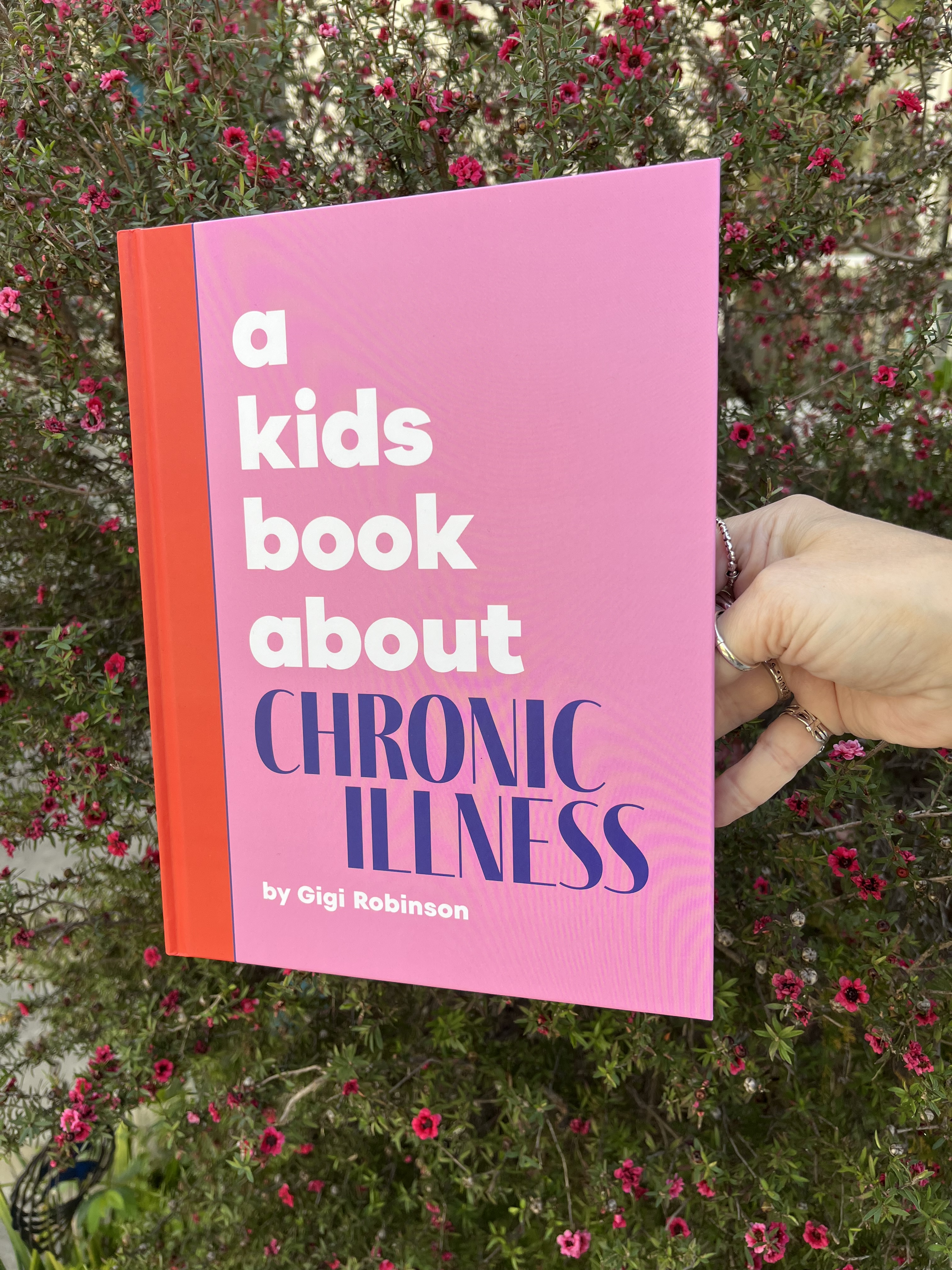
That’s how I felt when I happened to discover A Kids Book About Chronic Illness by Gigi Robinson.

Ms. Robinson’s book is definitely one I would have read with my son when he was a little guy. A book that may have helped him understand his Mommy’s invisible illness and the boo-boos inside my leg. 

The book is written for children, and features a relatively large font, easy-to-understand vocabulary, and definitions for a few words (including “symptom” and  “advocate” that may be new or unfamiliar to young readers). And, as stated on the author’s website: “This book teaches kids how to speak up, build confidence, and embrace their journey with chronic illness.”
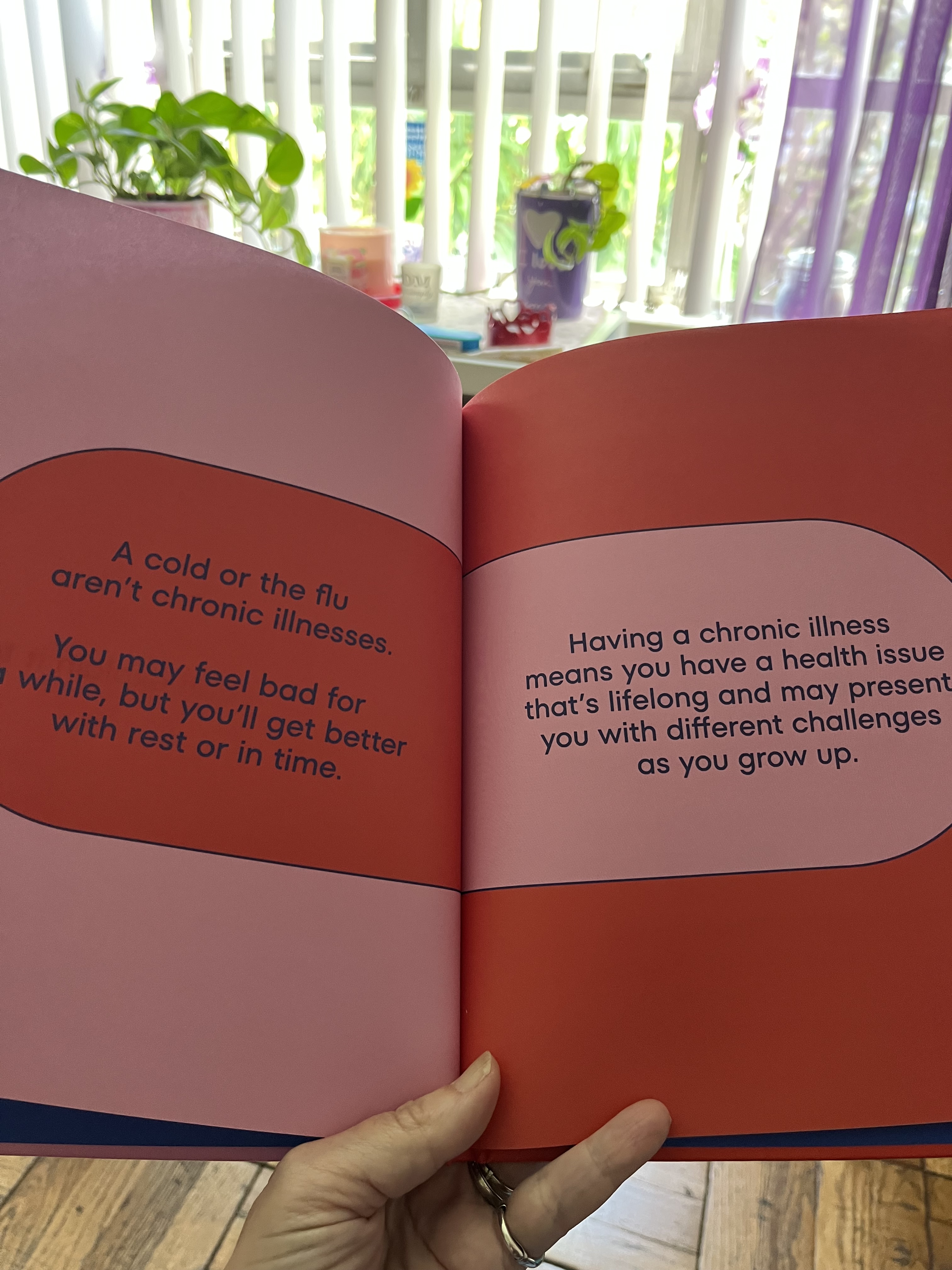
The book has a positive tone, is written in an easy-to-understand format, and manages to take a complex, could-be-scary-and-overwhelming topic like chronic illness and make it relatable by including the author’s own experiences with chronic illness. 

“You have the power to choose how you respond to the things you go through.”

“Your chronic illness is a part of you, and it’s one you may always have.
“But it’s not the only thing about you.”

And with all that, the book doesn’t shy away from the truth: 

“Living with a chronic illness means how you feel can change day by day, both physically and emotionally.” 

“I had no control over what my body did, and I felt mad and frustrated (and I still do).”

I love this message which shows up near the end of the book:

“But I’ve learned… Something invisible can become more visible the more you talk about it.”

The book description says the target age is 5-9, but I’m a big believer that books don’t need to have age limits. For my spoonie friends, I highly recommend sharing this book with young ones in your life. For my teacher friends, this book should be a part of every classroom, and school, library because even if you don’t have a student living with chronic illness, chances are you do have a student who knows someone/lives with someone/is related to someone who does have a chronic illness.

Please note: I am including a link to buy the book that I’m highlighting this week. If you use my link, I do make a small commission on your purchase at no additional cost to you. I am working with Bookshop.org which also sends a portion of the profit to support local, independent bookstores.
Books for Spoonies

March is Autoimmune Awareness Month.

Though the truth is, when you live with autoimmune disease (or multiple – as tends to happen), every month feels like Autoimmune Disease Awareness Month.

In my experience, I have found that the sadness, the frustration, the worry don’t get any easier the longer you live with a chronic illness. 

But, in my life there are two things that do help:

1. Connecting with others who “get it.” Whether it’s in-person or over Zoom, these relationships are essential in navigating a life with chronic illness. 

2. Books.

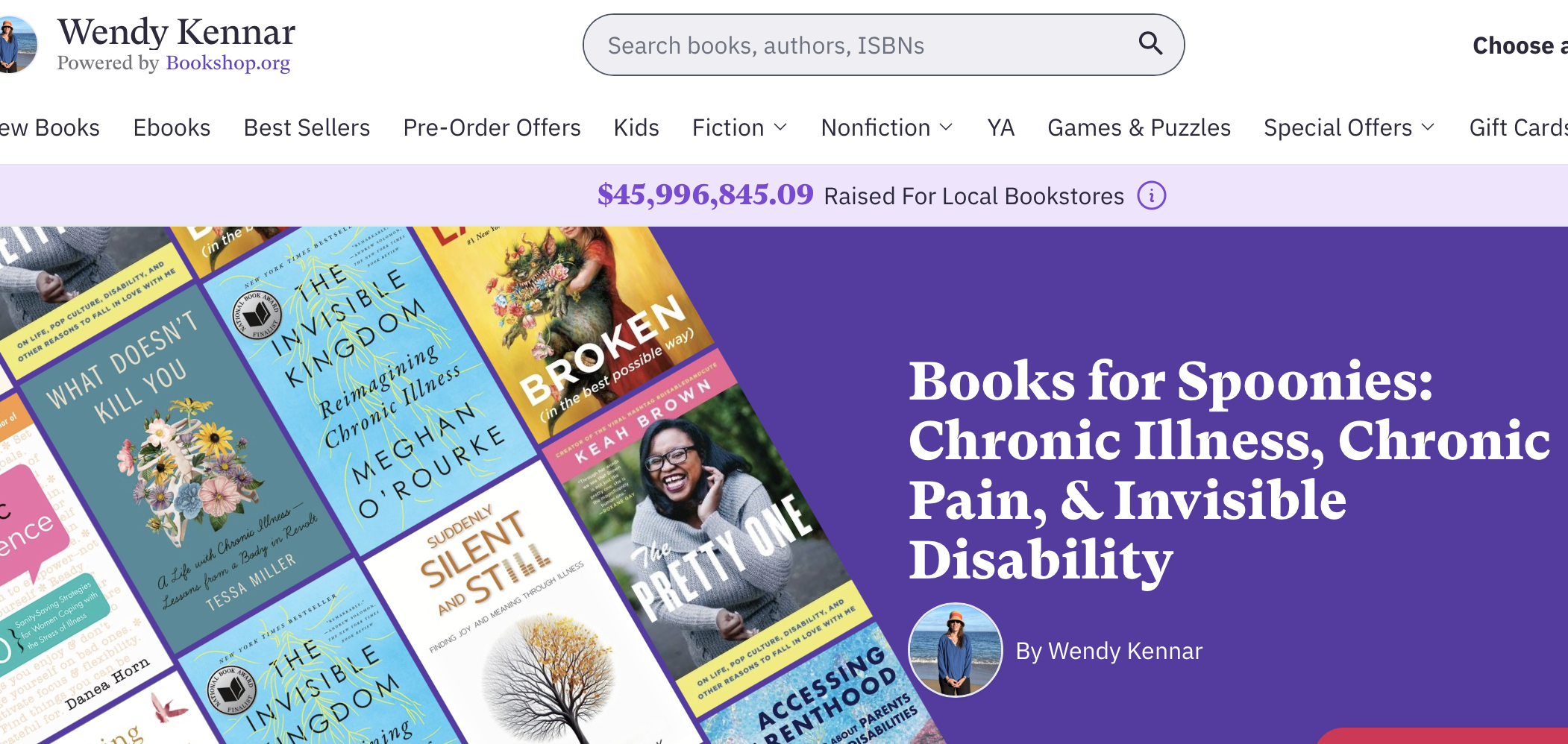
Along those lines, I’m excited to share I have curated a special booklist on Bookshop.org titled, “Books for Spoonies: Chronic Illness, Chronic Pain, & Invisible Disability.” These are all books I own. Books that have provided me with comfort and knowledge. Books that have made me feel seen and understood. 

If you’re looking to add any of these books to your own personal library, now is a good time to do it. Bookshop.org is offering 15% OFF* these select titles when you enter BSO15 at checkout, valid until April 1, 2026. *Discount off list prices, and excludes Ebooks. 

I don’t have a magic wand to ease the pain, to gift you a restful night’s sleep, or to lessen the persistent symptoms. But know that I’m here, thinking of you, thinking of us. We’re in this together. 

And, please let me know if I have missed any titles you think should be on my Books for Spoonies List. (Also, full disclosure, my writing does appear in two of these books — Accessing Parenthood: Stories By and About Parents with Disabilities and The Things We Don’t Say: An Anthology of Chronic Illness Truths.)

Please note: Just a reminder that if you do use my link to purchase any of these books, I do make a small commission on your purchase at no additional cost to you. And, for every commission I earn, Bookshop.org will match it and donate it to their indie bookstore pool. 


It’s a Pain

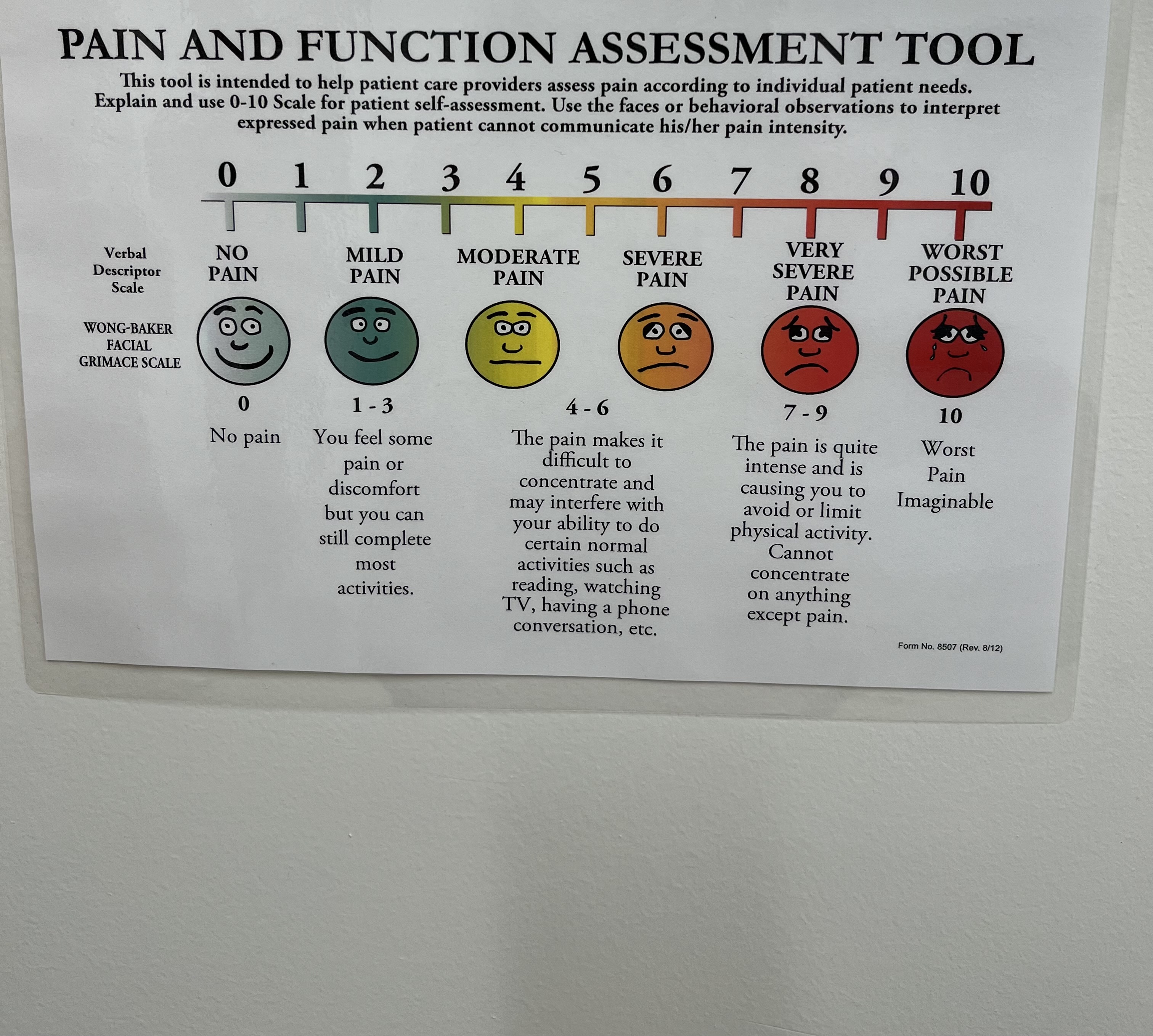
The nurse called my name and walked with me from the waiting room to the exam room. In the exam room, she had me step on the scale, and she checked my temperature and blood pressure. And while she stood at the computer, inputing the numbers, she asked me what my pain was like today.

This was about 9:30 am Tuesday morning. My pain was bad. But, the day before had been worse. After waking up to my 6:00 am alarm, I had made the bed, brushed my teeth and washed my face, gotten dressed, and come downstairs. Moving around I felt stiff. Standing up brushing my teeth, I put my weight on my right leg and foot. My left side felt weak, like it might give out. I knew it would be hard to walk down the flight of stairs to our living room and kitchen. I hadn’t expected to be crying before I reached the final step. 

Tuesday morning, appointment morning, there were no tears. Grimaces. Limps. Slow, laborious movements. But no tears. So technically I guess the pain was better, but it was still friggin awful. 

“It’s a hard question to answer when you live with chronic pain,” I told her. 

She didn’t look up.

I tried waiting her out. 

She wanted a number. I finally told her 7.

Was it a 7? I don’t know. I know my left leg felt pressure, as if something heavy was placed on my lap. My left calf felt tight, like it was stuck in almost-muscle cramp. I know getting in and out of my car wasn’t all quick, graceful moments but more like slow, intentional movements. 

When I met with the doctor, we reviewed all my medication, pain-related and otherwise. He told me the goal is to get me functional, so I don’t let the pain stop me from doing things in my life. 

Um, hello? 

What?

“To get me functional?” 

“So pain doesn’t stop me?” Most people who know me know that isn’t the case. 

Perhaps my favorite question was, “when did the pain start?”

I told him the truth. “2010.”

And, as if all that wasn’t bad enough, the doctor asked me his own pain-rating question. Except he didn’t want to know my current pain. Instead he asked, “What would you say was the average for the pain you experienced last week?”

A whole week? I have no idea, and that’s what I told him. My pain fluctuates. Pain can start off feeling incredibly intense and gradually ease up as the day goes on. And the flip side of that is also true — pain can be moderate and then, while doing one of my physical therapy exercises at home for example, something gets triggered and I need an ice pack on my knee, and I’m feeling much worse than I was.

Most frustrating was that my appointment was with a pain management group. These are healthcare providers who work with patients who live with chronic pain. And they should know that if you suffer from chronic pain, you’re looking at that pain scale very differently than someone who is dealing with acute pain. 

Acute pain is temporary. It’s pain that is caused by the result of something specific — an accident or injury of some kind, like falling down or getting hurt while playing a sport. But the key word is temporary. Acute pain won’t last. It will impact your daily life, but not forever.

Chronic pain, however, is long-lasting and difficult to treat. What works for one person might not work for another. And what worked for me three years ago may not work for me now.  

The doctor told me that no pain medication is going to make the pain go away completely. But the goal is for the pain medication to make a significant difference in my life so that my pain doesn’t stop me from doing what I want and/or need to do. 

“We don’t want your pain to stop you from being functional,” the doctor said.

I looked at the doctor in dismay. Shock. Disgust. Impatience. Probably a combination of all of those. 

I told him what I have told other doctors — I think when you live with pain for a long time, you get good at pushing through. You have to learn to live with the pain, alongside the pain, if you’re planning on living your life as fully as you can. 

The truth is no one can really know what my pain feels like. We each experience pain in our own way. However, I am convinced that those of us living with chronic pain, exercise a specific set of muscles. My pain level 6 would be someone else’s level 9. 

Those of us living with chronic pain have more than enough to deal with. I think we deserve a great deal of respect for all we do, including going in to see a doctor. That by itself is a big deal. 

And if I could ask healthcare providers for one change:

Please oh please, stop making patients use an emoji-like pain scale to describe our pain. 

It’s Hard Work

Each afternoon, I park the car near my son's high school and go for a walk in the neighborhood, before the dismissal bell rings. I usually walk for about ten minutes.

Last week was a “hard” week. 

I added quotation marks because I’m not certain that hard is the most accurate word to use to describe last week’s experiences. 

Let me tell you about it:

On Monday, I went in for my three-month follow-up with my rheumatologist. These appointments are rather brief, mainly because my doctor feels like things are “under control.” My current medication is “working” in that my inflammation levels have stayed more-or-less steady for the last year or two. (Again, the quotation marks because working doesn’t exactly represent my daily experiences.) From the doctor’s perspective, everything is going well. 

But it’s not.

Before he hurried out my exam room and into the room next door, I told Dr. P that I understand my labs look good in his eyes. But, I told him, I feel awful. Every. Single. Day. “So even though it looks like I’m doing great, I’m not,” I told him. 

He nodded. He told me all he can do is go by the numbers.    

On Tuesday, I had an appointment with my physical therapist, C. I haven’t been to physical therapy in over a month, because C had been on vacation for a while. However, I have been consistently doing my PT homework — daily walk(s), using my pedal machine twice a day, and working through my stretches/exercises every other day. 

C and I chatted while I used the armless-elliptical machine. He asked about my walking — the distance covered, the amount of time it takes. And I told him that my son told me it looks like I’m limping more than I ever have before. We talked about my treatment plan for the next few months. 

Because the reality is I am not an “easy” patient. (Again, easy may not be the right word.)

Doctors, in my experience, tend to focus on the labels — the diagnosis, the medication, the numbers. So my rheumatologist reviews labs and on his end, things are going well. Yet, each time I see him, I try to explain just how hard things have gotten. He knows I own a wheelchair. He knows how hard grocery shopping has become. He knows I wake up, every morning, already in pain. 

Likewise, as great as C is — I have worked with several physical therapists over the years and have never worked with anyone like C before! — I’m not the type of patient he is used to working with. I don’t have an injury that twelve weeks of physical therapy will help heal, for example. I don’t always experience pain in the same spot or in the same way. Some days are better than others. And perhaps most “challenging” is the reality —I will not get better.

Over the years, I have observed doctors and physical therapists become “frustrated” with me — through no fault of my own. The fact is I don’t have an easy-to-understand or easy-to-treat diagnosis. I don’t have a chronic illness that has a well-established prognosis. 

I get it. But that’s all out of my control. 

The goal, as I have told both Dr. P and C, is to work on strengthening my left leg and to maintain that strength as much as I can. Because ultimately I am trying to remain as mobile and independent as I can, for as long as I can.

It isn’t easy. 

But I’m working hard at it.

Sharing

Many people live with invisible illness(es). Many people look "fine" on the outside.

Last week, an acquaintance asked me about my chronic illness. We had recently started following each other on Instagram, and a few days after she started liking my posts, we bumped into each other in person. 

(Side note – You do follow me on Instagram. Right? I hope you do!
@wendykennar
You follow me, and then I will follow you back. Let’s support each other!)

Back to last week. 

J told me she had seen some of my posts. 

“You talk about pain, but what is it? What do you have?” she asked.

“It’s an autoimmune disease,” I began.

“Which one?” she asked. 

So I told J about my UCTD (Undifferentiated Connective Tissue Disease). I told her some days, and some parts of days, are much worse than others. I told her it was difficult to diagnose. 

“And that makes it hard to treat,” she said.

I looked at her. “Exactly,” I said.

“My sister has chronic fatigue syndrome,” J told me. 

“Oh my goodness, that’s awful,” I said. And it is. (If you don’t know about CFS, you can click here to read an article from the Mayo Clinic.)

“When my sister is in a flare, she says her bones hurt,” J said.

“But I would have never known you had anything. I couldn’t tell,” she said.

“That’s the way it works, right? I’m sure it’s the same for your sister,” I said. “I’m sure most of the time no one would suspect she lives with a condition that sometimes makes it impossible to leave her bed.”

J seemed surprised when I told her I own a wheelchair and use it from time to time. She seemed shocked when I told her I first became ill when my now-almost-eighteen-year-old son was two years old. But how would she have known? I don’t just go up to people and start talking about my autoimmune disease. And as those of you living with invisible illnesses know too well, spoonies have a lot of practice looking “fine,” as we’re out in the world, doing our best to go about our days and live our lives the best we can. 

Now here’s the part I’m most proud of, I didn’t end the conversation there. Friends, I then did something I don’t ordinarily do. I shared something else, something super important to me.

“I’m actually writing a book about living with an invisible illness,” I told J.

J nodded. “To explain about your experience?” 

“Yes, and more than that, to help others see that you can’t always tell what someone is going through simply by looking at them. Being sick has taught me that everyone is dealing with something. Everyone lives with some sort of pain.”

It might not seem like a lot, but for me, that was a big step. I’m not great at self-promotion, of talking about myself, my writing, and my writing goals. But I’m trying to improve on that and get more comfortable talking and sharing about my writing. After all, my writing is a huge part of who I am and what I do. And the truth is I don’t just want to write. And I don’t just want to be published. I also, most definitely, want to be read.

How about you, friends? Do you find it difficult to talk with others about your creative work? How do you go about sharing your writing (or whatever it is that you create)?

Broken (in the best possible way)

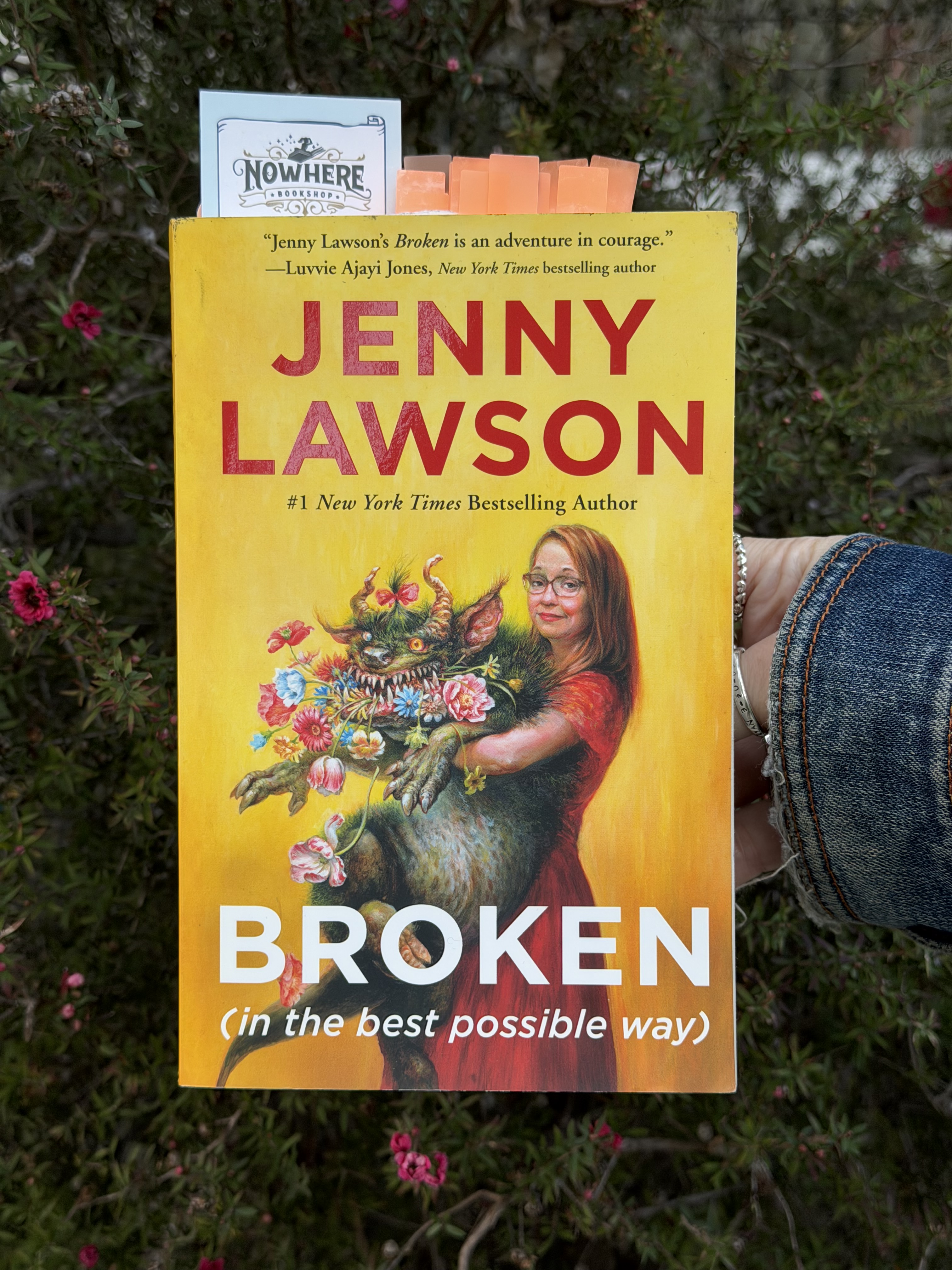
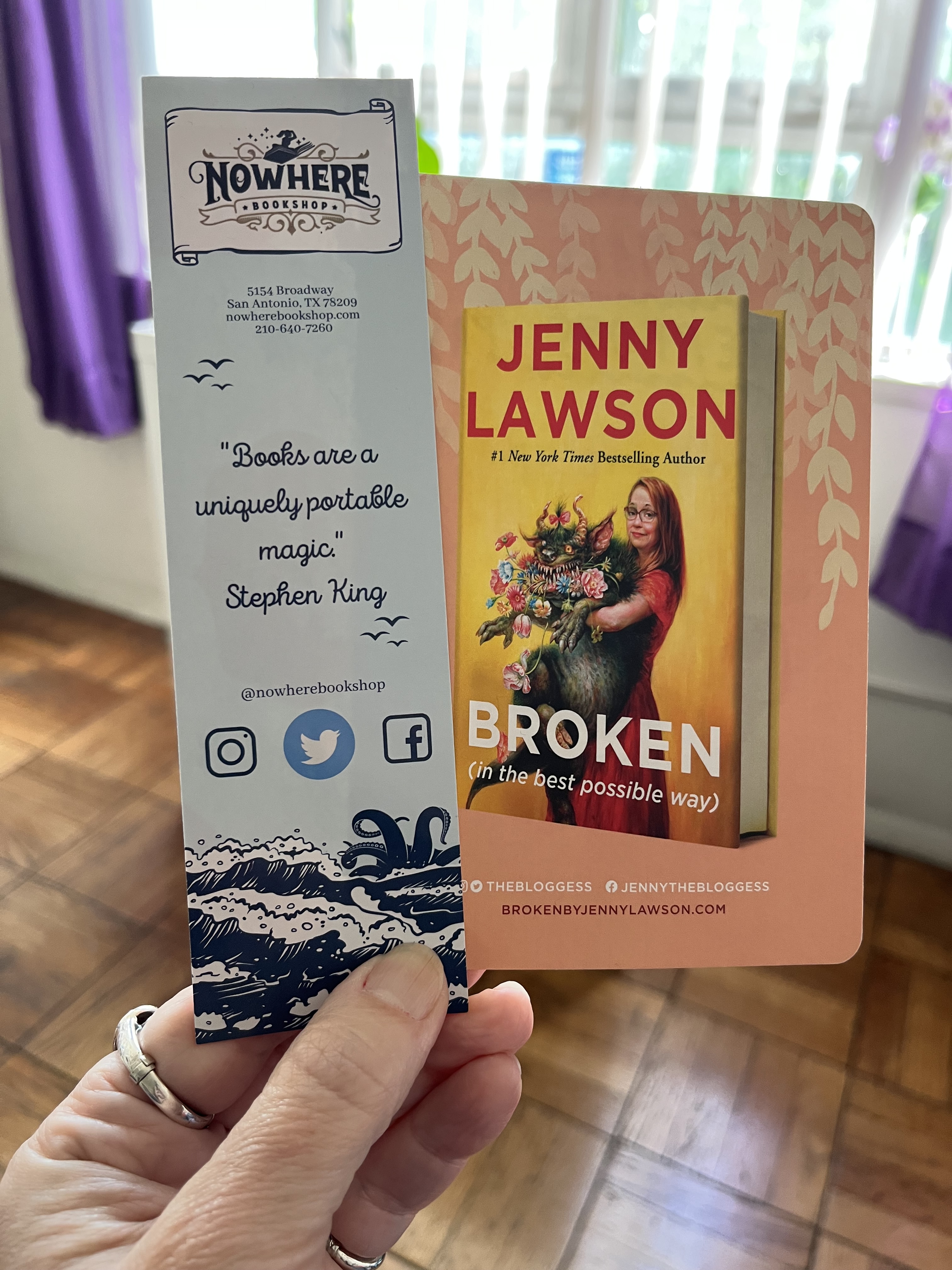
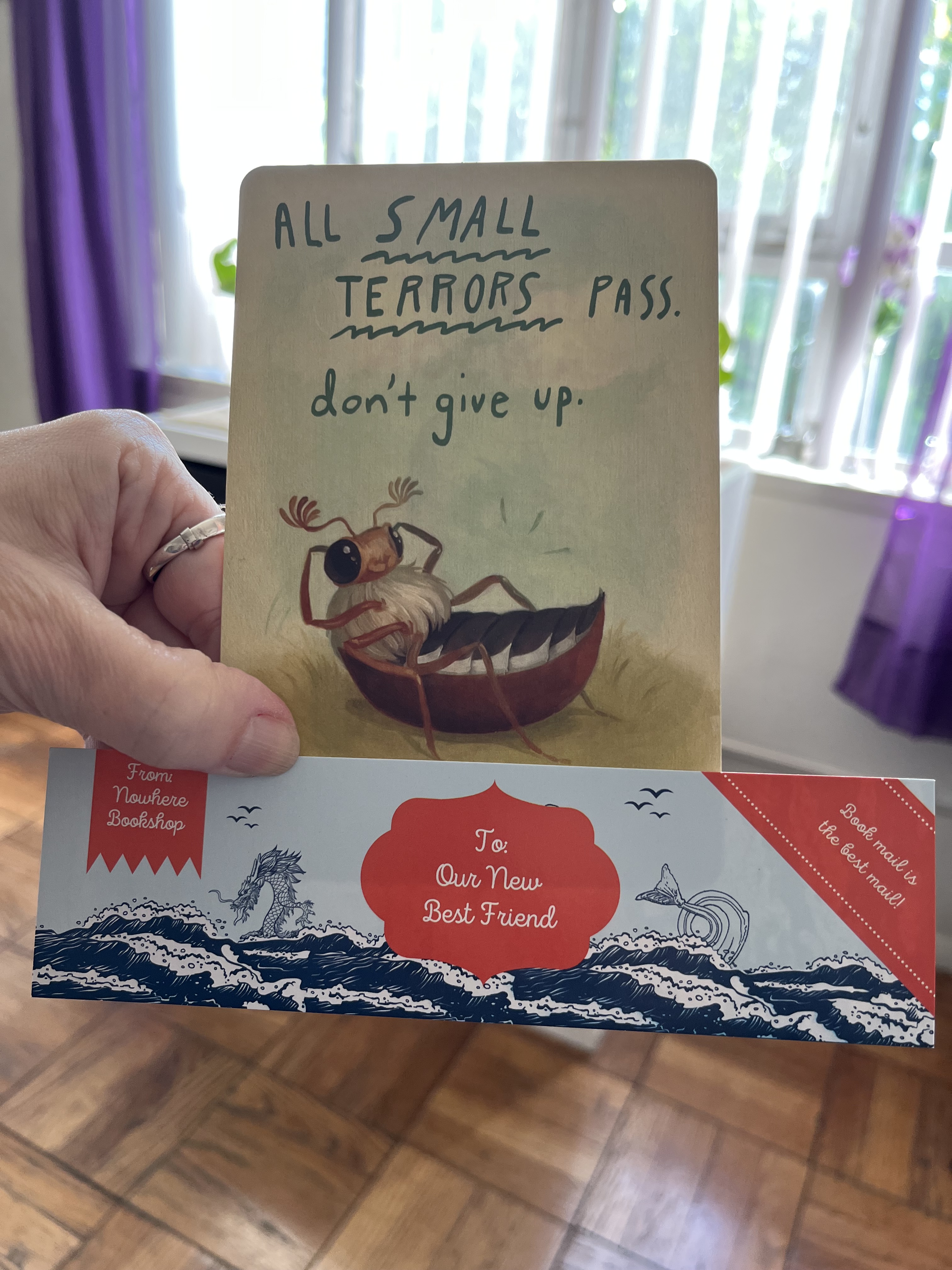
Jenny Lawson has been an author on my want-to-read list for a while now. I had seen, and remembered, her books — mainly because her covers are incredibly unique and absolutely do stand out and you can’t easily forget a cover that features a taxidermic roadkill raccoon. (That’s the cover of her nonfiction book, Furiously Happy.) I subscribe to Jenny’s blog, where she is known as “The Bloggess.” And, if I ever get to San Antonio, Texas I plan on visiting Nowhere Bookshop, the independent bookstore Ms. Lawson founded. 

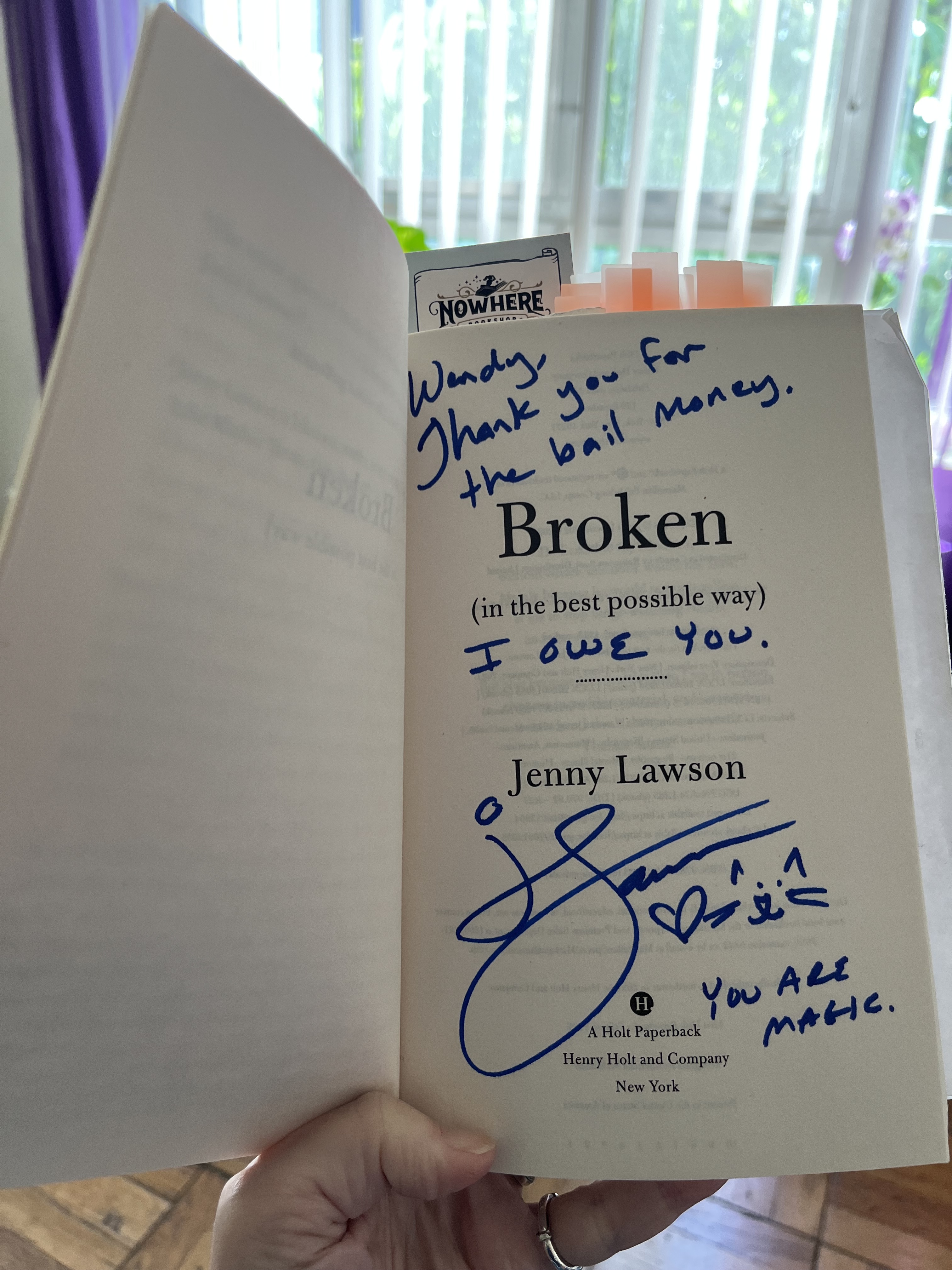
In fact, I purchased Broken (in the best possible way) near the end of 2024, complete with one of Ms. Lawson’s well-known personalized messages. A year later, I read the book and only have positive things to say (I mean, write) about it. 

From the back of the book: “In Broken, Jenny brings readers on her mental and physical health journey, offering heartbreaking and hilarious anecdotes along the way.” 

Not only did I place a sticky note on many pages of the book, I actually laughed out loud several times, too! (The chapter, “Six Times I’ve Lost My Shoes While Wearing Them: A List that Shouldn’t Exist,” is absolutely laugh-out-loud-funny!) 

This week, I share with you some of my favorite passages. (Keyword – some; I simply con’t include them all.)

“It’s weird because we often try to present our fake, shiny, happy selves to others and make sure we’re not wearing too-obvious pajamas at the grocery store, but really, who wants to see that level of fraud? No one. What we really want is to know we’re not alone in our terribleness. We want to appreciate the failure that makes us perfectly us and wonderfully relatable to every other person out there who is also pretending that they have their shit together and didn’t just eat that onion ring that fell on the floor. Human foibles are what make us us, and the art of mortification is what brings us all together.” 


“Be good. Be kind. Love each other. Fuck everything else. The only thing that matters is how you feel and how you’ve made others feel. And I feel okay (for the moment), and I make others feel okay by being a barometer of awkwardness and self-doubt.” 

“I try to look on the bright side. If I were still working in HR I’d have to be on disability now, but since I work from home I can adjust my schedule to my broken body and my mind. I can still afford the expensive medications and doctors’ bills and there are a lot of people who can’t. I’m lucky. I could be sicker. I could be dead.”

“But I’ll keep going. And I’ll keep fighting. And I’ll keep forgiving myself for being flawed and human, and if I can’t write a funny chapter I’ll write a chapter like this. One that might be a little pathetic, might not make sense to anyone but me, but is still true. Exactly like me.” 

I highly recommend the chapter, “These Truisms Leave Out a Lot of the Truth.” Ms. Lawson talks about those books “filled with small phrases and truisms that are supposed to be inspirational. And they were. In that I read them all and promptly added the parts that the authors had left out.” Ms. Lawson explains, “people tell you to ‘take the bull by the horns,’ but why? It’s a bull. Where are you taking it? And if you are going to take it somewhere I’m pretty sure you don’t drag it by the horns. The rule of bulls is avoid the horns. They aren’t bicycle handlebars.” 

Additionally, the chapter, “An Open Letter to My Health Insurance Company” is heartbreaking and honest and hilarious. This chapter needs to be given and read by every pharmacy. Every doctor. Every hospital. Every insurance company. Taken from the first paragraph: “It was a mistake to think that an insurance company claiming to want to help you in your sickest hours was anything other than a scam … after all, you are here to make money. And I am here to live. And it seems those things are sometimes mutually exclusive.”

“I don’t think I’m alone in this. I think many of us struggle with the thought that it’s okay to take care of ourselves, and it’s strange that it’s a struggle to treat ourselves as kindly as we treat the dog. The dog needs walks and healthy choices and water and play and sleep and naps and bacon and more naps. And love. I need that too. And so do you. It’s not just a gift we give to ourselves … it’s a duty.”

“… we are changed by life… it puts its teeth in us, it leaves its handprints and marks and scars on us. And as much as we try to ignore those things, in the end they make us who we are. For good or for bad, we are changed and touched and broken and mended and scarred. And those marks (inside and out) tell a story. They tell our story.” 

Also, the whole “Souls” chapter. Beautiful! That’s all I’m going to say. You really have to read it yourself.

And I’ll end this post with the sentences Ms. Lawson wrote to end her book: “Good night. Be safe. Be kind to each other. Be kind to yourself. And if no one else has said it yet, thank you for being you. You are magic. Never doubt it, my friend.”

Friends, have you read Broken? Or any of Jenny Lawson’s books? 

You can pre-order signed copies of Jenny’s new book How to Be Okay When Nothing Is Okay: Tips and Tricks That Kept Me Alive, Happy, and Creative in Spite of Myself from Nowhere Bookshop. The book publishes on March 31st, 2026.

Wishing you all a peaceful, joyful New Year! May it be filled with light, love, laughter, and books. And lots of reading time!

Please note: I am including a link to buy the book that I’m highlighting this week. If you use my link, I do make a small commission on your purchase at no additional cost to you. I am working with Bookshop.org which also sends a portion of the profit to support local, independent bookstores.
A Spoonie’s Guide to Self-Acceptance

I’ve written about being a “spoonie.” And the difficulty I had in referring to myself as a “spoonie.” (You can read more about it here.)

Whether or not I describe myself as a spoonie, certain facts remain:

– I live with a chronic illness causing chronic pain.

– I have limited amounts of energy each day.

– I cannot always rely on my body to do what I would like it to do.

– There is no denying all the ways illness has changed my life, and all these years later I still feel sad/angry/frustrated for all the “little” ways my daily life has been made harder since becoming chronically ill.

These feelings are not unique to me. Which is one of the reasons I wanted to read A Spoonie’s Guide to Self-Acceptance, a poetry chapbook written by Kelly Esparza. (Kelly serves as the Editor-in-Chief of FLARE Magazine, an online journal where my personal essay, “Am I a Spoonie?”, was published.)

Ms. Esparza’s collection is an honest, tender, thoughtful look at a spoonie’s life.

There were many times I read a poem and felt myself nodding in agreement. Because, unfortunately, Ms. Esparza “gets it.”

Here are just a few phrases that really made an impression on me:

“rashes snake up your legs,
a butterfly blush kisses your cheeks,” from “Blame It on the Sun”

“You get wheeled around in a wheelchair sometimes,
because you’re Fatigue’s next victim,
and you’re stuck in Inflammation’s sticky spider web of deceit”  from “Invisible Illness”

And the final poem in the collection may be my favorite. It’s titled, “Welcome to the Spoonie Club,” and includes these phrases:

“I’ve got a bouquet of spoonie problems,
but I’m not letting that stop me.”

And

“Knives cut where it hurts,
forks, are pitchforks for the hunted,
yet spoons scoop and uplift.”

One last thing, friends. Wishing you Merry, Happy Days. May you feel cozy and comfortable. And may you enjoy lots of reading time!

Surviving the Holiday Season with Invisible Illness

When this blog post publishes on Wednesday, December 17th, we will be a week away from Christmas Eve, a week and two days away from Kwanzaa, and at about the halfway point in terms of celebrating Chanukah. And I have a gift recommendation to share with you!

Author, coach, speaker, and friend, Sandra Postma, has written Surviving the Holiday Season with Invisible Illness. This e-book is under-60 pages, with large font and lots of white space. After purchase, you can access it on your phone or your computer monitor or print it out to have a physical copy nearby. All these options exist, all these thoughtful touches were put into place, because Sandra is herself a spoonie and she “gets it.” 

This book is a gift. 

A gift for someone living with an invisible illness. A gift that says, “I know. The holidays can be so tough. I’ve been there. Let’s see if I can help.”

A gift for someone living with an invisible illness to give to friends and families. A gift that says, “Here. Please read this. This is how I feel but didn’t know quite how to express.”

A gift for the friends and family of someone living with an invisible illness. A gift that says, “I wanted to learn more about how I can help you and support you during the holidays so I bought, and read, this book. This is what I learned. Now, let’s apply it.” 

Sandra has really thought of it all. Her book offers:

– Suggested scripts for when you have to decline an invitation (and a reminder that “you cannot control how others react, and saying no respectfully is a personal boundary; not a failure.”)

– Virtual pats-on-the-back for the work you’re doing living with a chronic illness and also trying to navigate the holidays, families, and different routines and activities in ways best suited for your individual situation

– Reminders to be gentle with ourselves. Our lives will look a lot different than others who are not chronically ill. 

– Encouragement in the truth we sometimes overlook. As Sandra writes, “Wherever you are in bed, on the sofa, or somewhere in between, there is one certainty in life and that is change.” Spoonies know that change isn’t always positive, but what if it is? “What if things will become amazing? I want to be here to see it.”

– Planning pages to help you intentionally create your own Survival Kit, so it will be ready when you need it

– Collection of Affirmations, when you just need a little burst of a pep talk

– A change in perspective. Sometimes it’s so easy to just keep going, telling ourselves the same thing over and over, behaving in the same way. Sometimes it really does take someone else to shine a light and help us see things differently. I keep returning to these statements: “We don’t always have to fix a negative emotion, distract ourselves from it or turn it around. We feel stuff for a reason and it doesn’t appear so we can then push it back down.” 

Thank you, Sandra, for taking the time and energy to put this e-book out into the world.

Will You Join Me, Please?

Hi Friends,

I don’t one-hundred percent know what I’m doing in terms of my writing career. (To be honest, I never dreamed I would even have a “writing career.”) I do know that I’m always learning, I’m always trying to improve — in terms of my writing craft, the way in which I share my writing, and the ways I connect with readers and other writers.

I have written a weekly blog for over a decade. In those very early years, before I invested in my website (www.wendykennar.com), each week’s post was written about any and all subjects. Anything I felt like writing and sharing I did. It was random, and because of the lack of cohesiveness, I think it was harder to find readers who would subscribe and regularly read my posts. It was much more difficult to form a community back then. 

Then, I re-organized my blog and wrote about one of three B’s in my life — Books (because writers are also readers), Boys (I’m the mother of a son and a former elementary school teacher), and Bodies (I live with an invisible disability). 

I have since deleted the “Boys” section, because my son is almost an adult. I don’t write about him and our interactions and relationship in the same way. Plus, I haven’t been a teacher now for twelve years. 

And, in another move that is also related to learning and growing, I have started a Substack account. Some of my blog subscribers have signed up for my Substack, currently known as “Wendy’s Weekly Words.” (wendykennar.substack.com) But for the most part, my Substack subscribers and my blog subscribers function as two distinct groups. 

I would like to change that. Here’s how:

I will continue posting my weekly blog here at www.wendykennar.com . My blog posts will generally be focused on books and bodies. Each week, I’ll continue writing about something I have read or my experiences with a chronic illness, life with chronic pain, and/or living with an invisible disability. 

And, I will be writing a bi-weekly Substack (wendykennar.substack.com), which will not just be a copy of what I have up on my blog. (Which is the way my relatively young Substack has been used up to this point.) 

My bi-weekly Substack will now include:

–  links to my recent blog posts in case you missed them 

– a writing prompt

– a wondering (something I’m confused about or have questions about. Maybe you have the answers.)

– a recommendation (something I read or watched or listened to)

– and when I can, a couple of famous dates in history that are somehow relevant to my writing and what I share. 

That’s what I’m planning to do. 

Here’s what I’m asking of you, please:

If you haven’t already done so, please subscribe to both my Substack (wendykennar.substack.com) and Blog (www.wendykennar.com). If you already are subscribed at both places, please just let me know in the comments section on one of my sites. (It would be great if you also followed me on Instagram @wendykennar. That way you’re sure not to miss out on anything I write or share.)

Those of you who subscribe to both my Substack and Blog, will then have a chance to win a book in a drawing. Names will be placed into a hat and I will randomly draw one reader’s name. As a thank you, I will mail you a personalized copy of Chicken Soup For the Soul: It’s Beginning to Look a Lot like Christmas. (My story, “A Timeless Gift,” is included in this collection.)

October 2019

This is all new to me. I’ve never done anything like this before. Maybe I’ll need to make some changes down the road. But for now, we’re going to give this a try. I hope you will continue being with me on this journey. Living with a chronic illness and writing can both be pretty isolating. I hope you know how much I value your support, how much your being here with me really does help!

Sign up by next week’s blog post on Wednesday, December 17th. That way I can have the drawing on Thursday, December 18th, and I can get your book out in the mail on Friday, December 19th. 

After that you can expect regular blog posts each Wednesday morning. 

And the first issue of my bi-weekly Substack will go out on Sunday, December 28th. (And the next Substack will be in your inbox on Sunday, January 11th, 2026.)

Thank you, friends. Thank you for reading. Thank you for supporting my writing. Thank you for supporting me.

Publication News!

“Mother, wife, daughter, friend. My most important roles. My most meaningful roles. And fifteen years ago, I added ‘spoonie’ to the list when I removed ‘teacher.’ It is a role I didn’t choose, a role I still don’t want, but one that is with me always, lurking like a shadow. Sometimes the spoonie version of me feels larger than all the other parts of my identity, overriding all other aspects of my life, screaming for attention, and unwilling to settle into the background. Sometimes the spoonie me is behind me or next to me, living alongside all my other roles, allowing me to live my life alongside my chronic illness. Rarely the spoonie shadow is not visible at all, and I am gifted precious reminders of the me that used to be — pain-free, illness-free, and free to do what I want, secure in the knowledge that my body would behave as I expected it to.”

The paragraph above is an excerpt from my recently published personal essay, “Attempting to Soar as a Spoonie.”

I’m pleased to share my essay was selected for publication in Issue 17 of Please See Me. The Issue’s theme is “Free,” and the prompts included:

– What does it mean to you to be truly Free – to live your best life no matter your health, life, or caregiving challenges? 

– What does it look like for you when you do not feel free?

The prompts allowed me to write an entirely new piece and include images and feelings I don’t think I’ve shared anywhere else in quite this way. I hope you’ll read it (by clicking here), and while you’re on the website, be sure to check out the other published pieces, including fiction, nonfiction, and poetry.