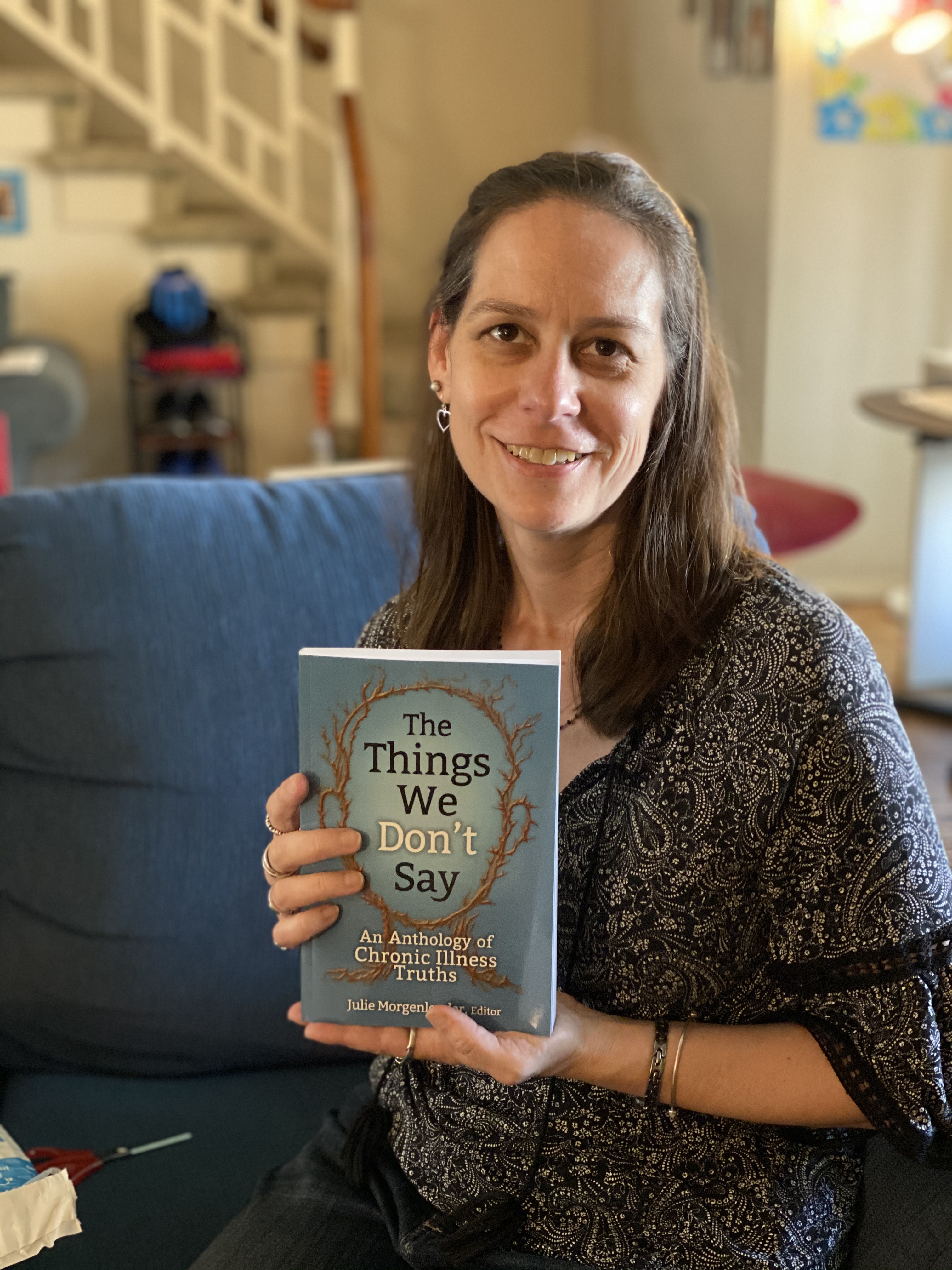
Over the years, more and more of my writing has described different aspects of my life with a chronic illness.
Writing about it is different than talking about it.
But that’s what I recently did.
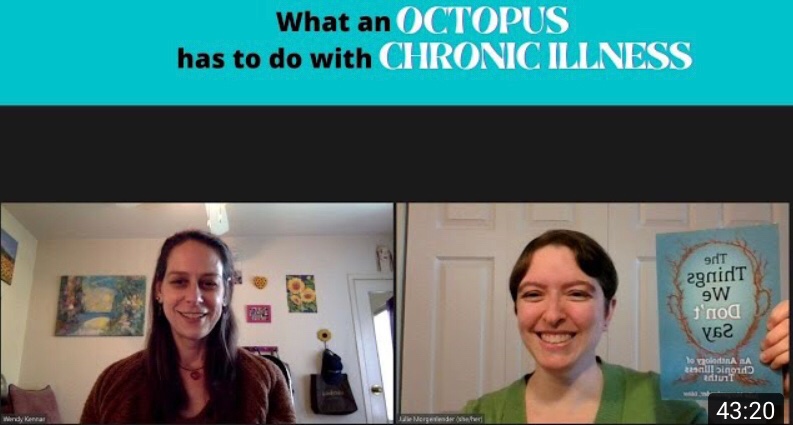
Julie Morgenlender, editor of The Things We Don’t Say: An Anthology of Chronic Illness Truths, recently spoke with me about my experience living with a chronic illness. Among other things, we talked about invisible disabilities and illnesses, ableism, diagnoses, and octopuses!
You can watch the video on YouTube by clicking here.
It began with a writing prompt. Then some notes. Then several drafts. And resulted in a completed essay published on The Mighty.
“ ‘My leg kinda hurts, but it’s okay.’
That’s my standard answer when I’m asked how I’m feeling. I hesitate to say more. I don’t want to tell them (my husband, my son, my parents) how bad my pain is, simply because there’s nothing any of them can do to ease my pain.”
You just read the beginning of my recently published essay “What I Really Mean When I Say ‘My Leg Kinda Hurts’.”
The reality is more complicated than that.
Click here to be re-directed to The Mighty to read my essay in its entirety.
It’s definitely not a doctor’s office or exam room. Still, doctors can learn a lot from teachers.
I first became ill ten years ago.
In that time I’ve seen a lot of doctors.
I don’t look forward to these appointments. Especially when I’m seeing someone new.
I dread having to explain and describe my symptoms and my pain to yet another doctor. I’m tired of re-hashing my story, my medical history. I’m tired of trying to explain to someone what my days and nights are like.
And after all that, I’m tired of the non-answers, the uncertainty and confusion that my particular medical condition seems to present.
It’s been my experience that doctors could learn a thing or two (or eight) from teachers. A parent/teacher conference does, in fact, share similarities to a doctor’s appointment.
Click here to read my personal essay “8 Things Doctors Can Learn From Teachers.”
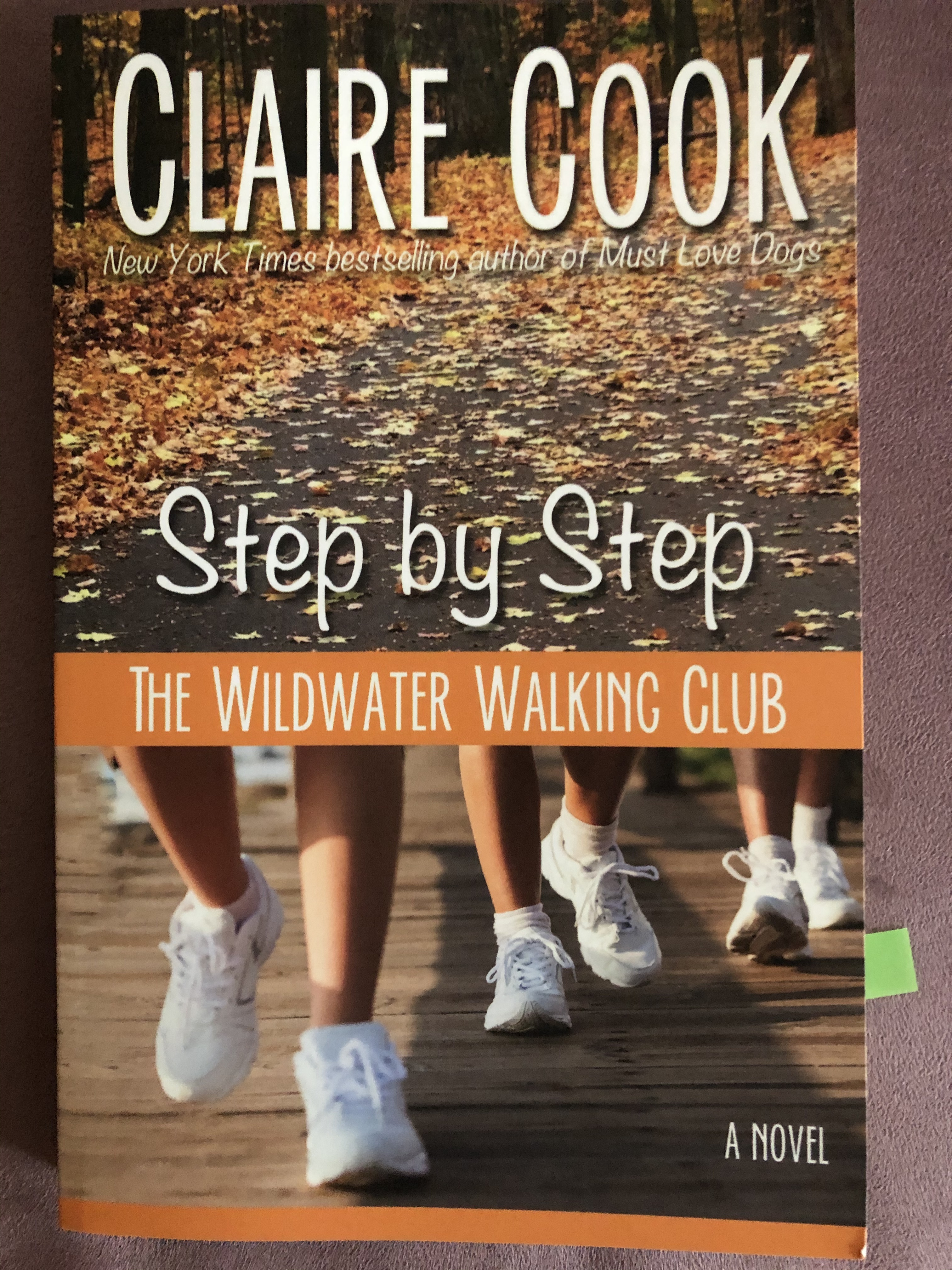
The book is meant to make readers feel good. To transport readers into another world, Noreen’s world, as she walks with Tess and Rosie and navigates life as a newly certified health coach.
So, why then, were there times I felt sad?
Why did this feel-good book leave me feeling a bit down at times?
It took me a while to figure it out.
And then I realized – it’s the walking. (Which is a big part of the book.)
I no longer know the easy joy and pleasure that comes from going on a daily walk.
I do continue to walk each day in my neighborhood, but they’re not always joyful. Not always pleasurable.
I walk. Certainly not at a quick pace. And not to count my steps.
But to walk. To exercise. To spend time with my family outdoors. To observe our neighborhood.
But my walking is … I struggle for the right word. Difficult? (Sometimes.) Unpredictable? (Sometimes.) Pain-inducing? (Sometimes.) Exhausting. (Sometimes.)
I don’t always experience more pain after a walk, but sometimes I do.
Sometimes I experience random pain during a walk. A step off a curb that sends a jolt up and down my left leg.
A sudden gripping pain in my calf, that causes me to stop and wait and hope it will pass so I can continue walking. But then the walking has a bit of limping to it.
If I walk while in pain, it’s still walking.
And so I keep doing it.
Because some days are better than others.
And I walk, step by step, hoping for one of those better-pain days.
I saw this on the sidewalk recently, before a doctor’s appointment. A thank you to the artist!
“I’ve been living with Undifferentiated Connective Tissue Disease for ten years now, and I’m still learning how to do it. I don’t know if there ever comes a time when you reach the finish line and achieve the “gold star” for figuring it all out. You just keep figuring it out, moment-by-moment, day-by-day, and wake up the next day, and do it all again.”
And so begins my recently published essay, “There Is No Shame in Life With Chronic Illness,” published at The Mighty. (Click here to read the article in its entirety.)
The conclusion of the essay goes like this:
“There is no shame in your body not working/functioning/behaving as it used to. Your body, your life, you – are still a marvel. Never forget that.
There is no shame in who you are and how you feel.
There is no shame in needing to learn this lesson over and over again.”
It’s an important lesson as we look with longing and hope to the new year.
Apparently, some people who know me find it hard to believe my pain can be pulling-my-hair, biting-my-finger-in-agony kind of pain when I’m still wearing all my jewelry. And it’s a lot – bracelets, nine rings, earrings, anklet.
But guess what?
“Yes, You Can Wear Jewelry and Be in Pain at the Same Time.”
That is the title of my recently published essay. Click here to be re-directed to The Mighty to read it in its entirety.
“It still isn’t easy for me to describe myself as a disabled woman. For a long time I didn’t think a disabled woman sat on the ground pulling out weeds. Or played handball with her son. Or helped her elderly neighbor carry in groceries. But I do all those things. Because being a disabled woman doesn’t look the same for every woman. And it doesn’t look the same for me each day.”
That paragraph is taken from “It’s Not All in the Family,” a personal essay I wrote that was published in the fall issue of Breath and Shadow. You can read the essay by clicking here.
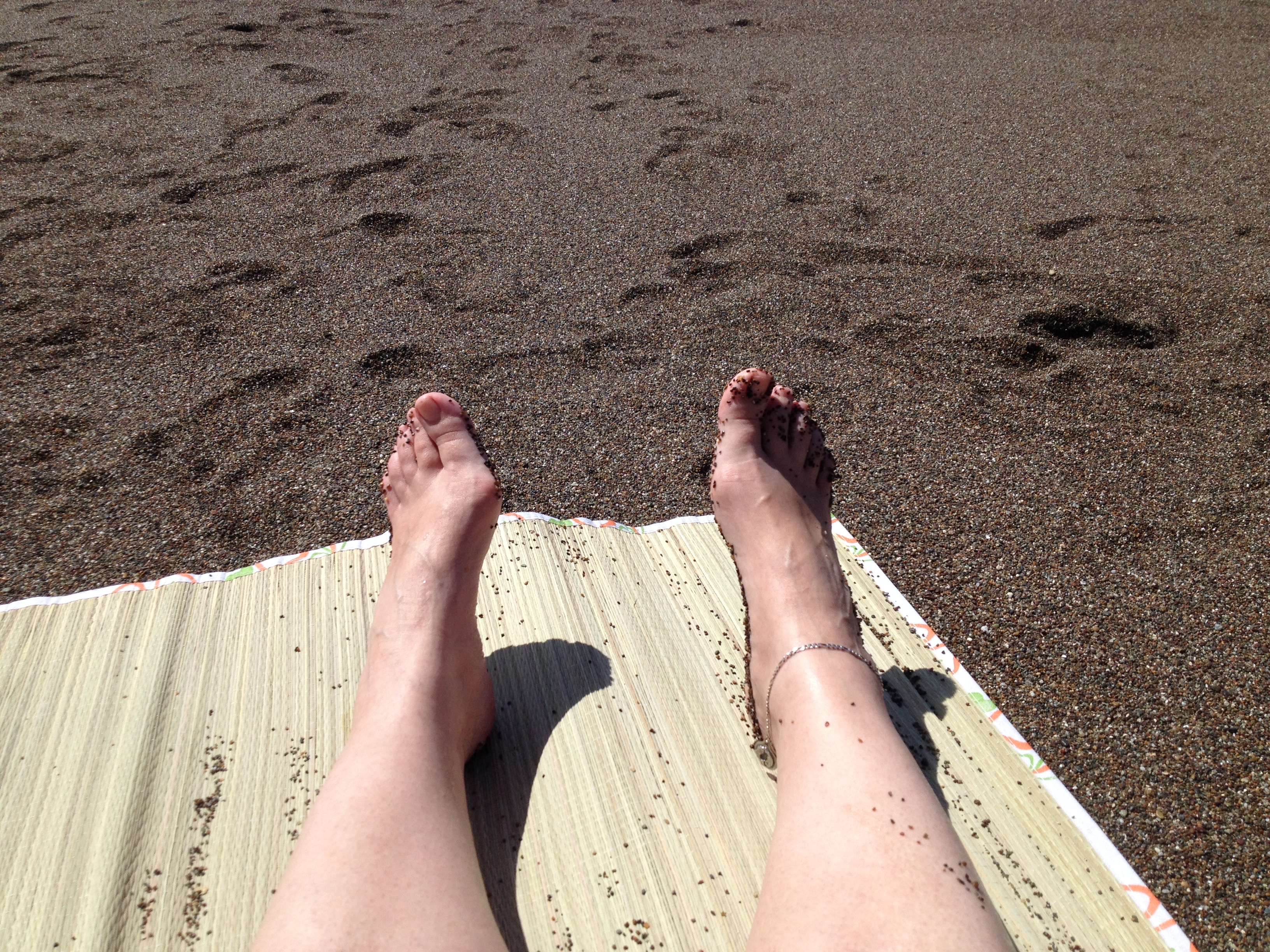
Sometimes it’s hard to look at my legs with gratitude for all they can still do.
September is Pain Awareness Month, a “time when various organizations work to raise public awareness of issues in the area of pain and pain management.”
Have you ever seen that 1-10 pain scale? The one doctors show you, with a range of facial expressions?
I don’t like that scale. And I don’t like being asked to rate my pain.
I remember a visit to a pain management doctor. During the intake, the nurse asked me to rate my pain, right then in that moment. I refused.
I’m usually a very compliant patient, obedient and direction-following.
But, let’s face it. After 10 years of living with my autoimmune disease, I’ve gotten really good at pushing through the pain. I have to. As a result, my pain scale most likely doesn’t look the same as yours. What I now consider a 6, my husband would probably classify as a 10.
Here’s what I can tell you about my pain. It fluctuates. And not just day-to-day. Sometimes hour-to-hour, even minute-to-minute.
In the interest of pain awareness, I thought I’d share just a bit of what my pain is like.
– Sometimes, my left calf is tight. That tight feeling you get before, during, and after a muscle cramp. Except my tightness lingers. For hours.
–Sometimes I don’t have pain. I have a general heaviness. My now twelve-year-old son and I used to play “squish” when he was younger. It was a wrestling-type game that happened either on the floor or on my bed. We’d tickle, but generally he would end up “squishing” me – pinning me with his body. That’s how I feel. Like I’m walking around, cooking dinner, watering my plants, and I have an invisible child strapped across my legs, weighing me down.
–Sometimes I have a throbbing pain. You know that pain you get when you’ve bumped into the sharp corner of a table? You can’t see a bruise, but the area is sore and sensitive and just hurts.
–Sometimes I just hurt. Like I’ve been pricked with needles (and I have been, so I know what it feels like). My calf is sensitive, and I have to roll up my pants so the fabric doesn’t touch my skin.
–Sometimes the pain is rocking-back-and-forth, pulling-at-my-hair kind of pain. Sometimes it just randomly hits. Sometimes I know it’s coming. My calf muscle may begin twitching. On certain occasions, I can even see it moving. It makes me think of when I was pregnant, and my husband and I would joyously watch my stomach move when our son would turn or stretch. There is nothing joyous about this though.
–Sometimes my leg feels twisted somehow. As if someone took my muscle and twisted it, the way you wring out a washcloth. And simple things, like bending to pull something off the bottom shelf of the fridge, or bending down to pick up the mail off the floor, or standing on my toes to reach the colander from the shelf in the kitchen, aren’t so simple for me to do.
And I could go on.
I don’t want pity. Don’t feel sorry for me.
Feel compassion and kindness and patience for everyone you encounter. Because you never really know someone else’s pain.
10 years ago this month, I woke up on a Sunday morning and couldn’t stand. For a few days, my left calf had felt sore and tight – the leftover feeling you get after a muscle cramp.
But on this particular Sunday morning, my calf wasn’t just sore and tight. It was red. Elmo-red. And swollen. And I couldn’t stand up.
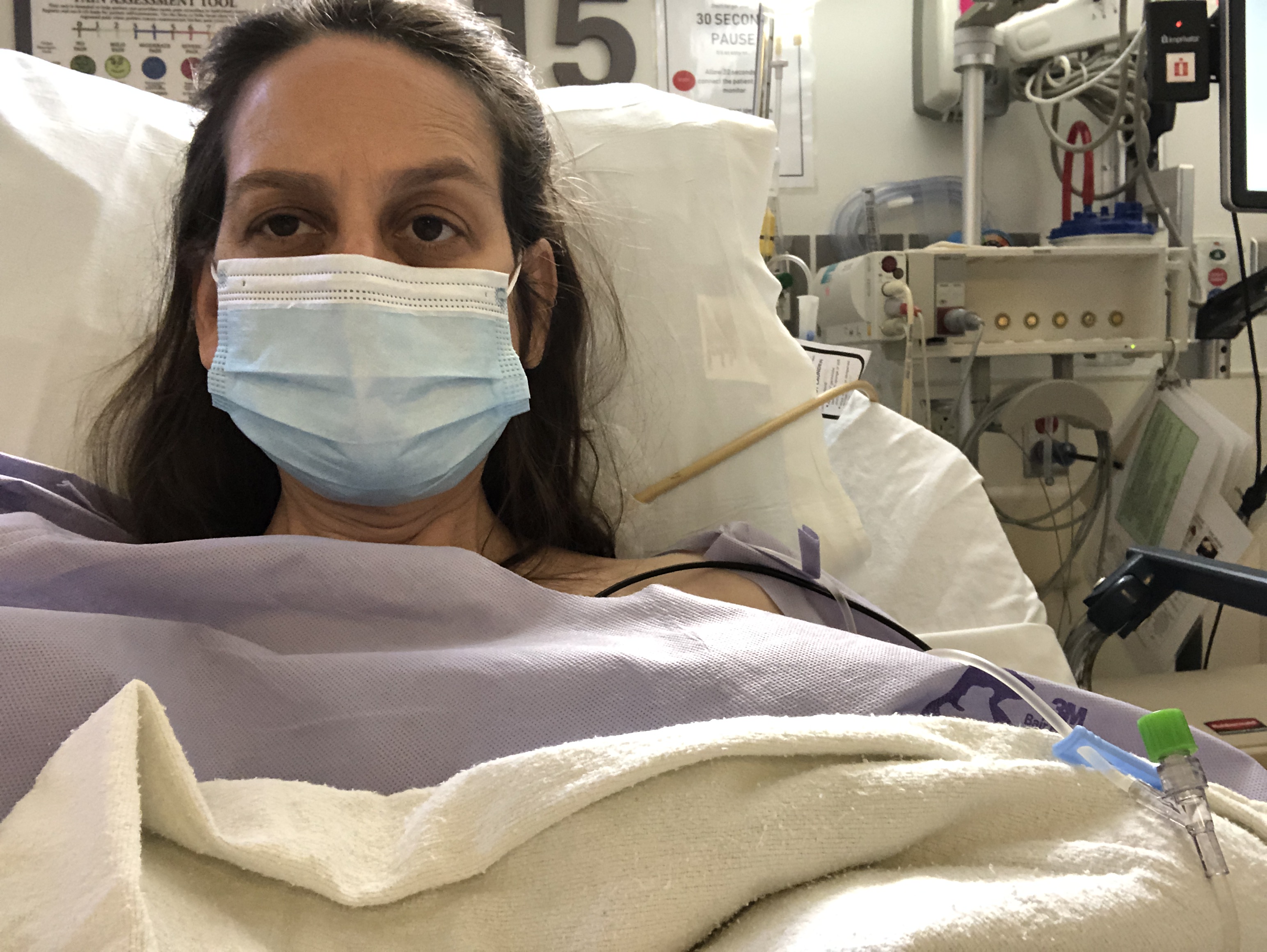
I knew something was wrong when the emergency room nurse admitted me as quickly as she did.
My prior emergency room experience was more than five years earlier when I cut the palm of my left hand while trying to cut open an avocado. I remember sitting in the waiting area that evening, my arm raised, my hand wrapped in dishtowels waiting to see a doctor. Waiting for stitches.
This time I was immediately admitted.
I knew that wasn’t a good sign.
But never could I have imagined that my left calf’s “issues” weren’t a temporary problem. Never could I have imagined that Sunday in July was just the beginning.
And never could I have imagined that my life would forever be changed.
“Even though my disease has been a part of my life for several years now, I don’t feel as if I’ve reached a level of total acceptance and understanding. I am more and more convinced that living with a chronic illness is synonymous with living a life full of contradictions.”