The Lives We Actually Have

Last week I wrote a personal essay for a submissions call. The prompt was New Year-related — about starting a new project, developing new habits, of making plans to live your dream life.

That last one — making plans to live your dream life — was the one that hurt the most. 

Because that doesn’t apply to those of us living with a chronic illness. 

Because no one dreams of a life with a forever-illness.

No one aspires to live each day with an incurable illness. 

And yet, that is my life. 

And though it isn’t what I dreamed of or what I would have chosen, it is my reality. And mixed in with the medications and heating pads, doctors appointments and physical therapy sessions are also moments of beauty and calm, of belonging and wonder, of a glorious full moon and a sink that isn’t draining.

Which brings me to the book The Lives We Actually Have: 100 Blessings for Imperfect Days by Kate Bowler and Jessica Richie.

You may remember that I’m a Kate Bowler fan. I wrote about her book Everything Happens For a Reason (And Other Lies I’ve Loved) back in March 2023. And I wrote about her book No Cure For Being Human (And Other Truths I Need to Hear) back in April 2022.

This book is different. The Lives We Actually Have is a collection of blessings. 

From the introduction:

“If we are very lucky, we have days lit up with fireworks. We have powerful moments of connection — to the world, to each other, and even to God — that dazzle us. Suddenly, beauty and possibility are everywhere. We thought we were living any old day, but no. We find ourselves amazed by the truths we didn’t set out to learn.”

“Contrary to most of the advice of the self-help and wellness industry, our days are not simply a reflection of our choices. We are not a tally sheet of all our yes and no decisions. We like to imagine that we are built out of every small choice we made.”

“We need a language of acknowledgment for the lives we have, not simply the lives we wish for. We need a spiritual account of time that is rich enough to name the breadth of our experience. Good. Bad. Difficult. Sublime. Mundane.”

“When I bless the actual days I am living, I suddenly find I have a great deal more to say that is honest. I am mourning. I am bored. I am exhausted. I am apathetic. I discover that I am freed from the need to declare everything #blessed. Good or bad, I don’t have to wait to say something spiritually true. I can simply bless it all instead.”

The book is a special collection, with some blessings that really touched me and others not-so-much. 

Dear readers, have any of you read this book? Was there a particular blessing that most touched you/moved you/comforted you? Feel free to share it in the comments.

Here’s a part of just one of the blessings that spoke to me:

Please note: I am including a link to buy the book that I’m highlighting this week. If you use my link, I do make a small commission on your purchase at no additional cost to you. I am working with Bookshop.org which also sends a portion of the profit to support local, independent bookstores.

Yes, And

Last week was a time of big emotions. A lot happened in my world and with it came a lot of mixed feelings.

My mom celebrated her 79th birthday on the same day my son celebrated his 16th birthday.

A former kindergarten student, a child I taught during my first year of teaching, looked me up online, found my website, and reached out with an email that made me cry. She wrote, “I wanted to thank you for being a great teacher and setting a solid foundation for my education.” Did I mention she’s now a teacher?

We had a family outing to The Huntington Library, Art Museum, and Botanical Gardens. A place we hadn’t visited since March 2020, a week before the world shut down because of the coronavirus. Only this time we visited with me in my wheelchair.

Our former next door neighbor, now 89 years old, remembered my son’s sixteenth birthday and called to offer birthday wishes. 

So, it’s been a lot. 

Something I have learned, through the work with my therapist and my years living with my autoimmune disease, is that it’s possible to feel two very different emotions at the same time. In fact, when you live with chronic illness, it happens quite a lot. At least to me.

I am currently reading The Lives We Actually Have: 100 Blessings for Imperfect Days by Kate Bowler and Jessica Richie. I try to read one blessing a day, though, I admit I sometimes forget and miss a day (or two).

This week, I’d like to share a bit of Kate Bowler’s blessing, “For Stretching Your Heart,” which I think explains these mixed emotions so well:

Yes, I have so much to be thankful for,
and this hasn’t turned out like I thought it would.
Yes, I feel moments of joy,
and I have lost more than I could live without.
Yes, I want to make the most of today,
and my body keeps breaking.
Yes, I am hopeful, and this is daunting.
Yes, I am trying to be brave, and I feel so afraid.”

Because the truth is — yes, things could be worse, and things could be better.

Please note: I am including a link to buy the book that I’m highlighting this week. If you use my link, I do make a small commission on your purchase at no additional cost to you. I am working with Bookshop.org which also sends a portion of the profit to support local, independent bookstores.

A Look Back at Six Months of Books

Since it’s the first week of July, I thought now would be a good time to pause and take a look at some of my favorite reads from the first half of the year. 

January:  Katherine Center’s The Bodyguard. I LOVE Katherine Center’s books. When she publishes a novel, I know I’m going to purchase it. She writes books that make you feel. Books that make you laugh. Books that are about people who experience hard times and then find a way to get back up. Books that you know will all end up okay in the end. (Side note – Hello Stranger will be published next week on July 11th. I have already pre-ordered it!)

February:  At the end of February I started reading Claire Cook’s Walk the Talk, the fourth book in her The Wildwater Walking Club series. There’s something so pleasing, so reassuring about coming back to characters you know from previous books.

MarchEverything Happens for a Reason: And Other Lies I’ve Loved by Kate Bowler.  Ms. Bowler is … a force. Of grace. Of compassion. Of humor. Of authenticity. Of heart.

April:  Thank you to Tara Schuster and her first book, Buy Yourself the F*cking Lilies: And Other Rituals to Fix Your Life From Someone Who’s Been There. It was the book I needed to read and I didn’t know it. And now, her newest book — Glow in the F*cking Dark — sits on my bookcase, waiting for me; a gift from one of my closest friends.

May:  This Time Next Year by Sophie Cousens – a fun, super-enjoyable read! (I also recommend her novel Just Haven’t Met You Yet and in my to-be-read pile is her other novel  Before I Do.)

June:  I finished reading Braided by Beth Ricanati at the end of June. It’s a book I’m still thinking about. In fact, I admit to checking out a couple of videos on YouTube featuring Ms. Ricanati not just discussing her book, but baking challah at the same time. 

Readers, any books you’ve read during the first half of 2023 that you loved? Enjoyed? Learned from? Please share!!

Please note: I am including a link to buy the books that I’m mentioning this week.  If you use my link, I do make a small commission on your purchase at no additional cost to you.  I have chosen to affiliate with Bookshop.org, which also sends a portion of the profit to support local, independent bookstores. 
Everything Happens For a Reason

Back in April 2022, I wrote a blog post about Kate Bowler’s book No Cure For Being Human (And Other Truths I Need to Hear). If you missed it, you can click here to read it. 

I recently finished reading Ms. Bowler’s other book Everything Happens For a Reason (And Other Lies I’ve Loved)

(Just so you know – this book was published in 2018, before No Cure For Being Human.) 

I am in awe of Ms. Bowler — the way she blends truth and humor, tenderness and rawness. 

Let me share just some of the passages that earned sticky notes in my copy:

“I have had two perfect moments in my life. The first was running down the aisle with Toban on our wedding day, and we burst through the church doors and stood, breathless, alone as husband and wife, gazing at each other like complete idiots. And the other was when they put Zach in my arms for the first time and we looked at each other like it was a conspiracy of mutual adoration. These are my Impossible Thoughts. These are my Can’t-Live-Withouts. I cannot picture a world where I am not theirs. Where I am simply gone.”

“When we arrived at the hospital, a day into hard labor that wouldn’t progress, the doctor looked me up and down and suggested that we return home again.
“ ‘You don’t have the look of someone in labor,’ she said matter-of-factly.
“  ‘Yeah, well, you’re going to want to check me. I am, unfortunately, amazing at being miserable.’”

“Infertility and disability should have taught me how to surrender, taught me how little I can control the conditions of my own happiness. Instead, that helplessness has only thickened my resolve to salvage what I can from the wreckage.”

“If I never nap. If I never complain. If I stifle my sharp intake of breath when I feel the pain. If I hide the reality, then maybe I’m not sick. So I continue to work full days. I get up at 6:30 am every day — no matter what — so I won’t miss a moment with my son. When I stop taking the medication that minimizes the numb feeling in my hands and feet, because I want to feel every shred of what is happening to me, my friends practically stage an intervention. When will I realize that surrender is not weakness?”

“But most everyone I meet is dying to make me certain. They want me to know, without a doubt, that there is a hidden logic to this seeming chaos. Even when I was still in the hospital, a neighbor came to the door and told my husband that everything happens for a reason.
“ ‘I’d love to hear it,’ he replied.
“ ‘Pardon?’ she said, startled.
“ ‘The reason my wife is dying,’ he said in that sweet and sour way he has, effectively ending the conversation as the neighbor stammered something and handed him a casserole.”

“There is no life in general. Each day has been a collection of trivial details — little intimacies and jokes and screw-ups and realizations. My problems can’t be solved by those formulas — those clichés — when my life was never generic to begin with. God may be universal, but I am not.”

What do I want to give them? I have taken the notebook back out and scribbled a couple of words.
Compassion.
That one is for Zach. I have always wanted to raise a boy who loves the underdog, who stops for snails, who wants to know why the man outside the car window says he will work for food. I want to raise a tough softy. He will know the pain of the world but all will be better for it. He will be brave in the face of heartbreak.”

And Appendix I, titled “Absolutely Never Say This to People Experiencing Terrible Times: A Short List,” is quite wonderful all on its own. Here are a few gems:

“ ‘Well, at least…’
“Whoa. Hold up there. Were you about to make a comparison? At least it’s not … what? Stage V cancer? Don’t minimize.”

“ ‘God needed an angel.’
“This one takes the cake because (a) it makes God look sadistic and needy and (b) angels are, according to Christian tradition, created from scratch. Not dead people looking for a cameo in Ghost. You see how confusing it is when we just pretend that the deceased return to help you find your car keys or make pottery?”

Disability Pride Month Reading

July is Disability Pride Month, and Sunday, July 10th is Chronic Disease Awareness Day

For me, July also marks  the anniversary of “the day,” — the day I went into the hospital with a swollen left calf, unable to walk, unable to stand, without knowing that was only the beginning of my life with an invisible disability. (Twelve years ago this month.)

After I became ill and was finally diagnosed, I went looking — for help, for support, for community — in books. I didn’t find much.

Since then, however, my library has expanded and includes books that speak to my life with an invisible disability. Not necessarily because the author also has an autoimmune disease or chronic pain in her left leg. In fact, the specific details can vary widely, yet it’s the emotions we share. I read these books, and feel understood, and heard, and seen. And when you’re living with a medical condition that isn’t easily understood — by those closest to you and those treating you — that sense of community is huge. 

So this week, I’d like to share just a few books in honor of Disability Pride Month and Chronic Disease Awareness Day.

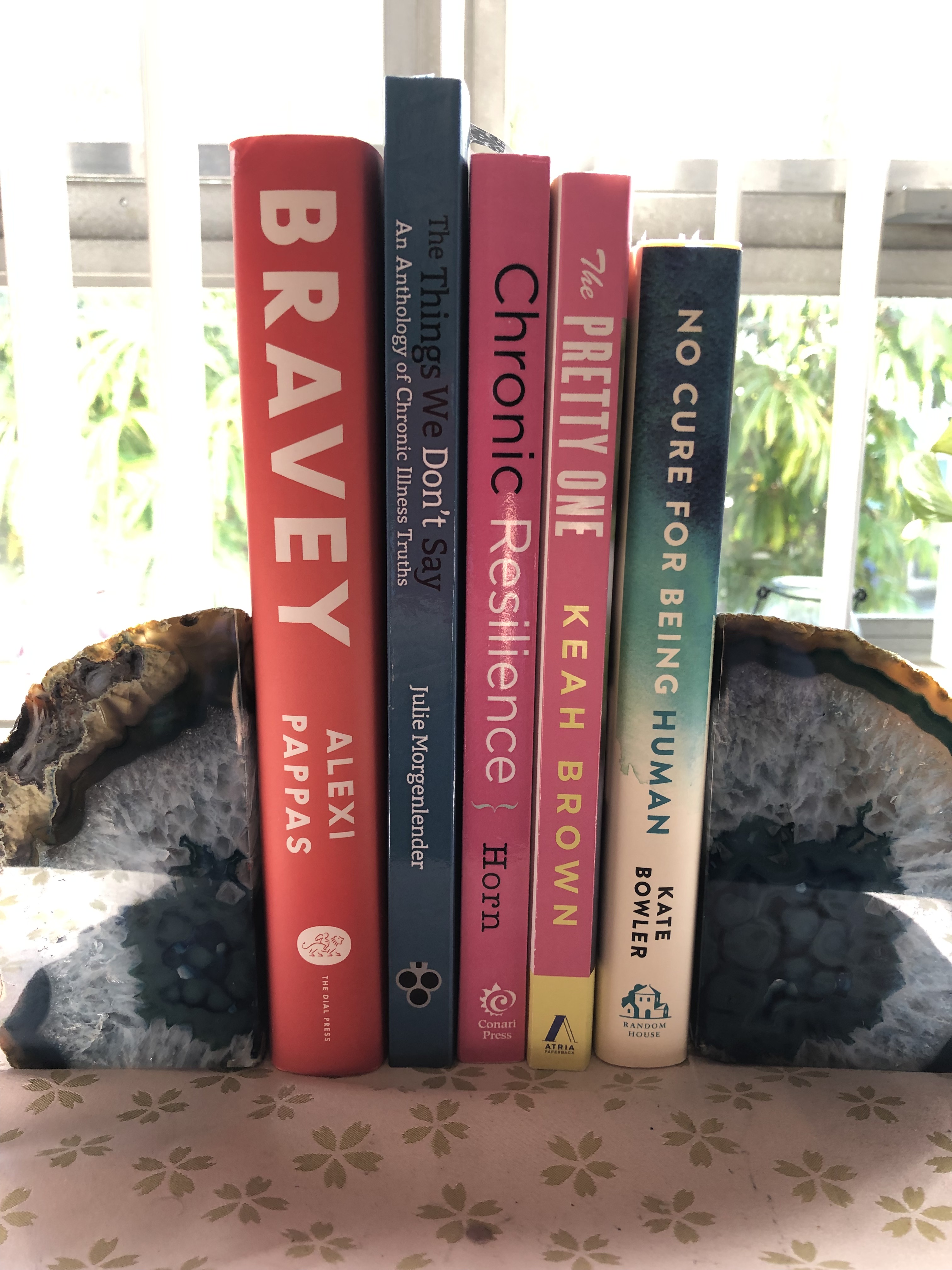
Bravey by Alexi Pappas. The specifics are very different (she’s an Olympian after all!), but the emotions are similar. My copy is full of sticky notes. (You can check out my blog post, “Trying To Be a Bravey,” by clicking here.)

The Things We Don’t Say: An Anthology of Chronic Illness Truths edited by Julie Morgenlender. I’m proud to say my essay, “Chronic Contradictions,” is included in this incredible collection. In this anthology “forty-two authors from around the world open up in fifty true stories about their chronic illnesses and their search for answers, poor treatment by doctors, strained relationships with loved ones, self-doubt, and more.” (You can read an earlier blog post written shortly after the anthology was published by clicking here.)

Chronic Resilience by Danea Horn. I don’t remember how I discovered this book. I just know I felt so lucky to have found it. I have read it more than once, and even wrote the author a fan letter! I highly recommend it. (You can learn more about the book here.)

The Pretty One by Keah Brown.  I found this book at Target and was captivated by the author’s smile and joy that is so evident on the front cover. (I wrote a blog post about Ms. Brown’s book and several of my favorite passages. You can read it here.)

No Cure For Being Human by Kate Bowler. Incredible writing. Beautiful, profound, and funny too. (This book I read fairly recently, back in April. You can read my blog post, “No Cure For Being Human,” by clicking here.)

Readers, any recommendations? I’d love to hear about books you have read that you think those of us with disabilities and/or chronic diseases would enjoy reading.  

No Cure For Being Human

No Cure For Being Human (And Other Truths I Need to Hear) by Kate Bowler. 

Wow.

And then after the initial “wow,” several adjectives come to mind — beautiful, heartbreaking, touching, profound, funny, moving.

I am blown away by the incredible way in which Ms. Bowler wrote her story — being diagnosed with stage 4 colon cancer in her 30s. She didn’t just write about it, she invited readers in. And along the way, shared some truths I know I needed to hear.

Here are just some of the passages that moved me:

“Before when I was earnest and clever and ignorant, I thought, life is a series of choices. I curated my own life until, one day, I couldn’t. I had accepted the burden of limitless choices only to find that I had few to make.”

“From my hospital room, I see no master plan to bring me to a higher level, guarantee my growth, or use my cancer to teach me. Good or bad, I will not get what I deserve. Nothing will exempt me from the pain of being human.”

“It’s easy to imagine letting go when we forget that choices are luxuries, allowing us to maintain our illusion of control. But until those choices are plucked from our hands — someone dies, someone leaves, something breaks — we are only playing at surrender.”

“The problem with aspirational lists, of course, is that they often skip the point entirely. Instead of helping us grapple with our finitude, they have approximated infinity. With unlimited time and resources, we could do anything, be anyone. We could become more adventurous by jumping out of airplanes, more traveled by visiting every continent, or more cultured by reading the most famous books of all time. With the right list, we would never starve with the hunger of want.
But it is much easier to count items than to know what counts.”

“I did not understand that one future comes at the exclusion of all others.
I had wanted two kids.
I had wanted to travel the world.
I had wanted to be the one to hold my mother’s hand at the end.
Everybody pretends that you only die once. But that’s not true. You can die to a thousand possible futures in the course of a single, stupid life.”

“The terrible gift of a terrible illness is that it has, in fact, taught me to live in the moment. Nothing but this day matters: the warmth of this crib, the sound of his hysterical giggling. And when I look closely at my life, I realize that I’m not just learning to seize the day. In my finite life, the mundane has begun to sparkle. The things I love — the things I should love — become clearer, brighter.
Burdened by the past, preoccupied by the present, or worried about the future, I had failed to appreciate the inestimable gift of a single minute.”

“It takes great courage to live. Period. There are fears and disappointments and failures every day, and, in the end, the hero dies. It must be cinematic to watch us from above.” 

“It became clearer than ever that life is not a series of choices. So often the experiences that define us are the ones we didn’t pick. Cancer. Betrayal. Miscarriage. Job loss. Mental illness. A novel coronavirus.”  

“Time really is a circle; I can see that now. We are trapped between a past we can’t return to and a future that is uncertain. And it takes guts to live here, in the hard space between anticipation and realization.”

And the book’s appendix is brilliant. Ms. Bowler has written a list of “clichés we hear and truths we need,” including:

Things People Say: Make every minute count. 

A More Complicated Truth: Life is unpredictable. You’re a person, not a certified account.