The Light We Carry, Part One

I am currently reading Michelle Obama’s The Light We Carry: Overcoming In Uncertain Times. And let me say, I am about halfway through the book and have many pages flagged with sticky notes. 

So rather than have one super-long post, I decided to share some of my favorite passages one part at a time. (The book is split into three parts.)

(Last week I wrote about buying a wheelchair and referenced a little bit from Mrs. Obama’s book. If you missed last week’s post, you can read it here.)

This week, allow me to share some of my favorites from Part One:

“That’s what tools are for. They help keep us upright and balanced, better able to coexist with uncertainty. They help us deal with flux, to manage when life feels out of control.” 

“What does it mean to be comfortably afraid? For me, the idea is simple. It’s about learning to deal wisely with fear, finding a way to let your nerves guide you rather than stop you. It’s settling yourself in the presence of life’s inevitable zombies and monsters so that you may contend with them more rationally, and trusting your own assessment of what’s harmful and what’s not. When you live this way, you are neither fully comfortable nor fully afraid. You accept that there’s a middle zone and learn to operate inside of it, awake and aware, but not held back.”

“Our hurts become our fears. Our fears become our limits.”

“Because what my mother showed me is that if you try to keep your children from feeling fear, you’re essentially keeping them from feeling competence, too.”

“The unknown is where possibility glitters. If you don’t take the risk, if you don’t ride out a few jolts, you are taking away your opportunities to transform.”

“What [Toni] Morrison was doing for her kids is what my own parents did for me: She was giving them a simple message of enoughness. She was validating their light, that unique bit of brightness inside each of them — literally showing them it was there and it belonged to them, a power they could carry for themselves.”

“My father, whose shaky demeanor and foot-dragging limp sometimes caused people to stop and stare at him on the street, used to tell us, with a smile and a shrug, ‘No one can make you feel bad if you feel good about yourself.’ “

Please note: I am including a link to buy the book that I’m highlighting this week. If you use my link, I do make a small commission on your purchase at no additional cost to you. I am working with Bookshop.org which also sends a portion of the profit to support local, independent bookstores.

Everyone Has a Story

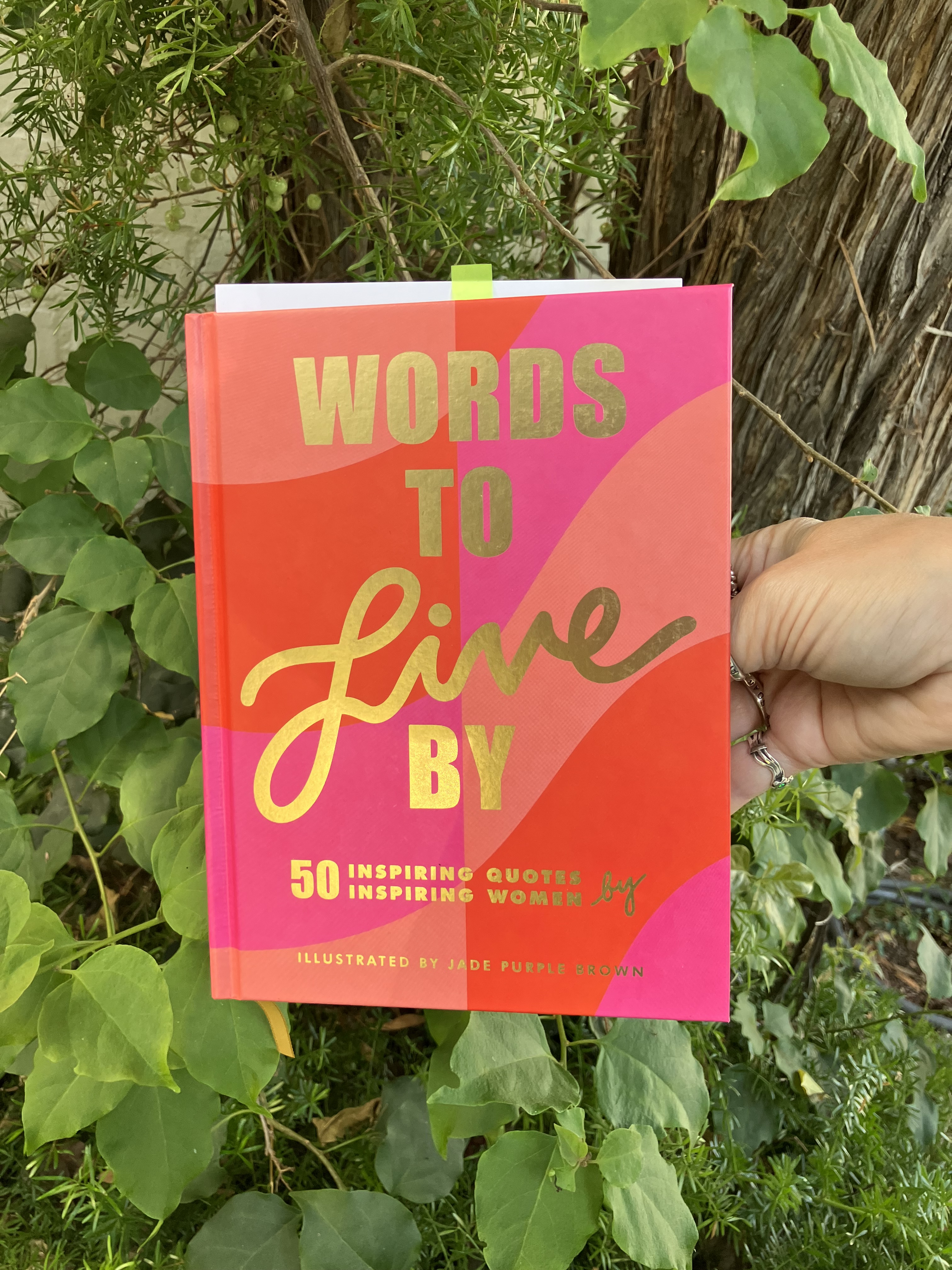
I am currently reading Words to Live By: 50 Inspiring Quotes by 50 Inspiring Women illustrated by Jade Purple Brown.

I bought this book back in July, on our last day in Washington, D.C. We had spent the morning exploring the National Portrait Gallery, and I found this book in the gift shop. (Truth be told, several books in the gift shop caught my eye. But I had to consider our limited luggage space.) 

I just started reading the book this past week. A few pages a day. Thought-provoking quotations accompanied by vibrant illustrations.  

This week I’d like to share a quote attributed to Frances Hodgson Burnett:

“Everything’s a story —

You are a story —

I am a story.”

I believe that everyone has a story to tell. It’s one of the reasons I read memoir. And it’s one of the reasons I’m writing a memoir. I can no longer teach in a classroom, but hopefully, I can continue to teach through my writing.

Question, dear readers:  Have you read any memoirs lately? Any recommendations?  

Please note: I am including a link to buy the book that I’m highlighting this week. If you use my link, I do make a small commission on your purchase at no additional cost to you. I am working with Bookshop.org which also sends a portion of the profit to support local, independent bookstores.

Left on Tenth

Left on Tenth: A Second Chance at Life is a powerful memoir written by Delia Ephron.

It’s easy to get caught up in her life, her story, and then feel a bit in-awe of being granted permission to come along for this roller-coaster of a ride. Incredible highs to despairing lows, and through it all — love and hope. 

Here are a few of my favorite passages:

“Writing taught me who I was, because your writing is your fingerprint. When I began to do it, I heard my own voice, my own observations, my own stories, my own gifts.” 

“I think about it all the time. Sometimes very consciously, and sometimes it’s just fluttering in the back of things. For me, that is the most stunning thing about remission — the glorious sense that I have been given back life coupled with the terrible fear that death is behind the next lamppost. This gift could be snuffed out at any moment.”

“… but my relationship to the world has changed. It’s as if I’ve been knocked on the head. I look the same, I think, although there is uncertainty in my reflection that wasn’t there before. Would anyone else notice that? I’m not sure. I am physically, mentally, and emotionally wobbly.”

“Over the years I have seen many people on Tenth Street with rollators and walkers. Old people. Sick people. I have felt sorry for them. I used to look away. I regret, am even appalled, by my previous lack of admiration and empathy. Now I am feeble and they are looking at me, or avoiding looking at me. I have to summon my nerve. I have to ‘own’ it. If you see my vulnerability, I force myself to think, well, I hope you respect my bravery.”

With transplants, he can follow his patients for years. He is very busy researching cures and saving lives, yet he finds time to read my novel Siracusa. He knows who I am. Not simply because he reengineered my bone marrow. He takes the trouble to know my brain and heart.”

“Everywhere I go, I get greeted with happiness and cheers for my bravery. It’s lovely but I don’t think I was brave. I was a captive on a no-exit journey. One way only. And, simply, I was fortunate that I didn’t die. I got my disease at a time of scientific discovery. I had great medicine and great love.”

Please note: I am including a link to buy the book that I’m highlighting this week. If you use my link, I do make a small commission on your purchase at no additional cost to you. I am working with Bookshop.org which also sends a portion of the profit to support local, independent bookstores.

Book Lovers Day!

Today, Wednesday, August 9th is Book Lovers Day! (It’s also known as National Book Lovers Day.)

To mark the occasion, I wanted to highlight just a few books which include the word “book” in their titles.

Of course the first book had to be Book Lovers by Emily Henry. Pure delight!

Zibby Owens, who may be the number one cheerleader for books and authors, wrote Bookends: A Memoir of Love, Loss, and Literature

Allow me to share this paragraph:   

“The cracking open of a book’s spine has always been an exercise in self-discovery, healing, and fortification. That subtle whoosh when words spill out makes me salivate. Then the feel of the coarse pages under my fingertips delights my consciousness, the sudden sprinkling of syllables, the black-and-white letters in various patterns, coalescing to find their way directly to my heart. It’s magic.”

The Bookish Life of Nina Hill by Abbi Waxman was such a fun, pleasurable read.

The Little Book of Hygge: Danish Secrets to Happy Living by Meik Wiking provided some insight into why candles in our home, among other things, are so important to me.

The Book of Hope by Jane Goodall and Douglas Abrams is a powerful read with many passages that really stood out. 

Dear Readers, have you read any of these books? What book(s) would you add to this list? Let me know in the comments.

Please note: I am including links to buy the books that I’m highlighting this week. If you use my link, I do make a small commission on your purchase at no additional cost to you. I am working with Bookshop.org which also sends a portion of the profit to support local, independent bookstores.

Write For Your Life

I read for many reasons. To be entertained and inspired. To learn and grow and find comfort in someone else’s words.

I write for many reasons, too. Which is why I was curious to read Write For Your Life by Anna Quindlen.

While many people might not consider themselves writers, Ms. Quindlen believes everyone has a story worth writing down. I agree. 

In addition to Ms. Quindlen’s words, the book also has some writing-related quotes as well as some prompts for writing exercises. Here are some of my favorite bits from Write For Your Life:

“We write to taste life twice, in the moment and in retrospect.” — Anaïs Nin

“While you have to mentally re-create what happened on a phone call — ‘Did she really say that?’ — you can actually reread a text. But much of that tech prose online felt so spontaneous as to be slapdash, unexamined. It’s why people will often say, when reminded of an email or an online post, that they can’t really recall writing it. Every day, unthinkingly, our lives can slip through our fingers in a cascade of computer code. Texts are like footprints in sand. By evening the tide has come in, and we are left alone.”

“The urge to get it exactly right often stands between you and beginning. ‘Don’t get it right, get it written’ demands composition first, cleanup later. The paralysis of perfectionism is a terrible ailment that can seep into so much of our daily lives. In writing, what it leads to is an empty page, and an empty page is neither good nor bad. It’s nothing. Honestly, if the choice is between an imperfect something and nothing — well, that’s easy, isn’t it? Get it written. You can get it right later.”

“Something written by hand brings a singular human presence that the typewriter or the computer cannot confer. There’s plenty of good writing done that way, but when you simply glance at the page, it could be the work of anyone. But when you’ve written something by hand, the only person who could have done it is you. It’s unmistakable you wrote this, touched it, laid hands and eyes upon it. Something written by hand is a piece of your personality on paper. Typed words are not a fair swap for handwriting, for what is, in a way, a little relic of you.” 

“I’m not sure writing about things always makes us feel better, but perhaps it sometimes does make loss, tragedies, disappointments more actual. It can turn them into something with a clearer shape and form, and therefore make it possible to see them more deeply and clearly, and more usefully turn confusion and pain into understanding and perhaps reconciliation. On paper our greatest challenges become A Real Thing, in a world in which so much seems ephemeral and transitory.”

“Butt in chair. That’s the piece of direction I give to anyone and everyone who wants to write, who is thinking about writing, who is asking how it’s done, who is fearful of and intimidated by the act. It’s not poetic, and it doesn’t bespeak inspiration. What it does suggest is a way into what is not a mystery but a process, a way into the story of yourself.”

Please note: I am including a link to buy the book that I’m highlighting this week. If you use my link, I do make a small commission on your purchase at no additional cost to you. I am working with Bookshop.org which also sends a portion of the profit to support local, independent bookstores.
Braided

I am not a baker. Meaning, I’m not a multiple-ingredients, multi-step-recipe kind of baker.

I’m more a Ghirardelli-Dark-Chocolate-Brownie-Mix (which only requires three ingredients) type of baker. 

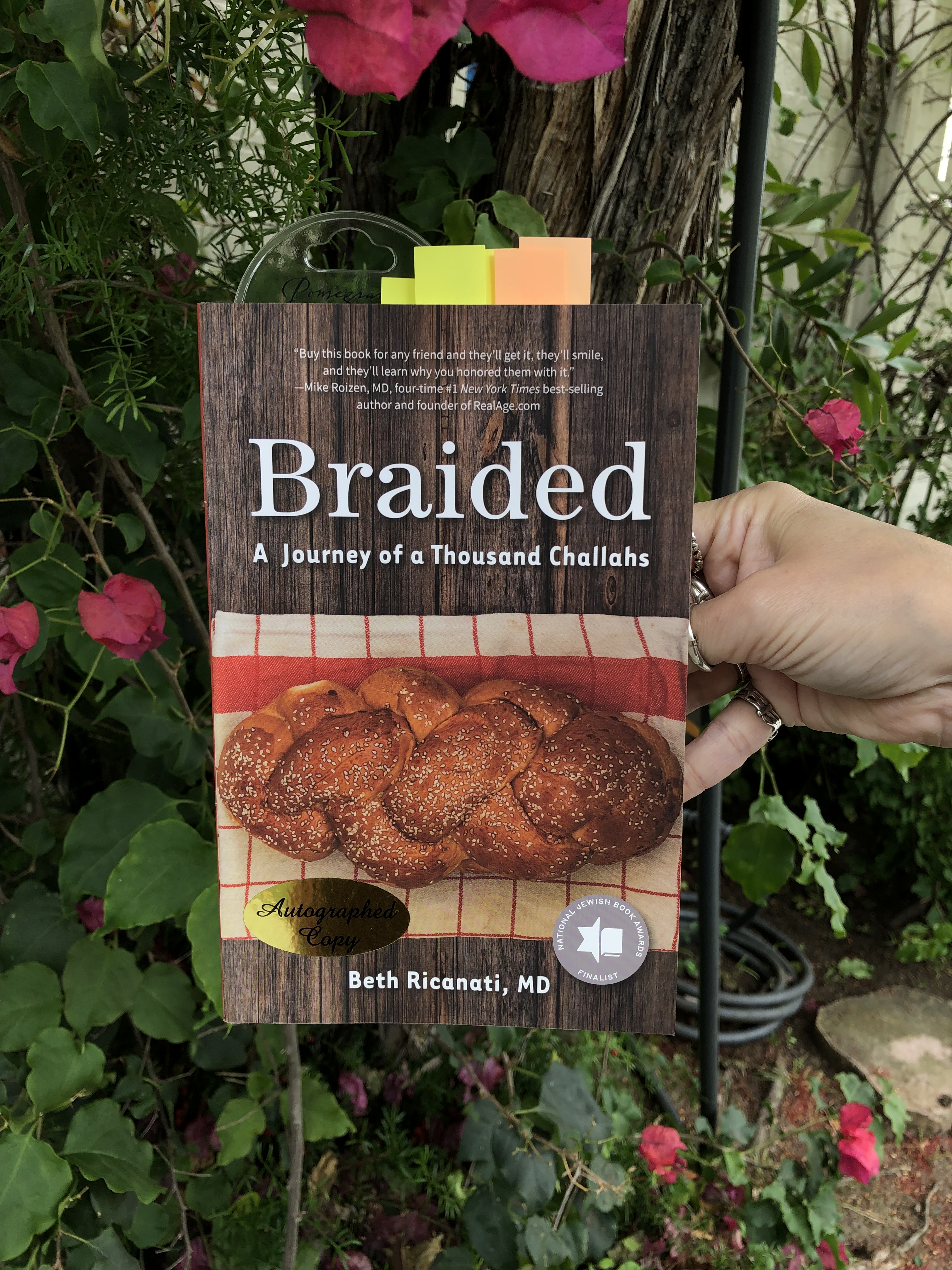
However, I was so intrigued by the premise of Braided: A Journey of a Thousand Challahs by Beth Ricanati, MD. (And I was tickled to learn that before her challah-baking, Ms. Ricanati counted her brownies, made from a Ghirardelli brownie mix, as her specialty.)

Here’s part of the description from the back cover:

What if you could bake bread once a week, every week? And what if the act of making bread — mixing and kneading, watching and waiting — could heal your sense of being overwhelmed? It can. This is the surprise that physician-mother Beth Ricanati learned when she started baking challah: that simply stopping and baking bread was the best medicine she could prescribe for women in a fast-paced world.”

And here are some of the passages I marked while reading:

“Actions always speak louder than words: our children absorb and learn by watching us, not necessarily listening to us.”

“This was a big lesson for me. It took making challah again and again to realize that when something goes wrong, it is not always because I did something wrong. ‘Sorry’ used to be one of my favorite words. A guy friend of mine bet me in high school that I couldn’t stop saying sorry. ‘Sorry,’ I replied. Alas, reflexively, I still want to blame myself first, to assume that I must have done something wrong.”

“Waiting for the yeast to proof exercises more than patience. Waiting also exercises humility. It’s the greatest of all character traits, according to the Talmud. Humility supplants the ego, pushes away the tendency for self-centeredness. With humility comes the ability to have empathy.” 

“We can’t always be happy. Sometimes happiness is taken from us. Sometimes terrible things really do go bump in the night. While painting challah with a red-tipped brush may seem childish, may seem frivolous, I look forward to this with almost too much glee. In fact, whenever possible, I insist on doing this step myself, instead of handing it over to a child or a friend or anyone else. I want the reminder. I want the physical reminder that when we have the choice to be happy, we have to grab it. We have to take it and own and cherish it. It is not always ours to choose.”

“I found in making challah that the magic for me is in the process of making challah. No ends-justify-the-means here. What happened as I went through the eleven steps each Friday in this challah recipe is where I really learned to be present. To slow down for a moment each week. To appreciate the here and now. To reconnect with women. I found through these eleven steps that challah is the ultimate soul food for me.
“It was here all the time, I just didn’t see it. I was so concerned with doing the right thing all the time, being the right person at the right time, that I had unknowingly lost the enjoyment, the fabulousness of the here and now.”

Please note: I am including a link to buy the book that I’m highlighting this week. If you use my link, I do make a small commission on your purchase at no additional cost to you. I am working with Bookshop.org which also sends a portion of the profit to support local, independent bookstores.
My What If Year

Do you ever think about other careers you might have had? Other choices you might have made? Other paths you might have taken?

And what if you had the chance to put much of your current-daily-real-life on pause and try out one of those unchosen careers? Would you take the chance to explore?

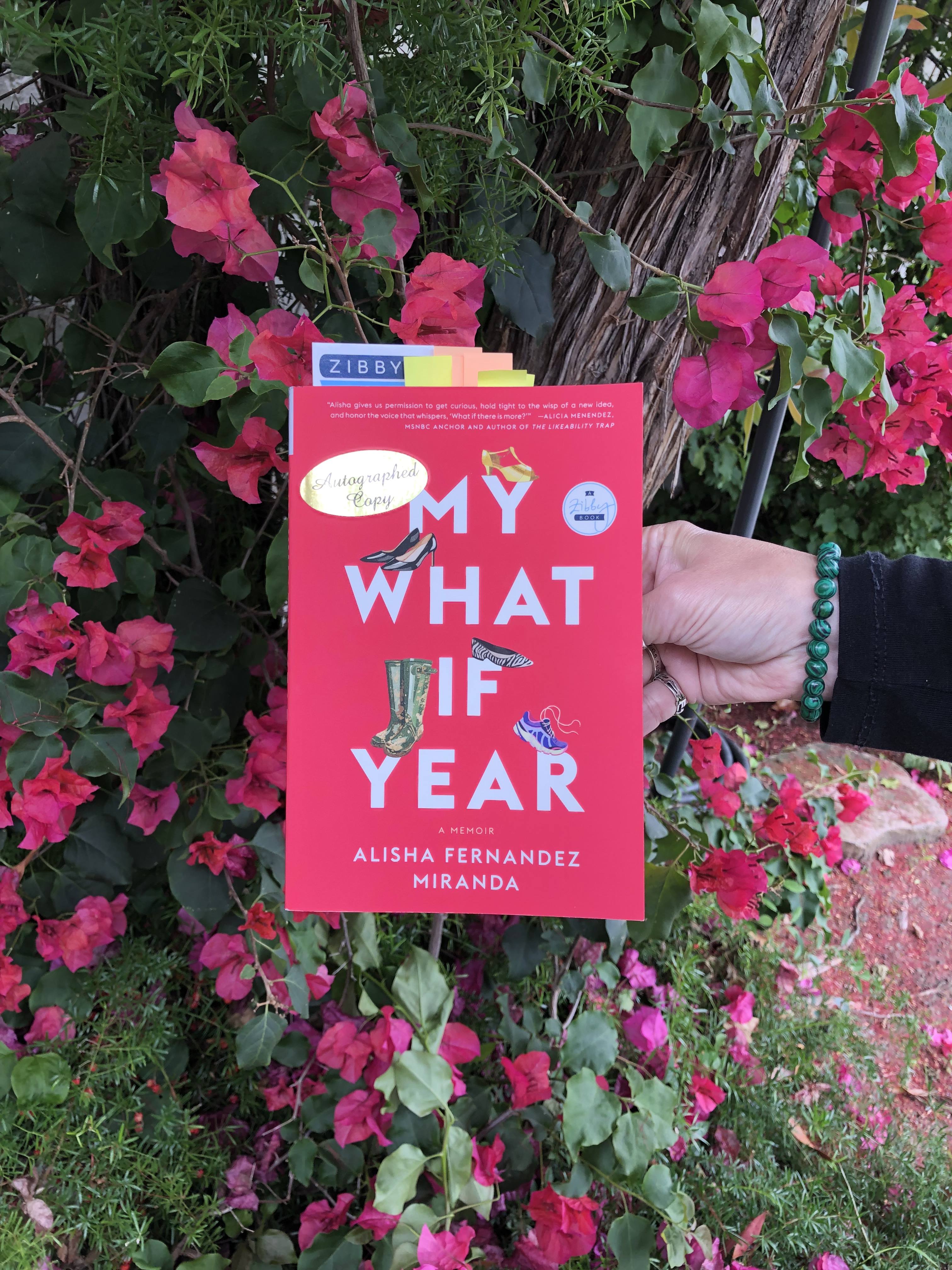
Alisha Fernandez Miranda did! And she wrote a memoir about it called My What If Year

From the back cover of the book:  “Delightfully irreverent, My What If Year recounts the adventures of a successful, Latina CEO and mother of twins who — on the cusp of turning forty — takes a break from her job for one year to explore the dream careers she never pursued. Alisha’s hilarious internship adventure takes her to Broadway, the London art scene, a posh Scottish hotel, and the workout world.”

Such a fun read! Here are a few of my favorite passages:

During her first internship, Ms. Miranda writes:  “How long had it been since I had been happy? For so long I thought the pursuit of happiness had been what was guiding me, but now I wasn’t so sure.” 

“I had no regrets, but it dawned on me that maybe my internship adventure, was, in a way, about revisiting that time of my life, a time when all the pages ahead were blank and unwritten.”

“Leaning into my strengths let me ignore my weaknesses. Yes, it allowed me to achieve and find success in the things I was good at. But I was starting to question whether I needed to be spending more time nurturing those tiny seeds of things I was terrible at — serving dinner, for example — to see if maybe they might blossom into something more, given some effort and some mistakes. Maybe it didn’t matter if it was ‘the best’ if I was doing something I loved. I didn’t even know what being the best meant anymore in this new world.”

“Truthfully, I was looking forward to seeing everyone. I was no longer as afraid of being subsumed in these other identities and knew that the core of who I was, or whoever I was figuring out I wanted to be, at least, was strong enough to stand on its own. In fact, the heft of my obligations no longer seemed overpowering; I had started to feel comforted by them, like a weighted blanket that kept me grounded.”

“ ‘Joy’ — such a simple, small word that holds so much complexity. It’s more than happiness. It’s ebullience. It’s celebration. A party all day, every day, where everyone is invited. People think joy is elusive, and they’re right; its impermanence is what makes it all the more important to cultivate, nurture, and appreciate it whenever it comes your way.” 

“But as I aged, I came to know that nothing is guaranteed. If you wanted to enjoy as much of life as possible, you had to put some intentionality behind seeking joy. You had to pay attention. If you didn’t it was likely to slip through your fingers.” 

“I didn’t want to have to keep taking side paths and then retracing my steps back to the main road. I wanted the detours to be the main road. Over the past few months, I had finally gotten, for brief moments in time, the chance to be the versions of myself I had seen in the shadows of my memories. I loved the chance to step into their shoes, but I didn’t want to be any of them, really. I wanted to be original me, but with the freedom to take the pieces from each and carry them with me as I continued on ahead.”

“One of the things I appreciated most about being an intern was the ability to not feel overwhelmed by my mental load. Making space meant that, all of a sudden, my brain had more room to think about other things and to consider other possibilities. Ideas for new projects sprang up like daffodils in the springtime. There was a lot in there that had been obscured by the constant to-do lists. My internships had given me a chance to see those things clearly.”

“I didn’t know much about what the next chapter of my life would hold, but I knew I needed to embody the spirit of being an intern in whatever I did: be adaptable; learn to fail; be okay with not being the best; let go of the plan sometimes; and above all, listen, learn, and find joy in every day.” 

Please note: I am including a link to buy the book that I’m highlighting this week. If you use my link, I do make a small commission on your purchase at no additional cost to you. I am working with Bookshop.org which also sends a portion of the profit to support local, independent bookstores.
(I apologize if any part of this week’s blog format looks strange. There may be a number or letter randomly showing up. Please, let’s just pretend it’s not there.)


Buy Yourself the F*cking Lilies

Sometimes you come across a book that you didn’t realize you needed to read until you’re in the middle of reading it, and you notice you’re running low on sticky notes because so many pages need to be marked.

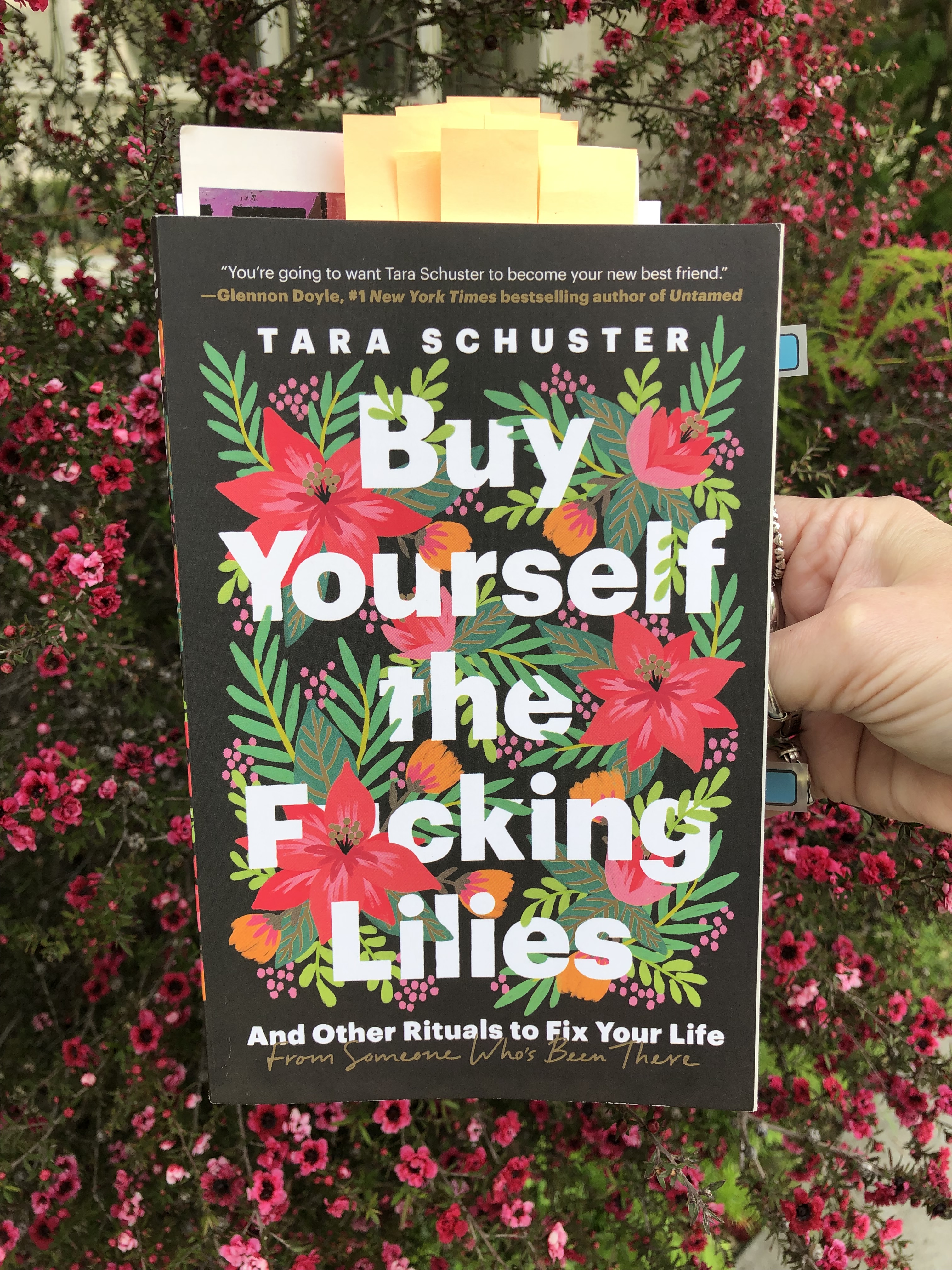
That was my experience reading Buy Yourself the F*cking Lilies: And Other Rituals to Fix Your Life From Someone Who’s Been There by Tara Schuster.

Ms. Schuster’s book is another wonderful example of how writing the specific actually makes it universal. Ms. Schuster and I had extremely different childhoods. Our adult life experiences are quite different as well. I’m older than she is, married, and the mother of a fifteen-year-old son. Yet, I found so much to love in this book. So much that spoke to me. So much that said, “Wendy try this. Wendy, you need to do this. Wendy, pay attention to this part.” 

Here are just some of the passages that I found to be deserving of sticky notes:

“What you are about to read is a guide to healing your traumas, big and small, in the pursuit of creating a life you will adore and be proud of. You don’t need to have had a mess-wreck-disaster childhood like mine for these tools to work for you. These lessons in self-care will be useful even if you had super-stellar parents who nurtured the shit out of you. This book is for anyone who simply needs to take better care of themselves — anyone who wants to lead a life they choose, embrace, and fucking love.”

But I decided it was time to stop comparing my pain to others’, time to quit telling myself that I shouldn’t feel this way, and time to start focusing on how I actually did feel, because that was real.” 

“Buy the fucking lilies. You are worth seven-dollar lilies. You are worth the thing that instantly makes your life better. I’ve heard people talk about their favorite exercise class this way. I’ve heard people talk about an order of guacamole with their tacos this way. I’ve heard people talk about the ten-dollar, ten-minute massage at the nail salon this way. That small, pleasurable thing that makes you feel like you are treating yourself — do not deprive yourself of this. Buy the fucking lilies, take the class, order the guac, get the massage.”

“Above all else: You are worth the lilies. The small, attainable luxury of lilies is not something to stress about, it is not something to deny yourself, it is something to make plans for and embrace. Small things that make you happy ARE a part of taking care of yourself. If you can’t put your money where your mouth is and say, ‘I am worth the lilies,’ or ‘I am worth six-dollar beef jerky’ or ‘I am worth the almond butter that makes me actually look forward to the morning,’ then why are you working so hard at your job anyway? Seven-dollar lilies won’t ruin you and they won’t make you poor; they will make you stronger. You are stronger when you treat yourself well. What are your lilies? Please go buy them today. If you feel weird about it at all, just blame me and then enjoy the fuck out of your flowers.” 

“What feeds your well? What’s the thing you love to do that makes your heart glad? Is it flower arranging? Is it people-watching at a café? Is it reading a book in a park without knowing what time it is? Is it going back to that dance class you used to love but for some reason stopped taking? What makes you so happy that it gives you rest and ease and feels so damn good that it sets your soul on fire with inspiration? These things that inspire us are often the easiest to lose sight of. We give them up because there is just so much ‘to do’ in a day. We are ‘very busy,’ after all. But you do not gain strength from denying yourself pleasure and being so serious about your life. Instead, keep your well full, and be astonished at the power, the motivation, the brilliance that you will inevitably find in the rest of your life.”

“What I have learned is that you are stronger when you give yourself incredible kindness.” 

Many more pages are marked with a peach-colored sticky note. In fact, Buy Yourself the F*cking Lilies inspired one of my April blog posts. (In case you missed it, you can read it by clicking here.)

There is just so much goodness in this book. Reading this book feels very much like having a super close friend right next to you, helping you to see your own wonderful-ness. A super close friend who wants you to see the sparkly brilliance within yourself. To which I say, “Thank you, Ms. Schuster. I’m working on it.” 

One additional note, Ms. Schuster has written a second book titled, Glow in the F*cking Dark: Simple Practices to Heal Your Soul From Someone Who Learned the Hard Way. You can bet it’s on my wish list!

Please note: I am including a link to buy the book that I’m highlighting this week. If you use my link, I do make a small commission on your purchase at no additional cost to you. I am working with Bookshop.org which also sends a portion of the profit to support local, independent bookstores.

Describe Yourself — Easier Said than Done, At Least for Me

The other night at dinner, I asked my fifteen-year-old son a question.

What three adjectives would you use to describe yourself?

I was inspired to ask, because I’m reading Tara Schuster’s book Buy Yourself the F*cking Lilies: And Other Rituals to Fix Your Life, From Someone Who’s Been There and earlier that day had read the chapter titled “If You Can Play Nice with Others, Play Nice with Yourself: Do One King Thing for Yourself on the Daily.” (By the way, I’m loving this book; more to come on this book in a future blog post or two.)

In the first paragraph of that chapter, Ms. Schuster tests her readers:

How nice are you to yourself? Don’t know? Let’s try a test. Right now, write down ten things you like about yourself. Go ahead and use the margins of the book.” 

I didn’t write in the margins of the book, though plenty of pages are marked with sticky notes and yellow highlighter. But I did pause in my reading and try to mentally list ten things I like about myself. It’s a hard thing to do.

So at dinner that night, I decided to try out an easier version on my son. 

What three adjectives would you use to describe yourself?

Of course, he first wanted to know why I was asking, and I told him I was just curious, based on something I had read in my book.

My high school-freshman-son took a few seconds before replying.

“Creative. Unique. Likable.” 

It was quick and easy for him. And I love the three adjectives he chose! It just made me feel like that was one of those moments when my husband and I each earned a little pat on the back, an acknowledgement from the universe that we’re doing a good job as parents. 

I’ve been trying to think of my three adjectives. It’s definitely harder for me to do, than it was for my son. 

So far I’ve got, “neat, kind, punctual.” 

Another time I came up with, “passionate, friendly, literary.”

How about you, dear readers? Feel free to share your three adjectives in the comments.

Everything Happens For a Reason

Back in April 2022, I wrote a blog post about Kate Bowler’s book No Cure For Being Human (And Other Truths I Need to Hear). If you missed it, you can click here to read it. 

I recently finished reading Ms. Bowler’s other book Everything Happens For a Reason (And Other Lies I’ve Loved)

(Just so you know – this book was published in 2018, before No Cure For Being Human.) 

I am in awe of Ms. Bowler — the way she blends truth and humor, tenderness and rawness. 

Let me share just some of the passages that earned sticky notes in my copy:

“I have had two perfect moments in my life. The first was running down the aisle with Toban on our wedding day, and we burst through the church doors and stood, breathless, alone as husband and wife, gazing at each other like complete idiots. And the other was when they put Zach in my arms for the first time and we looked at each other like it was a conspiracy of mutual adoration. These are my Impossible Thoughts. These are my Can’t-Live-Withouts. I cannot picture a world where I am not theirs. Where I am simply gone.”

“When we arrived at the hospital, a day into hard labor that wouldn’t progress, the doctor looked me up and down and suggested that we return home again.
“ ‘You don’t have the look of someone in labor,’ she said matter-of-factly.
“  ‘Yeah, well, you’re going to want to check me. I am, unfortunately, amazing at being miserable.’”

“Infertility and disability should have taught me how to surrender, taught me how little I can control the conditions of my own happiness. Instead, that helplessness has only thickened my resolve to salvage what I can from the wreckage.”

“If I never nap. If I never complain. If I stifle my sharp intake of breath when I feel the pain. If I hide the reality, then maybe I’m not sick. So I continue to work full days. I get up at 6:30 am every day — no matter what — so I won’t miss a moment with my son. When I stop taking the medication that minimizes the numb feeling in my hands and feet, because I want to feel every shred of what is happening to me, my friends practically stage an intervention. When will I realize that surrender is not weakness?”

“But most everyone I meet is dying to make me certain. They want me to know, without a doubt, that there is a hidden logic to this seeming chaos. Even when I was still in the hospital, a neighbor came to the door and told my husband that everything happens for a reason.
“ ‘I’d love to hear it,’ he replied.
“ ‘Pardon?’ she said, startled.
“ ‘The reason my wife is dying,’ he said in that sweet and sour way he has, effectively ending the conversation as the neighbor stammered something and handed him a casserole.”

“There is no life in general. Each day has been a collection of trivial details — little intimacies and jokes and screw-ups and realizations. My problems can’t be solved by those formulas — those clichés — when my life was never generic to begin with. God may be universal, but I am not.”

What do I want to give them? I have taken the notebook back out and scribbled a couple of words.
Compassion.
That one is for Zach. I have always wanted to raise a boy who loves the underdog, who stops for snails, who wants to know why the man outside the car window says he will work for food. I want to raise a tough softy. He will know the pain of the world but all will be better for it. He will be brave in the face of heartbreak.”

And Appendix I, titled “Absolutely Never Say This to People Experiencing Terrible Times: A Short List,” is quite wonderful all on its own. Here are a few gems:

“ ‘Well, at least…’
“Whoa. Hold up there. Were you about to make a comparison? At least it’s not … what? Stage V cancer? Don’t minimize.”

“ ‘God needed an angel.’
“This one takes the cake because (a) it makes God look sadistic and needy and (b) angels are, according to Christian tradition, created from scratch. Not dead people looking for a cameo in Ghost. You see how confusing it is when we just pretend that the deceased return to help you find your car keys or make pottery?”