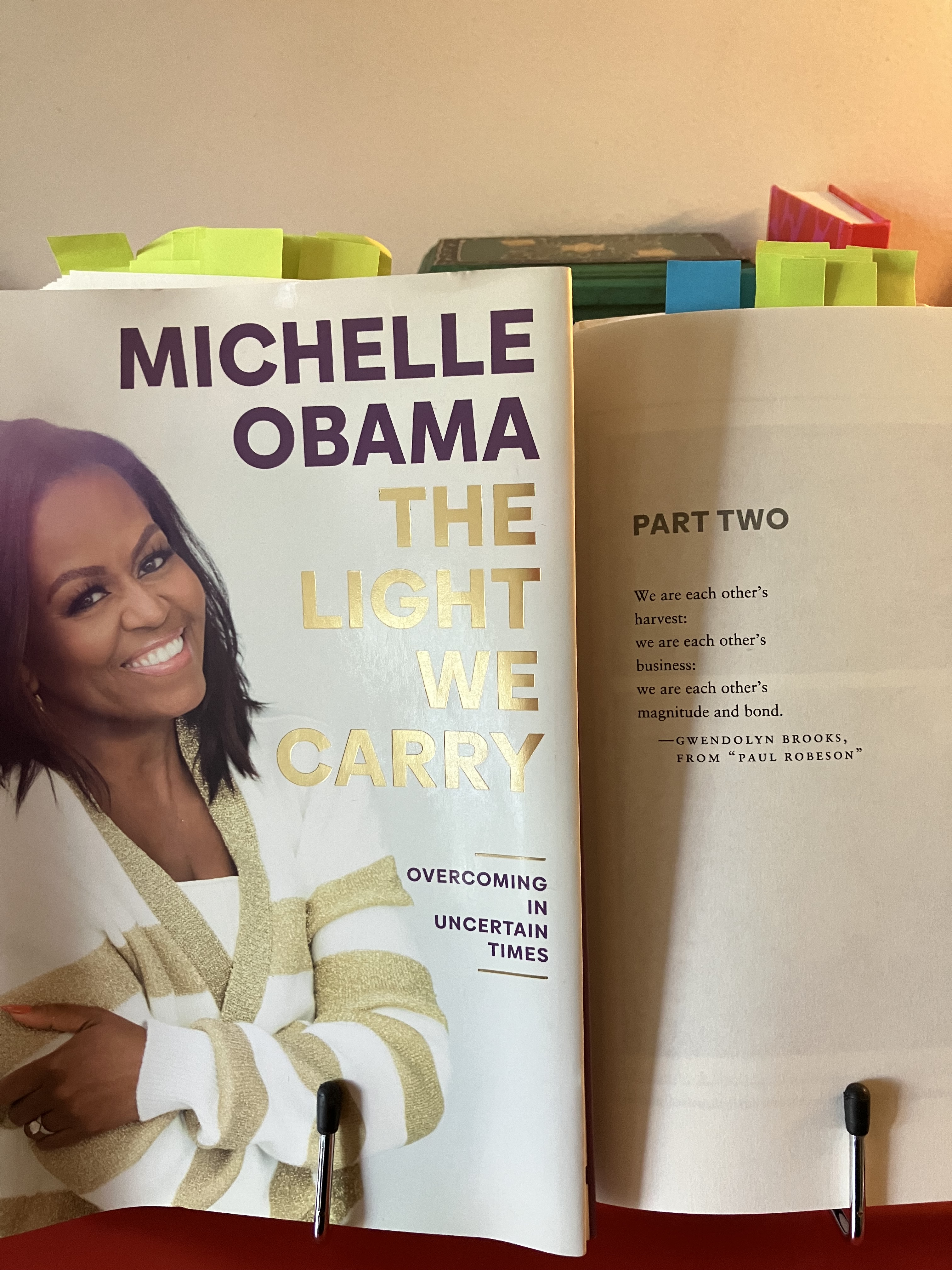
The Light We Carry, Part Two

This week’s blog post features some of the oh-yes-passages from part two of The Light We Carry by Former First Lady Michelle Obama. What do I mean by oh-yes-passages? Passages that resonated with me. Passages that made me pause and reflect. Passages that touched me in some way. 

(If you missed the blog post about part one, you can click here to read it.)

“I’m not sure how friendship, or even just engaging with another person in the three minutes it takes to buy your morning cup of coffee, has come to feel like a small act of bravery. But increasingly it seems that way. Perhaps, as I mentioned earlier, it’s because we now carry with us little rectangular shields against face-to-face sociability — our phones — which I think also shield us from serendipity. Any time we avoid even a small real-life connection, we are to some extent avoiding possibility.”

“When we drop our fears about newness and open ourselves to others, even through quick and casual interactions, even while masked — saying hello to someone in the elevator, for example, or chatting in a grocery line — we are practicing an important form of micro-connection. We’re signaling a general okayness between us, adding just a drop of social glue to a world that desperately needs it.”

“The best way to be a friend to someone, as I see it, is to revel in their uniqueness, to appreciate each person for what they bring, receiving them simply as themselves.”

“Over the course of my adult life, I’ve lived in a number of places, but as far as I’m concerned, I’ve only ever had one real home. My home is my family. My home is Barack.”

“Like a lot of people, I had ideas about what marriage would be like, and few of them turned out to be right.”

“Much as it is with marriage and partnership, the fantasy versions of being a parent sit at the forefront of our cultural imagination, whereas the reality is way, way, way less perfect.”

“Caring for your kids and watching them grow is one of the most rewarding endeavors on earth, and at the same time it can drive you nuts.”

Please note: I am including a link to buy the book that I’m highlighting this week. If you use my link, I do make a small commission on your purchase at no additional cost to you. I am working with Bookshop.org which also sends a portion of the profit to support local, independent bookstores.     

The Light We Carry, Part One

I am currently reading Michelle Obama’s The Light We Carry: Overcoming In Uncertain Times. And let me say, I am about halfway through the book and have many pages flagged with sticky notes. 

So rather than have one super-long post, I decided to share some of my favorite passages one part at a time. (The book is split into three parts.)

(Last week I wrote about buying a wheelchair and referenced a little bit from Mrs. Obama’s book. If you missed last week’s post, you can read it here.)

This week, allow me to share some of my favorites from Part One:

“That’s what tools are for. They help keep us upright and balanced, better able to coexist with uncertainty. They help us deal with flux, to manage when life feels out of control.” 

“What does it mean to be comfortably afraid? For me, the idea is simple. It’s about learning to deal wisely with fear, finding a way to let your nerves guide you rather than stop you. It’s settling yourself in the presence of life’s inevitable zombies and monsters so that you may contend with them more rationally, and trusting your own assessment of what’s harmful and what’s not. When you live this way, you are neither fully comfortable nor fully afraid. You accept that there’s a middle zone and learn to operate inside of it, awake and aware, but not held back.”

“Our hurts become our fears. Our fears become our limits.”

“Because what my mother showed me is that if you try to keep your children from feeling fear, you’re essentially keeping them from feeling competence, too.”

“The unknown is where possibility glitters. If you don’t take the risk, if you don’t ride out a few jolts, you are taking away your opportunities to transform.”

“What [Toni] Morrison was doing for her kids is what my own parents did for me: She was giving them a simple message of enoughness. She was validating their light, that unique bit of brightness inside each of them — literally showing them it was there and it belonged to them, a power they could carry for themselves.”

“My father, whose shaky demeanor and foot-dragging limp sometimes caused people to stop and stare at him on the street, used to tell us, with a smile and a shrug, ‘No one can make you feel bad if you feel good about yourself.’ “

Please note: I am including a link to buy the book that I’m highlighting this week. If you use my link, I do make a small commission on your purchase at no additional cost to you. I am working with Bookshop.org which also sends a portion of the profit to support local, independent bookstores.
An Unplanned Path

I am pleased to share that my personal essay, “An Unplanned Path,” has been published in the most recent issue of Cosmic Daffodil Journal. You can click here to read the essay in its entirety. (The theme was “NATURA,” and nonfiction submissions had a 300-500 word count limit.)

In addition, Cosmic Daffodil Journal has created a free e-book, which will soon be available for download on the website, so you can read all the fine pieces of writing included in NATURA

Bound by Love and a Zip Code

Nine years ago, my essay “Bound by Love and a ZIP Code,” was published  in the Los Angeles Times L.A. Affairs column.

I regularly read these columns and am always surprised/delighted/amused by the many different ways we search and find, or lose, love.

You may find it surprising that for quite a while I really didn’t think I had a romantic story to tell. In fact, it took me a while to see what was in front of me the whole time — the way my husband and I met and fell in love was pretty extraordinary.

This week, I’m pleased to share the essay with you. If you haven’t read it before, you can click here to read “A boundless love contained in a single ZIP code.” (Note – the digital title varies slightly from the in-print title.)

Julie and Julia

A few days ago, I was blindsided by the news.

Julie Powell had passed away.

I admit — my knowledge about Ms. Powell was largely limited to what I had read in her memoir, Julie and Julia: My Year of Cooking Dangerously, and what I had seen in the movie adaptation starring Meryl Streep and Amy Adams. 

I remember leaving the movie theater with my husband, and trying to decide what to go eat. (There really is no choice —  after watching the movie, you have to go eat.) I also remember my husband telling me I should start a blog, too.

At that time, my husband knew I enjoyed writing. He knew I wanted to write more. But he also knew that between my teaching career and our young son, there wasn’t a whole lot of extra time left for my writing.

But, because he knows me so well, my husband also knew that if I had a deadline, a self-imposed assignment, I would do what I needed to do to complete my assignment. 

That was the start of my first blog. A blog I called “Wendy’s Weekly Words.” A blog I published on Wednesdays to keep the W-theme going. A blog that was all over the place in terms of what I wrote about. 

Still, it got me to prioritize my writing time which got me writing on a regular basis. It led me to my current blog; the blog you’re reading now, which exists on my own website. 

And it all started from a movie that only existed because of the book that came before it.

And that’s the full-circle of this — words have power. The power to lift and inspire and encourage. 

The power to see a story unfold on-screen and think, maybe I could do that too

Julie Powell’s story did that for me. 

Rest in peace. 

These Precious Days

These Precious Days: Essays by Ann Patchett is one of those books that, while you’re reading, you stop and marvel at what you have just read. Not just the idea, but the way the idea was expressed. 

These Precious Days: Essays is one of those books you think about after you’ve finished reading it.

Though I admit, I struggled a bit in the beginning. Many of the essays seemed disjointed, and I couldn’t quite figure out how they fit together into one essay collection. I kept looking for the common thread, and it wasn’t until I was finished reading, that I realized I may have been looking too hard. 

“These precious days” — the phrase itself. Our days are precious. Whether it’s a chore day, a run-errands day, a have-coffee-with-a-friend day, all our days are precious. And sometimes, those days, my days, do feel disjointed.

Let me share with you some of the gems I marked as I read this book:

“The things we buy and buy and buy are like a thick coat of Vaseline smeared on glass: we can see some shapes out there, light and dark, but in our constant craving for what we may still want, we miss too many of life’s details.”

“I was an introverted kid, and not a strong reader. My grandmother had a stock of mass-market ‘Peanuts’ books she’d bought off a drugstore spinner. Titles like You’ve Had It, Charlie Brown and All This and Snoopy, Too were exactly my speed. I memorized those books. I found Snoopy in Paradise the way another kid might have found God.
Influence is a combination of circumstance and luck: what we are shown and what we stumble upon in those brief years when our hearts and minds are fully open.”

“Did I become a novelist because I was a loser kid who wanted to be more like the cartoon dog I admired, the confident dog I associated with the happiest days of my otherwise haphazard youth? Or did I have some nascent sense that I would be a writer, and so gravitated towards Snoopy, the dog-novelist? It’s hard to know how influence works. One thing I’m sure of is that through Snoopy, Charles Schulz raised the value of imagination, not just for me but for everyone who read him.”

“How I came not to care about other people’s opinions is something of a mystery even to me. I was born with a compass. It was the luck of my draw. This compass has been incalculably beneficial for writing —for everything, really— and for that reason I take very good care of it. How do you take care of your internal compass? You don’t listen to anyone who tells you to do something as consequential as having a child. Think about that one for a second.”

“I’d been afraid the stories of my youth would be as bad as my youthful poetry. I’d been afraid I’d somehow been given a life I hadn’t deserved, but that’s ridiculous. We don’t deserve anything — not the suffering and not the golden light. It just comes.”

“When I went to graduate school, hoping to be a writer, I had no idea that owning a bookstore was one of my career options. But I believe I’ve done more good on behalf of culture by opening Parnassus than I have writing novels. I’ve made a place in my community where everyone is welcome. We have story time and poetry readings and demonstrations from cookbooks. I’ve interviewed more authors than you could even imagine. Many of them sleep at my house. I promote the books I love tirelessly, because a book can so easily get lost in the mad shuffle of the world and it needs someone with a loud voice to hold it up and praise it. I am that person.”

“Where books are concerned, covers are what we have to go on. We might be familiar with the author’s name or like the title, but absent that information, it’s the jacket design — the size and shape of the font, the color, the image or absence of image — that makes us stop at the new releases table of our local independent bookstore and pick up one novel instead of another. Book covers should entice readers the way roses entice bees — like their survival depends on it.”

“In the twenty-six years that Karl and I had been together, I’d never had the experience of coming home to dinner being made. It was a minor footnote considering everything I got from Karl, but still, the warmth of it, the love, to walk in the door after a long two days and see that someone had imagined that I might be hungry knocked me sideways. This was what marriage must look like from the other side.”

Brighter By the Day

I’m a big fan of Robin Roberts and her books.  

In case you missed it, you can click here to read my blog post about her book From the Heart: Eight Rules to Live By

And you can click here to read my blog post about her other book Everybody’s Got Something

Which means I went ahead and ordered her most recent book Brighter By the Day: Waking Up to New Hopes and Dreams without even having seen the book in person.

I was not disappointed. My copy is full of sticky notes and many passages are marked with my highlighter. This book is really such a gift. And while we’re at it, Robin Roberts is really such a gift. 

It’s the way Ms. Roberts writes, as if she’s sitting down giving you a pep talk. Here are just a few gems to share with you:

“Yet here’s what I believe: Optimism is a muscle that grows stronger with use.”

“I’d like to pass on to you the gem my parents once gave me: You already have everything you need to forge a new path for yourself. I know you’re fierce, because it takes chutzpah to consider a new course. And I’m betting that you’ve got hope that tomorrow can be better, ‘cause otherwise, you probably wouldn’t have picked up this little tome.” 

“Confidence isn’t the absence of fear; it’s the presence of mind to move through the trembling.” 

“During my dual showdowns with cancer, I brought my gratitude A game. I knew I had just two plays: I could allow the illness to destroy and define me, to permanently cripple my spirit. Or I could embrace the experience as a rebirth, as a butterfly struggling against the walls of its cocoon, and getting stronger as it does.” 

“People often see the glass as half-empty or half-full. I simply see the glass.” 

“Do you want it more than you fear it? It’s what I now ask myself whenever trepidation makes a house call.” 

“We may not ever fully comprehend why catastrophe has befallen us, and that’s okay. Our job isn’t to comprehend it. It’s to redeem it for good.”

“My village — not an absence of fear — got me through the most harrowing two ordeals of my life-time. That is why I know this: Strength, the real kind, isn’t about braving the behemoths on our own. It’s about being willing to receive — to embrace the help, hope, and healing others want to give us. Vulnerability is the gateway to fortitude. An ever-deepening intimacy with those we love is the enduring treasure.”

“When I’m dealing with a situation I think is all-important, I put it through a litmus test: In a year or two, will this matter? Often it won’t, even in a few months. That awareness changes my perspective and re-anchors me in the present.”

“That’s part of what it means to be brighter by the day: to be mindful of every breath we’re given. Don’t rob yourself of that treasure.”

Giannis

“How’s the book?”

“It’s good,” I said as I held it up and showed it to the barista. He had just brought out my blended mocha and set it down on the table for me.

“It’s about Giannis, the basketball player,” I said.

“Oh, basketball,” he said it with a bit of a question in his voice.

It might not seem like a book I would pick up. Especially if you checked out my Goodreads record and saw the last book I read was Jasmine Guillory’s The Wedding Date.

I try to alternate, reading fiction and nonfiction. And when it comes to nonfiction, I enjoy reading memoirs and biographies. Because I believe everyone has a story. The specifics may vary, but in those specifics you tend to find the universal.

So now I’m reading Giannis: The Improbable Rise of an NBA MVP by Mirin Fader. (In case you don’t know, Giannis Antetokounmpo plays for the Milwaukee Bucks. In 2021, they won the NBA Championship.)

On the surface, Giannis and I don’t have much in common. 

But that’s okay. That’s more than okay. That’s why books are so valuable. They give us the chance to take a peek at someone else’s life. To realize the many ways we are similar. To acknowledge that what you see on the surface is rarely the full story.

My family and I are basketball fans. While we always root for our Los Angeles Clippers, we are admirers of the game and those that play with heart and soul. 

Players like Giannis. 

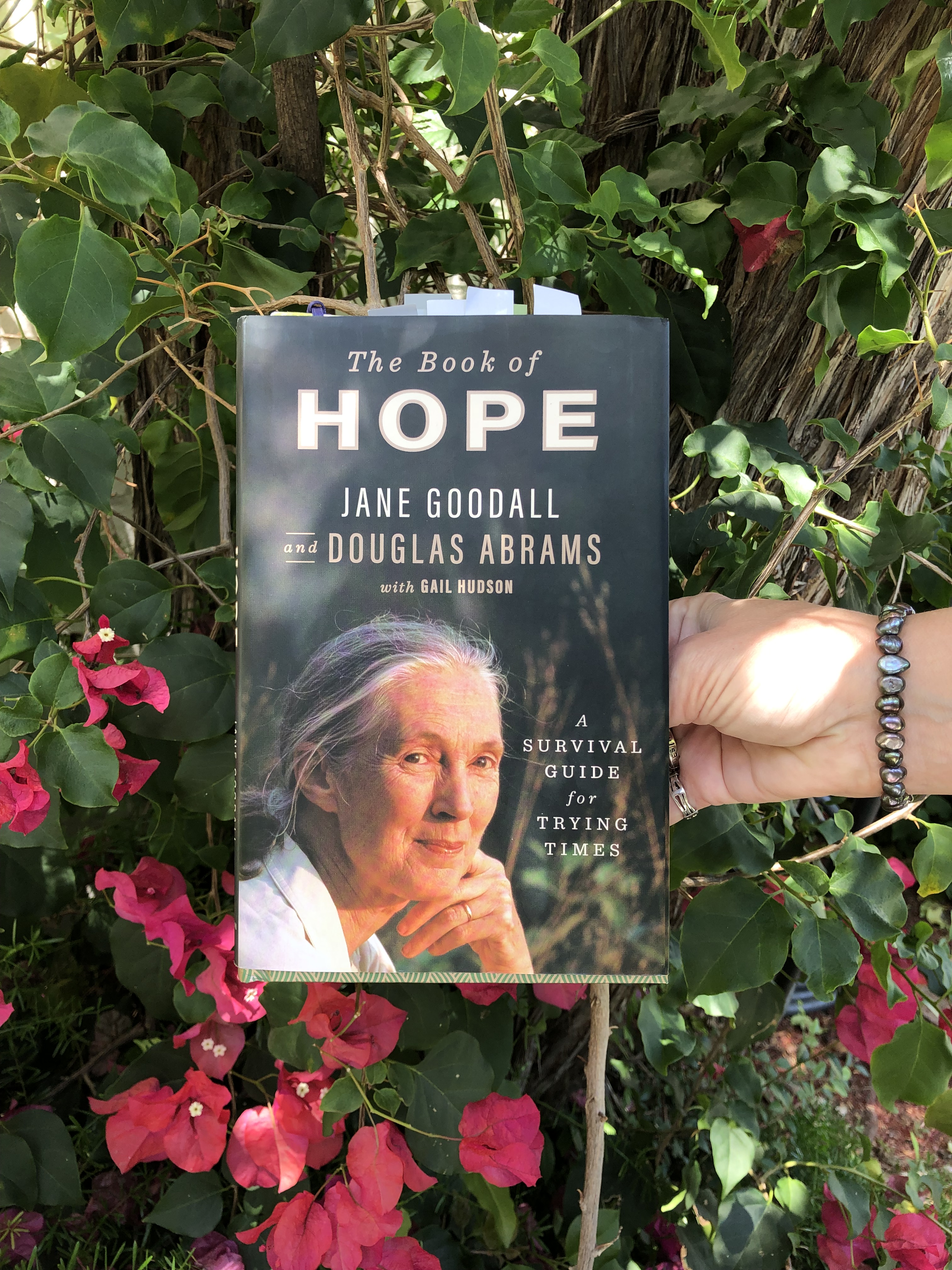
The Book of Hope

How do you explain “hope”?

In The Book of Hope by Jane Goodall and Douglas Abrams with Gail Hudson, Dr. Goodall describes hope as “what enables us to keep going in the face of adversity. It is what we desire to happen, but we must be prepared to work hard to make it so.”

This book was written during the pandemic, a time when it sometimes felt like all we could do was hope; hope to stay healthy, hope to stay safe, hope for a vaccine. 

This is a powerful book with a powerful message, and this week I’m sharing some of my favorite passages.

“You won’t be active unless you hope that your action is going to do some good. So you need hope to get you going, but then by taking action, you generate more hope. It’s a circular thing.”

From Douglas Abrams, “I was surprised to learn that hope is quite different from wishing or fantasizing. Hope leads to future success in a way that wishful thinking does not. While both involve thinking about the future with rich imagery, only hope sparks us to take action directed toward the hoped-for goal.”

“The trouble is that not enough people are taking action,” Douglas Abrams said. “You say more people are aware of the problems we face — so why aren’t more trying to do something about it?”

“It’s mostly because people are so overwhelmed by the magnitude of our folly that they feel helpless,” Jane Goodall replied. “They sink into apathy and despair, lose hope, and so do nothing. We must find ways to help people understand that each one of us has a role to play, no matter how small. Every day we make some impact on the planet. And the cumulative effect of millions of small ethical actions will truly make a difference. That’s the message I take around the world.”

“Jane’s stories affirmed that when we feel we can make a difference, and we’re given the means to do so, positive outcomes can happen that in turn allow hope to prevail. It was a powerful example of what the research had found contributes to hope: clear and inspiring goals, realistic ways to realize those goals, a belief that one can achieve those goals, and the social support to continue in the face of adversity.”

“From talking with Jane and doing my own research, I was starting to see that hope is an innate survival trait that seems to exist in every child’s head and heart; but even so, it needs to be encouraged and cultivated. If it is, hope can take root, even in the grimmest of situations…” from Mr. Abrams.

“Well, I always knew I had a gift for writing,” Jane added. “From an early age I was writing — stories, essays, poems. But I never thought I had a gift for speaking. It wasn’t until I was forced to make that first speech, and found that people were listening, and heard their applause at the end, that I realized I must have done okay. I think many people have gifts that they don’t know about because nothing forces them to use them.”

“That when the trials of life come, you’ll be given the strength to cope with them, day by day. So often I’ve thought at the start of a dreaded day — having to defend my Ph.D. thesis, giving a talk to an intimidating audience, or even just going to the dentist! — ‘Well, of course, I shall get through this because I have to. I will find the strength. And, anyway, by this time tomorrow it will be over’.”

Readers – I wrote this blog post before the horrific school shooting in Texas. I wrote this blog and now am re-reading it with a broken heart. Hope — it’s more than just wanting things to change. I hope my son will grow up reading about gun violence in history books, as something that used to happen, not reading about it in the newspaper because gun violence remains a current event. Hope involves action. For me, now, that takes the form of voting. Continuing to Vote in Every Single Election. And I hope my readers feel the same way.

Life Glows On

The first book I finished reading in 2022 is Claire Cook’s nonfiction book Life Glows On: Reconnecting With Your Creativity to Make the Rest of Your Life the Best of Your Life.

It’s a book about acknowledging all the ways we express ourselves creatively. It’s also about acknowledging the need for, and the benefits of, dedicating time and energy to a creative project.

I love Ms. Cook’s definition of creativity:

“Creativity is the box of crayons we use to tell our story, and in telling our story we figure out who we are.” 

And I love this recommendation:

“Every day, do one good thing. And after that, give yourself permission to do one creative thing for yourself.” 

Then there’s this bit of motivation:

“Being creative is about touching hearts. It’s about finding our own heart. It’s about tapping into our past and remembering the unique experiences and insights that make us who we are. It’s about flipping our adversity and challenges and experiences into a point of view, a vision, a style, a voice. It’s about standing strong in our authenticity and individuality and distinctiveness.”

I also enjoyed this paragraph about one of the benefits of getting older:

“Because the coolest thing about getting older is that we really can just be whoever the hell we want to be. If we’re lucky, we’ve stopped caring so much about pleasing the rest of the world. Nobody can tell us who we are. Or who we aren’t.”