A Small, Attainable Luxury

I’ve written before about one of my favorite not-at-home writing spots. (If you missed it, you can click here to read my post, “A Bit of Serendipity.”)

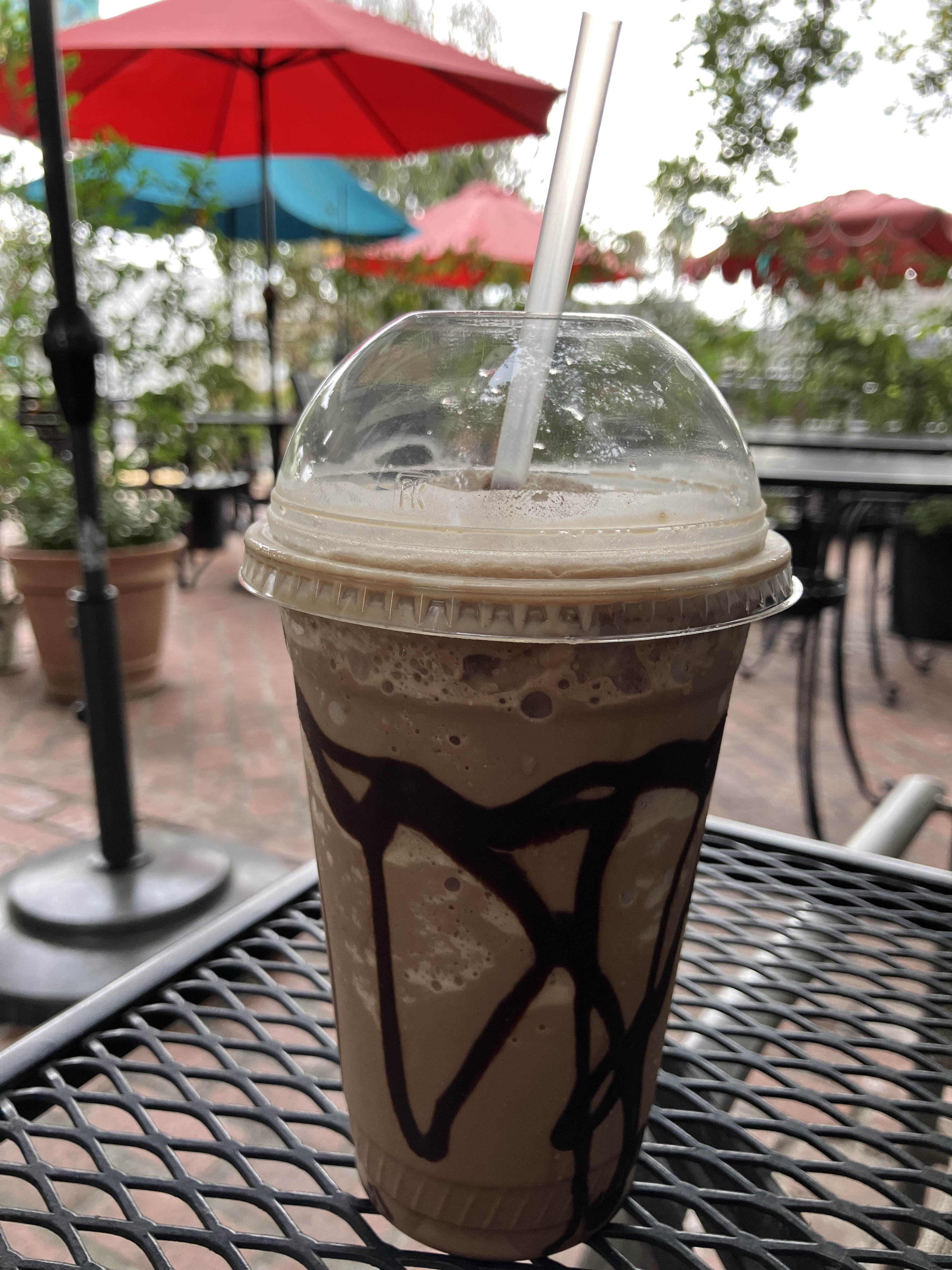
This week, I have a confession to make regarding this cafe: It is here, that I order the most expensive blended mochas I have ever had. 

I’m not sure why these drinks are so expensive, or why they cost more than their counterparts at Starbucks, Coffee Bean, or my local neighborhood indie coffee spot. The price of the beverage is high enough that it initially gave me reason to pause and wonder if I should keep spending my time, and my money, here. 

And the answer is yes

Yes, I most definitely should keep spending my time and money here at this cafe. 

Here’s why:

First off, I enjoy the blended mocha. I like that I can drink it slowly, throughout my writing time, and savor the yumminess. I like the chocolate swirls on the inside of the cup. It makes the drink look fancy, and not like your standard blended mocha. 

I appreciate the “writing cocoon” I create for myself at this cafe. Unlike my local neighborhood cafe, I don’t run into neighbors here. I don’t spend any of my writing time chit-chatting with others. I come here to read and write, and that’s what I do. Distractions are minimal and are generally limited to occasional loud talkers. 

I’m productive at this cafe. I set up my writing space, and I get to work. And by the time I pack up to go home, I am so pleased with my output. 

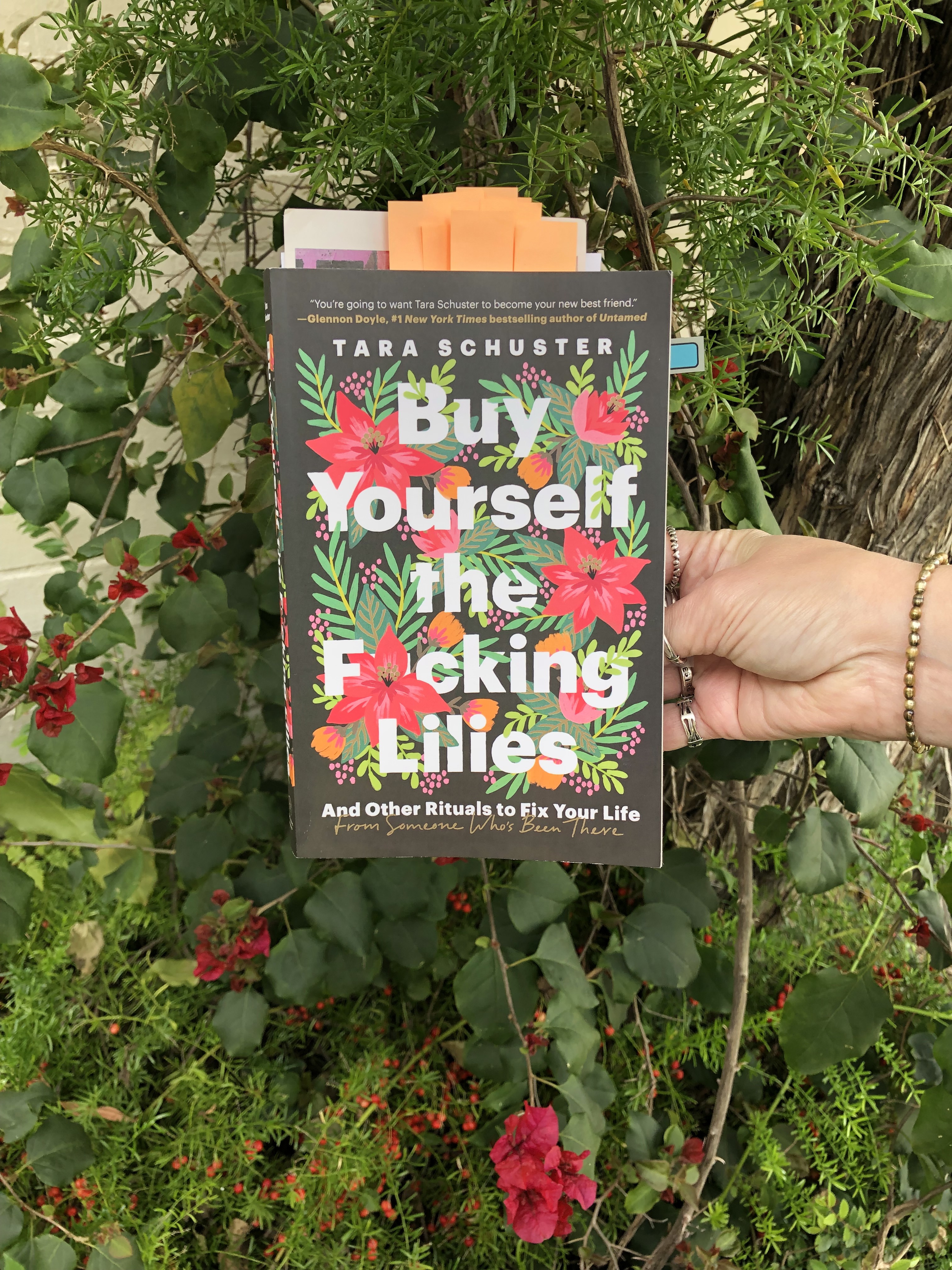
And, there’s something else. Something I read in Tara Schuster’s Buy Yourself the F*cking Lilies

Buy the fucking lilies.  You are worth seven-dollar lilies. You are worth the thing that instantly makes your life better. I’ve heard people talk about their favorite exercise class this way. I’ve heard people talk about an order of guacamole with their tacos this way. I’ve heard people talk about the ten-dollar, ten-minute massage at the nail salon this way. That small, pleasurable thing that makes you feel like you are treating yourself — do not deprive yourself of this. Buy the fucking lilies, take the class, order the guac, get the massage.”

“Above all else: You are worth the lilies. The small, attainable luxury of lilies is not something to stress about, it is not something to deny yourself, it is something to make plans for and embrace. Small things that make you happy ARE a part of taking care of yourself.”

“Seven-dollar lilies won’t ruin you and they won’t make you poor; they will make you stronger. You are stronger when you treat yourself well.”

Readers, what are your “lilies”? In addition to blended mochas, I would add flowers (usually from Trader Joe’s), candles, and books as other “small things” that make me happy. I’d love to know what your “small, attainable luxuries” are. Feel free to share in the comments. 

Please note: I am including a link to buy the book that I’m highlighting this week. If you use my link, I do make a small commission on your purchase at no additional cost to you. I am working with Bookshop.org which also sends a portion of the profit to support local, independent bookstores.

Questions and Clues

I sign up for many writing-related webinars (mostly free, though some are fee-based), and I like to watch interviews with authors on YouTube. I consider myself a life-long student, and have found the writing community to be very generous when it comes to sharing information and advice and encouraging other writers. 

I attend these webinars and watch these videos in my quest to learn more about building a writing career. As I continue to query literary agents, I have been learning about establishing and maintaining an author newsletter (something I plan to do in the future, so stay tuned!), creating a readership, and the different types of marketing options available for writers. 

A couple of weeks ago, I watched two different writing-related videos, featuring two different authors, and both videos left me with questions I haven’t been able to stop thinking about.

One author was asked how she shows herself self-compassion. I thought it was an interesting question for an interview. The memoir author spoke first of acknowledging the difficulty in writing about painful experiences. Writing memoir, particularly writing about a traumatic experience, requires a very different mindset than writing a scene in a romantic-comedy, for example. The author spoke of giving herself breaks, and being very intentional when it came to planning her writing time. She knew she would need to strategically plan when and where she’d engage in this writing, and then give herself the space and time needed to rest afterward. 

In another interview, a different author was asked what she does to nurture her resilience.

The questions stumped me. Me, who is seemingly always writing or thinking about writing, was at a loss for words. 

Do I show myself self-compassion? Probably not nearly as much as I should. 

Do I nurture my resilience? Honestly, I’m not a hundred percent certain what that means or how that would look. 

But that’s what I’ve been thinking about. Those are questions that I can’t seem to let go.

Then over the weekend, as I tried to make my way through a full inbox, I read agent Kate McKean’s latest Substack post titled, “Compulsory Rest.” This sentence stood out to me: “The universe is going to do what it’s going to do—and all you can do is make sure you’re taking care of yourself the best you can.”

She’s completely right. I like to think I’m in control, with my lists and schedules and dinner meals planned out a week in advance. But really, the truth is, I’m not at all. There is actually little I can control, and when it comes to my own body, there’s really very little I have control over. 

It’s been hard. “It” meaning life, though I hesitate to put that in writing. Thankfully, my family is healthy and safe. We are not worried about having enough food in the fridge or a roof over our heads. We are lucky, fortunate, blessed in so many ways. 

And yet, life has been hard.

I feel like these interview questions and this Substack statement are like clues. Clues from multiple sources and multiple people. Clues I am paying attention to. 

But, also, clues I’m not  entirely sure what to do with or how to use them as a springboard for changes in my daily life.

Anyone else feel that way?

A Bit of Serendipity

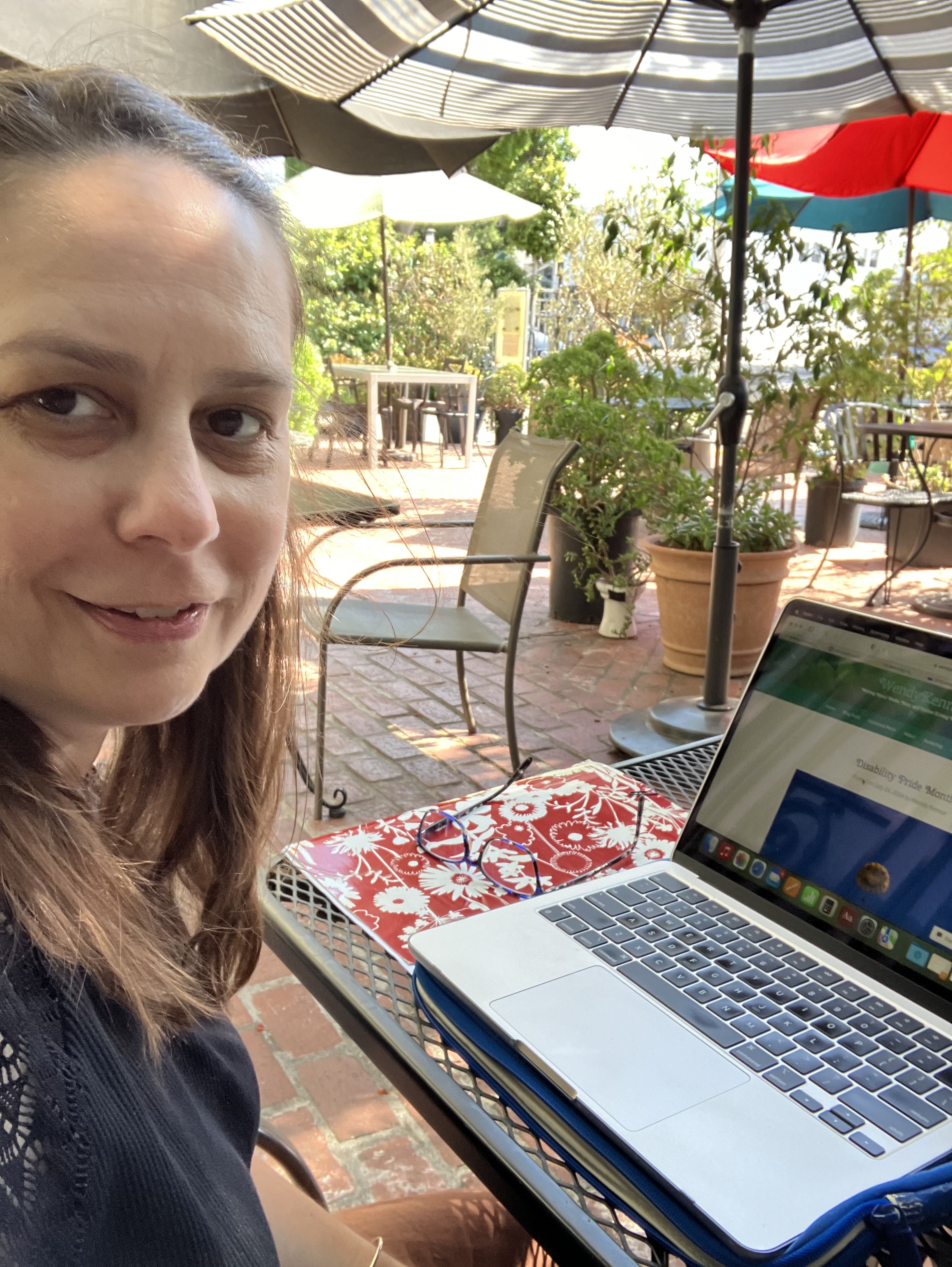
I took this photo during last week's writing session.

Last week I spent time at one of my favorite not-at-home writing spaces; a cafe serving a yummy ice blended mocha, and providing many tables and chairs on a large patio with plenty of shade. 

This week, I wanted to share something that happened during last week’s visit.

Two women sat at a table close enough to me that I could overhear bits and pieces of their conversation without even trying. It felt serendipitous that of all the available tables, these two women sat near me. After all, I was sitting off to the side, near a wall, trying to distance myself from any loud chatter and distractions. 

Within a few minutes, I learned the two women were middle school science teachers. I heard them talking about sixth grade, about sedimentary rocks and fossils, about a project requiring a long roll of adding machine paper. (And I admit to feeling old when one of the teachers had no idea what adding machine paper even was.)

These two teachers spent their own time lesson planning. These were “off-the-clock” conversations. Because that’s what teachers who are passionate about teaching do. Your teacher brain is never really off, and teachers don’t actually get “the whole summer off,” as many non-teachers believe. Teachers are always working in some shape or form. It brought back memories of my own lesson planning days and the blended mochas my closest teacher friend and I used to enjoy while brainstorming and planning for our fourth graders. (I’m thinking of you, Nance!)

As if that wasn’t enough, after a bit of quiet individual work time, the two teachers began chatting again. I heard different phrases this time — it’s so lonely, I look fine on the outside, many people don’t get it.  

I learned that one of the teachers lives with an invisible illness. The other teacher’s partner lives with an invisible illness and was asking questions about how to best support a chronically ill loved one. 

I momentarily sat there in shock. 

What were the odds? 

Not only were these two women teachers, they were also among the target audience for my memoir! (My target audience includes those living with chronic illness, especially invisible illnesses, both physical and mental, as well as friends and families of those living with chronic illness.)

That day at that cafe, I had spent a portion of my writing time researching literary agents to query my memoir-in-essays. 

And then these two women entered the outer edges of the writing cocoon I create for myself at this cafe. 

I took it as a sign.

Working Towards That One Yes

Twenty years ago this month, I earned my first byline

And not just any byline, but a byline in the Los Angeles Times

It all felt so easy. I wrote a personal essay. I submitted it to the Times. They published it soon after. 

The publication happened not too long after I had taken a weekend course about writing the personal essay through the UCLA Extension Writers’ Program

That class was the first of many I would take in the Writers’ Program. I got incredibly lucky, because Barbara Abercrombie was the instructor for that class. (If you’ve read my blog for a while, you know I have written about Barbara and credit her with helping me find my way as a writer. You can click here to read the tribute post I wrote after learning of Barbara’s death.)

Since that first publication, I have learned that writing and publishing aren’t often that easy. In reality, I may have to submit a piece to several different websites and/or print journals, before it finds a home. Sometimes I don’t find a home for a particular essay, and I have to put it away for a bit and move on with writing something new.

Now twenty years later, I am having a whole new writing experience. While I continue to write for MomsLA.com, and write these weekly blog posts, and write personal essays to answer a variety of submission calls for both print and online publications, I am also querying literary agents. 

Querying requires a whole different type of focus and time commitment. After all, I am searching for the person who will not only be an advocate for my memoir, but also an advocate and supporter for my writing career. 

So far, I have queried 58 agents.

So far, I have received 15 rejections — which does not include those agents who state on their website something along the lines of, “If you haven’t heard from us in 10-12 weeks, consider it a pass.”

It’s just a part of the process. Because it really doesn’t matter how many no’s I receive. 

All it takes is one yes

Something to Endure

My memoir is divided into three parts.
The final essay in this part, and the book, is
"Something to Endure."

Super exciting news:  my manuscript is complete, and I will now be entering a new stage of the writing process — the querying-agents phase. 

But before I got here, when I was revising and rewriting my manuscript, I had to make a decision regarding my final essay. I had three essays that my book coach and I agreed were all possible candidates for that all-important last essay in the book.

It is my hope that my memoir will be read by those living with chronic illnesses, as well as those who know people who are living with chronic illness. I’m hoping that my story can serve as an example. Though the medical specifics may vary, the emotions may be quite similar. So someone who lives with diabetes, for example, could give my book to a loved one, point to one of my essays, and say, “Here. Read this. This is what I feel like sometimes.” 

For far too long, terms such as “disability” and “disabled” have been too narrowly defined. I really want my memoir to broaden those definitions, and I would like my story to serve as just one example of what a disabled life looks like.

When I started working with my book coach, I told her I was writing the book I needed to read when I became ill. I hope after reading my memoir that my chronically ill readers feel less alone and more understood. Along those lines, I want my final essay to give readers a sense of comfort, a dose of good-feels. 

Before making my final decision, I stopped to reflect and think about how I want my readers to feel when they’re done reading my memoir-in-essays. 

These were the adjectives that I came up with:

Hopeful.

Enlightened.

Inspired.

Comforted. 

With that in mind, I made my decision (and my book coach agrees). My final essay is titled “Something to Endure.” Because basically that is the bottom line when it comes to chronic illness. You have to endure the illness. You need to stick it out and figure out ways to handle it, to be with it day-in and day-out for the long haul.

But you don’t have to do it alone. Books, including my own, connect us.

My Word for the Year

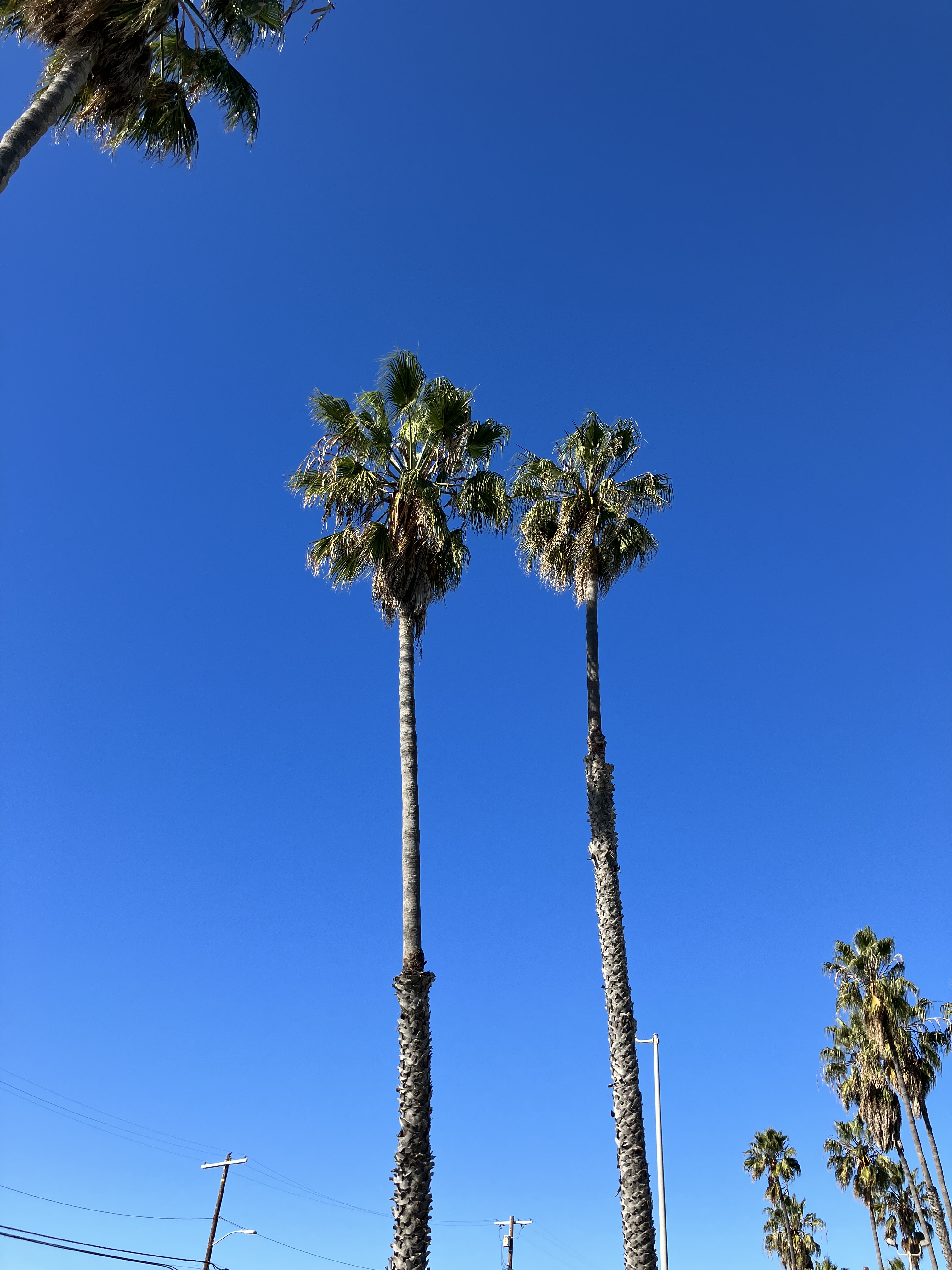
Photo of bright blue sky and two palm trees
Photo taken at the beach on New Year's Day 2024

Last week, I read a blog post written by writer and book coach Monica Cox. She wrote about picking a word for 2024, a word that is in sync with her goals for this year.

It got me thinking. I’ve never chosen a word for the year. Yet, as I was about to do my daily five-minute writing exercise, a word suddenly popped into my mind. A word that perfectly matches with my goals for the year — writing-related goals as well as life-related goals.

My word is Share

2024 is the year I will query agents, the first step in sharing my memoir-in-essays. 

An agent will then help my manuscript reach publication, which will allow my story of living with an invisible disability to be shared with readers. 

I am ready to share my story, ready to make the invisible visible.

And, there’s another way I hope to share this year. 

I am working on more openly sharing my feelings. Instead of biting my tongue and holding things in, I will try to honestly share what I’m really thinking and how I’m really feeling. 

My tendency to not always share is a result of my inclination to keep the peace, to not upset anyone. I keep so much inside, trying to pretend I’m feeling better than I am, trying my best to take care of those around me.

But, in 2024 I aim to share — my pain, my feelings, my story.

Dear Readers, do you select a word for the year? If you feel comfortable, you can “share” your word in the comments. Thank you!

My Spoonie NaNoWriMo

If you’re a fiction writer, or live with a fiction writer, you’re most likely familiar with NaNoWriMo, which is the abbreviation for National Novel Writing Month. NaNoWriMo takes place each November, with writers committing to work towards the goal of writing the draft of an entire novel (50,000 words) in one month. 

NaNoWriMo started back in 1999, and since then it has become a worldwide phenomenon. Writers find community, encouragement, resources, and support by participating and connecting with other writers going through the same process.

I don’t write fiction, and the sheer number of daily words required (50,000 words over 30 days works out to about 1,667 words a day) didn’t feel attainable for me, so I never participated in NaNoWriMo.

Until this year.

And it’s all because of Sandra Postma. (You may remember I wrote about Sandra and the incredible work she does as a Book and Spoonie Coach  in a blog post back in October. In case you missed it, you can click here to read the post.)

On her Instagram, Sandra encouraged spoonie writers to participate in NaNoWriMo in a way that worked for each of us. She pointed out that as people who live with chronic illness, we’re accustomed to modifying a variety of activities. Why should NaNoWriMo be any different? Sandra encouraged us to participate in a Spoonie NaNoWriMo — one with individual goals that work for each writer. That I could do. 

Being a former teacher, I printed out the goals I set for my NaNoWriMo, as well as a November calendar. Each day I met my goal, I put a sticker in the calendar box. (Again, former teacher. Plus I had all these cute stickers on-hand.)

My Spoonie NaNoWriMo Goals, as I printed them out:

Each day in November I will:

Complete a 5-minute writing exercise.

Write down one statement, acknowledging something I did, 

something my body was strong enough to do.

And I did it! (Note all the stickers!)

It certainly wasn’t easy. There were days I was tempted to skip the whole thing, but I’m glad I didn’t. The hardest part was the daily statement, a note of appreciation and gratitude for things my body is still strong enough to do, because I’m not used to highlighting myself in this way.

My statements tended to acknowledge a “bigger” outing or activity — taking down and putting away our Halloween decorations, decorating for Thanksgiving, grocery shopping (though I no longer do that by myself), a longer walk in the neighborhood. 

While those “bigger” activities were worth documenting, writing this list helped me see how hard I work each day, how much I continue to do each and every day, and all while my pain has consistently been more and more intense.

For instance: I make the bed each morning. I pick up my own prescriptions at CVS. I shower each night. I never skip brushing my teeth. I get dressed each day, complete with my daily jewelry (nine rings on eight fingers, bracelets, earrings, necklace). 

The unexpected result of my Spoonie NaNoWriMo is the feeling of achievement and pride — in my writing, yes, but also in myself! 

Dear Readers, anyone else participate in a version of NaNoWriMo? How did it go for you? Let me know in the comments.

A Safe Space

“I foolishly thought having an autoimmune disease would be no big deal. I thought it was something that would fade into the background, behind more important things like my family and career. I thought Undifferentiated Connective Tissue Disease (UCTD) would be another footnote in my medical history, along the lines of my allergy to penicillin. I disclose my allergy any time it’s relevant, explain about the hives that develop, and when necessary, wear a hospital bracelet identifying “allergy.” But on a daily basis, my allergic reaction to penicillin isn’t a big deal. I don’t give it much thought. I assumed having UCTD would work the same way.

Wrong.”

The paragraphs above are excerpts from my personal essay, “A Safe Space.” And I’m proud to share “A Safe Space” has recently been published in Wishbone Words, Issue 11. You can access the issue by clicking here.  (Just a note – there is a slight fee to download the issue.)

Write For Your Life

I read for many reasons. To be entertained and inspired. To learn and grow and find comfort in someone else’s words.

I write for many reasons, too. Which is why I was curious to read Write For Your Life by Anna Quindlen.

While many people might not consider themselves writers, Ms. Quindlen believes everyone has a story worth writing down. I agree. 

In addition to Ms. Quindlen’s words, the book also has some writing-related quotes as well as some prompts for writing exercises. Here are some of my favorite bits from Write For Your Life:

“We write to taste life twice, in the moment and in retrospect.” — Anaïs Nin

“While you have to mentally re-create what happened on a phone call — ‘Did she really say that?’ — you can actually reread a text. But much of that tech prose online felt so spontaneous as to be slapdash, unexamined. It’s why people will often say, when reminded of an email or an online post, that they can’t really recall writing it. Every day, unthinkingly, our lives can slip through our fingers in a cascade of computer code. Texts are like footprints in sand. By evening the tide has come in, and we are left alone.”

“The urge to get it exactly right often stands between you and beginning. ‘Don’t get it right, get it written’ demands composition first, cleanup later. The paralysis of perfectionism is a terrible ailment that can seep into so much of our daily lives. In writing, what it leads to is an empty page, and an empty page is neither good nor bad. It’s nothing. Honestly, if the choice is between an imperfect something and nothing — well, that’s easy, isn’t it? Get it written. You can get it right later.”

“Something written by hand brings a singular human presence that the typewriter or the computer cannot confer. There’s plenty of good writing done that way, but when you simply glance at the page, it could be the work of anyone. But when you’ve written something by hand, the only person who could have done it is you. It’s unmistakable you wrote this, touched it, laid hands and eyes upon it. Something written by hand is a piece of your personality on paper. Typed words are not a fair swap for handwriting, for what is, in a way, a little relic of you.” 

“I’m not sure writing about things always makes us feel better, but perhaps it sometimes does make loss, tragedies, disappointments more actual. It can turn them into something with a clearer shape and form, and therefore make it possible to see them more deeply and clearly, and more usefully turn confusion and pain into understanding and perhaps reconciliation. On paper our greatest challenges become A Real Thing, in a world in which so much seems ephemeral and transitory.”

“Butt in chair. That’s the piece of direction I give to anyone and everyone who wants to write, who is thinking about writing, who is asking how it’s done, who is fearful of and intimidated by the act. It’s not poetic, and it doesn’t bespeak inspiration. What it does suggest is a way into what is not a mystery but a process, a way into the story of yourself.”

Please note: I am including a link to buy the book that I’m highlighting this week. If you use my link, I do make a small commission on your purchase at no additional cost to you. I am working with Bookshop.org which also sends a portion of the profit to support local, independent bookstores.

The Healing Journal

I recently finished working my way through Emily Suñez’s beautiful book The Healing Journal: Guided Prompts and Inspiration for Life with Illness.

If you read my blog on a regular basis, you might remember that twice before my blog posts were inspired by prompts in this lovely book. (You can read “I Am Alive With Creativity” by clicking here, and “My Illness Does Not Define Me” by clicking here.)

I finished reading the book and answering the writing prompts, but I haven’t finished healing. And that’s part of what makes life with a chronic illness so complicated. You never really completely heal from a chronic illness. 

There is no finish line. No specific treatment plan in place, that once you work through all the steps you’re “better.” It doesn’t work that way for me. It doesn’t work that way for a lot of people. There is no ideal world of “fully healed” to strive for. 

What I have found in the more than-a-decade that I have lived with my autoimmune disease, is that healing is a continuous process. Just as my symptoms go through periods of flares and remission, my feelings about my invisible disability ebb and flow as well.

My illness, and my healing, will forever be a part of me.