One object you’ll pack up and move with you, no matter where you’re moving.
One object that is meaningful enough to hold on to, forever.
One object that brings you “joy, magic, and meaning”?
It’s not an easy question to answer.
But it certainly made for an interesting book.
Bill Shapiro and Naomi Wax have compiled that book. They asked people, from all walks of life, who live all across the country, that question. I recently completed reading that book – What We Keep: 150 People Share the One Object that Brings Them Joy, Magic, and Meaning. I found myself intrigued by these individuals, the glimpses into their lives, the objects they chose.
And, of course, it got me wondering, what would I pick?
There is my wedding photo album. My son’s baby book.
There is a childhood doll packed away in a box on a shelf in my closet. She had two names – Lovey and Jill. (I don’t remember why she had two names.)
There is a ceramic mask I painted and decorated when I was in junior high or high school and had a collection of ceramic masks hanging on my half of the walls in the bedroom I shared with my sister.
But I think the object I would pick would be my signed picture of Sally Ride.
When I was in the fourth grade, and until I was in high school, my career goal was to become an astronaut.
I wrote to Sally Ride. Though I don’t remember what I wrote.
And she answered me with an 8×10 photo, her NASA photo, signed to me: “To Wendy, Good Luck! Sally Ride.”
Now, that picture is framed and hanging in my writing room. She is there, smiling down on me, encouraging me, believing in me. (Some would call it an “office;” I prefer “writing room.”)
Readers, I’d love to know. What object brings you “joy, magic, and meaning”? Feel free to share in the comments section.
“It still isn’t easy for me to describe myself as a disabled woman. For a long time I didn’t think a disabled woman sat on the ground pulling out weeds. Or played handball with her son. Or helped her elderly neighbor carry in groceries. But I do all those things. Because being a disabled woman doesn’t look the same for every woman. And it doesn’t look the same for me each day.”
That paragraph is taken from “It’s Not All in the Family,” a personal essay I wrote that was published in the fall issue of Breath and Shadow. You can read the essay by clicking here.
(Check out my Published Work page to be re-directed to some of my published A to Z Lists including “The A to Z List of Verbs Teachers and Students Practice Daily,” “The Alphabetical Prescription for Living with a Chronic Medical Condition,” and “The A to Z List of Boys,” to name just a few.)
A novel written entirely in list form. And through these lists the reader learns about Dan – a former teacher, current bookshop owner, a husband, and soon-to-be dad.
These lists are honest. Charming. Amusing. Authentic.
Here are just a few tidbits from the book’s lists I’d like to share with you this week:
“Reasons I quit teaching
– Couldn’t continue to witness bad decisions at the expense of children
– Couldn’t stand one more minute of professional development that was neither professional nor developmental”
“My teaching beliefs
– Teachers must be reading and writing on a regular basis in order to be effective teachers of reading and writing.
– Teachers must think of parents as full and equal partners in the eduction of the child.
– The most important lessons taught by teachers often have little or nothing to do with academics.”
“Words that belong on a child’s T-shirt
– Are you really going to rob me of my precious childhood with this meaningless worksheet?”
“21 Truths About Love
– To truly love someone, you must love the person you never knew, the person you know today, and the person that will someday be.
– Love does not make everything better, but it makes everything a little easier.
– ‘I love you’ are three simple words that we whisper to lovers in the dark, say to dogs that don’t speak English, cry out during sex, speak to the dead while standing over their gravestones, tell parents before hanging up the phone, and repeat again and again to the people whose lives are gloriously intertwined with our own.
– Love makes you do the stupidest, bravest, most ridiculous and idiotic things in your life. It makes you scared and crazy and crazed and joyous. Love is all the feelings.”
Let me begin by saying I write these weekly blog posts in advance. You receive them in your inbox each Wednesday morning, but I write them before Wednesday.
Which means what you’re reading today has been written before the results of the United States election were made available.
So I don’t know what this morning looks like. I don’t know what the election results show.
But I’m hopeful.
And really, with so much uncertainty in the world, that’s all anyone can really do. Begin each day hopeful. Begin each day with the awareness and recognition that, no matter what, each day is a gift.
I try.
Hanging in my bathroom, I have a small, framed piece of art created by Flavia Weedn. It is a reminder to appreciate each day as a precious gift. It is a reminder that each day is a promise of beauty and grace and wonder and magic.
March 1, 2013. My last day as a public school teacher.
“ ‘Can you still teach?’ ”
‘Kind of,’ I answered.
‘You either can or you can’t. We can’t continue with this process if you can still teach.’
It was November 2012, and I didn’t know how to respond to the CalSTRS (California State Teachers‘ Retirement System) representative sitting across from my husband and me.
‘Can you still teach?’
There was a part of me that could still teach, that still wanted to teach. I’d only been teaching for twelve years. I wasn’t supposed to be looking into retirement this soon.
But this wouldn’t be a traditional retirement. This would be a ‘retirement due to a disability.’
Could I still teach? ”
The words above are taken from “Could I?, Should I?, Would I?” a personal essay that was recently published as part of Amsterdam Quarterly’s twenty-ninth issue “Choices.”
You can click here to read more about the story behind my decision to retire from my teaching career back in 2013.
A young child might think a non-green tree is weird.
Let me set the scene.
A virtual appointment with a neurologist, a man I have never met before. This was a doctor my rheumatologist and my neurologist both hold in high regard and wanted me to meet with. For a second opinion, for a different perspective, for a new set of eyes to look at me, my medical history, my test results.
He asked questions, I answered. He looked at my legs over a screen. He asked me to stand and sit and squat and tip toe and balance on one foot. Some things I could do, some I couldn’t.
And after all that, this doctor looked at me across a screen and said, “It’s strange.” (In all fairness, this doctor did refer to my symptoms and labs as strange rather than me.)
I momentarily bit my lip and replied, “I’ve heard worse. Usually I hear the word ‘weird.’ “
This doctor chuckled and said, “Weird works.”
And then I finally did it. I finally had an answer for a doctor in the moment.
“No, weird doesn’t work,” I began. “Because nobody knows what to do with weird. No one knows how to treat weird. No one knows how to help weird.”
A thirty-minute initial consultation with no answers. The doctor needs more time to review my medical history. I need to contact him after an upcoming ultrasound, and then we’ll set up an in-person visit for him to look at and touch my leg.
In the meanwhile, I’m left feeling despondent.
And still with pain in my leg.
You can click here to read “The Hard Realities I’ve Faced After My Doctor Told Me, ‘You’re Just Weird’ “ back in 2018.
You can’t find all answers in books. Ryan (age 4) and I at the public library.
“How did you get it?”
My son has asked me that question many times during the ten years I’ve been living with my autoimmune disease.
It doesn’t get any easier to answer, because there really is no answer.
And like most things in my life, things that are hard to understand, things that are hard to make sense of, I try to sort them out by writing about them.
Click here to read my personal essay, “Questions without Answers” recently published at ChronicallyLit.com.
I’ve wanted to add this impressive book to my library since I first read about it and then saw it in my local Barnes and Noble.
But – the book was $50. It was big and heavy. It took up a lot of space.
All that was true. And still true.
Except for the $50. I found the book on sale, and being the bargain-shopper I am, bought myself a well-deserved present.
But then Mr. Souza’s book arrived, protectively wrapped in cellophane, and I hesitated to open it.
I didn’t want to devour the book all at once. I wanted to savor it, the way my husband and I used to leisurely share a chocolate soufflé at our favorite French restaurant.
So that’s what I did.
Over the course of the last few months, I’ve looked at a few pages at a time. Many were images I had never seen before. Many were images that just made me thankful this man and his family were living in the White House when my son was born. In fact, my twelve-year-old son and I looked at most of the book together.
This is a book that will remain in our family for generations to come.
This is a book of proof – we, as a country, are capable of “this” – opportunity, diversity, acceptance, respect, greatness.
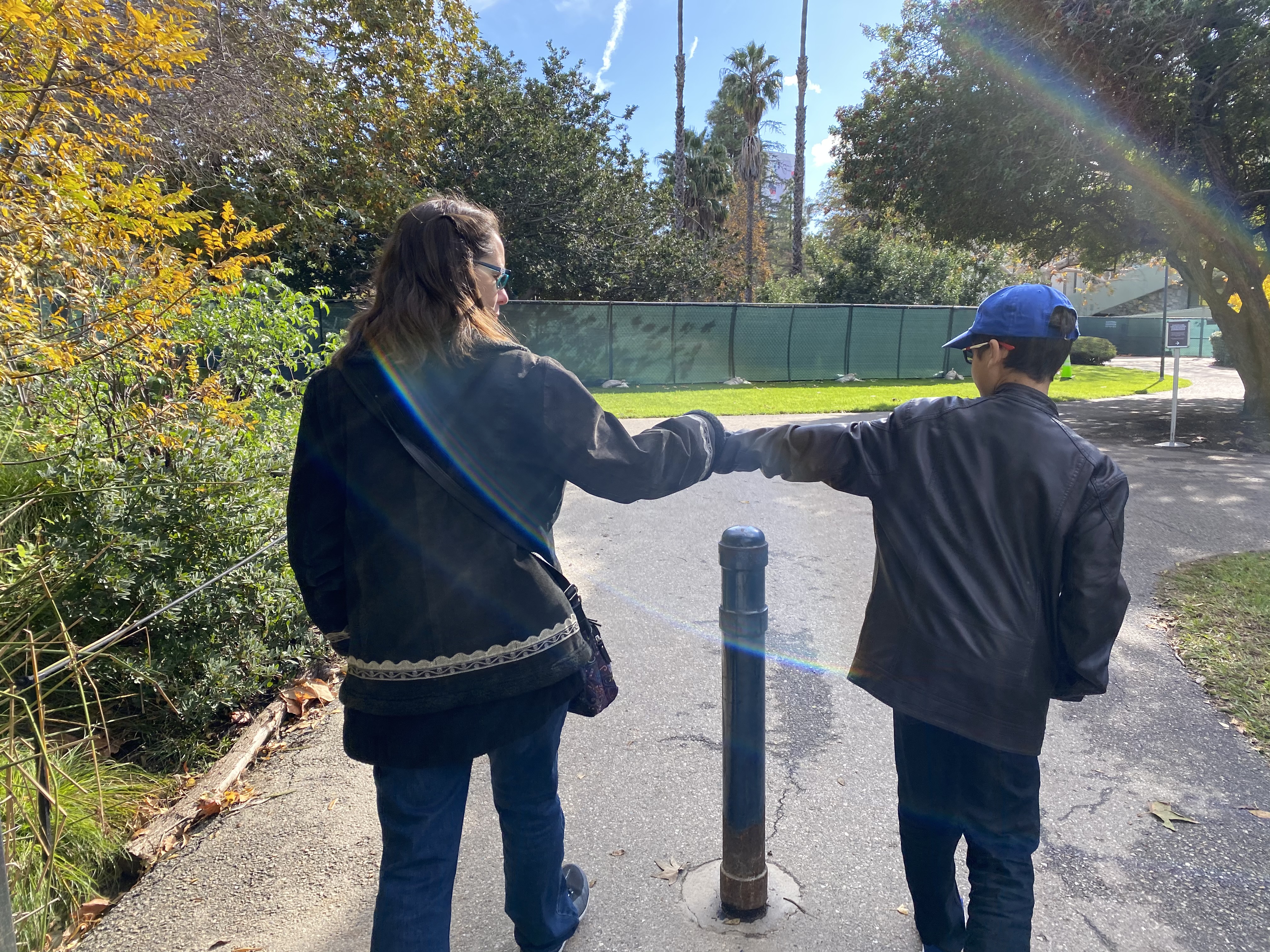
I don’t let pain stop me from enjoying walks with my son. LaBrea Tar Pits
“I had spent close to two hours, sitting outside at my favorite coffee shop, writing. It was my idea of a perfect morning. As I walked the block-and-a-half to my car, I had a nagging feeling I had forgotten something. I paused on the sidewalk and checked my bag. Keys, glasses, wallet, laptop, file of papers. Everything was there, but still I felt something was missing. I took a few more steps, and abruptly stopped on the sidewalk.
I knew what it was.
Pain was missing.
I wasn’t hurting.
It was a jarring feeling. The absence of pain. But instead of feeling euphoric, I felt intensely sad.
I walked to the car in shock.
This is what it feels like not to be in pain. This is how other people usually feel. This is how I used to feel.
I had forgotten what it felt like not to be in pain.”
The passage above is taken from my recently published personal essay, A Painful Reminder. By clicking here, you can read the entire essay online in issue 81 of Kaleidoscope: A Season of Hope.


 WendyKennar.com