It’s Women’s History Month, which has got me thinking about women I grew up admiring.
One of my earliest “famous” role models was Sally Ride. Famous, as in I could find a listing for her in our World Book Encyclopedia. (And I say “famous,” because in terms of role models, I looked up to my mom.)
From the time I was in fourth grade until the time I was a senior in high school, I wanted to be an astronaut. No one told me I couldn’t. After all, I was smart. I was good in math and science. And, Sally Ride had done it first. Other women had followed. There was no reason I couldn’t.
I admired Sally Ride so much, and tried to learn as much as I could about her. I remember saving up my money to purchase To Space and Back, a book Ms. Ride wrote with Susan Okie.
My goals and career dreams changed. But my admiration for Sally Ride never did. Inside the copy of To Space and Back, I have a ticket stub from 2005. A ticket stub that allowed me entry to hear Sally Ride speak at the Los Angeles Times Festival of Books, when it was held on the UCLA campus.
It’s been a long time since I’ve read this book. I used to bring it into my classroom, and share it with my students. My son and I have read it together. But for quite a while now, it has sat on a bookshelf (along with other space-themed books).
And that’s the power of role models – and books. They stay with you, and keep a special place in your heart.
By the way, in case you missed it, you can click here to read my blog post from November 2020 about my autographed picture of Sally Ride.
Readers, I’d love to know. Who is a woman you admire? A woman you consider a role model? Let me know in the comments section.
I’m not a podcast person. But I am most definitely a book person.
Zibby Owens is a podcast-about-books person. More than that, she is an author, publisher, and CEO. And a mom of four.
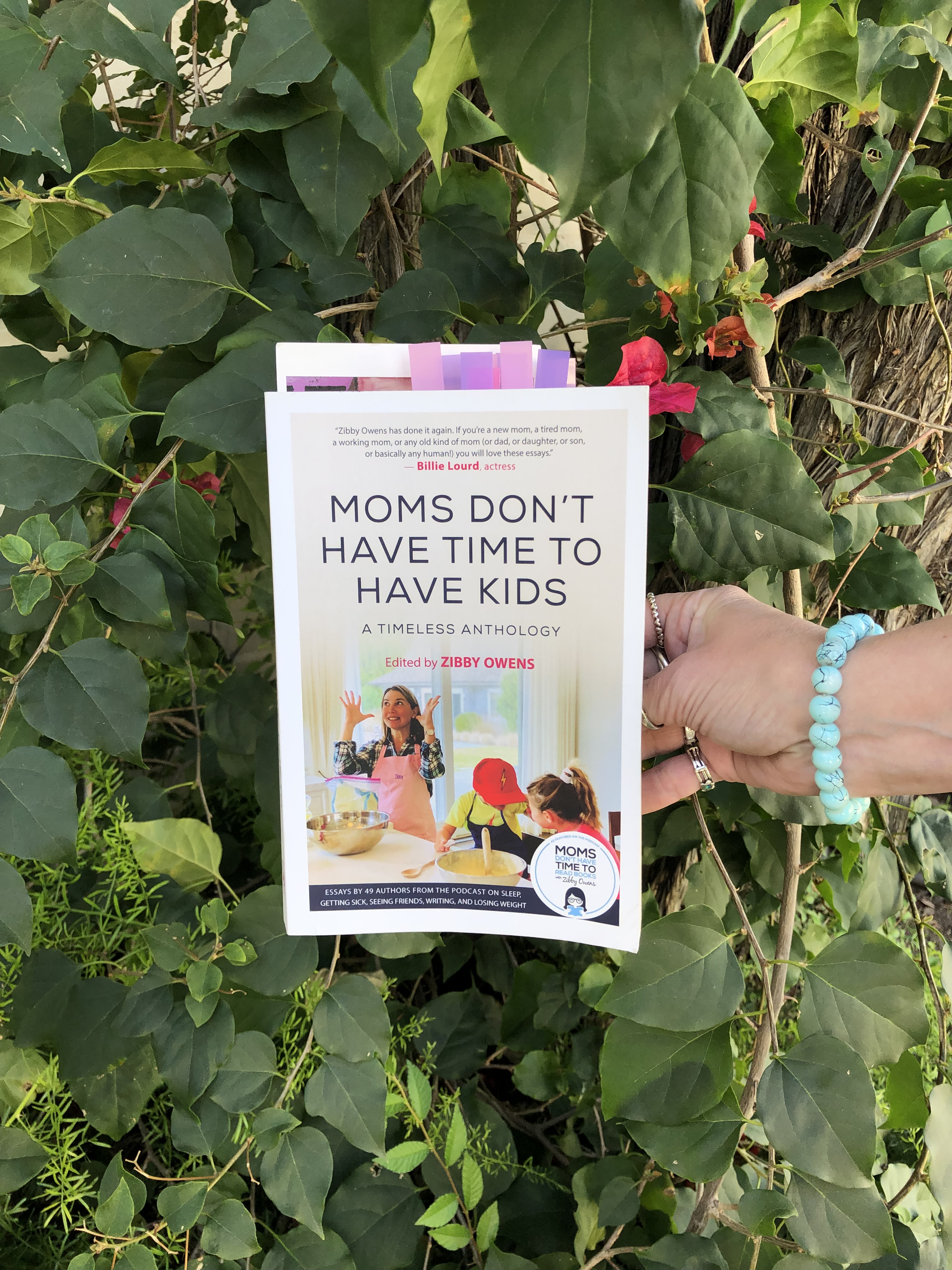
I recently finished reading Moms Don’t Have Time to Have Kids: A Timeless Anthologyedited by Zibby Owens. The anthology is a collection of essays written by more than forty authors who have all been featured on the podcast Moms Don’t Have Time to Read Books. The book is divided up into categories, things that moms (and dads) don’t have time to do: Sleep, Get Sick, See Friends, Write, and Lose Weight.
Here’s the incredible part about this book — I found myself relating to so many of the authors. The specifics may differ (where we live, how many kids we have, the ages of our kids) but the emotions are universal.
Not only did I enjoy reading this anthology, but I have also added to my ever-growing list of “want-to-read” books. Many times, after reading an essay I found myself looking up the writer and then adding their books to my Goodreads “want-to-read” list.
Allow me to share just a few of the book’s gems:
From “Room for One” by Allison Pataki:
“I could read the surprise on my husband’s face. He’d asked me what I wanted for my upcoming birthday and I’d answered quickly and simply: a night away. A night away from him, away from home, away from our daughters, our dog, our laundry — all of it. One glorious night in a hotel room by myself.”
From “While I Was Sleeping” by Camille Pagán:
“But mostly, I’d been the one to grow. As mothers, we do so very much because we can. Because we think we should. Because who else will do it? The rest of our families will.”
From “The Little Pink Unicorn” by Heather Land:
“These days, I have a new perspective on self-sacrifice. I will always give my love, my time, and my attention to the ones I care about most. But from now on, that has to include me. I’ll probably never quit tending to the needs of my children (when they have their own), but I will continue to remember that I should love and tend to my own heart as well.”
It all started from a 5-minute writing exercise. I used a prompt from Barbara Abercrombie’s A Year of Writing Dangerously: 365 Days of Inspiration and Encouragement (great book!), and when my timer went off five minutes later, I knew I had written the beginning of something. That first draft went through some significant changes.
13 Ways Writing Is Easier Than My Autoimmune Disease is the final result.
I’m happy to say it was recently published at The Mighty. You can click here to read the essay in its entirety.
“It’s not a realization that came to me easily or early on in my life as a chronic illness patient. It took me several years to finally recognize it and to see what had been in front of me all along.
Not until I marked my submission tracker with that most depressing word, “Declined,” did I make the connection. I realized that having a piece of writing declined and leaving a doctor’s appointment without any answers share many of the same emotions.”
Those paragraphs are taken from my personal essay, “Dismissals and Rejections — of Symptoms and Submissions,” recently published at Spoonie Authors Network. You can click here to read the essay in its entirety.
I’ve been told I have a positive attitude. I’ve been praised for not letting my autoimmune disease take control of my life.
I try. I try very hard to look at the bright side, to acknowledge that things could always be worse, to do the things I want to do pain or no pain.
But, in all honesty, the last couple of weeks have been really bad. Like trying-not-to-cry-as-I-walk-back-to-the-car-after-taking-my-son-to-school bad.
In our home, we don’t curse. Even words that other families might use, like “sucks,” isn’t a word we use. Except, occasionally.
Today is one of those occasions.
Chronic illness sucks. Chronic illness that causes chronic pain really sucks. There’s no rhyme or reason to it. For example:
Sleep does not equal less pain. I rarely sleep through the night. If I only wake up once, that’s a good night’s sleep for me. But the other night I did something I hadn’t done in a long time — I slept through the night. My body had a full night of uninterrupted sleep. I woke up, amazed to realize it was morning. I got out of bed and felt … lousy. Terrible pain. From the moment I woke up until I went to bed again that night.
Muscle spasms worsen everything. I was sitting at my desk, with the dull pain I’m used to in my left leg. As my son was showering, my left calf began to twitch. And not in its usual twitching spot — more on the inside of my leg. This was the outer side of my calf. My muscle twitched, and I tried to rub my leg. My muscle continued twitching, and I bit my finger. It finally stopped twitching and I had a really hard time getting up from my desk chair. I had an even harder time stepping into my own shower. My leg was tight when I went to bed that night and no different when I woke up with the alarm the next morning.
Rest doesn’t automatically mean relief. I have been making an effort to take time for myself. To rest. Not in the form of a nap, but sitting outside on our patio, reading a book. I usually spend my days taking care of household chores, dealing with appointments, and writing. But I have been making a conscious decision to set aside some time during the week — when my husband is at work and my son is at school — just for me. To sit in one of my favorite places, doing one of my favorite things. I hoped to notice an improvement — an increase in relaxation, a decrease in discomfort. Nope. Maybe it’s too soon. Maybe I need to do this more often, more consistently. In any event, I got in some extra reading time.
Pain levels fluctuate. When I spoke to my husband on one of his breaks, my pain wasn’t bad. It felt so good to be able to say that to him. By the time he called on his next break, about three hours later, it was bad. Pain-pill bad. I hadn’t done anything physically strenuous or anything I could see as a possible trigger (like gardening or standing on a step-stool to reach something on a high shelf in the closet). The pain shifted — from not bad to real bad. And for no apparent reason.
Months ago, I listened to a virtual author talk sponsored by the Los Angeles Public Library System. As a bonus, everyone in attendance was eligible to enter a raffle to receive a free copy of one of the author’s books.
For most of my childhood (fourth grade to eleventh grade), my dream was to become an astronaut. And today I am just as curious, just as awe-struck of those individuals who do become astronauts.
This week, I’d like to share a few passages that stood out to me during my reading. What really struck me were the supportive words and encouragement the author received from so many members of his family as well as several of his teachers.
“That is why the individuals who are named José are known as creators. You have the power to create a reality out of your dreams and shape your life accordingly.” Encouraging words spoken by Mr. Hernández’s abuelo.
I loved reading about Mr. Hernández watching Neil Armstrong on the moon and deciding he wanted to be an astronaut:
“When I heard these words, I felt indescribably shocked. I was captivated by this man, by this science, which left me in awe. Absorbed in the broadcast, I got up abruptly to get closer to the television screen. I had an epiphany. During that exact moment, I discovered what I wanted to be when I grew up: an astronaut, or un astronauta. And from that moment on, I was determined that absolutely nothing would get in the way of my dream.”
And while strapped in and waiting for space shuttle Discovery to launch, Mr. Hernández thought:
“La magia, or magic, is hard to discover, but I believe that passion in the heart and positive thinking in the mind are the two ingredients for achieving something extraordinary. Just ask a scientist, an inventor, or an artist — a simple idea or dream has given birth to some of our history’s greatest inventions.”
You can also learn more about Mr. Hernández and his Reaching for the Stars Foundation by clicking here. A Netflix film is being planned about Mr. Hernández’s life and journey into space.
A year ago there was a moment in time when I was thankful for the pandemic.
Because of the pandemic, my husband was working from home and my son was participating in Zoom school. Because of the pandemic we were all at home, all able to hold hands and witness together the historic Inauguration of President Joe Biden and Vice President Kamala Harris.
I don’t remember much of the speeches from that day. But I do remember a strong feeling of reassurance. The feeling you get when the teacher is back in the classroom instead of an inexperienced substitute who has poor classroom management skills.
And I absolutely do remember Amanda Gorman. I remember her yellow jacket and her red headband. I remember her poise and presence. And I remember the delivery of her powerful words. Words that seemed to envelope us all, and remind us of all that is good and possible. Words that made me feel we were on the road to being okay.
As Oprah Winfrey writes in the foreword of this collectible gift edition, “Everyone who watched came away enhanced with hope and marveling at seeing the best of who we are and can be through the eyes and essence of a twenty-two-year-old, our country’s youngest presidential inaugural poet.”
When I recently re-read The Hill We Climb: An Inaugural Poem For the Country, I was just as awestruck as I was the first time. If you haven’t re-visited Ms. Gorman’s powerful Inaugural Poem, I highly recommend it. This is a book which forever will find a home on my bookshelf, and years from now, will be passed on to younger generations.
It’s a book about acknowledging all the ways we express ourselves creatively. It’s also about acknowledging the need for, and the benefits of, dedicating time and energy to a creative project.
I love Ms. Cook’s definition of creativity:
“Creativity is the box of crayons we use to tell our story, and in telling our story we figure out who we are.”
And I love this recommendation:
“Every day, do one good thing. And after that, give yourself permission to do one creative thing for yourself.”
Then there’s this bit of motivation:
“Being creative is about touching hearts. It’s about finding our own heart. It’s about tapping into our past and remembering the unique experiences and insights that make us who we are. It’s about flipping our adversity and challenges and experiences into a point of view, a vision, a style, a voice. It’s about standing strong in our authenticity and individuality and distinctiveness.”
I also enjoyed this paragraph about one of the benefits of getting older:
“Because the coolest thing about getting older is that we really can just be whoever the hell we want to be. If we’re lucky, we’ve stopped caring so much about pleasing the rest of the world. Nobody can tell us who we are. Or who we aren’t.”
Since this is my first post in 2022, I wanted to take this opportunity to tell you about the #22in22 Initiative started by Zibby Books.
Here’s what you need to know:
The idea behind #22in22 is to visit 22 bookstores in 2022. Physically visit (if you’re able) twenty-two bookstores. This can be twenty-two different bookstores, or maybe you just visit your top three bookstores multiple times this year.
Your visits are a way to support bookstores and books. And by extension, you’re supporting authors and booksellers and everyone who works to get books on shelves.
You can sign up at https://www.22in22.net (it’s super easy), and each time you visit a bookstore, return to the website to log your visits. There are different incentives you can earn along the way. But really you’re doing it for yourself (because a visit to a bookstore is a great way to spend part of a day) and the larger book community.
The #22in22 Initiative started on Small Business Saturday, so I got a head start and have logged two visits so far:
Once in a while you come across a book and you suddenly have this urge to buy cartons and cartons of this book, plant yourself on a busy corner, and pass them out to everyone who walks by.
While our chronic illnesses and experiences are vastly different, the book is so very relatable. The bottom line is everyone living with a chronic illness and everyone who knows someone living with a chronic illness, should read this book.
I don’t remember how I first learned about this book. But I do know that this is one of the few books I have bought sight unseen. I bought it based on what I read about it. I bought it because I had a desire to read something by someone who “gets it.”
And Tessa Miller gets it:
“I needed a book written by someone who exists in that foggy space between the common cold and terminal cancer, where illness doesn’t go away but won’t kill you. I needed someone who lives every single day with illness to tell me that 1) I wasn’t alone and 2) my life was going to change in unexpected, difficult, and surprisingly beautiful ways.”
“I didn’t know then that my life had changed forever. That I’d be able to divide my experiences into before I got sick and after I got sick.”
“I became a professional patient, and a good one. I learned that bodies can be inexplicably resilient and curiously fragile. I would never get better, and that would change everything: the way I think about my body, my health, my relationships, my work, and my life. When things get rough, people like to say, ‘this too shall pass.’ But what happens when ‘this’ never goes away?”
“And they shouldn’t doubt the level of pain you’re in just because you’re not writhing around on the floor; chronic illness patients learn to live with a shocking amount of physical discomfort and often go about it looking natural.”
“But grieving yourself when you’re diagnosed with a chronic illness is different. The emotions might be similar to those felt when mourning a loved one—anger, sadness, numbness, disconnection from reality —but the process of ‘moving on’ is more complicated. Whereas the loss of a loved one has a sense of finality, the loss of self from chronic illness can feel never-ending.”
“See, chronically ill people grieve two versions of ourselves: the people we were before we got sick and the future, healthy versions that don’t exist (or, at least, look much different from what we’d imagined). There’s no guidebook for this kind of ongoing self-loss. No Hallmark card that says, ‘Sorry you’ll never be yourself again.’ “
“Your body and your brain are not two separate entities. They’re a partnership. What happens to your body affects your brain, and what happens to your brain affects your body. Taking care of your brain’s health should be no less of a priority than taking care of your body.”
“ ‘God doesn’t give you more than you can handle,’ as the saying goes. But that isn’t the way it works at all. Some people have more suffering, and some have less, and there’s no rhyme or reason why. Bad stuff happens to good people with no other explanation than it just happens. Little babies die suddenly and horrible old billionaires live to see 105 and decent people get sick forever. Shit will never make sense.”
“And despite what the writing of a memoir signals, I don’t love to talk about myself IRL; the page makes me appear much braver than I am. But despite the fear, I keep sharing my stories through writing because that’s how humans connect and stay alive. Stories give us empathy. They make us strong. They offer perspective.”




 WendyKennar.com