Monthly Book Highlights of 2022

As we approach the last week-and-a-half of 2022, I find myself reflecting on the year and thinking about the books I have read. As of this post, I have read 50 books this year, though that is short of my Goodreads Reading Challenge of 57 I had optimistically set back in January. 

This week, rather than focus on the books I didn’t read, I’m going to highlight one book from each month of 2022.

January

The first book I finished this year was Claire Cook’s Life Glows On. I felt like I was starting the year on the right foot, reading about creativity — the ways we demonstrate creativity, the reasons why we need to dedicate time and energy to creative endeavors.

February

During the shortest month of the year, I read Moms Don’t Have Time to Have Kids: A Timeless Anthology edited by Zibby Owens. As I wrote in my blog post: “I found myself relating to so many of the authors. The specifics may differ (where we live, how many kids we have, the ages of our kids) but the emotions are universal.”

March

In March, I read First Lady Dr. Jill Biden’s memoir Where the Light Enters: Building a Family, Discovering Myself. I loved reading about Dr. Biden’s passion for teaching, because I know that passion.

April

I picked up Just Haven’t Met You Yet by Sophie Cousens because I wanted a fun, entertaining read. This novel was that, and more. (Which reminds me, I still haven’t read her other novels.)

May

Jane Goodall’s The Book of Hope: A Survival Guide for Trying Times was a powerful book with a powerful message.

June

We’re a basketball family. And while our team will always be the L.A. Clippers, we respect and appreciate many players on many different teams. The “Greek Freak,” aka Giannis Antetokounmpo of the Milwaukee Bucks is one such player, and why I was interested in reading Giannis.

July

Brighter By the Day: Waking Up to New Hopes and Dreams is the third book I have read by Robin Roberts. The book feels like a pep talk Robin Roberts is sharing with you, simply because she believes in you and just wants the best for you.

August

Weather Girl by Rachel Lynn Solomon is much more than a rom-com. Plus, there’s that exciting feeling knowing an author you have recently discovered has written other books you have yet to read.

September

Jean Meltzer’s Mr. Perfect on Paper was such a great read. I love that Ms. Meltzer writes books featuring a protagonist who is not only Jewish, but who also lives with an invisible chronic illness. (Be sure to also check out her first novel, The Matzah Ball, perfect for reading during Hanukkah.)

October

Love and Saffron by Kim Fay was a story told through the letters two women write to each other during the 1960s. I was instantly intrigued because I have a pen pal. We have been exchanging letters for almost thirty years!

November

Book Lovers by Emily Henry is a special book, for a couple of reasons. First, I bought it during our family trip to Maui. And secondly, it earned five stars on my Goodreads review. 

December

Jasmine Guillory’s Royal Holiday was an entertaining holiday romance. It was a fun escape to be able to open the book and slip into this other world.

Readers, feel free to share some of your favorite books that you read during 2022!

Going There

I’ve had Katie Couric’s memoir, Going There, on my to-be-read shelf for quite a while. It’s a heavy hardcover book, though now a paperback version is available. 

I knew of Katie — her first husband’s premature death and her resulting advocacy on behalf of cancer and early screenings. I knew of her time on the morning show Today, and her historic role as the anchor of the CBS Evening News. 

The book goes there.

But it goes much deeper than what I already knew. 

It gives readers a chance to see things from another vantage point. What is it like to witness a historic event, 9/11 for instance, and then have to report on it while simultaneously trying to process the horror and make sure your loved ones are safe? 

Katie Couric goes there, too.

There are so many moving passages, so many “wow” scenes. But some of the parts that most touched me were somewhat unexpected.

“I called the reporter at the Washington Post who’d edited my father’s obituary. ‘I wanted to let you know my mom died, and I’d love to have an obituary for her,’ I said.
“‘Well what did she do?’ he asked. ‘Tell me about her.’
“The question caught me by surprise.
“‘She did everything,’ I replied. ‘Raised four kids, who all went on to be very successful people. She was the heart and soul of our family. She was ahead of her time, volunteering at Planned Parenthood. She worked at Lord and Taylor in the gift department; she arranged flowers for weddings.’
“I’ll never forget the sound of silence on the other end.
“That’s when it really hit me, how undervalued mothers are in our society, especially the full-time kind. I was incensed that somehow my mom’s accomplishments, her amazing life, were deemed not worth writing about.”

“When all is said and done, though, I am my mother’s daughter, becoming more like her by the minute: when I neatly peel a pear and present the girls with the tidy slices on a china plate, or when I fix them lunch and declare, ‘A sandwich always tastes better when someone else makes it for you.’ Or when one of my children feels slighted or wounded, and I rear up like a Kodiak bear on its hind legs, ready to maul whoever’s crossed her. My mom may be gone, but her essence is very much alive in me.”

“Sometimes I’ll post a video in Instagram of me showing off my garden’s bounty — makeup-free, bedhead, still in my pajamas.
“Once someone commented, ‘Wow, she got old.’
“And all I could think was Aren’t I lucky?”

“Everyone has a story. I encourage all of you to preserve yours so that it can be cherished by those you love for years — even generations— to come.”

Julie and Julia

A few days ago, I was blindsided by the news.

Julie Powell had passed away.

I admit — my knowledge about Ms. Powell was largely limited to what I had read in her memoir, Julie and Julia: My Year of Cooking Dangerously, and what I had seen in the movie adaptation starring Meryl Streep and Amy Adams. 

I remember leaving the movie theater with my husband, and trying to decide what to go eat. (There really is no choice —  after watching the movie, you have to go eat.) I also remember my husband telling me I should start a blog, too.

At that time, my husband knew I enjoyed writing. He knew I wanted to write more. But he also knew that between my teaching career and our young son, there wasn’t a whole lot of extra time left for my writing.

But, because he knows me so well, my husband also knew that if I had a deadline, a self-imposed assignment, I would do what I needed to do to complete my assignment. 

That was the start of my first blog. A blog I called “Wendy’s Weekly Words.” A blog I published on Wednesdays to keep the W-theme going. A blog that was all over the place in terms of what I wrote about. 

Still, it got me to prioritize my writing time which got me writing on a regular basis. It led me to my current blog; the blog you’re reading now, which exists on my own website. 

And it all started from a movie that only existed because of the book that came before it.

And that’s the full-circle of this — words have power. The power to lift and inspire and encourage. 

The power to see a story unfold on-screen and think, maybe I could do that too. 

Julie Powell’s story did that for me. 

Rest in peace. 

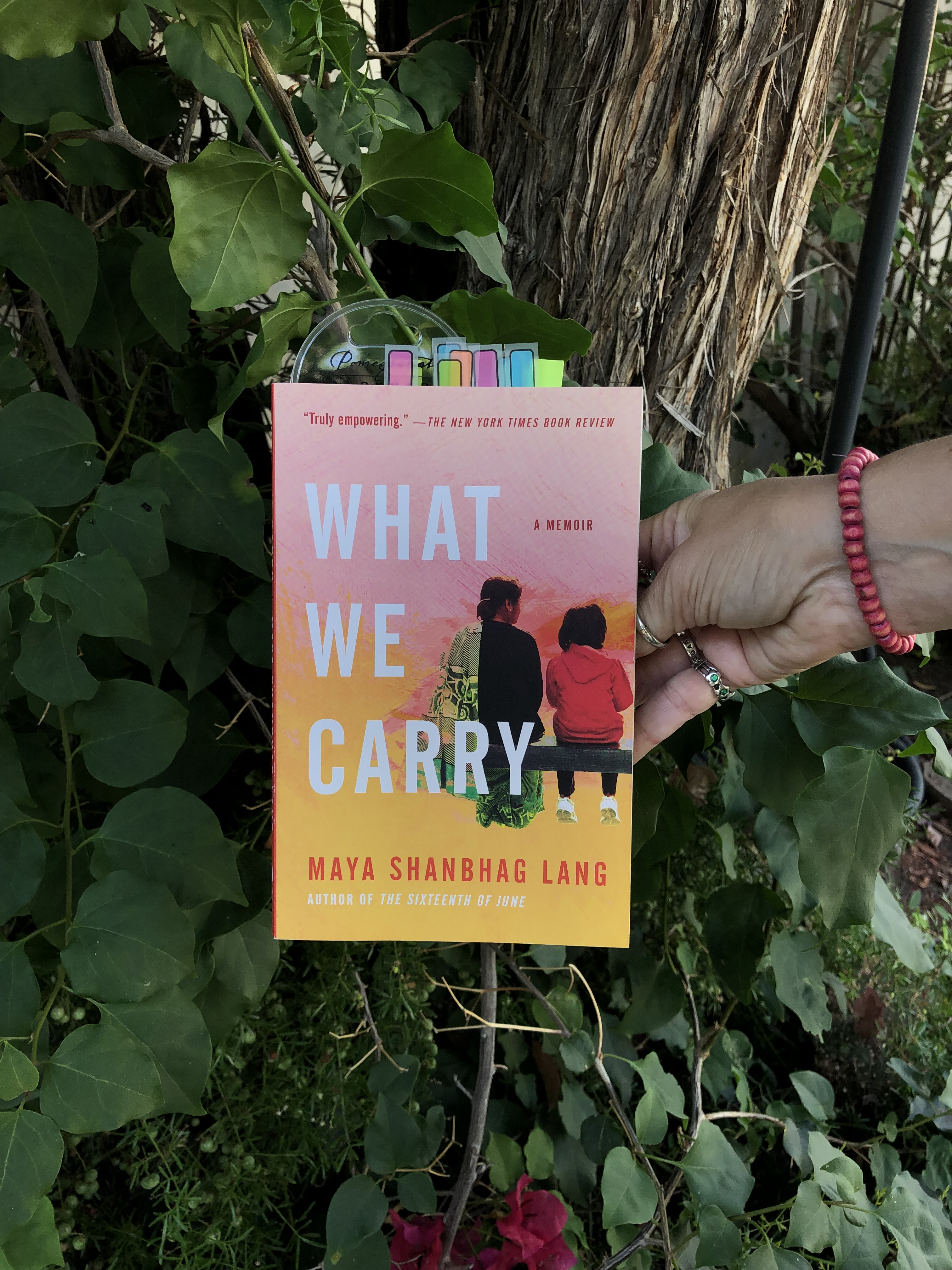
What We Carry

What We Carry: A Memoir by Maya Shanbhag Lang is one of those books that surprised me. I was not familiar with author Maya Shanbhag Lang, and I didn’t know much about the book other than the fact that it was a memoir, a story about a mother and a daughter.  

Now having recently completed the book, I realize my copy is full of sticky notes. 

How would I describe this book? 

With these adjectives — Touching, heartfelt, tender. Moving, affirming, empowering.

And by sharing these passages: 

“So it goes between us. Everything she does is for my benefit. This is what a mother’s love looks like to me. It looks like suffering.
“I accept it. I am about to become a mom three thousand miles away from her, in a gray, drizzly city that feels wholly unfamiliar. Soon, I will be the one putting my needs last. It helps to believe that somewhere in the world, I still come first.”

“It was a release to have her say what I could not. This was why I loved my mom, why I craved her audience, why only she would do. In life’s most difficult moments, there was no wall between us. She would never say, ‘I’m so sorry for your loss,’ would never put herself on the other side of hardship. She came over to my side. She ached for me, felt for me. She received life’s blows on my behalf.”

“I took refuge in stories. Books transported me to farms and ships and castles. Even when bad things happened in novels, the events followed a certain logic. This comforted me.”

“Contemplating worse pain doesn’t lessen mine.”  (This sentence shouts at me from the page, because I have marked it with a neon yellow highlighter. While the author wrote this sentence in relation to the difficult relationship with her father, I find I need this reminder as it applies to my physical pain.)

“My assumptions of motherhood have been all wrong. I feared I was supposed to have all the answers. I didn’t know my daughter would help me find them. I worried she would be an obstacle to my dreams, not the reason I went after them. Zoe makes me want to be the best version of myself. That isn’t sacrifice. It’s inspiration.”

“It sounds like the worst time to weigh one’s desires, as a new parent, but maybe it’s the best, the most necessary. When tasked with caring for a human being, when asked to subsume one’s own needs, this is when we require a firmer grasp on ourselves. Rather than telling new moms to indulge, to do the frivolous activities women in movies do, we should say this: Find yourself. Gather yourself up before it is too late. You are at risk of getting buried. Maybe you’re already feeling buried. Do something that will solidify your sense of self, buttress your retaining walls. Don’t worry if it feels scary. It’s probably a good thing if it does. 
“Working on my novel for an hour or two restores me. I return home from the coffee shop feeling renewed.
“Perhaps this is what we should give new moms: A laptop and a cup of coffee. A notebook and a pen. Permission to dream.” 

“I thought this was going to be a dark and difficult time for my family, one of strain. It occurs to me that diamonds aren’t made voluntarily. What lump of coal would opt for so much time and pressure? It could be that what shapes us against our choosing is what makes us shine.”

“Alzheimer’s is devastating because it annihilates one’s story. It vacuums it up. Even the name feels greedy to me. What gets me is the apostrophe, that possessive little hook. It drags your loved one away from you. My mom no longer belongs to me. She belongs to her illness.”

No Cure For Being Human

No Cure For Being Human (And Other Truths I Need to Hear) by Kate Bowler. 

Wow.

And then after the initial “wow,” several adjectives come to mind — beautiful, heartbreaking, touching, profound, funny, moving.

I am blown away by the incredible way in which Ms. Bowler wrote her story — being diagnosed with stage 4 colon cancer in her 30s. She didn’t just write about it, she invited readers in. And along the way, shared some truths I know I needed to hear.

Here are just some of the passages that moved me:

“Before when I was earnest and clever and ignorant, I thought, life is a series of choices. I curated my own life until, one day, I couldn’t. I had accepted the burden of limitless choices only to find that I had few to make.”

“From my hospital room, I see no master plan to bring me to a higher level, guarantee my growth, or use my cancer to teach me. Good or bad, I will not get what I deserve. Nothing will exempt me from the pain of being human.”

“It’s easy to imagine letting go when we forget that choices are luxuries, allowing us to maintain our illusion of control. But until those choices are plucked from our hands — someone dies, someone leaves, something breaks — we are only playing at surrender.”

“The problem with aspirational lists, of course, is that they often skip the point entirely. Instead of helping us grapple with our finitude, they have approximated infinity. With unlimited time and resources, we could do anything, be anyone. We could become more adventurous by jumping out of airplanes, more traveled by visiting every continent, or more cultured by reading the most famous books of all time. With the right list, we would never starve with the hunger of want.
But it is much easier to count items than to know what counts.”

“I did not understand that one future comes at the exclusion of all others.
I had wanted two kids.
I had wanted to travel the world.
I had wanted to be the one to hold my mother’s hand at the end.
Everybody pretends that you only die once. But that’s not true. You can die to a thousand possible futures in the course of a single, stupid life.”

“The terrible gift of a terrible illness is that it has, in fact, taught me to live in the moment. Nothing but this day matters: the warmth of this crib, the sound of his hysterical giggling. And when I look closely at my life, I realize that I’m not just learning to seize the day. In my finite life, the mundane has begun to sparkle. The things I love — the things I should love — become clearer, brighter.
Burdened by the past, preoccupied by the present, or worried about the future, I had failed to appreciate the inestimable gift of a single minute.”

“It takes great courage to live. Period. There are fears and disappointments and failures every day, and, in the end, the hero dies. It must be cinematic to watch us from above.” 

“It became clearer than ever that life is not a series of choices. So often the experiences that define us are the ones we didn’t pick. Cancer. Betrayal. Miscarriage. Job loss. Mental illness. A novel coronavirus.”  

“Time really is a circle; I can see that now. We are trapped between a past we can’t return to and a future that is uncertain. And it takes guts to live here, in the hard space between anticipation and realization.”

And the book’s appendix is brilliant. Ms. Bowler has written a list of “clichés we hear and truths we need,” including:

Things People Say: Make every minute count. 

A More Complicated Truth: Life is unpredictable. You’re a person, not a certified account.

Where the Light Enters

I admit. I didn’t walk into the bookstore looking for First Lady Dr. Jill Biden’s book. I was vaguely aware of it, but it wasn’t at the top of my ever-growing want-to-read list.

Yet, turns out I couldn’t resist the buy 2 get 1 display. And Where the Light Enters: Building a Family, Discovering Myself  was one of the books I purchased that day as part of that sale. And even after buying the book, it didn’t sit on my shelf for months before I picked it up. I felt there was something about this memoir. And I was right. 

This week, I’d like to share some of the passages that touched me:

“Every scene on those walls, every role I’ve played, has taught me so much about what family means. I’ve learned — and am still learning — about the bonds that make up a family. Few of us would reduce those bonds, that gravitational force, to something as simplistic as blood. Families are born, created, discovered, and forged. They unfold in elegantly ordered generational branches. They are woven together with messy heartstrings of desire and despair, friendship and friction, grace and gratitude.”

“I realized early on that teaching was more than a job for me. It goes much deeper than that; being a teacher is not what I do but who I am.”

“There’s always a part of you that wants to step into your children’s lives and make the right decisions for them — pick them up when they stray and put them on the safest, easiest path, just as we did when they were small. But the tragedy of being a good parent is that the better you are at your job, the less you will be allowed to swoop in and protect the people you love most in the world. You have no choice but to trust that they’ll do their best and hope that fate will be kind.”

“Over the years, I’ve heard so many people talk about teachers in a way that doesn’t reflect the reality of teaching that I know at all. They think it’s a job for people without ambitions, that teaching doesn’t take a lot of skill, and that teachers have short hours and summers off. I’ve taught in a lot of different environments, but one thing is always the same: teaching is rewarding, but it’s a tremendous challenge, too.”

“There’s something profoundly optimistic about teaching. We are taking the best of what humans have to give — lifetimes of knowledge, wisdom, craft, and art — and handing it over to the next generation, with the hope that they will continue to build, continue to make our world better. It’s a conversation with our past and future selves at once, a way of saying, Look what we’ve done! Now what will you do with it?”

“So why do we do it? We do it for that spark in a student’s eye when an idea falls into place. We do it for the moment when a student realizes she’s capable of more than she’d thought. For the chance to hold a student’s hand as she begins to explore this wild, incredible world through books and equations and historical accounts. We do it because we love it.”

Reaching For the Stars

Months ago, I listened to a virtual author talk sponsored by the Los Angeles Public Library System. As a bonus, everyone in attendance was eligible to enter a raffle to receive a free copy of one of the author’s books. 

You probably guessed by now that I was lucky enough to win a copy — José M. Hernández’s Reaching For the Stars: The Inspiring Story of a Migrant Farmworker Turned Astronaut. 

For most of my childhood (fourth grade to eleventh grade), my dream was to become an astronaut. And today I am just as curious, just as awe-struck of those individuals who do become astronauts. 

This week, I’d like to share a few passages that stood out to me during my reading. What really struck me were the supportive words and encouragement the author received from so many members of his family as well as several of his teachers. 

“That is why the individuals who are named José are known as creators. You have the power to create a reality out of your dreams and shape your life accordingly.” Encouraging words spoken by Mr. Hernández’s abuelo. 

I loved reading about Mr. Hernández watching Neil Armstrong on the moon and deciding he wanted to be an astronaut:

“When I heard these words, I felt indescribably shocked. I was captivated by this man, by this science, which left me in awe. Absorbed in the broadcast, I got up abruptly to get closer to the television screen. I had an epiphany. During that exact moment, I discovered what I wanted to be when I grew up: an astronaut, or un astronauta. And from that moment on, I was determined that absolutely nothing would get in the way of my dream.”

And while strapped in and waiting for space shuttle Discovery to launch, Mr. Hernández thought:

“La magia, or magic, is hard to discover, but I believe that passion in the heart and positive thinking in the mind are the two ingredients for achieving something extraordinary. Just ask a scientist, an inventor, or an artist — a simple idea or dream has given birth to some of our history’s greatest inventions.”

You can also learn more about Mr. Hernández and his Reaching for the Stars Foundation by clicking here. A Netflix film is being planned about Mr. Hernández’s life and journey into space. 

An Unlikely Ballerina

I admit to not knowing a whole lot about Misty Copeland. But after watching the segment of “Dear…” on Apple TV+, which profiled Ms. Copeland, I wanted to learn more. 

Recently I read her memoir Life in Motion: An Unlikely Ballerina and was left in awe of her talent, her spirit, her poise.

I’ve never read ballet described quite this way:

“Ballets are just stylized versions of these seemingly basic movements on a grand scale. If the basic strength and elegance of a barre class is like slipping on a little black dress, the challenge of dancing a full three-act ballet is like learning to accessorize for any occasion.” 

Though we may appear to be vastly different, there were also several passages I read that made me feel as if Ms. Copeland was writing about a younger version of myself.

“I was a nervous child. And my unease, coupled with a perpetual quest for perfection, made my life much harder than it needed to be.
“I think I was born worried. There wasn’t a day that I didn’t feel some kind of anxiety, especially in school, and my panic would begin from the moment I woke up, fretting that I would be late to homeroom, until I came back home in the early evening. I was just nervous about life, period. I felt awkward, as if I didn’t fit in anywhere, and I lived in constant fear of letting my mother down, or my teachers, or myself.”

“When I was a little girl, I lived in terror of being judged, of letting others down. I was the people pleaser.”

I really thought the only thing Misty Copeland and I would have in common was the fact we both grew up in Southern California. Reading her book made me realize there’s more to it than that. 

And this is one of the reasons why I read as much as I do. This powerful feeling of connection and understanding.

Cancer and Fishnet Stockings

As I continue working on my own memoir-in-essays, I find myself reading more memoirs. Partly because I’m curious about other people’s lives. But also because I’m curious to see how other writers did it. How did they structure their memoirs? What does their table of contents look like? Does their book include photos?

I discovered Cancer and Fishnet Stockings: How Humor Helped Me Survive a Life-Threatening Disease, the Loss of My Favorite Nail Polish… and Other Calamities by Maryann Grau when our family spent a few days in Cambria (one of our most favorite places, along California’s Central Coast). The book was for sale in one of the shops in town, and when the cashier told me it was written by a local author, I knew I had to buy it.

While reading the book, it’s impossible to miss Ms. Grau’s positive outlook and spunk. 

Here are a few gems:

“A few of the patients aimed weak smiles in my direction. My heart ached for them and their predicament, as though I wasn’t facing initiation into the same club. The question Why me? flashed through my mind followed immediately with the obvious answer …Why not me?” 

“Thinking back on the past hour of excruciating pain, I was reminded of an Ayn Rand quote I had read many years ago in her novel Atlas Shrugged. In discussing emotions, Rand begins with the premise that ‘joy is not the absence of pain.’ I understood and accepted the concept immediately, but never was it more self-evident to me until now. To not feel pain, physical or emotional, is a good thing, but it is a neutral feeling at best. Joy comes when you awake to find yourself wrapped in the arms of someone you love.”

“Just a little more than a year after the operation, and I sometimes think, my cancer may be back. The thought hits me hard. Not the cancer itself – the revelation that I used the word my. The acceptance of it, the familiarity with it, the ownership of that dreaded disease by referring to it as ‘my cancer.’
“Don’t we hold things that belong to us as good, desirable, worthy, or even cherished? Does the word ‘my’ presuppose that the things that belong to us are good for us; things like my home, my career, my garden, my child, my love? Shouldn’t cancer belong in the category used to describe words that distance themselves from us, like ‘that thief, that scoundrel, that crummy movie, that poison, that killer disease’?”

And from her last chapter, where she offers “words of wisdom”:

“Every one of us will face death…eventually. But why help it along by standing still? Instead, learn something new to keep your mind active, to grow intellectually.”

“Keep moving! Especially outdoors. That’s where most of life happens.”

“Let others help you. If you’re stubbornly independent like I am, get over it!“

“Indulge in your favorite things.”

Between Two Kingdoms

Sometimes you read a book, and long after you’ve finished it, and read the acknowledgements, and re-visited the author’s note at the beginning, the book stays with you.

You can’t seem to get the author’s voice and story out of your head.

That’s what happened with me and Suleika Jaouad’s memoir Between Two Kingdoms: A Memoir of a Life Interrupted.

While the specifics of Ms. Jaouad’s life vary greatly from mine — her travels, her leukemia diagnosis, her epic road trip — so much of what she wrote really touched me. So much so, that my library copy is full of sticky notes.

Allow me to share some of these passages with you:

“How do you react to a cancer diagnosis at age twenty-two?
Do you break down in sobs?
Do you faint, or scream?
In that moment, a feeling flooded through my body, unexpected and perverse: relief. After the bewildering months of misdiagnosis, I finally had an explanation for my itch, for my mouth sores, for my unraveling. I wasn’t a hypochondriac, after all, making up symptoms.”

“While my medical team was intent on saving my life, preserving my chance to be a mother someday hadn’t seemed to be on their radar. It was my first indication that, no matter how brilliant and compassionate my doctors might be, I would have to be proactive and learn to advocate for myself.”

“I understood now why so many writers and artists, while in the thick of illness, became memoirists. It provided a sense of control, a way to reshape your circumstances on your own terms, in your own words.”

“We were both forging unlikely careers: Melissa painted self-portraits from bed; I wrote self-portraits from bed. Watercolors and words were the drugs we preferred for our pain. We were learning that sometimes the only way to endure suffering is to transform it into art.”

“As a patient, there was pressure to perform, to be someone who suffers well, to act with heroism, and to put on a stoic façade all the time.”

“To be a patient is to relinquish control — to your medical team and their decisions, to your body and its unscheduled breakdowns.”

“I used to think healing meant ridding the body and the heart of anything that hurt. It meant putting your pain behind you, leaving it in the past. But I’m learning that’s not how it works. Healing is figuring out how to coexist with the pain that will always live inside of you, without pretending it isn’t there or allowing it to hijack your day. It is learning to confront ghosts and to carry what lingers. It is learning to embrace the people I love now instead of protecting against a future in which I am gutted by their loss.”